
The dirty secret about call pay is this: almost nobody gets what they deserve—only what they negotiate and what the hospital is afraid to lose.
If you’re a physician and you think call pay is some standardized, fair, RVU-based construct thoughtfully calculated by finance… you’re living in a fantasy. Senior physicians who get real call money do it by leverage, timing, and quiet coalition-building—not by “asking nicely” or quoting MGMA tables.
Let me walk you through how it actually happens behind closed doors. I’ve sat in those meetings. I’ve watched CMOs roll their eyes when someone cites “fair market value.” And I’ve heard the sentences that really move compensation: “We cannot safely staff this service if Dr. X walks.”
How call pay really gets decided
Hospitals don’t start from “what’s fair.” They start from: “What’s the least we can pay and still keep coverage without getting sued or shutting down a service line?”
That’s the framework. Everything else is window dressing.
Finance, legal, and admin will talk to you about:
- “Benchmarking”
- “Fair market value”
- “Budget constraints”
- “Alignment with peers”
What they’re actually thinking is:
- How replaceable is this specialty here?
- How fragile is coverage?
- How bad is it for us—politically, financially, reputationally—if they walk?
- Can they organize as a group and force our hand?
Call pay is a risk premium. You’re being paid, not just to answer the phone at 2 AM, but to keep the hospital out of a coverage crisis. The more irreplaceable your call, the more real money is on the table.
And yes, different specialties live on different planets.
| Specialty | Weeknight Call (per 24h) | Weekend Call (per 24h) |
|---|---|---|
| General Surgery | $500 - $1,500 | $1,000 - $3,000 |
| Cardiology (invasive) | $750 - $2,000 | $1,500 - $4,000 |
| Orthopedics | $600 - $1,800 | $1,200 - $3,500 |
| Neurology (stroke) | $800 - $2,500 | $1,500 - $5,000 |
| Hospitalist | Included/low stipend | Included/low stipend |
Those ranges aren’t from glossy brochures. They’re from what people quietly admit in side conversations at regional meetings, retreats, and recruiting dinners.
The four levers senior physicians actually use
Senior physicians who win the call pay game pull on four levers: scarcity, risk, coverage dependence, and group unity.
They don’t start with “I work hard, I deserve more.” Because admin has heard that 10,000 times and it moves nothing.
They start with: “Without this coverage, you lose X.”
X might be:
- Level II trauma designation
- Primary stroke center certification
- Cath lab revenue
- Emergency ortho coverage
- OB services in a rural county
Hospitals don’t pay for “hard work.” They pay to protect revenue streams and accreditation. Put your ask in those terms, or don’t bother.
1. Scarcity and replaceability
Here’s the brutal calculus that gets done in the C-suite:
- Replaceable = weak leverage
- Hard-to-recruit specialty = strong leverage
- Only group in town = nuclear leverage
I once watched a hospital stall a hospitalist group on call pay for 18 months. Hand-wavy “we’re working on it” nonsense. The group, frankly, was replaceable. There were three staffing companies willing to walk in and cover.
Contrast that with neurology stroke coverage at a different site. One small private group, tired of unfunded 24/7 stroke call. They asked for a structured stipend. Admin dragged it out. What changed things? The group said, “We’re giving 90 days’ notice on stroke call. We’ll still see clinic patients. But stroke call is ending.”
They didn’t threaten to collapse the whole department. Just that one revenue-critical, politically sensitive service.
Within three weeks, the CFO was in a room with them, legal was whispering about fair market value safe harbors, and magically there was a six-figure stroke call pool on the table.
Same hospital system. Completely different leverage profile.
2. Risk exposure and “headline risk”
Some call is annoying. Some call is terrifying—for the hospital.
Highly time-sensitive, high-liability call (STEMI, stroke, trauma, emergency OB) has more political weight than “slow burn” services. You know this instinctively. Admin knows it very clearly.
Behind closed doors, I’ve heard this phrase almost verbatim:
“If we lose stroke, that’s a headline risk. We can’t have a front-page story about someone not getting tPA because we didn’t pay for neurology call.”
That’s it. That sentence unlocks budgets that supposedly “do not exist.”
If you’re in a high-risk, time-critical specialty and you’re arguing for call pay like a generic outpatient doc—“We’re burned out, this is unfair”—you’re leaving a staggering amount of leverage on the table. You should be talking about:
- Door-to-needle metrics
- EMTALA violations if coverage lapses
- Loss of certifications (stroke center, trauma level, cath lab)
- Transfer leakage if your hospital can’t take call
When senior physicians negotiate, they don’t say “this is hard.” They say “this is risky for you if we walk.”
3. Coverage dependence and “no backup plan”
Another quiet factor: does the hospital have a credible backup plan?
I’ve seen systems tell a cardiology group, “Fine, if you won’t do call at that rate, we’ll hire employed cardiologists.” They had already been talking to a large regional group. The bluff was not a bluff.
I’ve also seen small rural hospitals practically beg a general surgeon not to cut back on call, because the alternative was shutting down the OR except for elective cases twice a week.
Senior docs who understand this don’t posture. They ask smart questions and quietly map out the hospital’s pain points:
- Are you the only group in town?
- Is there a nearby competing system sniffing around?
- Has the hospital failed prior recruitment for your specialty?
- Is your call required to maintain key certifications?
If you sense “no backup plan,” your call pay ask can be very firm and very specific. Not “Can we talk about maybe increasing the stipend?” but “We propose $X per weeknight, $Y per weekend day, and here’s the coverage schedule we can support.”
You present it as: this is the price of a stable, reliable, safe coverage model.
4. Group unity vs lone hero
This one matters more than anything else: senior physicians who get real call pay almost never negotiate alone.
Lone rangers get strung along. Groups that speak with one voice get checks.
The administrators I’ve sat with will always, always test whether a group is actually unified. They’ll have side conversations:
- “Between us, you’re more reasonable than Dr. Smith. Can we work with you?”
- “What if we just did a pilot stipend and saw how it goes?”
- “We don’t want to upset Dr. Jones; what do you think she’d accept?”
They’re probing for cracks.
The groups that win have already done the hard internal work:
- Agreed on the minimum acceptable structure
- Agreed on messaging: what’s about money vs what’s about safety
- Decided in advance what they’ll do if admin says no
No freelancing. No one making a side deal (“I’ll keep taking extra call for now, just pay me under the table”).
You want to know how senior physicians in private groups actually pull this off? They get in a room without admin and they do the messy, uncomfortable thing: they argue with each other until they know where the floor is. Then they present that as a united front.
The backchannel conversations you don’t see
Let’s talk about what really gets said when you’re not in the room.
Most formal meetings with admin are theater. PowerPoints, “we appreciate your service,” some references to MGMA, and vague promises to take it back to the board.
The real action is in:
- Side hallway chats between the CMO and the chief of staff
- Text chains between service line directors
- CFO calls with market competitors (“what are you paying your ortho call?”)
- Legal risk memos to the board about coverage gaps
I’ve literally heard:
“If we give ortho what they’re asking, general surgery will be in here next week.”
This is the admin fear that constrains your call pay: precedent. They’re not just negotiating with you; they’re negotiating with every other specialty watching from the sidelines.
Senior physicians know this. So they:
- Anchor high, expecting admin to worry about the precedent
- Offer structures that are harder to replicate mindlessly across specialties
- Tie their call pay explicitly to service-line-specific demands (trauma, stroke, cath)
So you might see something like:
Instead of:
“Ortho wants $1,500 per night.”
You frame:
“Ortho will provide 24/7 coverage for level II trauma under the following conditions: guaranteed OR block, backup call schedule, and a call stipend of X that recognizes the trauma designation and 24/7 response time.”
Now it’s not “ortho call.” It’s “trauma coverage.” Very different conversation when surgery or OB shows up later.
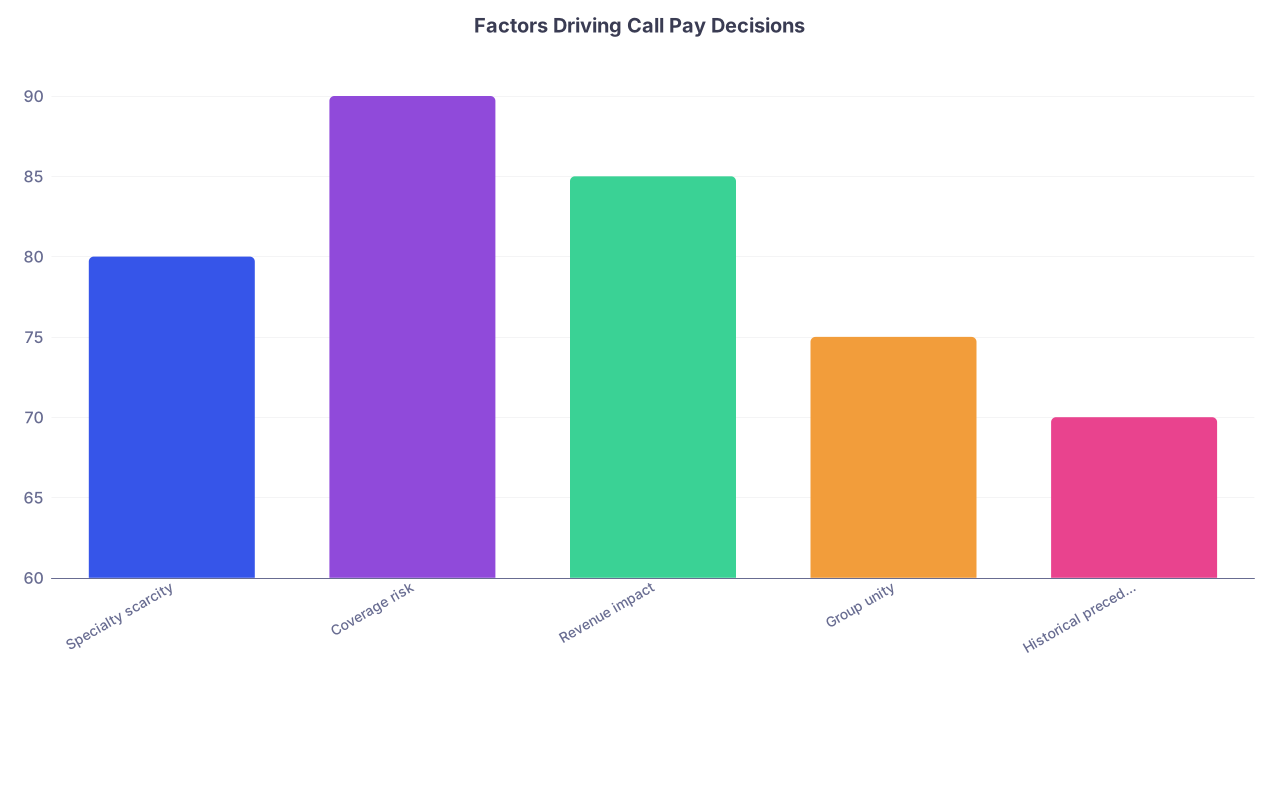
| Category | Value |
|---|---|
| Specialty scarcity | 80 |
| Coverage risk | 90 |
| Revenue impact | 85 |
| Group unity | 75 |
| Historical precedent | 70 |
What senior physicians actually say in negotiations
Let me give you some concrete phrases that get used when senior physicians know what they’re doing. These do not sound like begging. They sound like boundary-setting.
You’ll hear:
- “Here’s the coverage model we can support sustainably over 3–5 years.”
- “At the current structure, we’re not able to recruit or retain partners. That’s a patient safety problem in 12–24 months, not today.”
- “For us to continue 24/7 STEMI coverage, the call structure needs to look like this.”
- “We’ve reviewed the market data and the load here. This is not an ask for a bonus; this is the price of maintaining this service.”
You will not hear from savvy senior docs:
- “We’re burned out; we deserve more.”
- “Other hospitals pay more; this isn’t fair.”
- “We were hoping you might consider…”
Sentences that move money are very specific, time-bound, and anchored to hospital risk. Example of how a real conversation sounds:
“Right now, we cover 1-in-3 call with 45-minute door-to-balloon requirements. Two of our partners are late career, and recruitment has stalled because the call is uncompensated relative to the market. We can sustain this for another 6 to 12 months at most. After that, our group will have to move to a 1-in-4 model with fewer call days per physician, which means we either reduce coverage or go off STEMI designation. We’re proposing a $2,000 per 24-hour weekend call stipend and $900 weeknight call to stabilize coverage and recruiting. That’s consistent with what we’re seeing across comparable programs.”
No drama. Just a clinical description of reality combined with a specific proposal.
How “fair market value” actually gets used against you
This is the game: hospitals love the phrase “fair market value” because it sounds objective and protective. In practice, they use it as a ceiling, not a range.
Behind the scenes, what they’ll do is:
- Ask a valuation firm to generate a very conservative range rooted in old or low-ball surveys.
- Use the lowest part of that range as their internal target.
- Tell you the top of the range is “legally risky.”
I’ve sat through calls with outside valuation firms. Guess what they ask?
- “What are you currently paying?”
- “What are your budget constraints?”
- “Are you trying to justify an existing arrangement or design a new one?”
Everyone pretends this is some sacred, independent process. It’s not. It’s guided by the client’s (the hospital’s) goals.
Senior physicians who understand this do two things differently:
They gather their own market intel—quietly. They talk to friends at neighboring hospitals. They ask locums recruiters what they pay for emergency call in their specialty. They mentally anchor above whatever the hospital’s consultant is going to say.
And they attack the assumptions, not the idea of FMV itself. “Your consultant used general surgery call data from rural hospitals without trauma designation. That doesn’t reflect our case mix, trauma level, or transfer pattern.”
They don’t say “your fair market value is wrong.” They say, “You used the wrong market.”
Structures senior physicians push for (that juniors don’t even know exist)
Most early-career physicians think call pay is either “you get a stipend” or “you don’t.” Senior physicians know the menu is bigger.
Here are structures I’ve seen used effectively:
- Tiered call: Different rates for primary vs backup call. Higher rates for holidays.
- Stacked thresholds: Base stipend for being on call, plus additional payment once you cross a certain number of callbacks or hours in-house.
- Blended models: Lower per-day call rate but higher procedural or encounter pay for call-related work. Good for specialties with procedural-heavy nights.
- Service-line pools: A single pool for, say, stroke coverage split among neurology, radiology, and sometimes ED based on agreed weights. Keeps admin from doing whack-a-mole with each specialty.
- Recruitment-linked call pay: Temporary higher call stipends until a certain FTE level is reached, then a planned step-down.

The know-what-you’re-doing move is to walk in with a proposed structure, not “can you give us more?” The more work you’ve done to define a realistic, trackable structure, the easier it is for admin to say yes and justify it.
Admin hates the blank page. Do that work for them.
Where younger physicians screw this up
Younger physicians usually make three big mistakes around call pay:
They think productivity RVUs will fix everything.
They accept insane call loads, exhaust themselves, then go to admin saying, “Look at my RVUs; I deserve more.” Admin smiles and says, “Yes, your RVU-based comp reflects your hard work. Call is part of your professional obligation.”You baked your own exploitation into your base comp. They will not voluntarily carve out call now that your behavior proves you’ll kill yourself for the RVUs.
They underestimate how long these battles take.
Senior physicians understand that call pay fights are often 6–18 month projects. There are feasibility studies, “alignment with system policy,” and endless cycles of “we’re reviewing.” They start early and they don’t blink at delay tactics.They negotiate as individuals, not as a block.
Admin loves nothing more than one ambitious junior doc who says privately, “Just pay me a bit extra and I’ll cover.” You’ve just tanked any collective leverage your group had.
The senior physicians who actually shift call pay trajectories pull the juniors into the fold early. They share numbers. They explain the long game. They don’t let the fresh-faced eager beaver undercut the ask for coffee money.
If you’re junior reading this: do not volunteer for insane extra call “for the experience” without asking the older partners, “What are we negotiating for as a group? Am I undercutting something here?”
When senior physicians say “no more” and mean it
The single most powerful move in call negotiations is not a phrase. It’s an action: actually restricting or walking away from call.
Hospitals are shockingly good at ignoring emails, memos, and hurt feelings. They are very bad at ignoring:
- A formal 90-day notice terminating stroke coverage
- A group letter stating they will drop to backup-only call without stipend
- A documented statement that they cannot safely staff X service beyond a given date
The senior physicians who get real call pay do something most people are too scared to do: they put a date on the calendar and say, “Beyond this, the current model stops.”
Then they stick to it.
Not recklessly. They document their concerns. They put it through MEC channels. They loop in risk management. They give reasonable notice. They don’t ambush anyone.
But they don’t blink.
I’ve seen groups cave three days before go-live because “we didn’t want to hurt the hospital.” Admin now knows: they were bluffing. Those physicians will never get serious call money at that site. Ever.
On the flip side, I’ve seen a general surgery group say, “We’re moving to 1-in-5 call total. We can no longer cover 1-in-3 at current rates. Here’s the schedule starting July 1.”
The hospital flailed. Panic meetings. “You can’t do this to us.” The surgeons simply replied, “We are available at 1-in-5 at our proposed stipend. Beyond that, you’ll need additional surgeons or locums.”
Fast forward four months. Call pool approved. Locums considered but quietly dropped because they were more expensive and less reliable. The group didn’t shout. They just changed behavior.
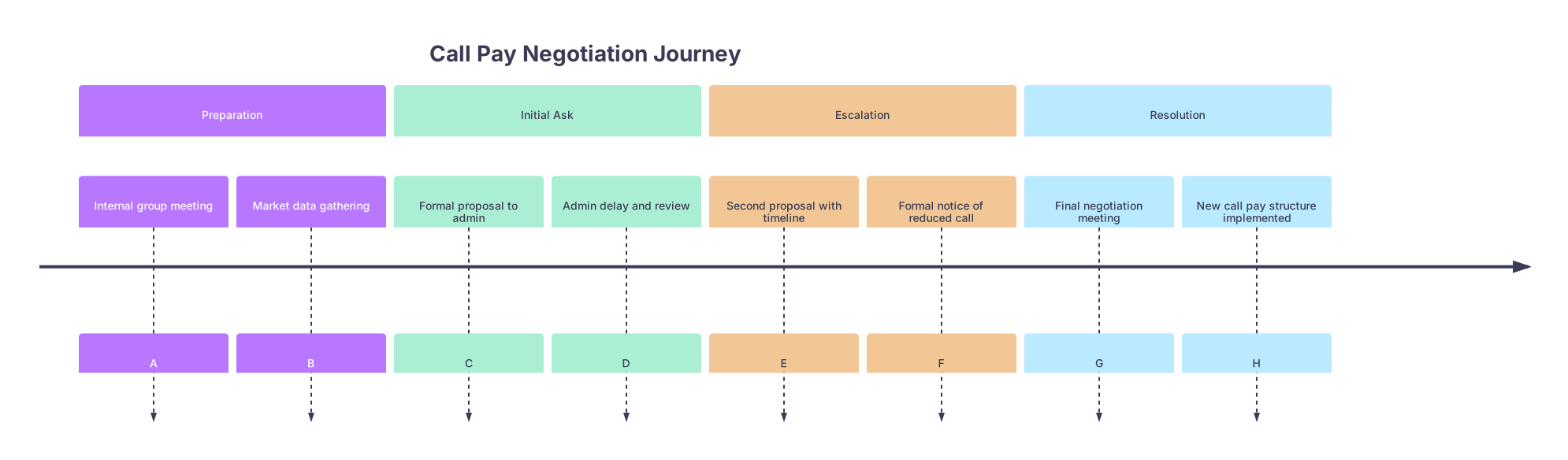
| Period | Event |
|---|---|
| Preparation - Internal group meeting | A |
| Preparation - Market data gathering | B |
| Initial Ask - Formal proposal to admin | C |
| Initial Ask - Admin delay and review | D |
| Escalation - Second proposal with timeline | E |
| Escalation - Formal notice of reduced call | F |
| Resolution - Final negotiation meeting | G |
| Resolution - New call pay structure implemented | H |
What you should be doing right now
If you’re serious about not being the sucker on the call schedule, start doing what senior physicians quietly do years before any big showdown.
Start tracking:
- How many days and nights you’re on call per month
- How often you’re called in and for what
- How many of those encounters are uncompensated or poorly compensated
- Your group’s age and recruitment pipeline
Keep a clean record for 6–12 months. Not for whining. For evidence.
Talk to colleagues in your specialty at other hospitals. Not “what’s your salary?” but “What’s your call structure? Is it a flat stipend or per diem? What are the numbers?” If they hesitate, share yours first. Someone has to go first.
Sit down with your group and ask the question most physicians avoid because it’s uncomfortable: “What’s our minimum? What would make this sustainable for the next decade?”
And then, when you’re ready, don’t walk into that room asking if admin “might consider” something. Walk in like the senior physicians who actually get results:
With data. With a specific structure. With a united group. And with a quiet, credible timeline for what will change if the hospital chooses not to act.
Because years from now, you won’t remember the exact per-night number you landed on. You’ll remember whether you allowed other people to dictate the value of your nights and weekends—or whether you finally acted like the only person in the room who truly understood what it costs you to pick up that phone at 2:17 AM.