
The phrase “competitive salary” in physician job postings is often a smokescreen, not a promise.
If you treat it as a green flag instead of a warning sign, you are exactly the candidate some employers are hoping for: under-informed, rushed, and easy to underpay.
Let’s walk through the traps I keep seeing physicians fall into, and how you avoid becoming the “I should have known better” story at the next conference.
1. “Competitive Salary” With No Numbers: Why That’s Already a Problem
When a posting uses “competitive salary” but refuses to show actual figures, you should assume one thing first:
They are not proud of the number.
Good employers who pay above the 50th–75th percentile usually say so, with data: “Base salary $320,000–$360,000, MGMA median+ for region.” Bad or mediocre offers hide behind adjectives.
Watch for these specific phrases in postings:
- “Competitive salary commensurate with experience”
- “Market-competitive compensation package”
- “Earn up to $X” with no base listed
- “Uncapped earning potential”
Those sound reassuring until you parse them:
- “Commensurate with experience” often means they will let you suggest a number first, then anchor low.
- “Uncapped earning potential” almost always means “low base, heavy RVU dependence, and very optimistic volume assumptions.”
If a job listing refuses to give you any range even after initial contact, that is not just annoying. It is a data point:
- They expect a wide spread in pay between naive and well-informed physicians.
- They want to see your number first so they can pay you just above your current salary, not what you are actually worth in that market.
Do not make this mistake: Accepting “we’re competitive” as an answer. Push for:
- Specific base salary range
- RVU rate (if applicable)
- Typical total compensation for current physicians in that group
If they refuse, treat that as a serious red flag, not a minor inconvenience.
2. When “Competitive” Means “Below Median”: The Data Gap
You cannot judge “competitive” without numbers. Or benchmarks. Or both.
Most physicians I talk to underestimate how far off an offer can be from fair market value. I have seen:
- Hospitalist offers $50,000–$80,000 below MGMA median for the region
- Outpatient primary care positions quoting $210,000–$220,000 as “very competitive” in markets where $260,000–$290,000 is normal
- Surgical subspecialty RVU rates 15–25% below what nearby systems pay
If you do not know the going rates, “competitive” will sound fine, because you have no reference point.
Use whatever you can get your hands on:
- MGMA, AMGA, or SullivanCotter benchmarks (through your institution, colleagues, or mentors)
- Specialty society compensation surveys
- Crowd-sourced physician salary data (Doximity, Medscape, specialty boards, vetted physician Facebook/Slack groups)
Then compare:
| Role | True Competitive Range | Red-Flag 'Competitive' Offer |
|---|---|---|
| Outpatient IM Physician | $260k–$300k base | $215k base |
| Hospitalist (7 on / off) | $300k–$340k total | $250k total |
| Noninvasive Cardiology | $450k–$550k total | $380k–$400k total |
If an employer is truly competitive, they should comfortably land around the 50th–75th percentile for that region and practice type, not 25th percentile dressed up in pretty language.
3. The RVU Trap: “Competitive” Production That Never Materializes
The most dangerous version of “competitive salary” is hidden in RVU and productivity-based models.
Here is the script I hear too often:
“Our physicians typically earn $400k–$450k once ramped up. The base is $220k, but the bonus structure is very generous.”
Then you find out later:
- RVU targets are based on the highest-producing physician in the group
- Your schedule is half new patients, half “inherited” from a retiring doc who did not actually retire
- Referral patterns are not in your favor; senior partners keep the best cases
- The bonus kicks in only after an unattainable RVU threshold
So you end up working 60 hours a week, charting at home, and still stuck at your “competitive” base.
Red flags in productivity language:
- “Earn up to $X” without specifying:
- Required RVUs
- RVU rate ($/wRVU)
- Actual historical average for new hires
- “Our top earners make $X” (outliers, not realistic averages)
- “Our physicians typically make $X” without data to back it up
You want at least:
- Written RVU rate (for your specialty and practice type)
- Clear RVU thresholds for bonuses
- Historical data: average wRVUs and total pay for:
- Existing physicians
- New hires in years 1–3
If they cannot or will not show this, you are gambling your life on marketing copy.
4. “Competitive Salary” That Ignores Cost of Living
Another classic move: quoting a “competitive” salary in a low-paying region while quietly exploiting cost-of-living misunderstandings.
For example:
- $250,000 “competitive” outpatient IM in a high-cost coastal metro = weak
- $250,000 “competitive” outpatient IM in a very low-cost rural Midwest area = maybe fair, maybe not, but still deserves scrutiny
The problem: many postings use national-sounding phrases (“competitive” “market-rate”) without acknowledging that their market is structurally lower because there are too many physicians or a dominant employer.
You must adjust for:
- Local housing costs
- State/local taxes
- Call burden and lifestyle expectations
- Commuting or multi-site practice
Do not get dazzled by a salary that looks big compared to your residency paycheck. Compare it:
- Against regional physician market data
- Against local living costs
- Against the actual workload described (or not described) in the posting
5. Benefits and Call: Where Employers Hide the Real Cost
A “competitive salary” can be torpedoed by quietly bad benefits and brutal call schedules.
Common mistakes I see:
- Focusing only on base salary while ignoring:
- Short- and long-term disability
- Retirement match
- CME funds and time
- Malpractice coverage type (occurrence vs claims-made, who covers tail)
- Underestimating the workload implied by vague phrases like:
- “Shared call”
- “Reasonable call”
- “Light weekend coverage”
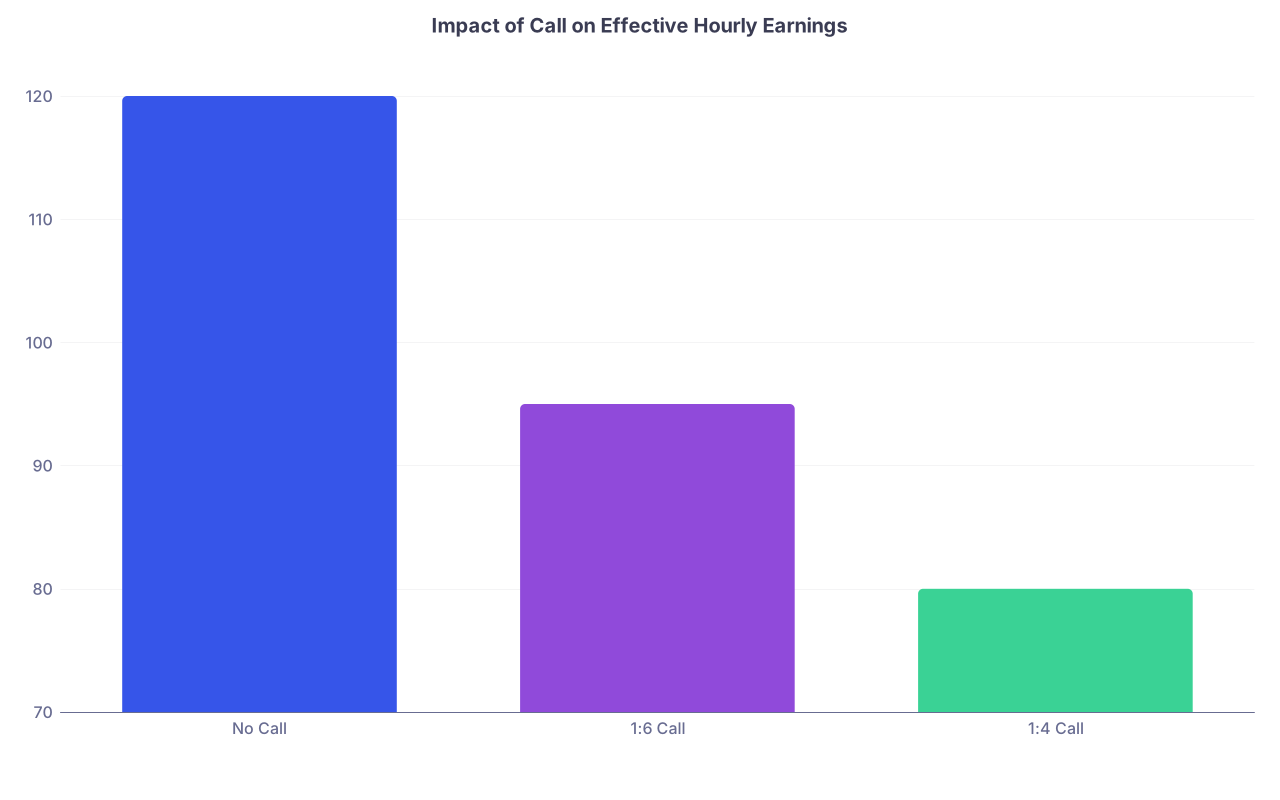
You must convert call into money in your head.
If you are on:
- 1:4 call with actual admits and consults most nights
- 1:2 unprotected home call for some surgical subspecialties
- Or the classic “pager call” that is not truly compensated
…then your “competitive salary” is being diluted by unpaid hours.
| Category | Value |
|---|---|
| No Call | 120 |
| 1:6 Call | 95 |
| 1:4 Call | 80 |
(Example: effective dollars per hour drop sharply as call increases without extra pay.)
Specific questions you must ask:
- Exact call schedule (weekday vs weekend, in-house vs home)
- Average call volume
- Call compensation (flat rate, per shift, RVU credit, or nothing)
- Whether call is included in “base salary” expectations
If they are vague here, assume you are subsidizing the schedule with your time.
6. Slippery Language in Job Postings: The Phrases That Should Make You Pause
Certain repeated phrases in physician job ads are almost always covering for something.
Here are some of the worst offenders and what they usually mean:
- “Salary competitive with regional market”
- Translation: We benchmarked against our own lower-paying competitors, not national data.
- “Opportunity to grow your income significantly”
- Translation: Your base is low, and hitting the bonus will be difficult.
- “Generous compensation package”
- Translation: We are counting non-cash perks to make the number sound bigger.
- “Above-average earning potential”
- Translation: One person here makes a lot. You will not.
Whenever you see these, your next steps should not be to get excited. Your next steps:
- Ask for the written range (base + realistic total comp).
- Ask for the formula (RVU, call pay, bonuses).
- Ask for historical averages (not cherry-picked best examples).
If they dodge all three, that “competitive” wording has done its job: lured you in without committing to anything.
7. The Legal and Contract Side: How “Competitive” Disappears on Paper
The posting can say “competitive salary.” The contract is what you live with.
Here is where many physicians get burned:
- The offer letter uses enthusiastic language; the contract quietly adds:
- Productivity thresholds that are much higher
- Short guarantee periods (12 months → then pure RVU)
- One-sided “may adjust compensation at employer’s discretion” clauses
- The contract is missing:
- Any mention of the rosy “up to $X” number they dangled
- Specifics about bonuses, timing, and calculation methods
If something about compensation is not:
- Written
- Specific
- Calculable
…it does not exist.
I have seen physicians trust spoken assurances like:
“Do not worry, our doctors always make at least $400k.”
Then 18 months later, they are stuck at $260k, the “guarantee” is gone, and there is nothing in writing to force the employer’s hand.
You must:
- Get every component of pay in the contract:
- Base salary
- RVU or productivity rate and thresholds
- Quality or metric bonuses (with clear criteria)
- Call pay
- Eliminate vague “at employer’s discretion” language related to compensation when possible
- Have a health care–savvy attorney review the contract, not just any lawyer
8. Non-Competes and “Competitive” Pay: The Golden Handcuff Problem
One of the nastiest traps is a “competitive” salary paired with a punishing non-compete.
Here is the pattern:
- They offer:
- Solid-looking starting salary
- Vague but exciting bonus talk
- But the contract includes:
- 10–25 mile non-compete radius
- 1–3 year duration
- Applies to all locations of the employer system (not just your clinic/hospital)
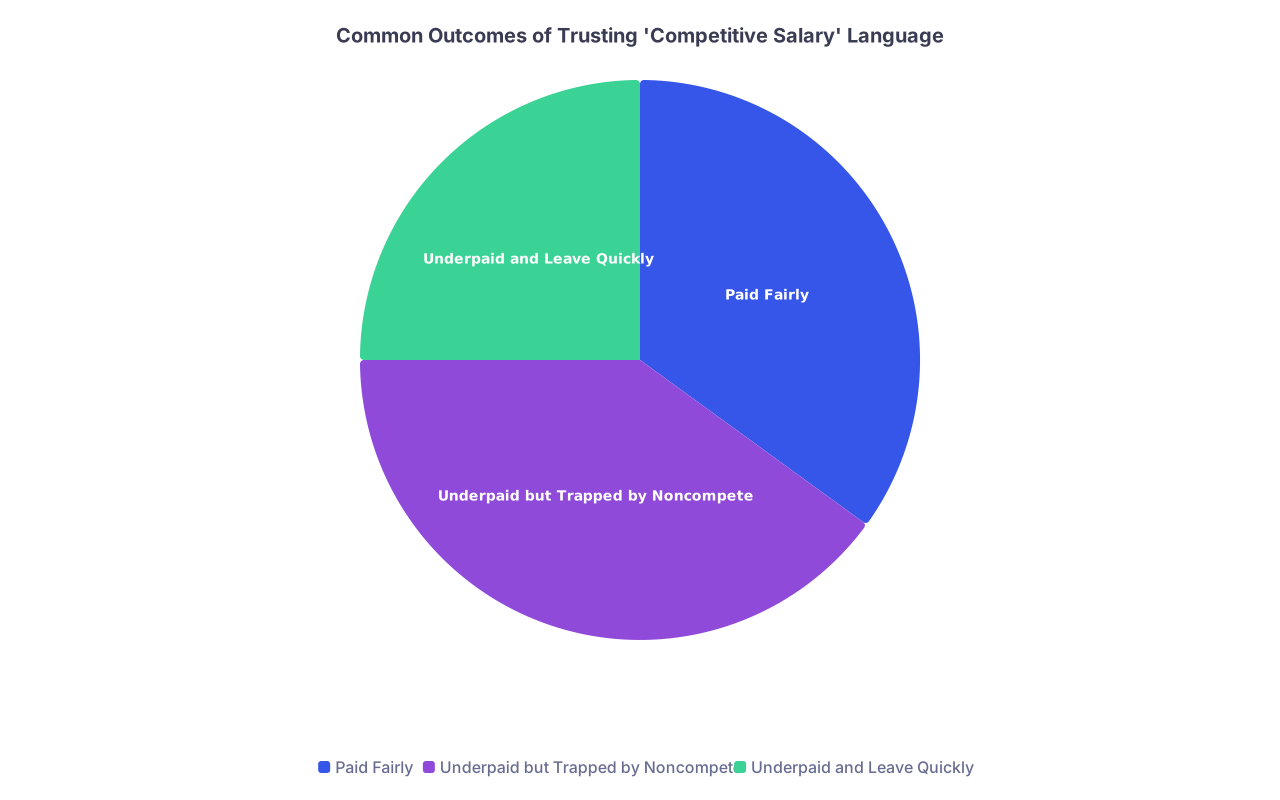
On day one, the salary feels fine. Three years later, when you realize your pay has stalled and your workload has not, the non-compete makes leaving extremely expensive:
- Your kids’ school, spouse’s job, entire support network are locked to that geography.
- Your only way out is:
- Leave the region entirely, or
- Take a non-clinical role, or
- Accept a significantly worse position just outside the non-compete area
So you stay. With your “competitive” but stagnant salary.
Non-competes are not always fully enforceable, depending on state law and current regulatory battles, but do not rely on that. Negotiate them as if they will be enforced.
Red flags:
- Broad geographic region without clear map
- Applies to any “affiliate” or “entity under common ownership”
- Non-compete triggered even if they terminate you without cause
If the pay is only barely competitive and the non-compete is aggressive, the overall deal is not physician-friendly.
9. The Onboarding Reality Check: Questions to Ask Before You Sign
The easiest time to avoid a bad “competitive salary” trap is before you sign. After that, your leverage plummets.
Do not just read the posting and smile. Ask hard, specific questions like you are assessing a patient with chest pain, not ordering a latte.
Minimum questions:
- What is the guaranteed base, and for how long?
- After the guarantee, what exactly determines my compensation?
- What did your last 3 new hires make in years 1, 2, and 3?
- What is the RVU rate or equivalent, and how often does it change?
- What is the current median compensation for physicians in this role here?
- How is call compensated, and how often will I take it?
- What are the non-compete terms (distance, duration, scope)?
If they cannot answer these cleanly, or they act offended that you are asking, that is not a culture that respects you as a professional.
10. A Quick Mental Checklist: When “Competitive Salary” Is Probably Fine
To be fair, not every use of “competitive salary” is malicious or deceptive. Some HR teams just copy boilerplate. There are situations where the phrase is annoying but harmless.
You can tentatively trust the posting more if all of these are also true:
- They publish an actual salary range up front.
- They reference known benchmarks (MGMA, AMGA, etc.).
- Physicians you talk to there:
- Are willing to share actual numbers.
- Say the written contract matches what they were told.
- The contract you receive:
- Matches what the recruiter described.
- Has specific, defensible compensation language.
- The non-compete is:
- Narrow in scope.
- Reasonable in geography and duration.
But treat that list as a safety checklist. If several are missing, stop assuming “competitive” means you are safe.

| Step | Description |
|---|---|
| Step 1 | See Job Posting |
| Step 2 | Compare to Market Data |
| Step 3 | Request Specific Range |
| Step 4 | High Risk - Proceed Carefully |
| Step 5 | Review Contract Details |
| Step 6 | Negotiate or Decline |
| Step 7 | Check RVU, Call, Noncompete |
| Step 8 | Attorney Review |
| Step 9 | Salary Range Listed |
| Step 10 | Refuse to Share? |
| Step 11 | At or Above Median? |
| Category | Value |
|---|---|
| Paid Fairly | 35 |
| Underpaid but Trapped by Noncompete | 40 |
| Underpaid and Leave Quickly | 25 |

FAQ: Hidden Risks Behind “Competitive Salary” in Physician Job Postings
1. The posting says “competitive salary” but the recruiter insists they cannot share numbers until later. Is that normal?
It is common. It is not benign. Employers who genuinely pay well usually do not mind sharing at least a range early, especially for in-demand specialties. Withholding numbers until you have invested time in multiple interviews is a tactic: once you are emotionally invested, you are less likely to walk away from a mediocre offer. You do not need exact figures on day one, but if they refuse to give even a range after a phone screen, assume the number is weaker than the language suggests.
2. How do I know if an RVU-based “competitive” offer is actually fair?
You need three things, minimum:
- The exact RVU rate (dollars per wRVU) for your specialty and setting.
- The expected annual RVU target and what triggers bonuses.
- Historical data from that group: average RVUs and total compensation for physicians in your role, ideally broken down by years in practice.
If they will not share those, or if the required RVUs to hit “competitive” income are dramatically above MGMA norms for your specialty, the model is stacked against you. Get a neutral third party (experienced colleague, advisor, or attorney) to sanity-check the math before you sign.
3. The salary looks mediocre, but the benefits and “earning potential” sound great. Should I still consider it?
Only if the “earning potential” is backed by hard numbers and the benefits are clearly superior. Convert everything to actual dollars and time:
- Quantify call, travel, extra duties.
- Put a dollar estimate on retirement match, CME, and malpractice coverage.
- Ask for real compensation data from current physicians in that role.
If the base is mediocre, bonuses are vague, and benefits are just average, do not let “competitive salary” language confuse you. You are not obligated to accept a “standard” offer just because HR insists it is market-rate. You are the one who will live with the consequences, not the recruiter.
Key points to keep in your head:
- “Competitive salary” is marketing, not data. Demand specific numbers and written formulas.
- Look past the posting to the contract: RVUs, call, benefits, and non-competes can erase any so-called competitiveness.
- If they will not show you the math behind their claims, assume you are the one expected to lose.