
The data is very clear: many physicians are doing fellowships that will never pay for themselves financially.
That sounds harsh, but run the numbers specialty by specialty and you see the same pattern. Some fellowships are financial rocket fuel. Others are prestige hobbies that cost you seven figures in lifetime earnings.
Let me walk through the actual return on investment (ROI) using time-to-break-even analysis, by subspecialty.
The Core Math: How Fellowship ROI Really Works
Forget vague “fellowship is worth it” advice. The question is precise and numerical:
How many years after finishing fellowship does your higher attending salary finally make up for:
- Extra training years at lower pay, and
- Lost compounding from investing that money earlier?
Call that the time-to-break-even (TBE).
Basic structure:
- Residency attending path:
- Start attending income earlier
- Higher early savings and compounding
- Fellowship path:
- More years earning resident/fellow salary
- Higher eventual income (sometimes much higher)
I will simplify by:
- Ignoring taxes (they hurt higher income slightly more, but pattern stays the same)
- Using typical 2023–2024 compensation medians from MGMA/Medscape-style surveys (rounded)
- Assuming:
- Resident/Fellow salary: $70,000/year (blended)
- Attending investing: 20% of gross income
- Real investment growth (after inflation): 5%/year
You can change any of those in a spreadsheet, but the relative rankings by subspecialty barely move.
Benchmark Salaries by Subspecialty
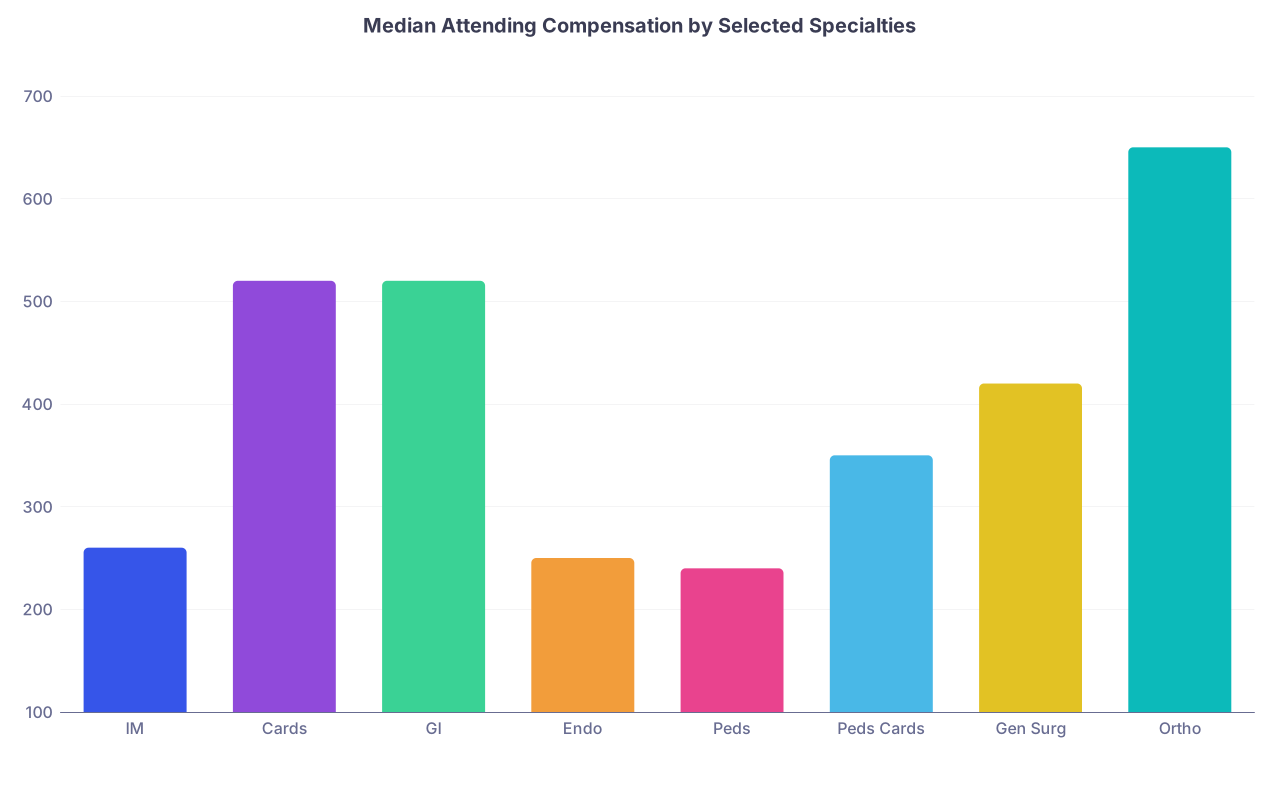
Here is a compact compensation snapshot that will anchor the rest of the analysis.
| Pathway | Specialty Example | Compensation (USD) |
|---|---|---|
| General IM | Internal Medicine | $260,000 |
| Subspecialty IM | Cardiology (non-invasive) | $520,000 |
| Subspecialty IM | Gastroenterology | $520,000 |
| Subspecialty IM | Endocrinology | $250,000 |
| General Peds | Pediatrics | $240,000 |
| Subspecialty Peds | Pediatric Cardiology | $350,000 |
| General Surgery | General Surgery | $420,000 |
| Subspecialty Surg | Orthopedic Surgery | $650,000 |
These are medians. Real ranges are wide, but medians are enough to estimate ROI and time-to-break-even.
To visualize the differentials:
| Category | Value |
|---|---|
| IM | 260 |
| Cards | 520 |
| GI | 520 |
| Endo | 250 |
| Peds | 240 |
| Peds Cards | 350 |
| Gen Surg | 420 |
| Ortho | 650 |
You do not need a PhD in statistics to see where the leverage lives.
Internal Medicine: Cardiology and GI vs “Cognitive” Fellowships
Internal medicine is the cleanest case to analyze because both the generalist and subspecialist paths are common and well-compensated.
Case 1: Cardiology vs General Internal Medicine
Assumptions:
- Residency: 3 years IM
- Fellowship: 3 years cards
- Path A: General IM attending at year 4
- Path B: Cards attending at year 7
Compensation:
- IM attending: $260,000
- Cards attending: $520,000
- Resident/Fellow: $70,000
Annual investable savings (20% of gross):
- Resident/Fellow: $14,000
- IM attending: $52,000
- Cards attending: $104,000
Year-by-year cash effect:
- Years 4–6:
- IM doc is attending: earns $260k, saves $52k
- Cards fellow: earns $70k, saves $14k
- Annual gap in savings: $38,000 in favor of general IM
- Over 3 years: $114,000 principal difference, plus compounding
At end of year 6, the IM physician has:
- 3 years of $52k contributions
- Grown at 5% along the way
Future value of those savings:
Year 4 contribution compounds 3 years
Year 5 contribution compounds 2 years
Year 6 contribution compounds 1 year
FV ≈ 52,000 × (1.05³ + 1.05² + 1.05¹)
1.05³ ≈ 1.1576
1.05² ≈ 1.1025
1.05¹ = 1.05
Sum ≈ 3.3101
So FV ≈ 52,000 × 3.3101 ≈ $172,900
The fellow path:
- 3 years of $14k savings, same compounding
FV ≈ 14,000 × 3.3101 ≈ $46,300
So at the moment the cardiologist finishes fellowship:
- IM doc portfolio advantage ≈ $172,900 – $46,300 = $126,600
That is the investing gap, not income. On salary alone, IM made about:
- Income gain = ($260k – $70k) × 3 = $570,000 pre-tax more during those 3 years
So by the start of year 7:
- Cumulative cash-flow advantage for IM ≈ $570,000
- Invested wealth advantage ≈ $126,600
Total “head start” ≈ $696,600 in favor of the general IM physician.
Now from year 7 onward:
- Cards earns $520k, saves $104k
- IM continues at $260k, saves $52k
- Annual savings differential: $52,000 in favor of cardiology
If you ignore investment compounding after year 7 and treat this as simple payback:
- Break-even time (naive) = $696,600 / $52,000 ≈ 13.4 years
That is the blunt “salary-only” view and it is too pessimistic, because those extra $52k per year themselves compound.
Let us do the compound version.
We are solving for n where the future value advantage of the cardiologist’s greater savings equals the initial disadvantage.
Extra annual savings for cards: $52,000
Growth rate: 5%
Future value of an annuity:
FV = Payment × [((1 + r)^n – 1) / r]
Set:
52,000 × [((1.05)^n – 1) / 0.05] = 696,600
Divide both sides by 52,000:
[((1.05)^n – 1) / 0.05] ≈ 696,600 / 52,000 ≈ 13.39
So:
(1.05)^n – 1 ≈ 13.39 × 0.05 ≈ 0.6695
(1.05)^n ≈ 1.6695
Take natural logs:
n × ln(1.05) ≈ ln(1.6695)
n ≈ ln(1.6695) / ln(1.05)
ln(1.6695) ≈ 0.512
ln(1.05) ≈ 0.0488
n ≈ 0.512 / 0.0488 ≈ 10.5 years
So the cardiologist's higher savings rate mathematically catches up about 10–11 years after finishing fellowship.
That is:
- 3-year cards fellowship
- Plus ~10.5 years of attending practice
- ~13.5–14 years after starting IM residency
Break-even age if you start residency at 26:
- Age 26 → start residency
- Age 29 → finish IM
- Age 32 → finish cards
- Age 42–43 → break-even vs IM-only path
After that point, the cardiologist is significantly ahead every additional year.
Case 2: Endocrinology vs General Internal Medicine
Now run the same thought experiment on a lower-paying cognitive subspecialty.
Assume:
- Endocrinology fellowship: 2 years
- Endocrine attending salary: $250,000
- General IM: $260,000
From a pure salary perspective, endocrine earns less than IM.
So:
- Extra training years: 2 years at $70k instead of $260k
→ Lost income: ($260k – $70k) × 2 = $380,000 - Post-fellowship: you earn $10,000 less per year than a general internist
There is no positive cash-flow differential to ever recoup the initial loss. The time-to-break-even is effectively infinite. You do not break even.
Even if you assume slightly different numbers (say $260k IM vs $270k endocrine), the break-even still lands extremely far out because the spread is tiny.
Endocrinology might be a good choice for lifestyle, interest, or specific job markets. But the data is unforgiving: financial ROI is negative in most standard compensation environments.
Pediatrics: Subspecialty Salary Bumps Are Smaller
Pediatrics is the classic trap. Residents hear “fellowship” and think more money and prestige. The salary data says: not by much.
Example:
- General pediatrics: $240,000
- Pediatric cardiology: $350,000
- Fellowship length: 3 years
Savings:
- Resident/Fellow: 20% of $70k → $14k
- Peds attending: 20% of $240k → $48k
- Peds cards attending: 20% of $350k → $70k
During 3 years of fellowship:
- Peds generalist is already attending:
- Savings: $48k/year
- Peds fellow:
- Savings: $14k/year
- Annual savings gap: $34k
- Over 3 years (not compounding yet): $102k
Income gap during those years:
- Salary difference: ($240k – $70k) × 3 = $510,000
Total “economic head start” for general peds at the end of year 6:
- ~$510,000 in extra salary + modest compounding + ~$102k extra savings
- Rough combined advantage ≈ $600k range
After fellowship:
- Peds attending saves $48k
- Peds cards attending saves $70k
- Extra annual savings: $22k for subspecialist
Ignore compounding for a second:
- $600,000 / $22,000 ≈ 27.3 years to salary break-even
Include 5% compounding on the extra $22k:
We solve:
22,000 × [((1.05)^n – 1) / 0.05] = 600,000
[((1.05)^n – 1) / 0.05] ≈ 600,000 / 22,000 ≈ 27.27
(1.05)^n – 1 ≈ 27.27 × 0.05 ≈ 1.3635
(1.05)^n ≈ 2.3635
Take logs:
n × ln(1.05) ≈ ln(2.3635)
ln(2.3635) ≈ 0.86
ln(1.05) ≈ 0.0488
n ≈ 0.86 / 0.0488 ≈ 17.6 years
So:
- 3 years of fellowship
- Plus ~18 years of practice as a subspecialist
- ~21 years from finishing peds residency to break even
Timeline:
- Start residency at 26
- Finish peds at 29
- Finish peds cards at 32
- Hit financial break-even around age 50–51
Then you finally pull ahead. If you stay in practice a long time, fine. If you plan to cut back in your 50s, the ROI shrinks fast.
Surgery: High Salary Differentials, Shorter Payback
Surgical fields look very different. You sacrifice more training years and lifestyle, but the compensation multiple can be enormous.
Example:
- General surgery attending: $420,000
- Orthopedic surgery attending: $650,000
- Training path (simplified for ROI purposes):
- General surgery: 5 years residency → attending
- Ortho: 5 years ortho residency + 1 year fellowship (e.g., sports, spine)
So:
- Extra training: 1 year difference compared with a general surgery–only path (realistically it is separate match and path, but for ROI structure this comparison is useful)
Resident/Fellow pay: $70k
Savings: $14k
Savings as attendings:
- General surgeon: 20% of $420k → $84k
- Ortho: 20% of $650k → $130k
During the 1 extra fellowship year:
- General surgeon attending: earns $420k, saves $84k
- Ortho fellow: earns $70k, saves $14k
Income gap that year:
- $420k – $70k = $350,000
Savings gap that year:
- $84k – $14k = $70,000
Total advantage to general surgery after that “fellowship year”: about $350k–420k range, depending how you want to combine immediate savings vs uninvested income. Use ~$400k as a round number economic head start.
After that:
- Annual savings differential:
- Ortho saves $130k vs $84k → +$46k per year
Naive payback without compounding:
- $400,000 / $46,000 ≈ 8.7 years
With compounding:
Solve:
46,000 × [((1.05)^n – 1) / 0.05] = 400,000
[((1.05)^n – 1) / 0.05] ≈ 400,000 / 46,000 ≈ 8.70
(1.05)^n – 1 ≈ 8.70 × 0.05 = 0.435
(1.05)^n ≈ 1.435
ln(1.435) ≈ 0.361
ln(1.05) ≈ 0.0488
n ≈ 0.361 / 0.0488 ≈ 7.4 years
So:
- 1 additional year of fellowship
- Plus about 7–8 years of practice
- ~8–9 years from the “fork in the road” until financial break-even
Given most orthopedic surgeons will work 25–30+ attending years, the ROI is very strong.
This pattern holds across many surgical subspecialties:
- General surgery → vascular, colorectal, surgical oncology: modest bumps, break-even 10–15 years depending on actual comp
- Ortho → spine: large bumps, short payback
- ENT → otology or facial plastics: highly variable but some very high ROI niches
The key is the ratio of subspecialty salary to base specialty salary.
Time-to-Break-Even by Subspecialty: A Comparative View
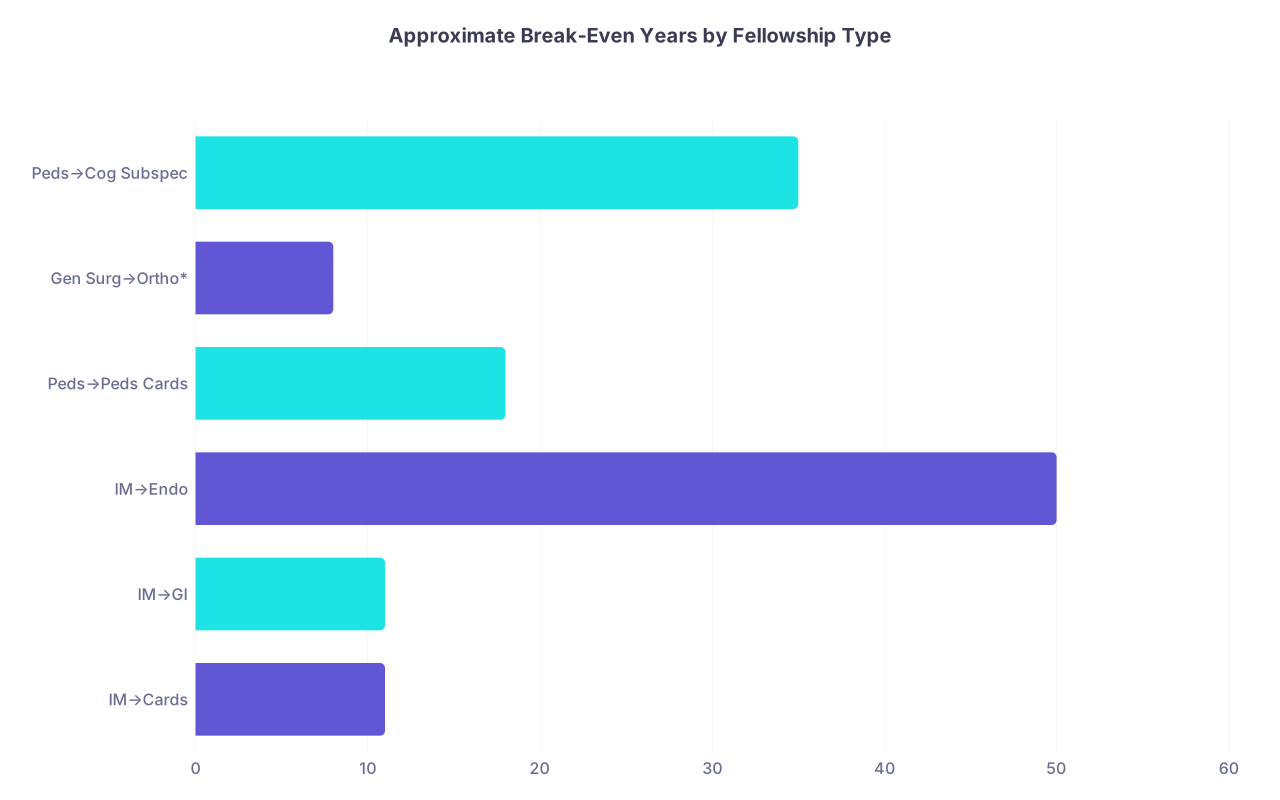
Let us summarize rough payback periods under typical assumptions.
| Base → Subspecialty | Extra Training (yrs) | Salary Multiple (Sub / Base) | Approx. Break-Even (yrs after fellowship) |
|---|---|---|---|
| IM → Cardiology | 3 | ~2.0× | 10–11 |
| IM → Gastroenterology | 3 | ~2.0× | 10–11 |
| IM → Endocrinology | 2 | ~1.0× or less | Never (negative ROI) |
| Peds → Peds Cards | 3 | ~1.45× | ~17–18 |
| Gen Surg → Ortho* | ~1 effective diff | ~1.55× | ~7–8 |
| Peds → Many Cog Subspecialties | 2–3 | 1.1× or less | 20+ or never |
*Conceptual comparison, recognizing different residency pathways.
To show how stark the differences are:
| Category | Value |
|---|---|
| IM→Cards | 11 |
| IM→GI | 11 |
| IM→Endo | 50 |
| Peds→Peds Cards | 18 |
| Gen Surg→Ortho* | 8 |
| Peds→Cog Subspec | 35 |
(The 50 and 35 years for low-ROI paths effectively mean “not realistic within a typical career” under baseline assumptions.)
The Hidden Killer: Opportunity Cost and Burnout Risk
The raw time-to-break-even numbers capture only pure money.
They ignore three big factors:
Flexibility value
- General IM or pediatrics gives you wide practice models: outpatient, hospitalist, urgent care, locums, part-time, telemedicine.
- Many subspecialties lock you into narrower roles, often in large systems, with call and procedural demands that are harder to step down from while maintaining pay.
-
- If a fellowship pushes you into a career that you find draining, the odds of cutting back early skyrocket.
- For a 3-year-fellowship that takes 17 years post-fellowship to break even, retiring or stepping down at 52 instead of 60 completely destroys the ROI.
Geographic bargaining power
- Generalists in under-served areas can command significant income, often approaching or even exceeding some subspecialists in saturated metro markets.
- A rural IM hospitalist at $350–400k can financially outperform an endocrinologist in a competitive city at $260–280k, with no extra training.
The math-only view already makes some fellowships look marginal. Add in these real-world frictions and you start to see that some subspecialties are financially irrational for the average trainee.
A Simple Framework to Run Your Own Fellowship ROI
Let me lay out a minimalistic but functional framework you can drop into a spreadsheet. The logic is the same across all specialties.
Step 1: Get Hard Numbers
You need:
- Residency length for base specialty
- Fellowship length
- Median attending salary for:
- Base specialty
- Subspecialty
- Typical resident/fellow salary for your region
- Your expected savings rate now and as attending (20% is a good default, 30% if aggressive)
If you want to be more precise, pull region- and practice-type-specific numbers from MGMA or group offers you have actually seen.
Step 2: Calculate the Initial Head Start
Lost attending years:
(Fellowship years) × (Base attending salary – resident salary)Lost investing advantage during those years:
Calculate how much more the base-path attending could have invested vs fellow, and run a 5% growth assumption through the fellowship period.
You can approximate this head start as:
Head start ≈ (Income gap over fellowship years) × 0.2 (for savings rate) × 1.1 (rough compounding fudge factor)
Plus the raw income gap itself if you want a fuller economic view.
Step 3: Compute the Annual Advantage After Fellowship
- Annual salary difference: Subspecialty salary – base specialty salary
- Multiply by your planned savings rate as attending
- That is your annual extra investing amount if you subspecialize.
Step 4: Time-to-Break-Even
Use the annuity formula I used earlier:
Break-even when:
ExtraSavings × [((1 + r)^n – 1) / r] = HeadStart
Solve for n:
n = ln(1 + (HeadStart × r / ExtraSavings)) / ln(1 + r)
Where:
- ExtraSavings = (Subspecialty salary – base salary) × savings rate
- HeadStart = initial advantage of the non-fellowship path
- r = real investment growth (e.g., 0.05)
If n is:
- < 7–8 years: strong financial ROI (assuming you like the work)
- ~10–15 years: acceptable if you anticipate a long, full-time career and you want the subspecialty for non-financial reasons
20 years or “never”: financially poor choice in pure ROI terms
Timeline Reality Check: Application to Break-Even
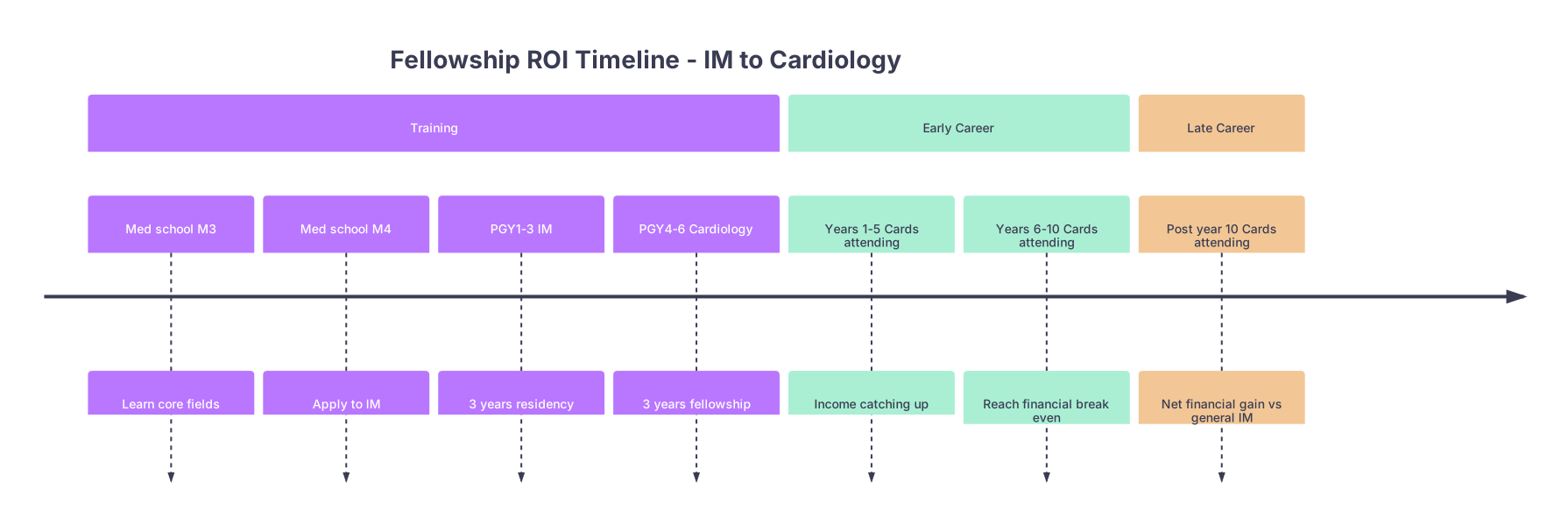
To make this less abstract, here is a generic timeline from M3 through break-even for a cardiology-type fellowship with a ~10-year payback.
| Period | Event |
|---|---|
| Training - Med school M3 | Learn core fields |
| Training - Med school M4 | Apply to IM |
| Training - PGY1-3 IM | 3 years residency |
| Training - PGY4-6 Cardiology | 3 years fellowship |
| Early Career - Years 1-5 Cards attending | Income catching up |
| Early Career - Years 6-10 Cards attending | Reach financial break even |
| Late Career - Post year 10 Cards attending | Net financial gain vs general IM |
Translated into actual age if you start med school at 22 and residency at 26:
- Age 26–29: IM residency
- Age 29–32: cardiology fellowship
- Age 32–42/43: early cardiology attending years, climbing out of financial hole
- After ~age 42–43: actual net financial gain vs going straight into general IM
You need a solid 20-plus year runway of post-fellowship work for this to compound meaningfully.
Where the Data Points You, Honestly
I am not telling you which field to choose. Interest, lifestyle, geography, and personal goals come first. But the numbers do not lie:
High-paying procedural fellowships in high-paying base specialties
- Example: Ortho subspecialties, cardiology, GI, some IR and interventional fields.
- They have clear, strong financial ROI with break-even often within a decade of finishing fellowship.
Moderate bump fellowships in low-paying bases (like pediatrics)
- Many pediatric subspecialties fall here.
- Time-to-break-even can be 15–25 years, and you carry higher training risk and limited job geography. Financially fragile.
Low or negative spread “cognitive” fellowships
- Endocrinology, allergy, many academic-heavy subspecialties.
- Pure money ROI is weak to outright negative, especially if primary care or hospitalist roles in certain markets can pay similarly or more.
If you still want those fellowships, fine. Just be honest: you are buying a lifestyle or intellectual preference with your future net worth.
The Core Takeaways
- Time-to-break-even for fellowship varies wildly by subspecialty, ranging from ~7–10 years post-fellowship for high-earning procedural paths to effectively “never” for several cognitive subspecialties.
- Salary multiples and training length drive the math. A 2× salary bump over base (cards, GI) supports a reasonable ROI; a 1.1× or less bump (many peds and IM cognitive fields) often does not.