
Physician burnout is not a mystery. The data show it is strongly tethered to how physicians are paid, how much they work, and how little control they have over both.
When you line up compensation statistics next to burnout rates by specialty, the story is blunt. More money does not automatically protect against burnout. Certain high-paying fields are among the most burned out. Some lower-paying fields carry a heavy emotional burden that pushes burnout even higher despite moderate workloads. And the structure of compensation—RVU pressure, productivity bonuses, administrative creep—often matters more than the absolute dollar amount.
Let me walk through what the numbers actually say, using the best large-scale surveys (Medscape, MGMA, AMA, Doximity) and some realistic interpretation of how people practice.
The Data Landscape: What We Actually Know
There is no single perfect dataset on physician burnout and pay. Instead, we have multiple large surveys that, taken together, paint a consistent picture.
Across the last few years:
- Most major surveys put physician burnout in the 45–55% range overall
- Many specialties cluster between 40–60%
- Average compensation varies roughly 2–3x from the lowest- to highest-paid specialties
A simplified crosswalk helps. Numbers vary year to year, but the relationships are stable.
| Specialty | Avg Compensation (USD) | Burnout Rate (%) |
|---|---|---|
| Family Medicine | 260,000–280,000 | 50–55 |
| Internal Med | 280,000–300,000 | 48–55 |
| Pediatrics | 240,000–260,000 | 45–55 |
| Emergency Med | 380,000–420,000 | 60–65 |
| General Surgery | 420,000–480,000 | 45–55 |
| Anesthesiology | 430,000–480,000 | 45–55 |
Different surveys report slightly different numbers, but the pattern is stubborn:
- Primary care: lower pay, high burnout
- ED: high pay, very high burnout
- Surgical/procedural: high pay, mid-to-high burnout
- Cognitive subspecialties (e.g., rheumatology, endocrinology): moderate pay, moderate burnout, but with rising documentation burden
So the naive assumption—“burnout is just about being underpaid”—does not hold up. The regression line is not that simple.
Compensation vs Burnout: The Correlation Problem
If you compute a crude correlation between average specialty compensation and burnout rates, you do not get a strong linear relationship. In some analyses using Medscape-style aggregate data, the correlation coefficient (Pearson r) between specialty-level mean salary and burnout rate tends to be weak, often near zero or slightly positive.
In plain language: across specialties, higher pay is not reliably associated with lower burnout. Sometimes the opposite.
This shows up clearly when we plot selected specialties by pay and burnout.
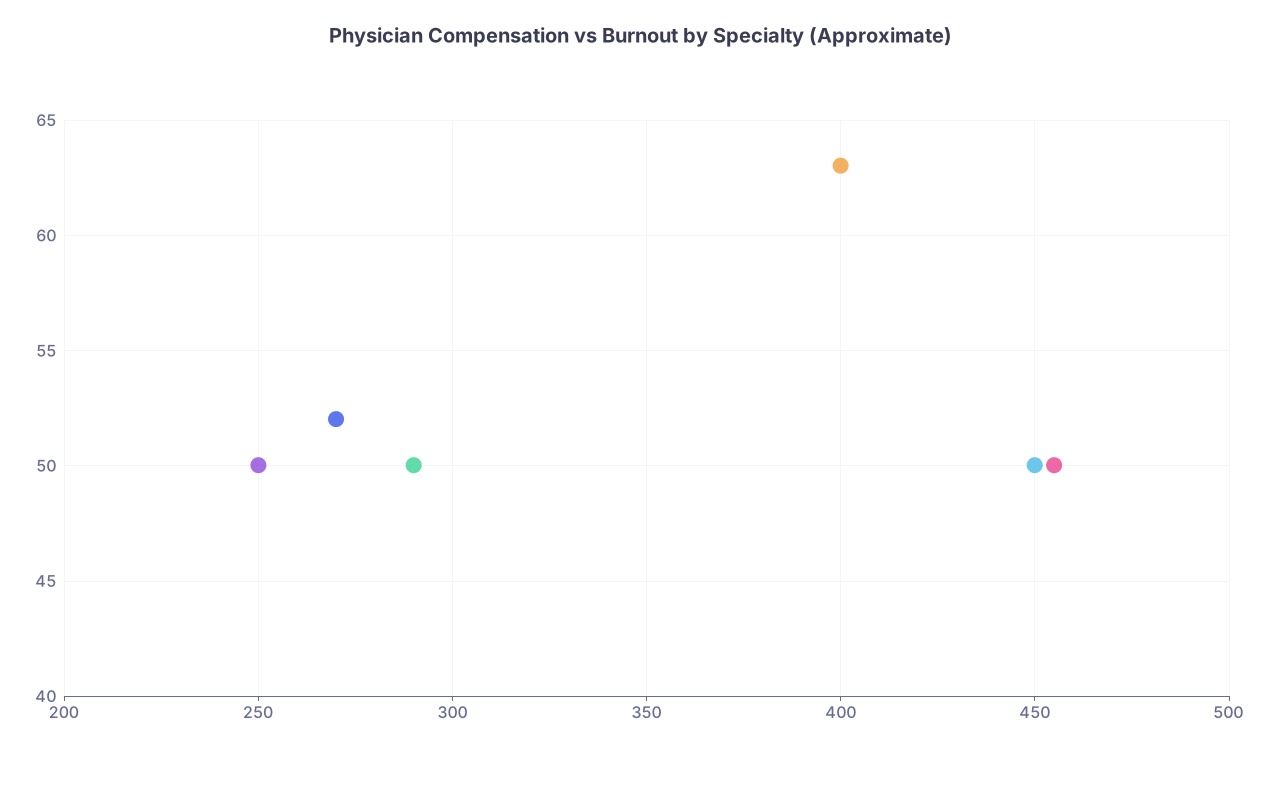
| Category | Value |
|---|---|
| Family Med | 270,52 |
| Pediatrics | 250,50 |
| Internal Med | 290,50 |
| Emergency Med | 400,63 |
| Anesthesiology | 455,50 |
| General Surgery | 450,50 |
Each point is [salary (thousands), burnout %]. Emergency medicine sits high on both axes—one of the best-paid core specialties and one of the most burned out. Family medicine and pediatrics are low on salary but mid-to-high on burnout. Anesthesia and surgery are well paid yet not immune.
So what actually tracks with burnout more consistently?
- Work hours and intensity
- Night and weekend coverage
- Administrative burden and EHR time
- Autonomy (control over schedule, patient load, practice model)
- Misalignment between expectations and reality (the “I didn’t sign up for this” effect)
Compensation is the background variable. When physicians feel underpaid relative to their workload and training, burnout risk climbs. That “relative to” part is critical.
Time, Money, and RVUs: How the Payment Model Drives Exhaustion
The harshest burnout effects show up when compensation is tightly coupled to productivity metrics—RVUs, visit counts, procedures—without guardrails.
I have watched this play out in large multi-specialty groups:
- Primary care physicians pushed to 20–25 patient visits per day
- 0.5 hours of unpaid charting after hours becomes 1–2 hours
- “Panel size” quietly creeps up by 20–30% over a few years
- Compensation plans revised to weight RVUs or encounter volume even more heavily
The data back this:
- Surveys consistently show physicians with >60 hours/week have substantially higher burnout rates than those at 40–50 hours
- Physicians who report >2 hours of EHR work outside clinic daily have materially higher burnout scores than peers with <1 hour
You can think of burnout risk as rising nonlinearly with three variables:
- Total weekly hours
- After-hours/EHR burden
- Perceived fairness of compensation for that load
The “perceived fairness” piece is the bridge between money and burnout. Two internists each making $280,000 may have very different burnout risk:
- Physician A: 4-day week, 16–18 patients/day, limited call, admin support, 0.5 hours EHR after hours
- Physician B: 5+ day week, 22–24 patients/day, frequent call, minimal support, 2 hours EHR nightly
If both get the same paycheck, Physician B is significantly more likely to feel exploited. That perceived inequity—hours, hassle, and liability not matched by pay—is exactly where compensation and burnout intersect.
Specialty Patterns: Who Is Paying the Price?
The cross-specialty patterns matter for anyone deciding where to land long term.
Primary Care: Undercompensated Relative to Complexity
Family medicine, general internal medicine, and pediatrics often sit in the worst quadrant: demanding work, emotional load, heavy bureaucracy, lower pay.
Typical pattern:
- 45–55% burnout range
- Salaries trailing procedural specialties by ~$150,000–300,000
- High administrative demands (prior auth, population health metrics, quality reporting)
The data show primary care physicians spend a disproportionate share of their day on non-reimbursed tasks: refills, forms, portal messages, care coordination. When you combine:
- High cognitive/relational load
- Moderate-to-low pay
- Low control (panel assignments, schedules set by systems, quality metrics imposed from above)
You get persistent burnout. Many primary care doctors I have spoken with use the same phrase: “I feel nickel-and-dimed by the system.” That is a compensation story as much as a workload story.
Emergency Medicine: High Pay, High Cost
Emergency medicine is the poster child for “high compensation does not protect you from burnout.”
You see numbers like:
- Compensation: high 300s to 400k+ in many markets
- Burnout: often 60%+ in major surveys
Drivers are obvious from the data:
- Irregular hours: nights, weekends, holidays
- High volume and acuity with little control over patient flow
- Frequent exposure to violence, moral injury, and constraints on care
- Productivity-based pay tied to throughput and RVUs in a chaotic environment
Many ED physicians essentially trade their circadian rhythm and family time for money. Over 5–10 years, the cumulative toll shows up as burnout, early retirement, or exit to urgent care/telemedicine. Again, money is there. But the “price per unit of suffering” is not favorable.
Procedural and Surgical Specialties: High Pay, Mixed Burnout
General surgery, orthopedics, cardiology, GI, anesthesia—these fields tend to show:
- Compensation: 450k–700k+ common, higher in many subspecialties
- Burnout: mid to high, often 45–55%, sometimes higher in high-call subspecialties
Key factors in the data:
- Long training path and delayed earning
- High stakes, high liability
- Intense call schedules, especially early/mid-career
- Strong reliance on OR block time and hospital politics
But the compensation feels more “proportional” for many surgeons. They work brutally hard but get paid accordingly. That proportionality can buffer burnout somewhat, especially if they have:
- Some control over case mix
- Reasonable staffing
- Predictable blocks instead of constant battles for access
This is one of the rare spaces where data and anecdotes align: surgeons who feel well-compensated for their intensity tend to have more “engagement” burnout profiles (tired but still committed) than “cynical and checked out” profiles.
Cognitive Subspecialties: Complex Work, Midrange Pay
Rheumatology, endocrinology, infectious disease, geriatrics, neurology—the data show these specialties often:
- Earn significantly less than procedural peers
- Deal with complex, chronic, often undifferentiated problems
- Have heavy documentation, prior auth, and care coordination
- Carry substantial cognitive and emotional load
Their burnout rates are not always the highest, but they are trending up as panels get more complex and administrative friction rises. When a rheumatologist spends 30 minutes on the phone for a biologic prior auth that might pay a few hundred dollars, the pay-to-hassle ratio is abysmal.
How Payment Models Shape Burnout Risk
The structure of compensation is the lever you can actually pull. Different models create different burnout profiles.
The most common ones:
- Pure salary
- Salary + productivity bonus (RVU/collections-based)
- Pure productivity (RVU, collections, or encounter-based)
- Partnership/equity models with profit sharing
Salary vs Productivity: What the Data Suggest
Physicians in heavily productivity-based models frequently report:
- Higher income potential
- Higher stress and pressure to maintain volume
- Less willingness to take complex patients or spend extra time without compensation
- More after-hours work to keep up with documentation and maximize billables
On the other side, physicians in salary-heavy models often report:
- More stability and predictability
- Less direct financial pressure per patient
- Frustration when their extra work is not differentially rewarded
The sweet spot in burnout data tends to be hybrid models with:
- A guaranteed base (70–90% of expected income)
- Reasonable productivity incentives with caps or guardrails
- Explicit protection for non-RVU work (teaching, admin, QI)
Where the system goes wrong is when:
- Compensation is heavily RVU-weighted
- Admin time is either unpaid or not realistically allocated
- “Panel management” and inbox work are not recognized financially
That configuration pushes physicians into high-effort, low-control, high-friction practice environments that are almost engineered to generate burnout.
Non-Financial Variables that Modulate the Money–Burnout Link
You cannot analyze burnout with just salary and hours. The moderating variables matter.
Three stand out statistically:
Autonomy
When physicians have more say over their schedule, patient mix, and practice style, burnout rates drop, even at similar pay levels. Independent and small-group physicians often report lower burnout than their hospital-employed peers at equal compensation, largely because they control more levers.Workload composition
Two physicians both “40 hours/week” can live totally different lives:- Physician A: 30 hours direct patient care, 10 hours admin/EHR
- Physician B: 25 hours patient care, 15 hours teaching/research
Burnout risk is consistently higher in the first configuration, particularly when the admin work is chaotic, interrupt-driven, and poorly supported.
Organizational culture
Supportive leadership, fair policies, and meaningful physician input into system decisions consistently correlate with lower burnout—independent of pay. Toxic or chaotic organizations will burn people out even at high salaries.
You see this when you compare physicians leaving large hospital systems for direct primary care, concierge models, or small groups. Many take a pay cut. Yet self-reported burnout often drops. That is not magic; it is autonomy and control trumping raw dollar amounts.
Trends Over Time: Burnout Rising Faster Than Pay
The last decade has seen two big trends:
- Nominal physician compensation has increased in many specialties
- Burnout rates have also risen and stayed stubbornly high
So again, the “more pay fixes burnout” thesis does not survive contact with the data.
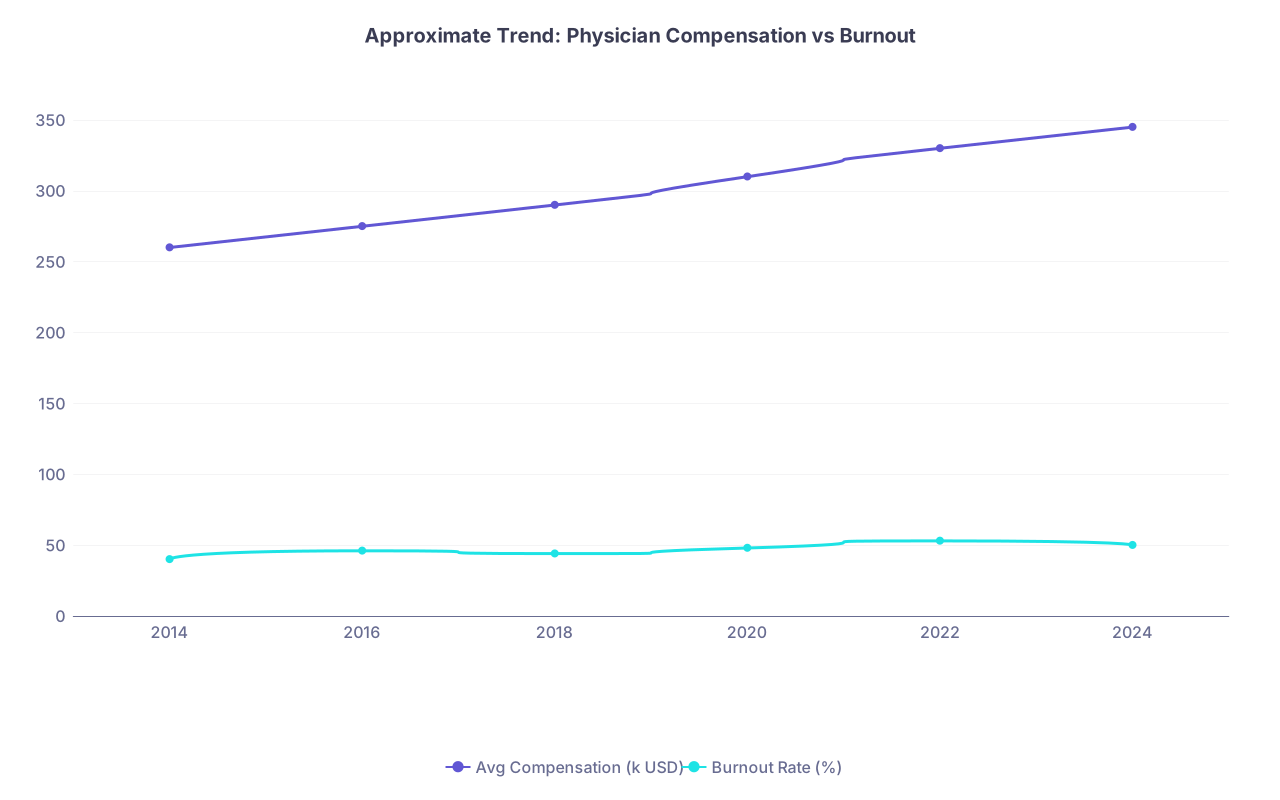
| Category | Avg Compensation (k USD) | Burnout Rate (%) |
|---|---|---|
| 2014 | 260 | 40 |
| 2016 | 275 | 46 |
| 2018 | 290 | 44 |
| 2020 | 310 | 48 |
| 2022 | 330 | 53 |
| 2024 | 345 | 50 |
The money line creeps slowly up. The burnout line jumps around but stays elevated, with spikes during COVID and only partial recovery.
Key structural drivers during this period:
- Rapid EHR adoption and growing documentation burdens
- Increasing consolidation and physician employment by large systems
- Expanding quality metrics, prior auth, and regulatory overhead
- Pressure to maintain or grow productivity despite staffing shortages
Compensation has risen, but so has workload complexity. The net effect on many physicians is a feeling that they are “working harder for their raise” rather than getting ahead.
Practical Implications for Physicians Choosing or Re-Negotiating Roles
You cannot fully escape the macro forces, but you can use the data to make more rational decisions.
When evaluating roles or contracts, I would treat these as core metrics—not fluff:
- Total weekly hours including documented expectations for after-hours EHR
- Expected patient volume (visits/day, OR days/month)
- Call responsibilities (nights, weekends, in-house vs at home, volume)
- Compensation structure (base vs productivity %; RVU targets; caps)
- Protected time for admin, teaching, research, or leadership
- Support staff ratios (MA/physician, scribe availability, RN support)
Think in terms of “effective hourly rate” and “burnout probability,” not just annual salary.
A 450k job at 65+ stressful hours/week with heavy call and RVU pressure might have a worse effective rate and much higher burnout risk than a 320k job at 40–45 hours with limited call and decent autonomy.
If I had to simplify to one rule: do not trade away all control and margin for the highest headline salary. The data show that deal usually backfires within a few years.
Legal and Contractual Angles: Where Burnout Gets Locked In
From a financial and legal standpoint, the contract is where burnout risk gets formalized.
Common contractual elements that correlate with higher burnout over time:
- Aggressive RVU thresholds for full bonus
- Vague language around “reasonable duties as assigned”
- Unspecified or unprotected admin time
- Call expectations written loosely (“equitable distribution”)
- No cap on panel size or patient load
When someone ends up in my office with 3–4 years of data saying, “I can’t keep going like this,” the story often traces back directly to those vague clauses.
If you have any leverage, the data-driven asks are:
- Clear caps or ranges on expected patient volumes
- Explicit FTE definition (number of clinic sessions, OR days, etc.)
- Protected, paid non-clinical time for inbox, documentation, and meetings
- Transparent RVU targets with historical data from comparable physicians
- Call frequency and structure in writing
You are not just negotiating money; you are negotiating burnout probability.
Where the System Is Starting to Correct—Slowly
Not all the data are grim. There are pockets of correction:
- Some systems are beginning to pay for inbox time explicitly
- Others are implementing team-based care models that offload low-value tasks
- A few are building compensation for quality and panel management that is not solely RVU-based
These moves are early and uneven, but they recognize a basic truth: if you pay physicians only for speed and volume, you will get speed, volume, and burnout.
The more progressive models:
- Put 50–70% of compensation in stable salary
- Tie 10–20% to quality, access, and team metrics
- Tie 10–30% to productivity but with realistic bounds and no punitive cliffs
That balance tends to produce better satisfaction scores and somewhat lower burnout, according to internal system data I have seen. Not perfect, but clearly better than pure RVU treadmill models.
Closing: The 3 Takeaways the Data Refuse to Let Go
I will keep the ending short. You have enough numbers already.
Absolute income does not reliably protect you from burnout. The relationship is weak. Compensation must be evaluated relative to workload, call, admin burden, and autonomy.
Payment structure and workload design matter more than headline salary. Productivity-heavy, RVU-tied models with vague workload language are consistently associated with higher burnout, even when they pay well.
Control is the hidden currency. Physicians who trade a bit of income for more autonomy, better support, and sane hours often end up ahead—financially sustainable and far less burned out—over a 10–20 year career arc.