
The public conversation about academic vs private practice pay is sanitized. The private conversation in physician lounges is not.
Let me tell you what actually gets said when the door closes, the EMR is finally silent, and attendings start talking real numbers and regret.
The First Truth: The Gap Is Bigger Than You Think
I’ve sat in plenty of division meetings where leadership dances around money. Then I’ve listened to the same attendings in the parking garage.
Here’s the real pattern you’re not seeing in glossy “salary reports” and residency noon conferences:
- In most non-surgical specialties, pure academic base pay is often 30–50% lower than what your co-resident gets walking into a solid community or private practice job.
- In some high-RVU procedural fields (cards, GI, ortho), that gap can climb to 60–80% at peak earning years when you compare total comp (base + bonus + ancillaries).
No, the MGMA “academic” vs “private” medians do not fully capture this. Those reports get softened by outliers and by the way institutions bundle “incentives.” What matters is what hits your checking account.
Let’s anchor this with typical real-world numbers I’ve seen or been told directly by attendings across multiple institutions.
| Specialty (General) | Academic Starting Total | Private/Community Starting Total |
|---|---|---|
| Internal Medicine | $190k–$230k | $260k–$325k |
| Hospitalist | $220k–$260k | $280k–$350k |
| General Surgery | $325k–$400k | $450k–$600k |
| Cardiology | $375k–$450k | $550k–$750k |
| GI | $375k–$450k | $600k–$800k |
Those are not MGMA abstractions. Those are the “I just signed” numbers I’ve heard over coffee from new grads.
Now, here’s what attendings will say when residents aren’t around:
- “If I’d gone straight private, I’d be financially independent by 50.”
- “Academics set me back five to ten years wealth-wise, minimum.”
- “My co-resident in private bought their second rental property while I was still on my K-award.”
And they’re not exaggerating.
What’s Actually in the Contract: Line by Line Reality
The big misunderstanding among trainees is this: you look at base salary and stop there. Attendings do not. They look at what actually moves the needle: wRVUs, bonuses, call pay, ancillaries, and non-clinical “protected time” that’s… not really protected.
Let’s break down how the money actually differs.

1. Base Salary: The Official Story
Academic:
- Tied to rank (Assistant/Associate/Full) and “track.”
- They love the phrase “salary band.” That’s code for: do not expect them to move much, no matter your leverage.
- I’ve seen internal medicine academic base offers sit at $205k–$230k in major cities where hospitalists in the same building (employed by a different entity) are making $290k–$340k.
Private/Community:
- Tied to market and revenue. If they need you, the offer moves.
- You see more signing bonuses ($20k–$75k), relocation cash, and productivity guarantees.
The quiet part attendings say:
- “Academia acts like the non-compete is you not leaving them; in private, the non-compete is them making sure they can recoup what they pay you.”
- “Academic HR will straight-up tell you ‘we don’t negotiate on base’ then move $15k when they think you have a competing offer.”
2. RVUs and Productivity: The Trap Door
Academic:
- RVU rates are often lower per wRVU.
- Thresholds are often unrealistic for the way they load you with teaching, meetings, and committees.
- They’ll hand you a contract with something like:
- Base: $220k
- Target wRVUs: 4,500
- Bonus: $10–$18 per wRVU over threshold
What they do not tell you: your schedule will make hitting 4,500 almost impossible unless you sacrifice every other academic activity.
Private/Community:
- Higher wRVU rates, often $45–$70+/wRVU in some procedural fields.
- Lower or more realistic thresholds.
- In the best groups, partners own ancillaries (ASC, imaging, lab), which can quietly add six figures.
Here’s what one cardiologist told me after leaving a university job:
“At the university, I killed myself to clear 7,000 wRVUs and brought home $450k. In private, I hit 9,000 wRVUs with better support and made over $900k including ASC distribution. The work felt less chaotic.”
3. “Protected Time”: The Academic Mirage
This is the part residents consistently overvalue.
Academic contracts will say: “0.7 FTE clinical, 0.3 FTE admin/teaching/research.”
The truth on the ground:
- That 0.3 FTE is often swallowed by:
- Endless emails
- Meetings that could’ve been emails
- Uncompensated committee service
- “Can you just help with this curriculum thing?”
- When clinical volumes spike, that non-clinical time evaporates first.
I’ve heard the same line from assistant professors across multiple universities:
“My ‘protected time’ is 7–10 pm after my kids go to bed.”
In private practice, you rarely see “protected time,” but here’s the trade:
- You work your clinical schedule.
- When you’re home, you’re actually off more often.
- Your evenings aren’t consumed by grant portals and teaching slides—unless you voluntarily take that on.
So academically you feel important. Financially and time-wise, you may feel scammed.
Where the Money Really Diverges Over 10–20 Years
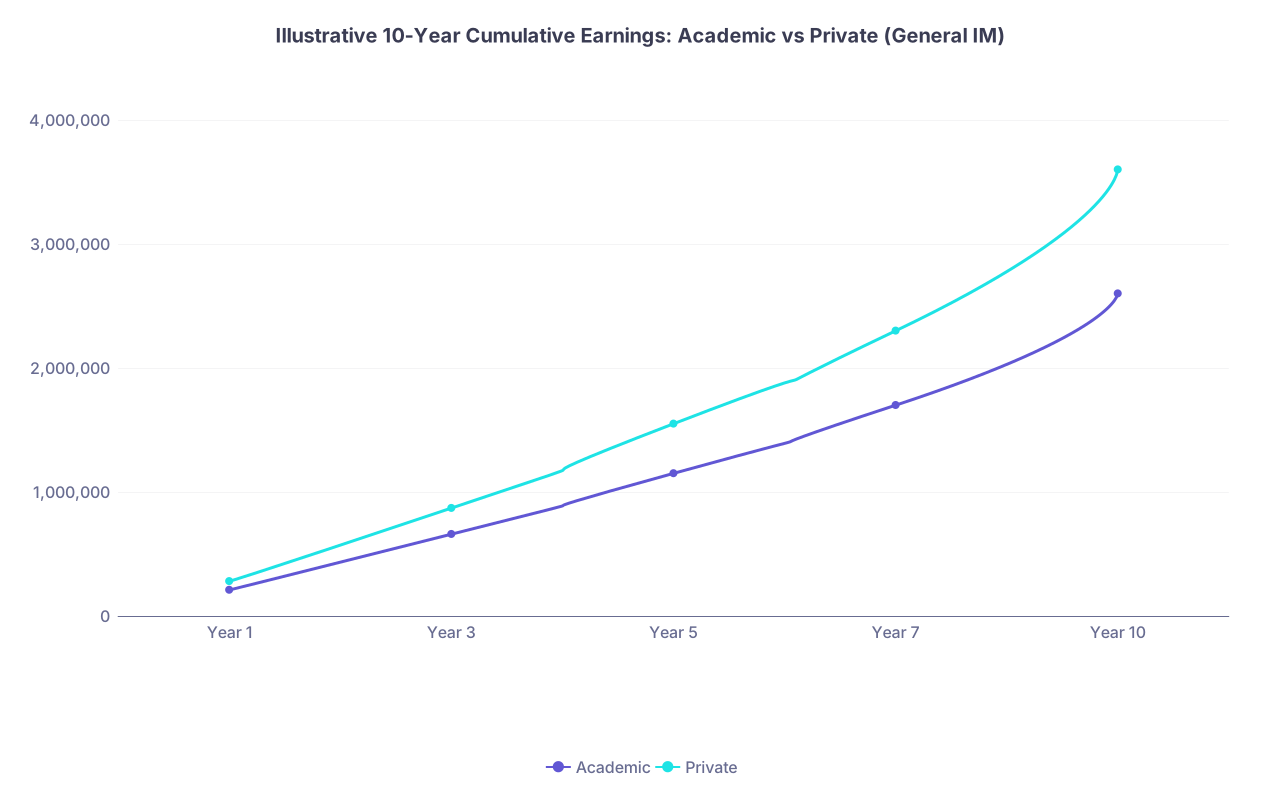
The honest comparison isn’t year one. It’s year ten.
That’s when academic vs private practice pay stops being about salary and starts being about compound effects: retirement contributions, debt payoff speed, housing, investing, and burnout.
| Category | Academic | Private |
|---|---|---|
| Year 1 | 210000 | 280000 |
| Year 3 | 660000 | 870000 |
| Year 5 | 1150000 | 1550000 |
| Year 7 | 1700000 | 2300000 |
| Year 10 | 2600000 | 3600000 |
Those aren’t exact, they’re representative of what I’ve seen across multiple attendings’ real finances.
Here’s what attendings admit, usually with a sigh:
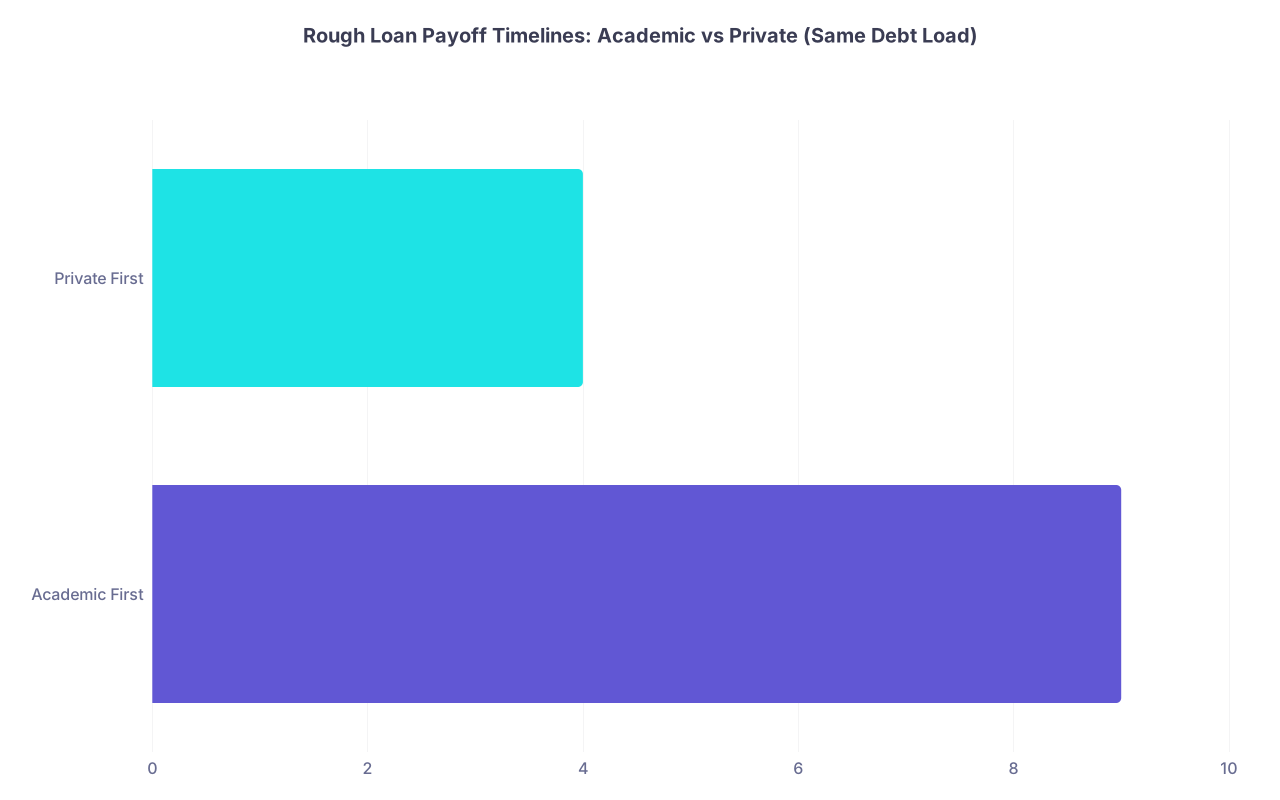
- “My co-resident had their loans gone in 4 years. I’m 9 years out and still chipping away.”
- “They maxed 401k, backdoor Roth, kids’ 529s. I spent my 30s just trying to stay afloat in a high cost-of-living city for the prestige.”
- “I ‘loved’ my academic job right up until I calculated what I’d given up.”
Do some academics make it up? Yes—but the path is narrower than they advertise:
- You need real grants with salary support (K, R) or major endowed roles.
- You need admin titles that actually come with money, not just workload.
- Or you need to be in a highly paid subspecialty at a well-funded institution that’s decided to actually pay competitively (a minority).
Everyone else? They’re subsidizing the institution’s prestige with their income.
The Unspoken Perks (and Costs) of Each Path
Money is only one lever. Off the record, attendings are surprisingly candid about non-monetary tradeoffs—many of which indirectly affect your finances via burnout, side gigs, and attrition.

Academic Medicine: Why People Stay Despite the Pay
Behind closed doors, academic attendings say things like:
- “I stay because I like working with residents. Period.”
- “Private practice money doesn’t make up for taking away the residents and fellows.”
- “I like my colleagues. I don’t want to spend my life hustling for RVUs with people I don’t respect.”
The real upsides:
- Intellectual environment. Grand rounds, complex cases, tumor boards, sub-subspecialists in the hallway.
- Learners. You get energy and meaning from teaching, shaping residents, watching them match.
- Niche clinical work. Highly specialized clinics, rare diseases, advanced procedures.
- Brand/pedigree. Some people care a lot about saying “I’m on faculty at X.”
The hidden costs:
- Politics. Endless promotion criteria, titles, tracks, and “service” work with no pay.
- Slow raises. Three percent COLA if you’re lucky, while your hospital margin climbs.
- Admin bloat. Every year, more people who don’t see patients tell you how to see patients.
- Side gigs often less tolerated. Moonlighting and industry work can be more tightly policed.
One academic hospitalist summed it up perfectly:
“I pay a six-figure annual ‘prestige tax’ to be in this ecosystem. I’m OK with it for now.”
Private Practice / Community: Why People Leave Academia and Don’t Look Back
What do ex-academics say after 1–3 years in private or community settings?
- “I didn’t realize how much emotional bandwidth the university sucked out of me.”
- “Clinic is clinic, but I feel less constantly judged and evaluated.”
- “I thought I’d miss learners more than I do. I don’t miss the committee work at all.”
Actual advantages that show up in the bank account and in your evenings:
- Higher take-home pay. Obvious, but the magnitude changes your life options.
- More autonomy day-to-day. Yes, there are still suits and administrators, but fewer academic committees breathing down your neck.
- Better leverage to walk. In many markets, if you’re a productive doc, you have options.
- Side income flexibility. Locums, consulting, speaking, expert witness work—often easier to negotiate.
But let’s not romanticize it:
- Volume pressure is real. “Eat what you kill” is exciting until flu season hits.
- Call can be brutal in smaller groups. You are the back-up.
- Business risk. In small groups, bad partners or poor management can hurt you.
- Teaching opportunities are thinner. Some docs really do miss the academic feel.
A surgeon who left a university hospital put it bluntly:
“In academics, I was underpaid and overgoverned. In private, I’m well-paid and overworked. I’ll take the second one for this decade of my life.”
What Attendings Actually Advise Residents (When They Trust You)
Here’s where it gets interesting. Publicly, faculty give you the party line: “Follow your passion, think about fit, academics vs private are just different paths.”
Off the record, the advice shifts.

| Step | Description |
|---|---|
| Step 1 | Resident Near Graduation |
| Step 2 | Strongly Consider Private |
| Step 3 | Academic but Be Strategic |
| Step 4 | Hybrid or Short Academic Stint |
| Step 5 | Watch for Dead-End Tracks |
| Step 6 | Protect Time and Negotiate |
| Step 7 | Evaluate Call and Noncompete |
| Step 8 | 2-3 Years Academics then Reassess |
| Step 9 | Primary Goal |
Things I’ve heard repeatedly, in closed doors:
From older academic attendings
- “Do not come to academics for the money. You’ll resent it.”
- “If you do academics, do it at the place that actually gives you resources and time, not just a name.”
- “If research is not a genuine internal driver for you, don’t torture yourself here.”
From relatively junior attendings who went straight academic
- “I wish I’d done 3–5 years private, cleared loans, then come back.”
- “I massively underestimated how hard it is to get promoted while running at 0.8–1.0 clinical FTE.”
- “No one told me the K-award odds were basically a lottery.”
From those who went private first
- “Best decision I made was crushing my loans in 3 years with a private job I didn’t ‘love’ but could tolerate.”
- “Now, if I come back to academics, it’s on my terms. I’m not financially handcuffed.”
- “The prestige hit you think you’ll feel? You stop caring quickly when your net worth climbs.”
| Category | Value |
|---|---|
| Academic First | 9 |
| Private First | 4 |
Same $300k loan balance. Different trajectory.
Specific Red Flags and Green Flags Attendings Watch For
Residents almost never see how attendings read contracts and institutions. But they do. Meticulously. Burnout teaches you to become very picky.
Here’s the real filter:
Red flags in academic offers that attendings quietly warn against:
- Clinical FTE ≥ 0.8 with no meaningful salary support for research/education, but the job is sold as “research heavy.”
- Promotion expectations built on grants and publications with no track record of the department actually getting people promoted.
- “Service” roles (clerkship director, committees, QI lead) with titles but no pay.
- Leadership that brushes off your questions about RVU expectations with “we’re collegial; we don’t worry about that here.” Translation: you’ll be underpaid and overworked.
Red flags in private/community offers:
- Short or vague partnership track with no transparent buy-in structure or financials.
- Non-competes that essentially lock you out of your whole metro area.
- Call burden that looks survivable on paper but covers multiple hospitals with limited backup.
- Compensation formulas that are black box: “Trust us, our partners do very well.” Real groups will show sample K-1s and historical distributions.
When attendings talk honestly, they’re not subtle:
“If they won’t show me partner numbers, I assume the partners are screwing the juniors.”
“If the academic chair can’t tell me what percentage of faculty hit promotion on time, I assume the answer is bad.”
How to Decide Without Lying to Yourself
The worst mistake I see residents make is pretending they don’t care about money when they absolutely do. Or pretending money is all that matters when they clearly light up around teaching.
You need to be more honest with yourself than most of your attendings were at your stage.
Ask yourself some blunt questions:
- If I made $120k less per year for the next 10 years, would the academic environment truly make up for that hit? Or am I just chasing prestige and familiar mentors?
- Do I want to build a CV or a balance sheet in my 30s?
- Do I actually enjoy research enough to write at 9 pm on a Wednesday when no one is watching?
- How much does the idea of owning a practice, ASC, or real estate appeal to me?
Here’s what several attendings have quietly advised their best residents:
- “If you’re even 50/50, do a short academic stint (2–3 years). Get the network, the CV, then don’t be afraid to leave.”
- “Or flip it: do private first, kill your debt, build a financial base, and then come back only if you still want the academic life—and negotiate hard.”
A path almost no one regrets? Getting your financial house in order early—whatever path you choose—so you’re never stuck in a toxic environment because you’re broke.
The Bottom Line, Without the Spin
Let’s strip the romance and the institutional propaganda away.
The pay gap is real and large. Over a decade, many generalist academics give up high six to low seven figures in potential earnings compared to private peers. That’s not a rounding error. That’s generational wealth.
Academics can be worth it—if you actually want the academic life. If you crave learners, research, and niche complexity more than you care about cars, houses, and early financial independence, fine. But do not go in half-heartedly and expect the money to feel “good enough.” It won’t.
The smartest attendings are strategic, not loyal. They use academia for what it’s good at (training, networking, CV building) and private practice for what it’s good at (cash flow, autonomy). They treat jobs as tools, not identity.
You do not owe any institution your financial future. Choose the path with your eyes open, not with the brochure version of reality ringing in your ears.