
The biggest gap in physician income isn’t between specialties. It’s between doctors who understand equity and side deals—and those who only know their W‑2.
Let me be blunt. Most attendings leave six figures on the table every year because they think “salary plus RVU bonus” is the whole game. That’s the kiddie table. The real money for physicians sits in equity stakes, ASC distributions, professional service agreements, medical directorships, and a mess of “consulting” and call coverage deals that never show up on those Medscape salary surveys you keep reading.
I’ve watched two cardiologists with the same clinical load, same call, same hospital, end up with a $400,000 difference in annual income. Not because one worked harder. Because one understood the hidden channels money flows through in modern healthcare—and positioned himself where those streams hit his bank account.
Let me walk you through how it actually works.
The Three Stacks of Physician Money
Here’s the framework program directors and department chairs quietly use when they talk about “comp packages” behind closed doors. They think in three stacks.
The official stack
Base salary, RVU bonus, quality bonus, benefits. This is what HR shows you. It’s what recruiters advertise. It’s designed to look competitive enough to get you in the door.The semi-hidden stack
Call stipends, directorships, committee stipends, “administrative time,” teaching add‑ons, coverage payments, medical staff leadership roles. This is usually controlled locally by the department chief, service line leader, or hospital CMO. It’s on paper, but not in the brochure.The off‑brochure stack
Equity in surgery centers, imaging centers, ancillaries. Ownership in the practice entity or management company. Side consulting for vendors. Co‑management agreements. Joint ventures. This is where physicians quietly cross from “well‑paid professional” into “high‑net‑worth.”
The mistake? Young physicians obsess over the first stack and don’t realize the second and third even exist until someone 15 years ahead of them casually mentions their “quarterly distribution” or “JV payout” over coffee.
Let’s get into those second and third stacks.
Equity: Where the Real Leverage Lives
Equity is just code for “you get a share of the profits instead of only wages.” Hospitals and large groups have figured out that most doctors don’t understand this language, so they dangle a slightly higher base salary instead of giving you access to ownership.
In private groups and joint ventures, equity usually shows up in a few flavors.
1. Surgery Center & Imaging Center Ownership
If you’re in any procedure-heavy field—ortho, ENT, GI, ophthalmology, pain, cards, even some IM subspecialties—you will see this.
The playbook is consistent:
- A group of physicians and a management company or hospital form an ASC or imaging center.
- Docs get the professional fee for their work. That’s normal.
- The center collects facility or technical fees. That’s where the margin is.
- Owners get distributions from the profit after expenses.
What does that mean in practice?
A mid‑career orthopedic surgeon I know in the Midwest:
- W‑2 income from clinical work: ~$650k
- ASC equity distributions: $300–400k/year
- A small stake in a PT company tied to the ASC: another $75k+ some years
He’s not working 90‑hour weeks. He just owns the room his OR time is in, instead of only renting it with his labor.
Here’s the pattern you’ll see: early partners who bought in when the ASC was risky and small paid peanuts. The buy‑ins offered to new associates 8–10 years later? Far more expensive and politically harder to get.
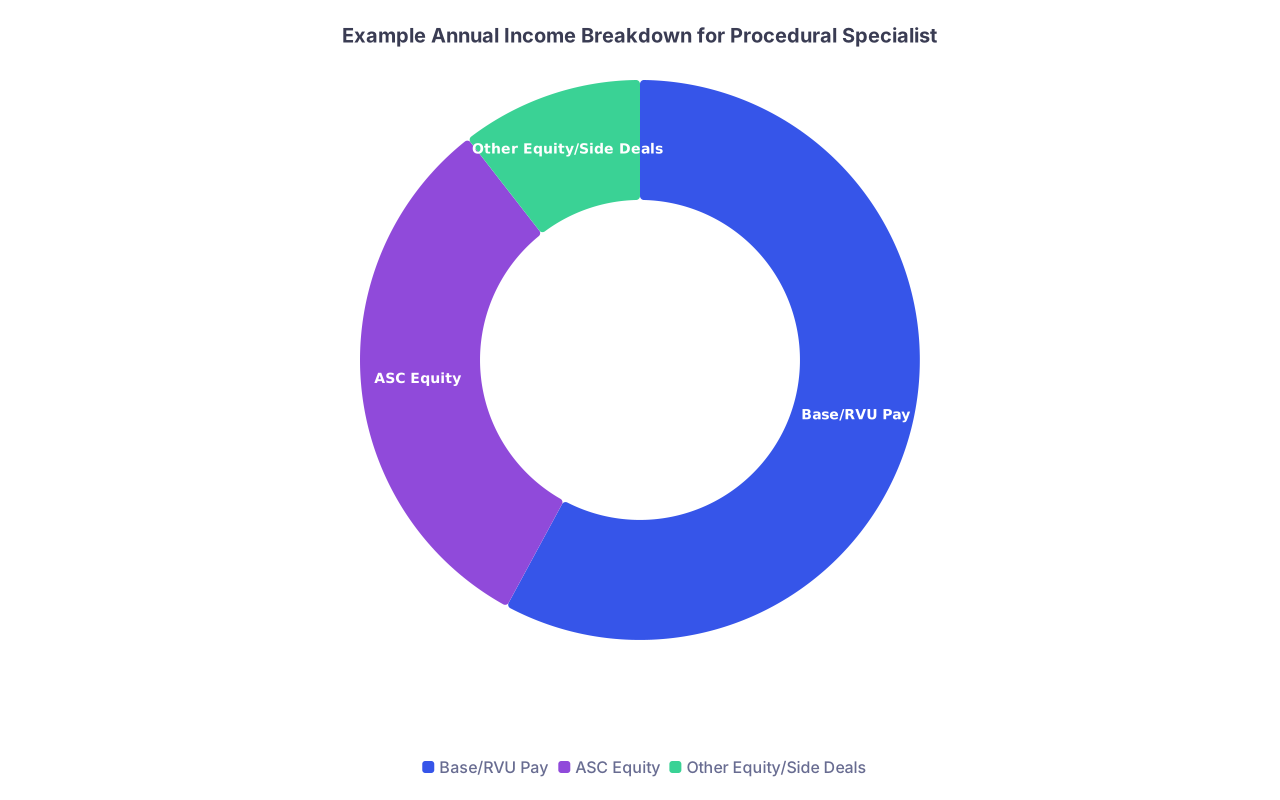
| Category | Value |
|---|---|
| Base/RVU Pay | 550000 |
| ASC Equity | 300000 |
| Other Equity/Side Deals | 100000 |
Why you usually never see this as a resident:
- Program directors rarely talk about it. Many are salaried academics who don’t participate in these deals.
- Hospital-employed attendings often aren’t allowed to share ownership by contract. Or if they are, they’re the last ones invited.
- The finance guys know: once physicians understand equity, salary becomes less of a leash.
2. Practice Equity vs. “Senior Partner” Theater
Not all “partnership” is created equal. This is where I see young attendings get played.
There are three broad models:
True equity partnership
You literally own a piece of the group. You share in profits from ancillaries, real estate, buy‑outs, goodwill. You see the financials. You vote.Tiered income share without true equity
They call you “partner” but you’re just at the top of the compensation formula. No real ownership in assets. When the group sells, you get something, but not the same multiple as founding partners.Faux partnership
They bump your salary, call you “partner,” maybe give a token vote in decisions—but no real financial upside beyond your own production.
I’ve been in rooms where senior partners literally said, “Call them partners, but don’t touch the imaging distributions.” They know the word itself has a strong psychological pull on young docs desperate for belonging and stability.
If you’re looking at a job and they’re vague about what you actually own, here’s the translation: you own nothing.
Side Deals: The “Random” Money Streams
The side deals are where the older attendings quietly pad their income by another $50–200k without changing their clinical hours much. Residents almost never see these because they happen in boring meetings and contract addenda, not in the OR.
Let’s break down the big ones.
1. Call Coverage Money
Call is not just torture; it’s an income lever.
At community hospitals and many non‑academic centers, call coverage is often separately compensated by the hospital or the group. But you’d never know it from the job posting.
Call deals look like this:
“Unassigned” ED call stipends
Trauma, neurosurg, ortho, OB, cards, GI, etc. The hospital pays doctors or the group to guarantee coverage. Sometimes per shift, sometimes as a lump annual pool distributed by the group.“Backup” or specialty call
Example: IR backing up diagnostic radiology, vascular covering complex cases, anesthesia providing OB coverage.
The politically savvy docs negotiate:
- Higher per‑call rates
- Lower required call frequency for themselves
- Extra pay for “uncomfortable” weekends or holidays
The junior, clueless docs?
They get stuck with the heaviest call and no idea how badly the numbers could have been negotiated.
I’ve seen this split more times than I care to count:
| Physician Type | Call Frequency | Annual Call Stipend | Notes |
|---|---|---|---|
| Naive New Hire | 1:4 | $0 | Included in base “for free” |
| Savvy Partner | 1:6 | $60,000 | Separate hospital contract |
| Group Call Chair | 1:8 | $90,000 | Negotiated premium + low load |
Same hospital. Same department. Same specialty.
The only difference is who sat at the table when the deal was inked, and who understood call was negotiable.
2. Co‑Management and Service Line Agreements
This is where admin money gets laundered into “clinical quality” talk.
Hospitals are under crazy pressure to improve metrics and cut costs, so they create “co‑management” deals: service line or department management agreements where a group of physicians gets paid to help run a line of business (orthopedics, cardiology, oncology, etc.).
Practically, that means:
- Monthly or quarterly meetings
- Protocol development
- Quality initiatives
- Metric tracking
Compensation structure?
Fixed administrative stipend plus quality metric bonuses.
The reality:
- The same 3–5 physicians get appointed to every co‑management committee.
- They “represent” the rest of the docs and collect the checks.
- Younger physicians might have no idea such a contract even exists.
A very typical example I’ve seen:
- Co‑management contract: $400k per year to the physician group
- Divided between 4–6 physicians based on a formula that mysteriously favors the ones who wrote the contract
- Result: $50–120k per year per doc for a handful of extra meetings and emails
These deals are often invisible to outsiders because they’re baked into management service agreements, not your personal contract.
3. Vendor Consulting and “Advisory” Work
The version you hear at conferences: “I’m a consultant for Company X. I do some speaking.”
The version that actually exists:
- Device companies pay “consultant fees” for feedback, training, “advisory boards,” preceptorships.
- EHR and health IT vendors pay docs to give “clinical input” or be a site champion.
- Pharma (still) pays honoraria and speaking fees, just structured more carefully post‑Sunshine Act.
The Sunshine database made a lot of this more visible. It didn’t make it go away. It just pushed it to slightly more sophisticated structures.
Who gets asked?
- High volume users of a product
- Early adopters in a region
- Physicians with influence in a hospital or region
- People already in leadership positions
Most residents underestimate how much of this is about local power, not academic clout. You don’t need to be the national expert. You just need to be the person whose opinion the hospital listens to when choosing Vendor A vs B.
Medical Directorships: The Legalized Side Gig
You want the cleanest, most defensible side income in medicine? Become a medical director.
Hospitals, nursing homes, SNFs, hospice agencies, dialysis centers, home health, imaging centers, urgent care chains—they all need a “medical director” on paper. Someone to:
- Sign off on policies
- Attend regulatory meetings
- Do chart reviews
- Handle clinical complaints
- Deal with accrediting bodies
The dirty little secret: in many places, the day‑to‑day “work” is light. Some are real jobs with real effort. Others are glorified rubber stamps with occasional fires to put out.
Typical structure I see:
- 4–16 hours/month of “administrative work”
- Stipend of $1,500–$10,000/month depending on the entity and your negotiation skills
- Often bundled with a clinical contract, which makes the real value murky
| Role | Hours/Month | Monthly Stipend | Annual Income |
|---|---|---|---|
| SNF Medical Director | 8 | $3,000 | $36,000 |
| Hospice Medical Director | 12 | $5,000 | $60,000 |
| Hospital Service Line Director | 16+ | $8,000 | $96,000 |
How people actually land these roles:
- They’re the “reasonable” doc admin likes
- They show up to committee meetings and don’t derail them
- They answer emails
- They don’t blow up at nurses in front of the CMO
In other words, professionalism and basic political sense. Not brilliance.
No one told you this in residency because your program was laser‑focused on your clinical competence, not positioning you as a future decision‑maker.
The Legal Lines You Really Can’t Ignore
Now the part nobody likes to talk about but you absolutely must understand: this stuff is heavily regulated.
The two big hammers in the US:
- Stark Law (physician self‑referral)
- Anti‑Kickback Statute (AKS)
And then a bunch of state‑level corporate practice and fee‑splitting rules layered on top.
Here’s what they practically mean for you.
You can’t be paid for referrals. Full stop.
If the compensation depends on how much you refer to a facility or vendor, you’re playing with fire.Any arrangement tied to Medicare/Medicaid business has to be “fair market value” and commercially reasonable.
That’s why you see so many “FMV” reports and third‑party valuations attached to medical directorship and co‑management fees. It’s legal armor.Equity deals are scrutinized.
Buying into an ASC or imaging center at a sweetheart price purely because you’ll steer cases there? That can trigger Stark/AKS issues. The law requires real investment risk and FMV terms, not token ownership to camouflage kickbacks.Documentation matters.
Off‑the‑books payments, “just send me a check” agreements, vague consulting roles with no deliverables—that’s how doctors find themselves in OIG settlements and compliance nightmares.
I’ve watched hospital lawyers shut down a very lucrative call deal because no one could clearly explain, on paper, what the physicians were being paid to do besides “be nice to the ED and keep cases in‑house.” That’s not a billable service. That’s a kickback.
You don’t need to become a health law expert. But you do need to know this: if a deal feels too slick, or the explanation is “don’t worry, we’ve always done it this way,” you should worry. And get your own health‑care‑savvy attorney—not the hospital’s—before you sign.
How These Deals Actually Come to You (Or Don’t)
The cruel reality: the best income opportunities never hit a job board. They go to:
- The doc who’s been there forever and stayed “reasonable”
- The person the CMO trusts to get things done without drama
- The physician who already sits on two committees and knows how the money really flows
Most residents imagine their income ceiling is set by their specialty. That’s outdated thinking. In the current environment, your local ecosystem and your political capital matter just as much.
Look at how this evolves over time:
The big mistake I see young attendings make?
They treat the first contract like a marriage instead of a starting position. They don’t ask about:
- Who holds the current medical directorships and when they turn over
- Whether there are co‑management or service line agreements in place
- Whether the group has equity in ancillaries and how those distributions work
- How new physicians historically have gotten access to leadership and ownership
So they enter an ecosystem blind, then discover three years later that all the good seats are already taken.
The Hospital-Employed Trap vs. Independent Leverage
You’ve heard the narrative: “Private practice is dying. Go employed. It’s safer.”
There’s truth there. But here’s the part left out of the brochure.
Employment packages usually do:
- Reduce your downside risk
- Simplify your life with one check and “covered” overhead
- Shield you from some business headaches
They also:
- Cut you off from ownership in ancillaries the hospital wants to control
- Put you in a compensation grid where your upside is tightly capped
- Make you subject to system‑wide decisions you cannot influence
So where do hospital‑employed docs get their hidden income?
- Medical directorships (hospital or service line)
- Call stipends (if not rolled into base)
- Committee and governance stipends
- Occasionally, allowed equity in an ASC/imaging JV (but often on worse terms than true independent groups)
Independent or large multi‑specialty groups, in contrast, usually have:
- More access to ancillaries (labs, imaging, PT, ASCs)
- More flexibility in structuring leadership pay, call pools, side deals
- More political leverage because the hospital needs them to keep lines open
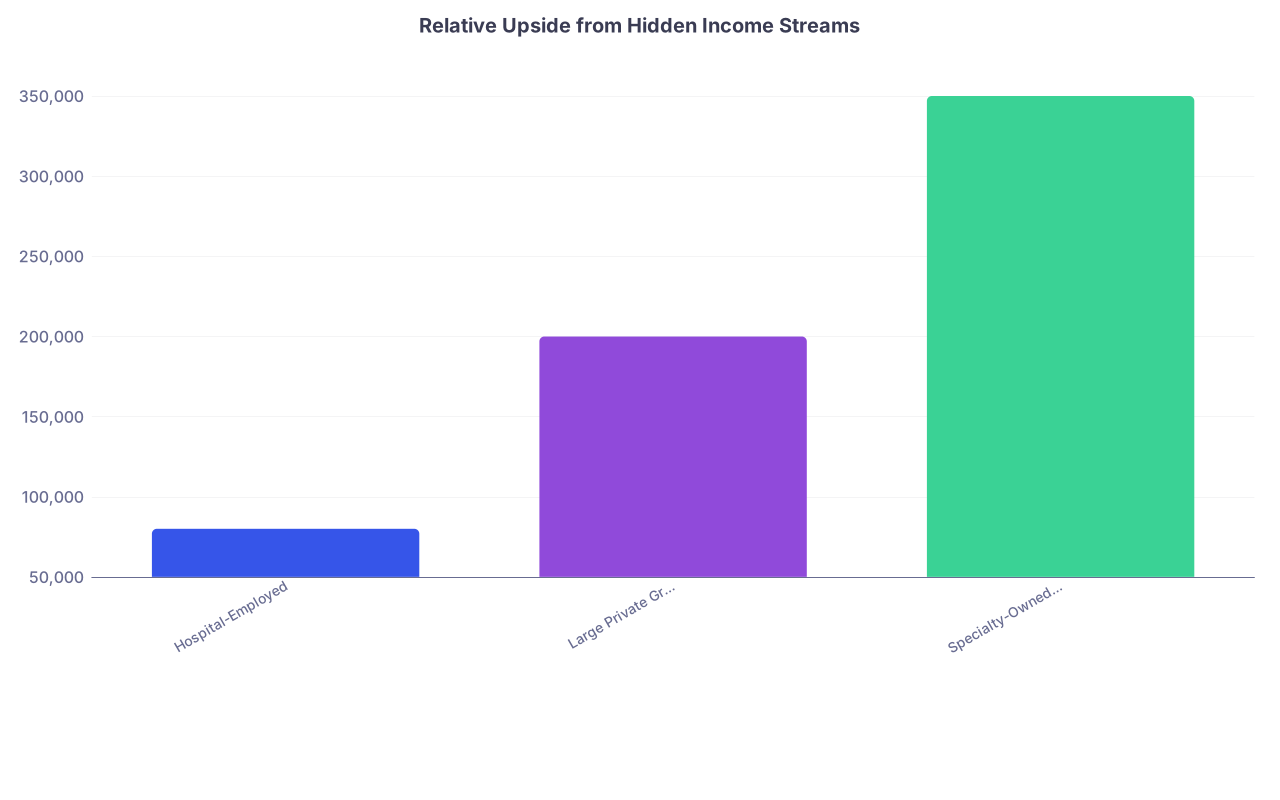
| Category | Value |
|---|---|
| Hospital-Employed | 80000 |
| Large Private Group | 200000 |
| Specialty-Owned ASC Group | 350000 |
Those numbers aren’t fantasy. I’ve seen hospital-employed surgeons with maybe $50–80k of “extra” income through leadership and call, while their colleagues across town in a physician-owned ASC model quietly clear an extra $300–400k through distributions and directorships.
Same specialty. Same city. Very different financial lives.
What You Should Actually Do With This Information
I’m not telling you to chase every sketchy deal or sell your soul to management. That’s how people end up in compliance hell or burned out doing five committee jobs they hate.
You should do three things.
First, stop being naïve about where the money comes from. When you’re interviewing or considering a move, you ask—not just about RVU targets and vacation weeks—but about:
- Existing medical directorships and how they’re assigned
- Whether co‑management or service line contracts exist
- Who owns the ASCs, imaging, or ancillaries you’ll be feeding
- How partnership/equity works in reality, not just on a PowerPoint
Second, cultivate political capital, not just RVUs. The physicians who end up with the medical director titles and co‑management seats are rarely the absolute top billers. They’re the ones leadership trusts. They answer messages. They show up to meetings prepared. They don’t set things on fire in public.
Third, stay on the right side of the law. If a deal sounds like “we pay you more if your referrals go up,” walk away or get serious legal counsel. Make sure:
- There’s a written agreement
- The compensation is tied to actual work (meetings, reviews, oversight)
- Someone independent has blessed the “fair market value” if it touches Medicare/Medicaid space
You’re a physician, not a healthcare attorney. But pretending this stuff doesn’t exist because it’s messy? That’s how you end up the 55‑year‑old doc with a good W‑2 and no assets while your colleague down the hall quietly built a seven‑figure portfolio off the same starting line.
The key truths, without the sugar:
- Your specialty doesn’t determine your income ceiling—your access to equity, side deals, and directorships does.
- The best-paying roles are almost never advertised; they go to the politically competent physicians who understand how money and power flow locally.
- Every “extra” dollar has legal strings attached; if you do not understand Stark, AKS, and fair market value, you’re playing a game whose rules can hurt you badly.
You can choose to be the physician who only knows their salary, or the one who actually sees the whole board.