
The belief that “telehealth is the future and will permanently boost physician salaries” is only half true. For most physicians, telehealth is not a magic long‑term salary booster. It is a billing tool, and like every billing tool, it lives or dies on reimbursement and leverage.
Let me be blunt: the 2020–2021 telehealth gold rush was a temporary spike driven by emergency rules, inflated reimbursement, and desperate patient demand. A lot of that is already unwinding. The real question is not “Does telehealth pay more?” but “In which situations does telehealth give you more bargaining power, more billable volume, or lower overhead than in-person care?”
That answer is very different for a rural PCP employed by a hospital, a dermatology private practice owner, and a psychiatrist working fully remote.
What actually happened to telehealth and pay during COVID?
Before COVID, telehealth was marginal. Then March–April 2020 hit, and the Centers for Medicare & Medicaid Services (CMS) basically flipped a giant switch.
They:
- Loosened originating site rules (home suddenly counted).
- Allowed phone-only codes in many situations.
- Reimbursed many telehealth visits at or near parity with in‑person E/M.
- Let many cross‑state practice barriers slide under emergency waivers.
Employers panicked about losing visit volume. So they pushed physicians onto telehealth platforms overnight. I remember hospital admins literally saying in town halls: “Every visit we can do on video is revenue we don’t lose.” This was survival mode, not long‑term strategy.
Did this raise salaries? Not directly. For most employed physicians on RVU or salary-plus-RVU contracts, telehealth:
- Preserved RVUs that would have vanished when patients stayed home.
- Sometimes increased visit counts slightly when no‑shows dropped.
- Shielded compensation from collapsing in 2020.
But “not falling off a cliff” is not the same as “long-term booster.” That period made a lot of people believe telehealth magically pays more. It doesn’t. It just became billable.
Here’s the reality in a compact snapshot.
| Factor | 2019 (Pre-COVID) | 2020-21 (Peak) | 2023-24 Trend |
|---|---|---|---|
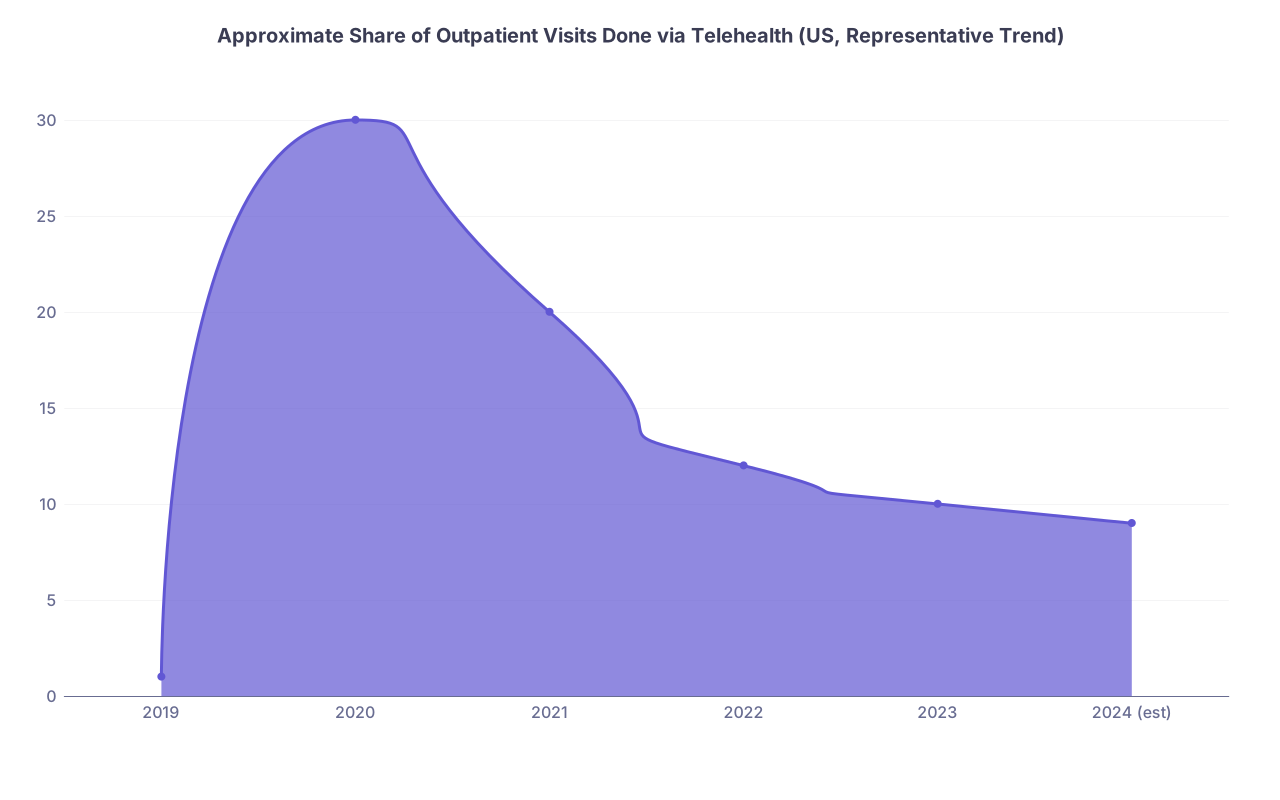
| Telehealth share of visits | <1% | 30–40% many settings | 5–15% typical |
| Reimbursement vs in-person | Lower/limited | Parity for many codes | Mixed, creeping down |
| Physician pay impact | Minimal | Stabilized incomes | Neutral to slight |
The myth started because people confused a one-time policy shock with a structural pay raise.
Follow the money: reimbursement, RVUs, and margins
If you want to know whether telehealth is a long-term salary booster, stop listening to tech evangelists and look at the billing stack.
Reimbursement reality
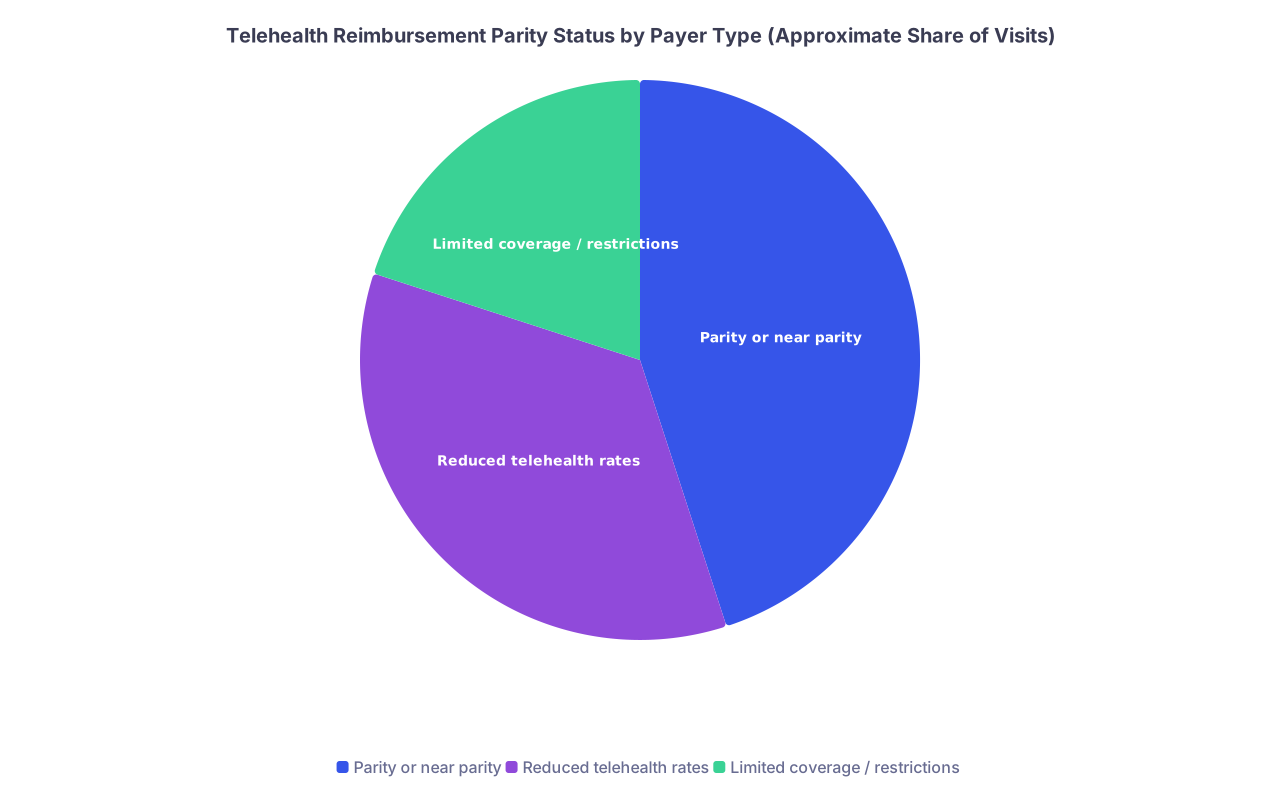
Insurers and CMS are already grinding down the “telehealth premium.”
| Category | Value |
|---|---|
| Parity or near parity | 45 |
| Reduced telehealth rates | 35 |
| Limited coverage / restrictions | 20 |
Broadly:
- Medicare: Extended many telehealth flexibilities through at least end of 2024, but they’re clearly treating this as “under review,” not a permanent entitlement. Phone-only will remain vulnerable. Documentation standards are getting stricter.
- Commercial payers: Some kept parity. Many quietly reduced payment, restrict which codes are allowed, or differentiate video vs phone vs asynchronous messaging.
- Medicaid: Patchwork. Some states generous, others already trimming.
If your telehealth work is paid at the same RVU rate as in‑person, your RVU-based comp is about the same per unit of work. If it’s paid at a lower rate or limited to certain visit types, that’s a headwind, not a booster.
Telehealth becomes a “salary booster” only if at least one of these three things is true:
- You can do more billable work per hour than in-person.
- Your overhead (especially if you’re an owner) is meaningfully lower for the same revenue.
- Telehealth gives you leverage in the labor market—e.g., lets you live cheap and still tap higher-paying markets.
For most employed docs in large systems, #2 and #3 are heavily diluted, and #1 is not as impressive as consultants pitch it to be.
RVU math: why most telehealth is neutral, not magical
Most outpatient telehealth visits simply map to standard E/M codes tied to time or complexity. Your 99214 on video is still a 99214.
Where telehealth helps slightly:
- You sometimes cut dead time: walking between rooms, waiting for MA, room turnover.
- Fewer late patients stuck in traffic.
- Cancellations are often easier to backfill.
Where it hurts:
- Tech issues eat minutes that don’t pay.
- Patients treat video like a casual chat and expand scope (“while I’ve got you…” into three problems).
- Documentation requirements are no lighter; often more meticulous because payers are hunting for abuse.
I’ve seen physicians convinced they’d be able to “double-book” telehealth slots and crank out 6–8 visits an hour. Then admin audits hit, patient satisfaction drops, and compliance teams step in. That fantasy dies fast.
Net effect in many real settings: 10–20% gain in visit throughput at best, offset by some lower reimbursement on certain telehealth codes. That’s margin improvement, not a revolution.
Where telehealth really can boost your income
There are some honest, structural ways telehealth can raise physician income. They’re just narrower, more specialty‑dependent, and more entrepreneurial than the hype suggests.
1. Tele-psychiatry and certain cognitive specialties
Behavioral health is the poster child. Psychiatry, therapy‑adjacent services, ADHD management, sleep medicine, some endocrinology and rheumatology workflows—these are particularly telehealth‑friendly.
Why?
- Exams are minimal or easily adapted.
- Follow‑ups are frequent and short.
- Patients really care about convenience and privacy.
- Many payers accept parity in these domains because access is terrible without it.
A psychiatrist doing 100% remote telehealth can:
- Live in a low cost-of-living area.
- See patients in higher paying markets (via multi-state licensing or working with a national group).
- Reduce no-shows dramatically.
- Pack more visits into a day with less downtime.
If that psychiatrist is on a revenue share or owns their own small tele-psych practice, then yes, telehealth can be a long-term salary booster. Because it’s not just telehealth—it’s geography arbitrage, overhead reduction, and schedule optimization rolled together.
2. Private practice owners who aggressively cut overhead
In private practice, telehealth can meaningfully shift your cost structure:
- Fewer exam rooms, lower rent.
- Leaner staffing model (less front-desk, rooming, cleaning).
- More flexible scheduling (evening/weekend sessions without running a full office).
If your fixed overhead drops by 20–30% and revenue is roughly stable, that’s profit. Owners feel this directly. Employed physicians do not.
The key point: telehealth is the enabler, not the driver. What boosts income is redesigning the practice for lower cost per RVU. Just bolting video visits onto a full brick-and-mortar setup doesn’t do much.
3. Niche telehealth side gigs (but be realistic)
You’ve seen the ads: “Earn extra income from home doing telemedicine!” Some of this is legitimate. Some is barely above scam.
Legit but modest:
- After-hours urgent care telehealth shifts at $100–$200/hour.
- Remote chronic disease management programs.
- Occasional tele‑urgent care for systems short on coverage.
These can add $20k–$60k a year if you’re disciplined. But rates have come down as supply of physicians willing to do this from their laptop has exploded.
The less savory side:
- High-volume weight loss / testosterone / ADHD mills.
- “Click-and-ship” DTC platforms focused on scripts, not care.
- Companies skirting standard-of-care under the telehealth umbrella.
Yes, some docs make serious money there—for a while. Until payers, state boards, or the DOJ show up. If your “telehealth salary boost” is anchored on legally fragile business models, that is not long-term by definition.
Where telehealth does NOT boost physician salaries
Now the uncomfortable part.
Large health systems and RVU-locked employed docs
If you’re a hospital-employed PCP, hospitalist, cardiologist, or surgeon, telehealth alone will not rescue your pay trajectory.
What happens instead:
- System negotiates telehealth rates with payers.
- Admins allocate throughput and margin gains to “the system.”
- Your contract is still wRVU-based with fixed conversion factors (often lagging inflation) or straight salary.
Maybe you see slightly more visits. Maybe your panel is a bit more efficient. The system’s contribution margin per doc goes up. Your pay barely moves.
In some cases, systems have even used telehealth to justify more aggressive panel sizes (“You can handle 20% more patients now, right?”) without proportional pay increases. That’s not a booster; it is a disguised productivity demand.
Procedural specialties
Surgeons, interventionalists, proceduralists—telehealth is mostly pre‑op, post‑op, and follow-up logistics.
Value add:
- Fewer unnecessary in‑person evals.
- More efficient triage.
- Happier patients who don’t burn a day for a 5‑minute wound check.
But the bulk of your income is still in the OR, the lab, or the procedural suite. Telehealth can help funnel cases to you more efficiently, but on its own it does not materially change your earning ceiling.
Primary care… unless you own the game
PCP telehealth can help:
- Reduce no-shows.
- Keep some acute/low-complexity visits in-house.
- Improve access metrics.
But:
- Reimbursement pressure is highest in primary care.
- Payers are shifting certain low‑complexity issues toward nurse triage, midlevels, or even non-physician virtual care.
- Many employers pay PCPs via salary models that barely reflect small changes in visit volume.
Unless you own the practice or are in a compensation model that shares in margin improvements, telehealth just makes your day more flexible, not more lucrative.
The regulatory and legal landmines
If you are basing a “salary boost” on telehealth, you’d better understand the legal scaffolding it stands on. A lot of 2020–21 flexibilities were temporary.
Key pressure points:
- Cross‑state practice: Multi-state compacts help, but big national telehealth groups are being forced to tighten their compliance. That reduces wild-west scaling.
- Prescribing controlled substances: Tele‑prescribing rules for stimulants, benzos, and opioids are under heavy scrutiny. If your income depends on “easy scripts over video,” that’s a countdown timer.
- Fraud and abuse enforcement: The DOJ has already gone after telehealth mills for upcoding, ghost visits, and unnecessary DME or testing linked to cursory online visits.
Bottom line: The more your telehealth revenue model depends on regulatory gray zones, the less “long-term” your salary boost is.

| Step | Description |
|---|---|
| Step 1 | Telehealth Revenue Model |
| Step 2 | Moderate long term risk |
| Step 3 | High legal complexity |
| Step 4 | High enforcement risk |
| Step 5 | Limited financial upside |
| Step 6 | Depends on stable parity pay |
| Step 7 | Depends on cross state practice |
| Step 8 | Depends on high risk prescribing |
Where the long-term signal is actually pointing
Ignore the hype cycles and look at the structural trends.
| Category | Value |
|---|---|
| 2019 | 1 |
| 2020 | 30 |
| 2021 | 20 |
| 2022 | 12 |
| 2023 | 10 |
| 2024 (est) | 9 |
We’ve already come off the peak and are settling into a hybrid equilibrium:
- Stable telehealth share in the 5–15% range for many general specialties.
- Higher sustained share in behavioral health and a few cognitive fields.
- Asynchronous and “digital front door” tools eating away at some simple visits entirely.
That’s not a salary revolution. It’s a modality shift.
What will matter more for your pay over the next decade:
- Payer pressure on E/M reimbursement.
- The rise (or collapse) of value-based payment in your market.
- Supply–demand imbalances by specialty and geography.
- Your willingness to control your own billing and overhead versus remaining purely employed.
Telehealth can amplify good positioning. It does not fix bad positioning.
So, is telehealth a long-term salary booster or just a spike?
Here’s the unvarnished answer:
Telehealth was a temporary spike in opportunity and a permanent shift in workflow. For a minority of physicians—especially in behavioral health and entrepreneurial private practice—it can be a durable income booster, but only because they use it to:
- Reduce overhead,
- Expand market reach, and
- Increase billable productivity within compliance limits.
For the majority of employed physicians, telehealth is now table stakes. It protects income. It improves flexibility. It might nudge productivity a bit. But it is not, by itself, a long-term salary booster.
If someone is selling you telehealth as a universal financial upgrade, they’re either trying to recruit you, sell you software, or both.