
Only 38% of the top‑earning physicians in some recent compensation surveys are surgeons.
So no—surgeons do not automatically dominate the salary food chain. And if you’re planning your whole career around “surgery = most money”, you’re building on a pretty shaky foundation.
Let’s untangle what actually drives physician income, who really earns the most, and which salary myths keep getting repeated despite being wrong or at least badly incomplete.
Myth #1: “Surgeons Always Earn the Most”
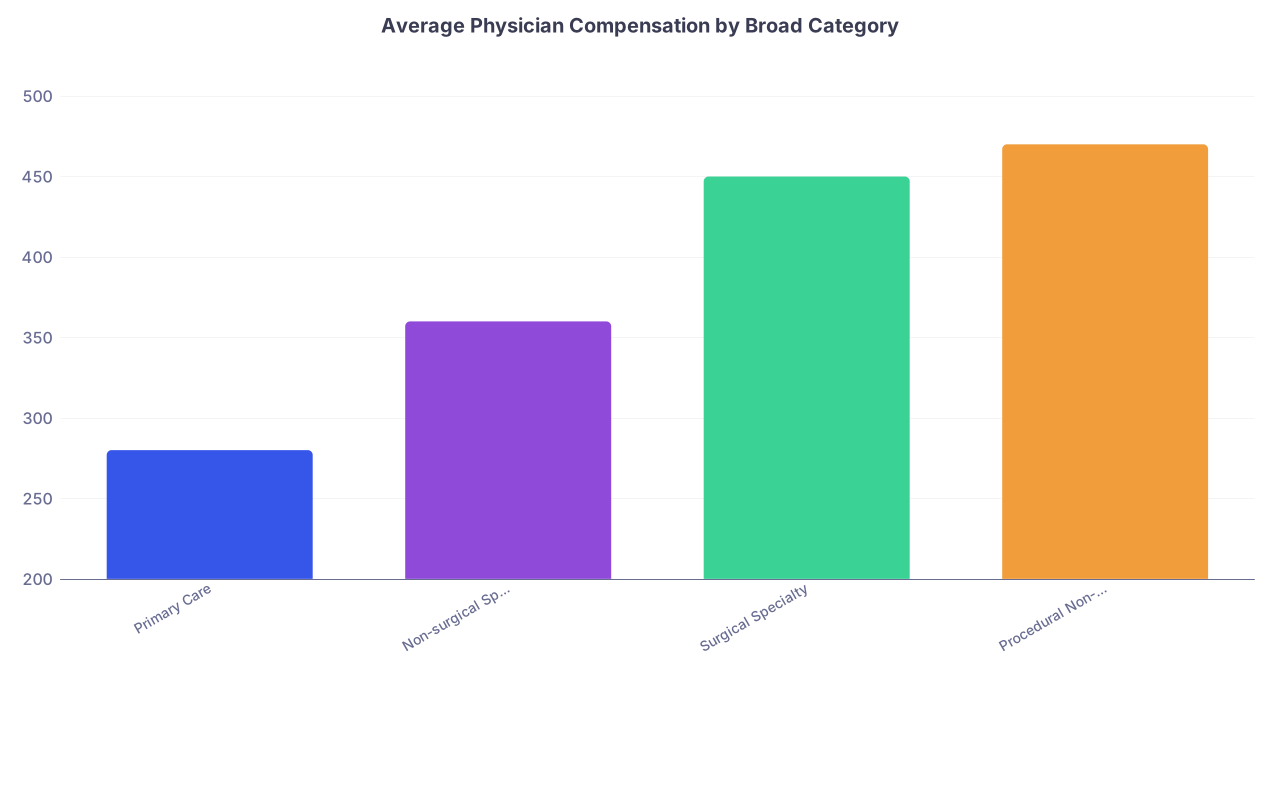
| Category | Value |
|---|---|
| Primary Care | 280 |
| Non-surgical Specialty | 360 |
| Surgical Specialty | 450 |
| Procedural Non-surgical | 470 |
The classic hallway wisdom: “If you want money, go into surgery.”
There’s a tiny grain of truth—surgical fields on average earn more than primary care. But “highest earning” is not synonymous with “surgery”.
Look at actual numbers from sources like Medscape, MGMA, Doximity, and large employer data over the last several years:
- Orthopedic surgery and neurosurgery often appear near the very top.
- But anesthesiology, cardiology, GI, and radiology are frequently right there with them—or above, depending on the year and survey.
- Procedural non‑surgical subspecialties (GI, cardiology, interventional pain) routinely beat many surgical fields.
I’ve seen practice offers where:
- A community orthopedic surgeon was offered $600k with RVU bonus.
- A GI doc in the same region had a realistic path to $800k+ with endoscopy volume and ownership in an ASC.
- An interventional cardiologist in a “boring” Rust Belt town was clearing $1M+ thanks to call pay and procedures.
So what’s really happening?
The truth: It’s procedures and leverage, not just “surgery”
The market doesn’t reward “cutting” per se. It rewards:
- High‑RVU procedures
- Ability to generate facility fees (hospital or ASC)
- Scarcity in a given geography
- Control/ownership of ancillaries (imaging, endoscopy, pain procedures, etc.)
A GI doc doing a high volume of colonoscopies and endoscopies can rival or exceed many general surgeons. An interventional cardiologist doing caths, PCI, and structural work can outrun a lot of surgical colleagues. A pain physician running a procedure-heavy ASC can blow past nearly everyone.
Surgeons are often top earners, sure. But they’re not automatically at the top, and they don’t own that space anymore.
Myth #2: “Pick the Highest Paying Specialty From the Chart”

You’ve seen the tables: “Top 10 paying specialties, 2025.” Students share screenshots in group chats like it’s the stock market.
The usual conclusion: just pick something from the top five and enjoy the money.
Reality is much uglier.
Public salary surveys give you averages. They don’t show variance, outliers, or how your choices about practice type and geography will blow those numbers up or drag them way down.
Let’s be concrete.
| Specialty | Setting | Approx Comp (USD) |
|---|---|---|
| General Surgery | Academic, major city | 325,000 |
| General Surgery | Community, medium city | 450,000 |
| General Surgery | Rural private practice | 600,000+ |
| Cardiology (non-int) | Academic, coastal | 350,000 |
| Cardiology (non-int) | Large private group | 550,000+ |
Same specialty, one person is making “average-ish” $350k, another is at $600k+, and both are technically “cardiologists” or “general surgeons”.
If you latch onto specialty averages without understanding the spread, you’re doing lazy financial planning.
The real drivers: Where and how you practice
Three things routinely matter more than the specialty line on your badge:
Practice type
- Academic vs private vs hospital-employed vs hybrid.
- Academic centers often pay 20–40% less in base salary but may have intangible benefits (prestige, research, lifestyle, niche training) that don’t show up in MGMA tables.
Location
- Rural and less desirable regions often pay dramatically more.
- Coastal metros saturated with residents and fellows? Expect depressed offers, even in “high-paying” fields.
Ownership and ancillaries
- Partners in a GI or ortho group with ownership in an ASC, imaging, PT can double or triple “average” compensation over time.
- Hospital-employed with no ownership? You’re capped by salary grids, RVU ceilings, and compliance.
So no, the right question is not “Which specialty pays the most?” It’s “Given what I like doing, what practice model and geography will maximize my earning power?”
Myth #3: “Lifestyle Specialties = Low Pay”
Derm, ophtho, radiology, anesthesia, PM&R—people love to dismiss these as “lifestyle” and assume they’re mid-tier pay at best.
Again, partial truth, mostly misused.
Med students tend to think “lifestyle” means fewer hours and less call. Employers and payors think “lifestyle” means high demand and limited supply. Those are very different conversations.
Here’s what the data and real life show:
- Dermatology and ophthalmology are almost always above primary care and general IM.
- Dermatology in certain private practices with cosmetic work can hit numbers that embarrass many surgeons.
- Radiology and anesthesiology swing heavily with call, shifts, and location. Teleradiology nights, rural anesthesia groups, or high-intensity locums can generate huge incomes—for people willing to do the less glamorous version of “lifestyle”.
The myth comes from a lazy mental shortcut: “If they go home earlier, they must make less.”
Not necessarily. If each hour is packed with billable procedures, cash-pay work (cosmetics, LASIK), or high-margin reading/coverage, the hourly rate can be excellent.
What is true: if you choose a lifestyle specialty and also want:
- Big city
- Academic job
- Minimal call
- 0 interest in ownership
You’ve just traded away a huge chunk of earning potential. Lifestyle and top 1% income exists, but it comes with tradeoffs: more hustle on the business side, less glamorous locations, or less secure setups.
Myth #4: “The Market Is Fair—More Training = More Money”
You’d think more training and responsibility equal more pay. That’s naïve.
Example: A fellowship-trained academic neurosurgeon doing skull base work can absolutely get paid less than a busy private practice general surgeon doing bread-and-butter cases in a mid-sized city.
I’ve seen:
- A cardiothoracic surgeon in a coastal academic center making less than an interventional cardiologist in the Midwest.
- A pediatric subspecialist who did med school + residency + TWO fellowships, making less than a community hospitalist doing seven-on/seven-off.
Why? Because the system doesn’t pay you for years of training. It pays you for billable work that someone will reimburse at decent rates—plus how hard you are to replace.
Pediatrics, psychiatry, and many cognitive subspecialties are systematically undervalued in reimbursement. They’re no less important. Just less lucrative in the current RVU/fee-for-service world.
So if you’re lining up extra fellowships because you think “more letters after my name = guaranteed bigger paycheck,” you’re confusing prestige with pricing power.
If you want both advanced training and strong income, you have to ask:
- Does this subspecialty significantly increase my RVU potential, procedure mix, or scarcity value?
- Or is it mainly academic/interest driven with modest to no increase in reimbursements?
If the answer is the latter, that’s fine—just don’t rewrite the math in your head.
Myth #5: “Your First Contract Locks In Your Lifetime Income”
I’ve heard this panic from PGY-3s: “If I accept 260k as a hospitalist now, I’ll never catch up to my classmates making 350k in cards or GI.”
No. That’s not how this works.
Career earnings are a function of:
- How quickly you move to more favorable contracts/practice types
- Whether you ever become a partner or owner
- Whether you leverage side income (locums, consulting, med-legal, speaking, telehealth, entrepreneurship)
- How long you actually practice and how burned out you get
It is absolutely possible for:
- A motivated hospitalist who moves into a leadership role, does med-legal consulting, and invests intelligently to end up financially ahead of a burned-out surgeon who quits at 50 after a string of toxic jobs.
- A FM doc who builds a high-efficiency clinic plus a cash-pay niche (weight loss, aesthetics, procedures) to outperform a generic mid-level specialist who stays in a low-paying academic role forever.
Compensation surveys won’t show any of this because they’re taking simple annual snapshots.
Your income is dynamic. It changes with your leverage, reputation, and your willingness to change environments.
Myth #6: “Salary = Take-Home Money”
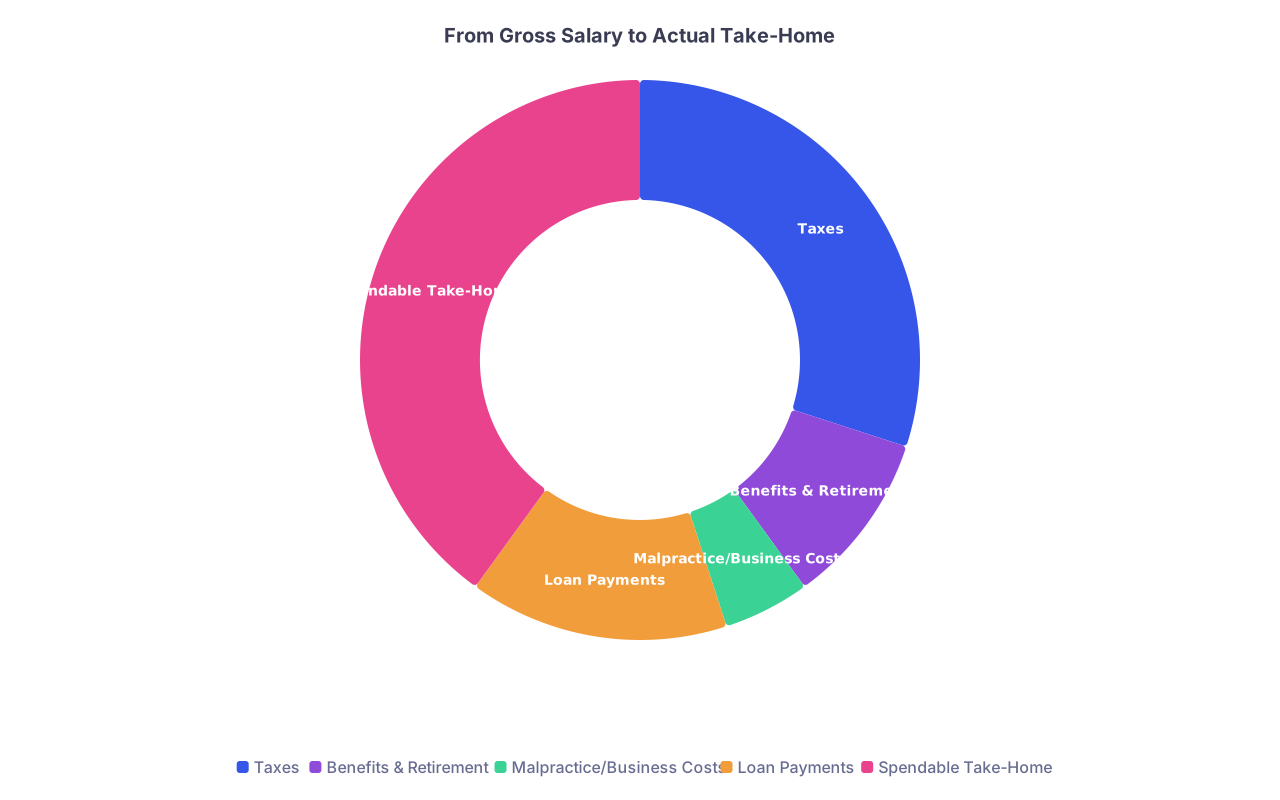
| Category | Value |
|---|---|
| Taxes | 30 |
| Benefits & Retirement | 10 |
| Malpractice/Business Costs | 5 |
| Loan Payments | 15 |
| Spendable Take-Home | 40 |
Med students obsess about whether a specialty average is 420k or 480k. Most of them never run a single after-tax, after-expense projection.
Two surgeons: both “make” 500k. Their actual financial lives can be wildly different:
- Surgeon A: W2 employee, high-tax coastal state, maxes 401(k), heavy student loans, high cost-of-living.
- Surgeon B: S-corp partner in a practice, moderate-tax state, distributions, business deductions, lower cost-of-living, earlier loan payoff.
Same “salary”. Very different net worth trajectories.
Non-surgical high earners (radiology, anesthesiology, GI, interventional cards) often have more flexibility to:
- Pick lower cost-of-living areas
- Do locums or extra shifts at very high hourly pay
- Mix W2 and 1099 work more easily
Meanwhile, some surgical jobs that look rich on paper come with:
- Unpaid call that wrecks your life
- High malpractice premiums
- Expectations of 60–80+ hours/week
- Political battles for OR time that limit your ability to hit the RVU bonus
So when you see “orthopedic surgery: $650k” and think that’s automatically superior to “radiology: $550k” or “GI: $580k,” you’re ignoring taxes, hours, and burnout risk.
Dollar for dollar, hourly rate and sustainability matter more than sticker salary.
Myth #7: “The System Will Fix Itself; I Don’t Need to Understand Any of This”

| Step | Description |
|---|---|
| Step 1 | Choose Specialty |
| Step 2 | Lower pay, prestige |
| Step 3 | Higher pay potential |
| Step 4 | New Market or Model |
| Step 5 | Income Plateau |
| Step 6 | Higher or Lower Earnings |
| Step 7 | Adjust Lifestyle and Savings |
| Step 8 | Academic or Private |
| Step 9 | Change Job? |
Here’s the harsh part: most physicians never get more than a surface-level understanding of how they’re actually paid.
They rely on:
- Recruiters (biased)
- Older colleagues (often outdated or jaded)
- Random online anecdotes (cherry-picked extremes)
Meanwhile, hospital systems and large groups absolutely understand:
- RVU conversion factors
- Payer mix implications
- How to structure contracts to cap your upside and protect their margins
If you walk into this thinking, “I’m a doctor, not a businessperson,” you’re volunteering to be underpaid for the next 20–30 years.
You do not need an MBA. You do need basic literacy:
- How RVUs work and what typical values are for your key procedures
- Local market ranges for your specialty (MGMA, Doximity, word-of-mouth, and yes, multiple offers)
- The financial impact of W2 vs 1099 vs partnership
- What ancillaries are on the table and who owns them
The biggest income myth is that knowledge is optional. It’s not. It’s leverage.
So, Do Surgeons Always Earn the Most?
No. Sometimes they do. Sometimes they don’t. And that nuance matters more than any one number.
Let me boil this down.
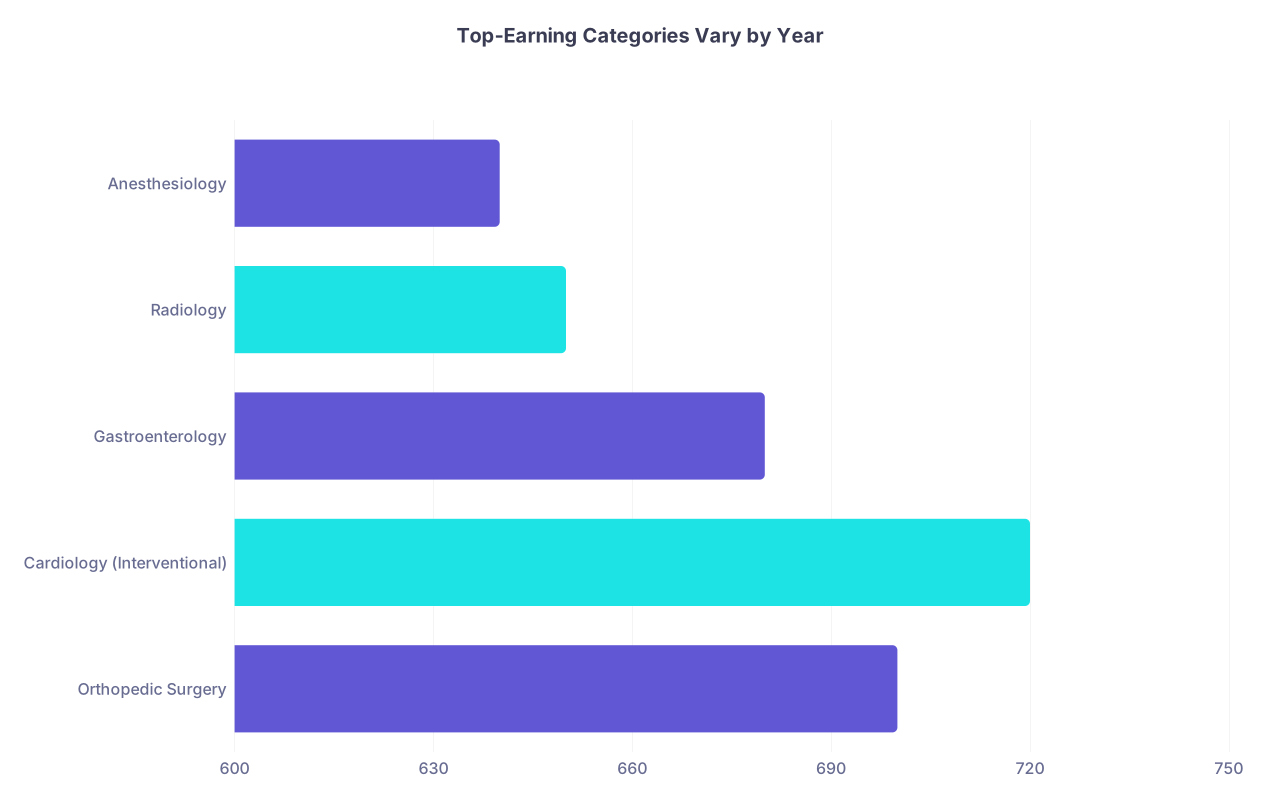
| Category | Value |
|---|---|
| Orthopedic Surgery | 700 |
| Cardiology (Interventional) | 720 |
| Gastroenterology | 680 |
| Radiology | 650 |
| Anesthesiology | 640 |
Across recent years and surveys, the real top earners cluster in a familiar group: orthopedics, neurosurgery, interventional cardiology, GI, radiology, anesthesia, sometimes urology and ENT. The exact ranking shifts every year. The pattern does not: procedures, scarcity, and leverage drive pay—not the word “surgeon” on your badge.
The Short Version: What Salary Myths Get Wrong
“Surgeons always earn the most” is a lazy half-truth. High-paying procedural fields—some surgical, some not—cluster at the top. The specific ranking is noisy and heavily shaped by practice model and geography.
Specialty choice is only half the money story. Where and how you practice (academic vs private, urban vs rural, W2 vs ownership, ancillaries vs none) can swing your income by hundreds of thousands per year inside the same specialty.
Sticker salary is not real life. Taxes, hours, call, burnout, and your ability to change jobs or build ownership matter more over a 20–30-year career than whether your specialty average is 30–50k higher on some survey.