
The idea that “RVU models always reward high-volume doctors and punish everyone else” is lazy and wrong. It is sometimes true. It is often weaponized. But it is not a law of nature.
If you actually look at contracts, specialty benchmarks, and how RVUs are priced, the real story is more uncomfortable: some high-volume doctors are underpaid on RVU models, and some relatively low-volume physicians are making out extremely well. The system is skewed—but not always in the direction people think.
Let’s dismantle the myth and look at where RVU compensation quietly flips in favor of the “lower-volume” doc.
Quick primer: how RVUs really move money
I am not going to re-teach RVUs from scratch, but you need a minimal framework.
Three big moving parts:
- wRVUs – this is the “work” component, tied to CPT codes.
- Conversion factor – dollars paid per wRVU in your contract.
- Benchmark – MGMA/AMGA/etc percentiles used to justify both your target and your pay.
What actually matters to your paycheck is the triangle: your specialty’s typical wRVU profile, your personal coding mix, and that conversion factor.
That’s where the “high-volume always wins” story breaks down. Because the system is not neutral across specialties, code sets, or practice structures.
Myth: “RVUs always favor whoever sees the most patients”
Reality: RVU models favor whoever generates the most wRVU value per unit of time, at the negotiated rate, compared to their specialty benchmark. That is a very different statement.
Take two physicians:
- Physician A: high-volume, pure evaluation and management, mostly 99213, in a low-paying primary care RVU environment.
- Physician B: moderate volume, procedure-heavy specialty, with codes that spit out big wRVUs per hour.
The second doctor can work fewer hours, see fewer patients, and still crush the first physician’s RVU numbers and compensation.
The myth persists because people conflate “volume” with “RVUs.” They overlap but they’re not the same thing.
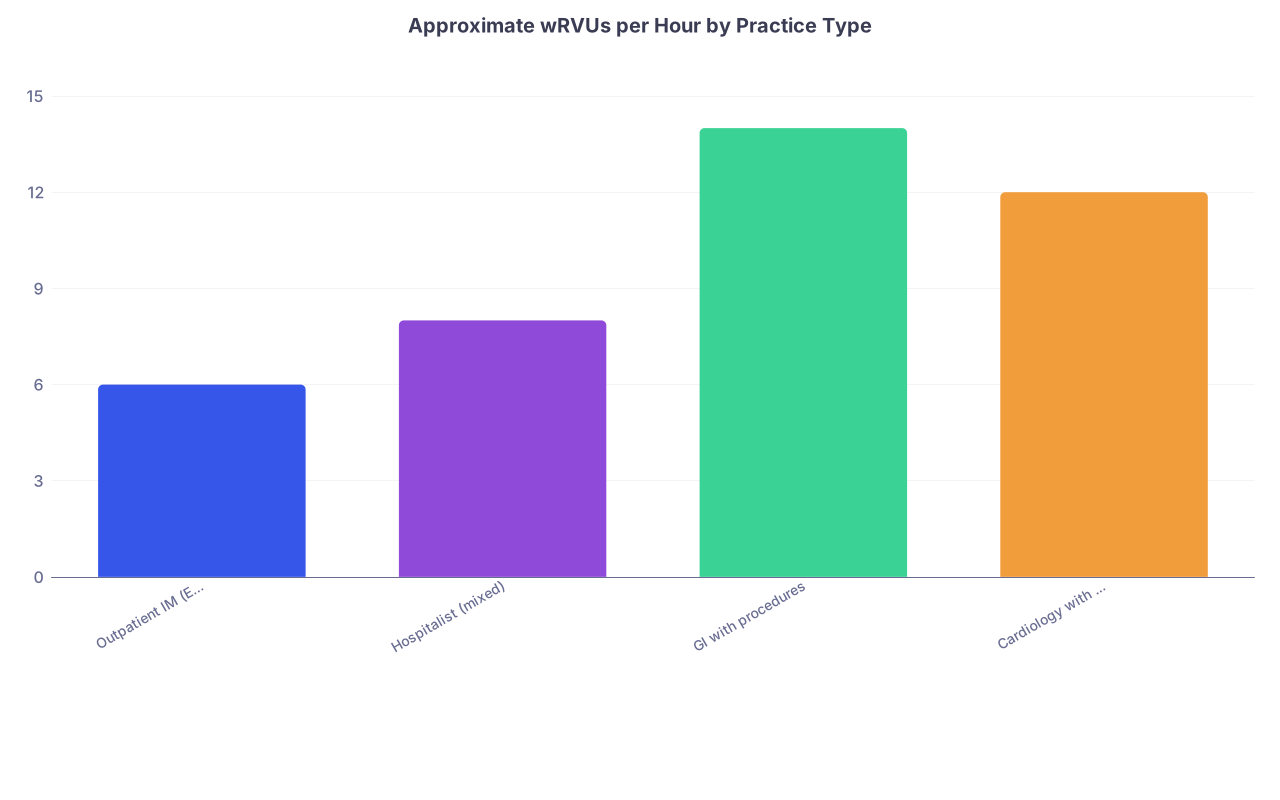
| Category | Value |
|---|---|
| Outpatient IM (E/M heavy) | 6 |
| Hospitalist (mixed) | 8 |
| GI with procedures | 14 |
| Cardiology with procedures | 12 |
Those are not exact numbers, but they are in the ballpark of what I’ve seen looking at practice data and benchmark reports. Notice who “wins” here. Not the person necessarily seeing the most patients—the one doing the highest-value work per hour.
So no, RVU models do not inherently favor “high-volume.” They favor high RVU density. Different thing.
Where lower-volume doctors win big under RVU models
Let’s walk through the main exceptions where RVU setups quietly favor lower-volume or “normal-volume” physicians.
1. Procedure-heavy specialists with realistic schedules
This one is the most obvious and yet people still pretend RVUs only reward grind.
Gastroenterology, cardiology (with caths), interventional radiology, ortho spine, some pain practices—these fields generate disproportionate wRVUs per patient and per hour.
If your schedule is built around a few hours of procedures plus some clinic, you can easily look “moderate volume” on paper while landing in the 75–90th percentile for wRVUs and compensation.
I have literally seen GI docs doing:
- 1–1.5 days of clinic
- 2.5–3 days of endoscopy
- 1 admin day
…and hitting wRVU numbers that would take a primary care physician a terrifying number of 99213 visits to match.
The RVU system, as priced by Medicare and then mirrored by commercial payers, strongly rewards procedures. A 15-minute follow-up visit just does not move the needle the way a colonoscopy or cath does. You can complain about that (you’d be correct to), but pretending that “high volume” is the only way to win obscures the real structural bias: cognitive work is devalued, procedural work is rewarded.
2. Hospitalists with high-paying conversion factors
Hospitalist medicine is a strange beast in RVU-land.
Some hospitalists are on pure shift-based or salary models. Others are heavily RVU-based. Among RVU-based groups, the details matter.
If your hospital wants 24/7 coverage and cannot easily replace you, you often see:
- Higher per-RVU conversion factors than outpatient primary care
- Embedded incentives: nocturnist differentials, bonus tiers, quality bonuses stacked on top
Now imagine two hospitalists in similar systems:
- Doc X: Sees “average” 15 patients/shift, hits 4,000–4,500 wRVUs/year, but has a very strong $/wRVU rate and quality bonuses that actually pay out.
- Doc Y: Sees 20+ patients/shift in an understaffed group, billed aggressively, churns to 6,000+ wRVUs, but with a lousy conversion factor and no meaningful bonus structure.
I have seen Doc X making almost as much—or, with night shifts and quality bonuses, more—than Doc Y, with far fewer burned-out miles on the odometer. Same “RVU model,” very different outcomes.
Lower-volume, but better-paid per unit because of leverage and negotiation. The model did not inherently favor the grinder; it favored whoever had the better rate and structure.
3. Subspecialists anchored to over-generous benchmarks
Here's a dirty secret about many RVU contracts: the compensation tables are out of sync with reality.
Employers often anchor RVU expectations and compensation tiers to MGMA (or similar) benchmarks that lag the market by a year or two. In some subspecialties, compensation has been climbing faster than RVUs. In others, work has exploded without proportional pay increases.
If your group is still using old tables, you can end up in a bizarre situation:
- Your wRVUs are “only” at the 55th percentile.
- The comp schedule pays the 55th percentile wRVU producer at close to 75th percentile income based on outdated or cherry-picked benchmark years.
I’ve seen electrophysiologists, rheumatologists, and some academic-adjacent subspecialists land in this sweet spot. They are absolutely not the highest-volume folks in the system. But they are standing in a specialty/payment niche where the wRVU → dollars curve is steeper than anybody bothered to update.
That’s an RVU model that quietly favors the moderate-volume doc.
4. Physicians with heavy non-RVU compensation layered on top
RVUs are just one stream. Too many people forget that.
Plenty of hospital-employed physicians have contracts where:
- They get a base salary tied nominally to RVUs.
- Then they stack on: medical directorship stipends, call pay, committee stipends, teaching stipends, quality bonuses, co-management fees.
I’ve seen cardiologists and intensivists who are “borderline average” on wRVUs but pull in extra six figures annually from ICU directorships, heart failure program oversight, EP lab medical director roles, etc.
The classic misunderstanding is: “He only works 3 clinic half-days and some call; how is he making that much on RVUs?” He is not. The wRVU model is there, technically. But the real money is in all the stuff that does not show up in the wRVU ledger.
From the outside, that looks like a lower-volume physician winning in an RVU system. And in practice, they are. Not because of visit volume—but because they have multiple revenue or stipend streams that most people ignore when they whine about “RVU-only” pay.
Where the high-volume doc actually gets burned
Now let’s flip it. There are situations where the high-volume RVU workhorse is absolutely being exploited.
1. Primary care with low conversion factors and “safety net” rhetoric
Family medicine and general internal medicine are the poster children here.
Huge visit volume. Tons of care coordination. Inbox madness. And a conversion factor that often lags other specialties, especially in hospital systems that justify stingy pay with “mission,” “community,” and “access” talking points.
Outpatient IM doc doing 4,800 wRVUs on a $45/wRVU contract is making $216k in productivity pay. A GI doc at the same system might be getting $70–80/wRVU for a similar percentile of production. Do the math.
The high-volume primary care doc looks like the “winner” in RVU land on paper (big numbers, lots of visits). In reality, they’re underpaid per unit of work and may not even crack median total comp compared to other specialists.
2. EM and urgent care with RVUs plus volume caps and “efficiency” pressure
Emergency medicine is a weird RVU half-breed. Many contracts have a base hourly plus productivity tied to RVUs per hour. But almost everywhere, there’s a strong push to see more patients per hour.
What happens? You can see more and more volume, hit higher and higher RVUs per shift, but your schedule and staffing do not expand comparably. Burnout goes up faster than compensation.
I’ve seen EM docs essentially capped by:
- Fixed shift counts
- Group-level policies about “fair distribution” of nights/weekends
- Admin expectations around “productivity norms”
They become high-RVU individuals trapped in a structure that prevents them from fully monetizing that productivity. Meanwhile, newer hires or lower-volume colleagues working fewer shifts but in richer contracts sometimes land at similar or higher pay-per-hour.
3. Academics on hybrid RVU + academic salary models
Academic physicians love to say “we’re not on RVUs” while quietly being on RVUs.
Common structure:
- Base academic salary for teaching/research.
- Plus “clinical incentive” tied to RVUs.
- RVU targets set aggressively, but conversion factors kept low “because you have the privilege of teaching and research.”
End result: the clinically heavy academic workhorse often has the highest wRVUs on their team and the least flexibility to add non-clinical income. But their pay increments per wRVU are tiny compared to private or community jobs.
RVUs are there. Volume is high. The reward? Modest bumps. The system is not designed to let the high-volume doc actually win.
Comparing two doctors: when the lower-volume one wins
Let’s put numbers to this with a simplified comparison.
| Scenario | Annual wRVUs | $ per wRVU | RVU Pay | Extra Stipends | Total Comp |
|---|---|---|---|---|---|
| A: High-volume PCP | 5,000 | $45 | $225,000 | $0 | $225,000 |
| B: Moderate-volume GI | 7,000 | $75 | $525,000 | $25,000 | $550,000 |
Both are “working hard.” Only one is being heavily rewarded.
Now, change the specialty and play this game again with hospitalist vs outpatient, or subspecialist with director roles vs pure clinic workhorse. The pattern repeats: the pure volume hero is often not the one extracting the most value.
And there are flips inside a single specialty too. I’ve seen within one hospitalist group:
- Doc 1: Most shifts, most admissions, highest wRVUs, few or no stipends.
- Doc 2: Fewer shifts, lower wRVUs, but nocturnist differential + sepsis committee stipend + QI project bonus.
Same group. Same “RVU model.” The second doc, who looks “lower volume,” sometimes walks away with equal or higher compensation per hour worked.
The real levers that matter more than sheer volume
Once you stop worshiping raw volume, you start seeing the real levers:
- Your specialty’s inherent wRVU pricing (cognitive vs procedural).
- Your personal code mix (are you living on 99213s, or do you have access to higher-complexity codes and procedures?).
- The conversion factor in your contract compared to current market rates.
- Whether your RVU expectations are benchmarked fairly to your specialty, or inflated.
- Your access to non-RVU income: call pay, directorships, teaching stipends, quality incentives that actually pay.
RVUs are not the enemy. Blindly signing an RVU-heavy contract without understanding these levers is.

Once you see the web, you stop asking “does RVU favor high volume?” and start asking “where does this RVU setup channel money, and how do I position myself?”
Practical takeaways if you’re staring at an RVU contract
I am not your lawyer, but I am going to be blunt.
If you are evaluating or renegotiating a contract with RVUs:
- Stop obsessing over “expected volume” in isolation. Ask precisely: what are the RVU targets, what is the $/wRVU, and how does that compare to MGMA/AMGA medians for your specific specialty in your region?
- Look at your likely code mix. A rheumatologist with a procedure room or infusion center access in the same “RVU model” is playing a different game than one doing only 20-minute follow-ups all day.
- Hunt for non-RVU dollars. Stipends, call pay, and leadership roles often dwarf marginal RVU adjustments, especially for moderate-volume physicians.
And yes—if you are in a low-paying cognitive field with a weak conversion factor and no meaningful extras, then yes, RVU models usually do favor the highest-volume grinders and punish everyone else. That is not a universal rule. That is a sign you are in a particularly bad implementation of the model.
The depressing part is not that RVUs always reward high volume. It is that the system is selectively generous: it over-rewards certain procedure-heavy or leverage-rich roles and under-rewards high-volume cognitive work. Usually by design.
The bottom line
Three points and we’re done.
First: RVU models do not universally favor high-volume physicians. They favor high RVU value per hour in well-negotiated specialties and contracts. Plenty of moderate-volume doctors quietly win here.
Second: some of the most overworked, high-volume clinicians—especially in primary care and academic-heavy roles—are actually punished under RVU systems with low conversion factors and unrealistic targets.
Third: if you want to protect yourself financially, stop asking “How many patients will I see?” and start asking: “What’s my realistic wRVU mix, what’s the true $/RVU, and what non-RVU income can I layer on top?” That is where the money—and the real power imbalance—actually lives.