Academic medicine does not always pay less. It usually pays differently. And the people who repeat that “academics = pay cut” line without nuance are either out of date, overgeneralizing from one specialty, or never actually looked at real comp data across models.
Let’s pull this apart.
Most residents hear some version of: “If you go academic, plan on making 30–40% less for life.” That used to be broadly true. It is not universally true now, and in some niches it is flat-out wrong.
What the Data Actually Shows (Not the Lounge Gossip)
Broad strokes first.
Surveys from MGMA, AAMC, and large recruiting firms (Merritt Hawkins, AMN, etc.) show a pretty consistent pattern:
- Pure private practice and private equity–backed groups often top the charts in raw dollars.
- Hospital-employed physicians (non-academic) cluster just below that.
- Traditional academic departments tend to start lower on base salary, but the gap varies wildly by specialty, geography, and whether you’re mostly clinical or seriously academic.
Let’s anchor this with realistic ballparks, not fantasy numbers thrown around at 2 a.m. on call.
| Specialty (early career) | Academic hospital | Non-academic employed | Private practice / PE-backed |
|---|---|---|---|
| General IM | $200–260k | $240–300k | $260–350k+ |
| Cardiology | $450–600k | $500–700k | $600–900k+ |
| GI | $450–650k | $500–750k | $700–1.0M+ |
| Gen Surg | $350–500k | $400–600k | $500–800k+ |
| Radiology | $400–600k | $450–650k | $600–900k+ |
These aren’t “offers on paper,” they’re ranges that show up again and again in real contracts I’ve seen and in national data. The pattern: academics usually on the left, private practice on the right. But the gap is not a fixed percentage, and it is shrinking in some fields.
Let’s visualize how this plays out for something common like general internal medicine.
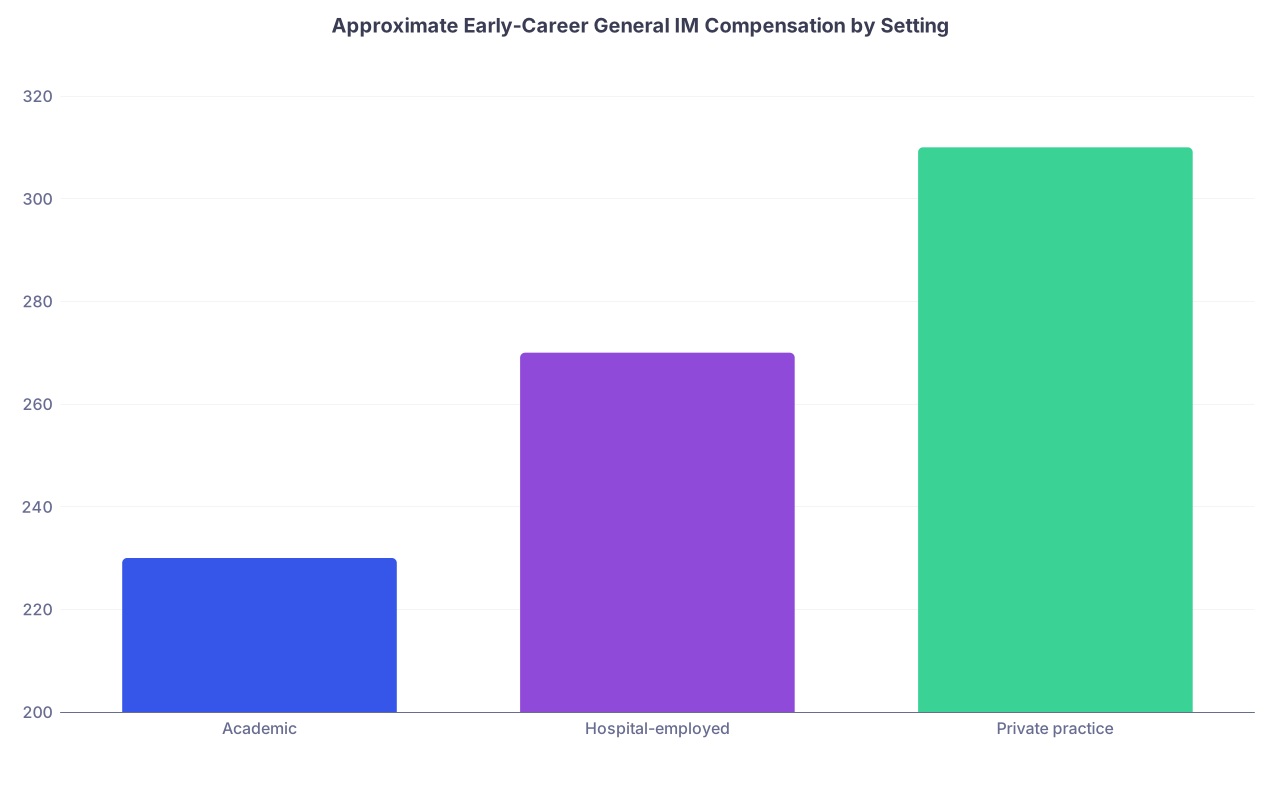
| Category | Value |
|---|---|
| Academic | 230 |
| Hospital-employed | 270 |
| Private practice | 310 |
Looks like academics lose, right? Slow down. That bar chart ignores three big realities:
- Academic comp structures are often less RVU-insane and more stable.
- Benefits, loan programs, and retirement plans in academics can be significantly richer.
- Academic time (protected research, teaching, administrative) is still time you’re being paid to work…just not bill RVUs.
The myth is not that academics ever pay less. The myth is that “less W-2 equals worse deal, full stop.” That’s lazy thinking.
Where the Myth Came From (And Why It’s Outdated in Places)
The “academic pay cut” story wasn’t invented out of nowhere. It came from a period where the model was pretty rigid:
- Lower base salary.
- Heavy teaching and research expectations.
- Minimal bonus opportunity.
- Prestige as the main “compensation.”
If you talk to a senior attending who started in academics in the 1990s, they’ll give you horror stories:
- $120k as a junior faculty hospitalist.
- Zero productivity bonus.
- Constant pressure to publish just to keep promotion moving.
- Watching their co-residents in community jobs hit double their income in three years.
They’re not lying. That was real.
But several things changed:
- RVU-based comp invaded academic centers.
- Health systems realized they needed to be competitive to recruit in-demand subspecialties.
- Research and education funding shrank relatively, forcing many “academic” physicians into more clinically productive roles.
So in 2024, you’ll see “academic” cardiologists with 80–90% clinical time and very real bonus plans that are not wildly different from the non-academic hospital down the street.
Some departments still live in 1995. Others are essentially hospital-employed groups with a university logo and some modest academic expectations.
This is why blanket statements about pay gaps are garbage. You need to know which kind of academic job you’re talking about.
The Core Trade: RVUs vs “Invisible” Compensation
The heart of the myth: people compare only one number—the top line salary.
Academic offers often look like this:
- Lower base than a private offer.
- Richer benefits (especially retirement).
- More non-clinical time: teaching, research, admin, leadership development.
Private practice offers:
- Higher base and/or strong productivity upside.
- Often leaner benefits.
- More of your calendar and energy locked into RVU generation, procedures, or call.
Let’s put some numbers behind “invisible” compensation, because this is where people misjudge badly.
| Component | Academic center | Many private/PE groups |
|---|---|---|
| Base salary | Lower | Higher |
| Productivity bonus | Mild–moderate | Moderate–high |
| Retirement match/plan | 8–12% of salary not unusual | 0–4% common |
| Loan repayment / PSLF | Often compatible / supported | PSLF may be lost or complicated |
| Protected non-clinical time | 0.2–0.5 FTE possible | Rare or unpaid |
Now, look at retirement. An academic job with a 10% retirement contribution on a $250k salary is $25k a year you’re not seeing as W-2 but you are getting. Over 10 years, with normal market returns, that’s several hundred thousand dollars.
That private practice job with a $310k salary and a 2% match might feel richer now and still win long-term—but the gap is not as simple as $60k per year.
Same with loan forgiveness. Many academic physicians are at large non-profit hospitals that qualify for PSLF:
- 10 years of qualifying payments (often on income-driven plans during residency + early attending years).
- Then six-figure balances wiped out.
A private equity–owned practice does not do that for you. You’ll be paying that $300k principal plus interest out of pocket, out of your “higher” salary.
So the real question is not “Who pays more?” It’s “What’s my after-tax, after-loan, after-benefit position over 10–15 years?” That answer is often much closer than the starting salary suggests.
The Exceptions: Where Academic Medicine Absolutely Pays Less
There are definitely places where the myth is basically reality.
You see this pattern most strongly in:
- High-RVU, procedure-heavy specialties: GI, orthopedics, cardiology, neurosurgery, interventional radiology.
- Regions where private practice is still dominant and extremely lucrative.
- Old-school academic departments that haven’t updated comp models in decades.
The logic is simple. If you’re in a specialty where adding one more case per week equates to tens of thousands of dollars per year in personal income, an academic model that de-emphasizes pure productivity will rarely compete in raw dollars.
Think:
- GI doc in a high-volume private group: buy-in to ASC, generous share of technical fees, aggressive RVU bonuses. Hitting $900k–$1.2M isn’t fantasy.
- GI doc in academics: strong clinically, maybe some research, but no ASC ownership, lower RVU rates, and admin/teaching time. $450k–$700k is more typical.
That’s not a few percentage points. That’s life-changing money if you care primarily about top-line income.
So for some subspecialties and markets, “academic medicine pays less” is not a myth. It’s just not universal.
The Other Side: Where Academics Compete or Even Win
Now flip the script.
There are scenarios where academic jobs are at least financially competitive:
Lifestyle-dependent or less lucrative specialties
Pediatrics, infectious disease, endocrinology, rheumatology, geriatrics. These fields often don’t have massive private practice multiples to begin with. The gap between academic and non-academic pay may be 5–10%, not 40–50%. I’ve seen ID or endo offers where the academic hospital actually beat the local private group because the system is desperate to recruit.Underserved or less desirable locations
A major academic medical center in a Rust Belt city or mid-sized Southern town may throw very competitive packages at candidates who’d otherwise flee to the coasts. Meanwhile, the “sexy” private practice in a saturated coastal metro quietly compresses salaries because they can.Hybrid academic–clinical roles
Many “academic” jobs are now quasi-hospitalist or clinical work with some teaching. These can have highly competitive clinical pay plus enough academic flair to keep your CV alive for promotion and future opportunities.Long game: leadership and niche expertise
Department chairs, program directors, division chiefs at big-name places can absolutely earn at or above non-academic peers—especially when you factor in stipends, leadership bonuses, and the consulting/board honoraria that flow naturally from national reputations.
Let’s visualize something people rarely compare: lifetime earnings in a modest-paying specialty with and without PSLF in the mix.
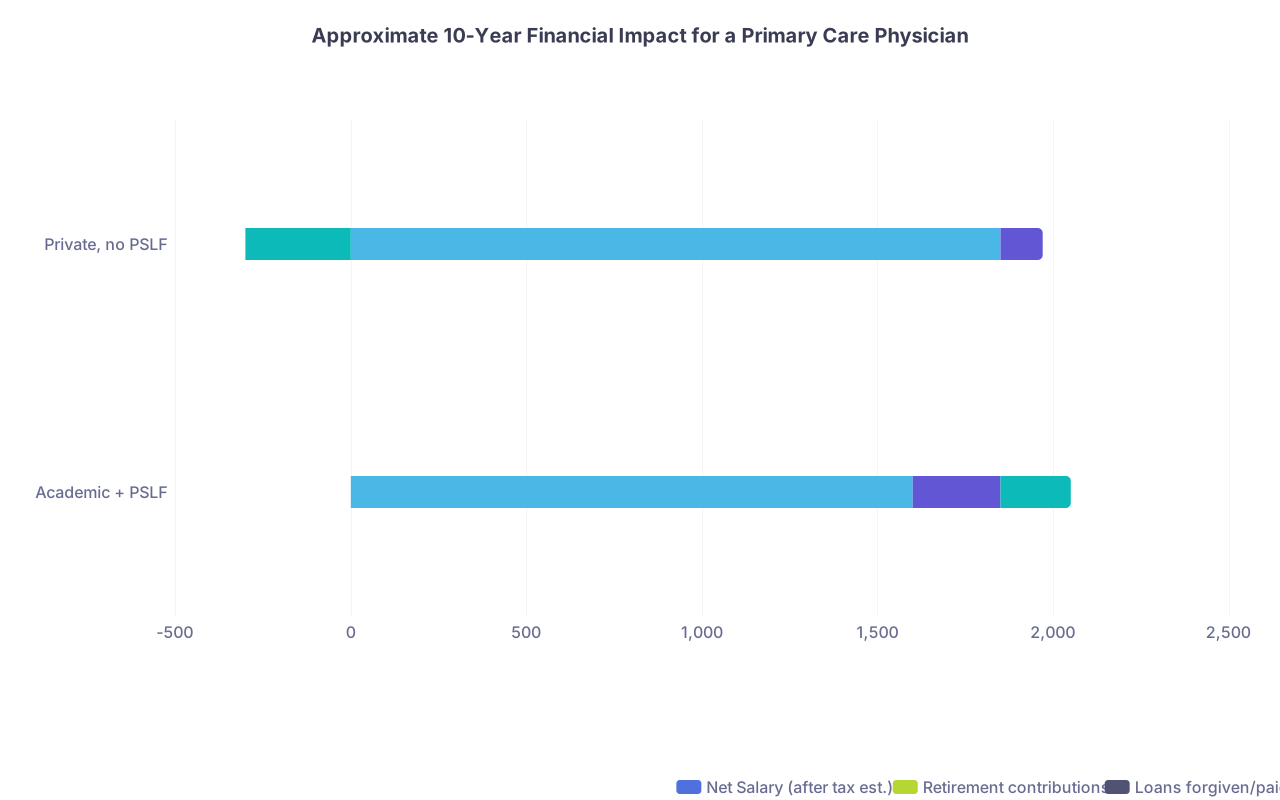
| Category | Net Salary (after tax est.) | Retirement contributions | Loans forgiven/paid |
|---|---|---|---|
| Academic + PSLF | 1600 | 250 | 200 |
| Private, no PSLF | 1850 | 120 | -300 |
Values in thousands, very rough. The point isn’t the exact number. It’s that once you factor retirement contributions and $200–300k of loan forgiveness, the “lower-salary” academic path may not be financially inferior over a decade.
Again—that’s for certain fields and situations. Not all.
Academic RVU Reality: You Still Work. Hard.
One of the worst myths on the other side is that academics is where you hide out and see fewer patients.
At many modern academic centers, faculty are on:
- RVU-based comp plans with thresholds and tiers.
- Work RVU targets that rival or exceed local community standards.
- Call schedules that are not meaningfully lighter.
I’ve watched junior academic hospitalists crank 18–20 patient lists with teaching teams, spend extra time on complex teaching cases, and then stay late to catch up on documentation, only to see a mid-career community hospitalist across town earning 30–40% more with fewer learners to manage and less committee work.
So, no, academic automatically paying less doesn’t mean you pay for “lifestyle.” In some places you are paying for:
- Mentorship.
- CV lines.
- The possibility of fellowships or leadership.
- Being attached to a brand name.
If you don’t actually want those things, you’re burning money for prestige that doesn’t matter to you.
What Residents Actually Get Wrong When Comparing Offers
I’ve watched this play out in real time every year with graduating residents and fellows. The same mistakes repeat:
They compare only base salary.
They ignore RVU rates, realistic productivity, quality incentives, and call pay. They also ignore non-salary value like PSLF qualification or retirement.They underestimate taxes.
Jumping from $300k to $400k sounds like a $100k “raise.” It is not. After federal, state, and payroll taxes, you may see only half of that. Then subtract increased loan payments if you leave PSLF-eligible employment.They ignore time.
Private practice: 1.3 FTE clinically plus business headaches and partnership politics. Academics: maybe 0.9 FTE clinical with some portion dedicated to research or teaching. That “pay cut” might be $40–60k per year for 20–25% fewer high-stress clinical hours.They don’t price out risk.
Some private gigs are fantastic—until the group sells to PE or loses a major contract and your comp model implodes. Academic jobs can implode too, but the variance is often lower. Less ceiling, but also less floor.They overvalue short-term cash at the expense of optionality.
It’s a lot easier to move from a top academic program to private practice than the reverse, especially for highly competitive subspecialty fellowships or leadership tracks. That doesn’t show up in any pro/con spreadsheet, but it’s real.

The Honest Answer: Myth, Half-Truth, or Reality?
So where do we land?
“Academic medicine always pays less” is a half-truth that functions like a myth when people use it uncritically.
- It’s true enough in many procedural and high-RVU specialties, especially in competitive urban markets and at old-school departments with outdated comp models.
- It’s misleading or false in several cognitive/lower-RVU specialties, in less desirable locations, and when you account properly for PSLF, benefits, retirement, and non-clinical time.
- It’s dangerous if you let it scare you away from academics when your actual goals are research, education, or leadership—because in those lanes, academics are where the long-term money and influence often are.
The smarter question isn’t “Does academics pay less?” but:
- In my specialty and region, what is the realistic 5–10 year financial picture in:
- Academic center A
- Academic center B
- Hospital-employed group C
- Private/PE practice D
And you build that picture from:
- Actual contract numbers (not hallway rumors).
- RVU targets and rates.
- Call schedules.
- Benefit summaries.
- Loan strategy (PSLF vs refinance vs pay off aggressively).
- Your real tolerance for clinical grind vs non-clinical work.

| Step | Description |
|---|---|
| Step 1 | Job Offer |
| Step 2 | Check base, RVU, benefits |
| Step 3 | Check base, RVU, ownership |
| Step 4 | Model 10 yr net with loan forgiveness |
| Step 5 | Compare to refinance plan |
| Step 6 | Model buyin and future income |
| Step 7 | Assess stability and upside |
| Step 8 | Compare lifestyle and long term goals |
| Step 9 | Academic or Not |
| Step 10 | PSLF eligible |
| Step 11 | Partnership or PE |
If you do not run those numbers and just repeat “academics pays less,” you’re not being strategic. You’re letting someone else’s outdated experience hijack your decision.

Where This Actually Matters For You
Two practical points you should walk away with.
First, if you’re leaning academic for reasons that actually matter to you—research, education, complex cases, leadership, or just enjoying the teaching environment—don’t automatically walk away because the base number is 15–25% lower. Run a proper financial model that includes:
- Taxes.
- Loan strategy.
- Benefits and retirement.
- Realistic work hours and call.
- Your spouse/partner’s income if relevant.
You may find the “hit” is smaller than you think. Sometimes negligible.
Second, if you’re primarily income-driven and have no real interest in academic work beyond the vague idea of “prestige,” be honest with yourself. In that case, yes, academics very likely represents an opportunity cost—especially in lucrative procedural fields. You’re the person for whom the half-truth is effectively true.

The bottom line: “Academic medicine always pays less” is too blunt to be useful. The real world is messier—and more interesting. Salaries, benefits, loans, time, risk, optionality, identity. They’re all in the equation.
If you treat your first contract like a permanent label—“academic, therefore poorer”—you’re missing how fluid this career actually is. You’re not locking in your entire financial future with one job choice. You’re choosing your first version of it.
Years from now, you won’t remember the exact dollar difference between your academic offer and the private one you turned down. You’ll remember whether the trade you made—money for meaning, or meaning for money—felt like a bargain or a regret.