
The biggest lie in physician compensation is that productivity metrics “reward your hard work.”
They’re designed, very deliberately, to cap what you earn once you become truly efficient and valuable.
I’ve sat in those closed-door comp committee meetings. I’ve heard the phrases administrators use when a doctor starts making “too much”:
“He’s becoming an outlier.”
“Her pay is drifting above market.”
“We need to rebase the plan.”
That’s code for: we need to quietly build a ceiling on this person’s income without them realizing it until it is already done.
Let me walk you through how groups, hospitals, and corporate employers actually use productivity metrics—RVUs, collection thresholds, “performance tiers”—to control and cap your earnings while still selling it to you as a merit-based system.
The Sales Pitch vs. The Real Game
On paper, productivity compensation sounds fair. You work more, see more, bill more, and you get paid more. Simple, right?
Here’s the script you’ll hear:
- “We pay based on wRVUs so your income reflects your effort.”
- “There’s no cap to your earnings potential here.”
- “Our physicians are in the 75th–90th percentile for compensation.”
Behind the curtain, the same group is saying:
- “We cannot let physicians drift above MGMA medians or our margins collapse.”
- “We’ll let the comp formula run for 2–3 years, then we’ll ‘recalibrate’ once they’re hooked.”
- “We need standardization; our top billers can’t be making double what others do.”
What they actually build is a system where:
- Your upside is front-loaded and temporary.
- Your comp formula gets “adjusted to market” as soon as you outperform.
- The practice, not you, keeps the long-term benefit of your efficiency.
You’ll see this most clearly with RVU-based comp, so let’s start there.
How wRVUs Become a Soft Earnings Cap
wRVUs are the perfect control tool because they feel objective. CPT code, assigned value, multiply by your rate, done.
Except here’s what really happens when you’re productive.
First contract:
They’ll dangle something like $55–$70 per wRVU depending on specialty and region. They’ll guarantee a base for 1–2 years tied to a “target” number of RVUs (often MGMA median or 60th percentile). You outperform. You think you’re winning.
Year 1: You crush it. Hit 8,000 RVUs on a 6,000 target.
You run the math. At $60 per wRVU, that should be $480k. You’re guaranteed 360k. They quietly “true up” a bonus, but it’s not quite what you expect—suddenly there are “budget constraints,” “quality adjustments,” or “citizenship expectations.”
Year 2: You stay at 8,500–9,000 RVUs. Same contract, maybe a small bump. You’re now that “top producer.”
Year 3 renewal: This is where the trap closes.
You’ll hear phrases like:
- “We’re aligning everyone with current market data.”
- “We can no longer support that wRVU rate, but we’ve increased your base.”
- “The health system is transitioning to a standardized comp model.”
Translation: We liked your productivity; we do not like paying you for it at this level.
So they:
- Lower your wRVU conversion factor (example: from $60 to $50).
- Raise your “expected” RVUs to your current performance (example: from 6,000 to 8,500).
- Flatten your bonus structure so your upside above target is much smaller.
You’re now working at your previous level—or even more—but your total pay is “normalized” back to some MGMA percentile that CAO and HR agreed on.
Here’s how it looks in practice.
| Contract Year | Target RVUs | Actual RVUs | wRVU Rate | Total Comp (approx) |
|---|---|---|---|---|
| Year 1 | 6,000 | 8,000 | $60 | $420k (360k base + bonus) |
| Year 2 | 6,000 | 8,500 | $60 | $450k |
| Year 3 (new) | 8,500 | 8,800 | $50 | $425k |
You got more efficient. They lowered the rate. Your marginal dollar went to the group, not you.
“Market Data” – The Most Convenient Weapon They Have
The cleanest way groups justify capping your earnings is with “market data.” MGMA. AMGA. SullivanCotter. Pick your flavor.
Here’s the part no one tells you as a resident or early attending: those surveys are used as ceilings, not guides.
Inside admin meetings, the conversation sounds like this:
- “She’s at the 90th percentile for comp on only 70th percentile RVUs. We’re overpaying relative to market.”
- “We can’t defend this to the board; HR wants us clustered around median to 75th.”
You’ll see it play out in a few consistent patterns:
Comp-to-RVU ratio “too high”
If your dollars per RVU are charted against survey data and you sit above the 75th–90th percentile, you become a problem to “fix.” They don’t say, “Good for her, she’s very efficient.” They say, “We’re paying above market.”Forced “alignment to peers”
They’ll claim it’s about fairness:
“We need internal equity; it’s hard to justify you making 100k more than colleagues with similar RVUs.”
Translation: we want to pay you less without saying that out loud.Capped bonus percentages
Even if the math of your contract suggests you should earn at the 95th percentile, they’ll slip in language like:
“Total compensation may be adjusted at the employer’s discretion to remain consistent with market benchmarks.”
That one sentence is the nuclear weapon buried in many contracts. It gives them legal cover to not pay you what the formula promises if you become “too expensive.”
Collections Models: The Invisible Overhead Game
If you’re on a collections-based model—either in a private group or a pseudo-“eat what you kill” hospital arrangement—the cap is subtler but just as real.
The story they tell:
“You get X% of your collections after overhead. The more you bring in, the more you take home.”
The reality:
- Overhead is opaque, elastic, and controlled by them.
- As you get more productive, overhead mysteriously “rises.”
- Your percentage of collections quietly shrinks via “shared costs.”
I’ve seen this exact pattern:
Year 1 in a group:
They quote you 40–45% of collections. Overhead is “around 50–55%.” You accept it. You’re building a panel.
Year 3–4:
Your volume is maxed out, collections robust. Suddenly, the group “updates” overhead allocation. They add:
- A larger share of admin salaries
- EMR “upgrade” costs
- New NP/PA support you “benefit from”
- Marketing expenses
Overhead allocated to you jumps from 55% to 65%. Your effective take-home rate just dropped, even though your top-line revenue increased.
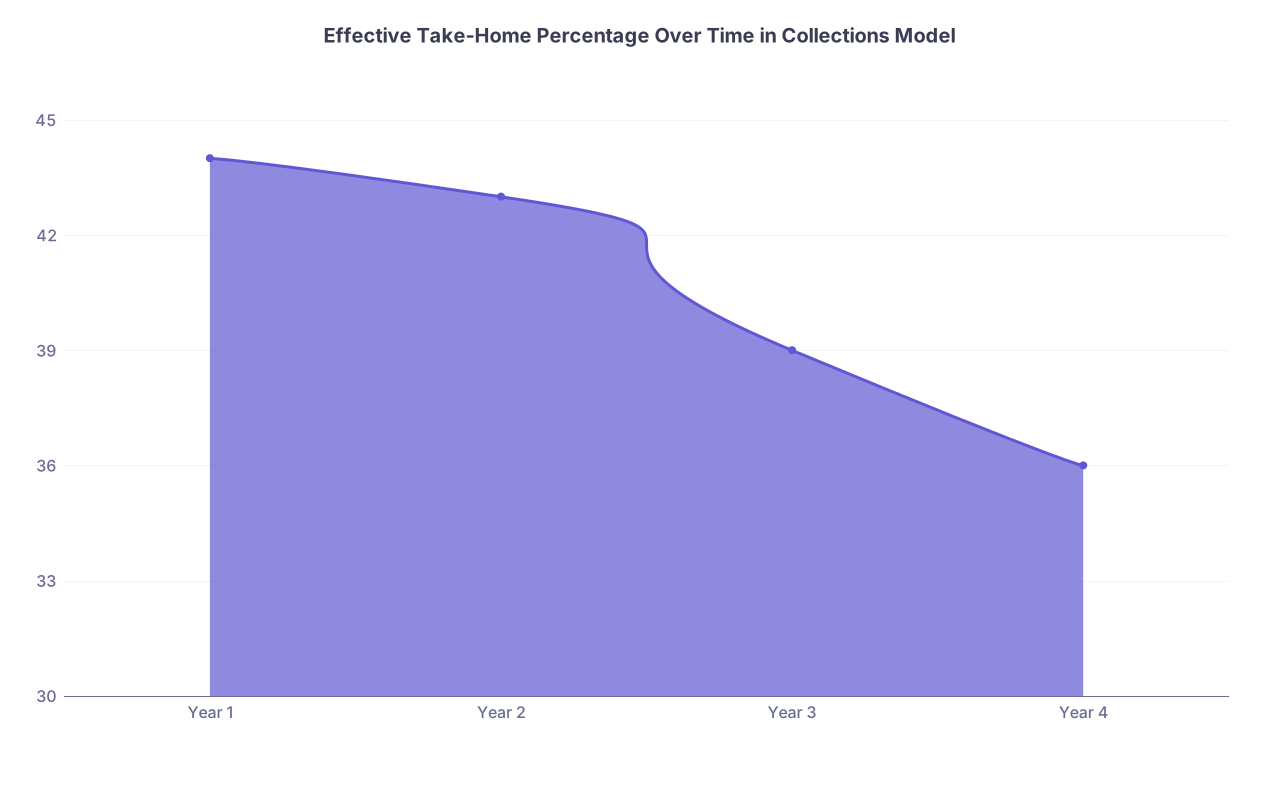
| Category | Value |
|---|---|
| Year 1 | 44 |
| Year 2 | 43 |
| Year 3 | 39 |
| Year 4 | 36 |
They brag that your collections “grew 20%.” Your actual income barely budged or even fell on a per-RVU or per-hour basis. The practice’s margin improved. Yours did not.
The “Tiered” Bonus System: Looks Generous, Pays Tight
Tiered productivity bonuses are a classic way to look generous on paper while capping real upside.
You’ll see language like:
- Tier 1: 0–6,000 RVUs – Base salary only
- Tier 2: 6,001–7,000 – $20 per RVU above 6,000
- Tier 3: 7,001–8,000 – $10 per RVU above 7,000
- Tier 4: >8,001 – “Discretionary” or low marginal rate
Notice the slope: your marginal dollar drops as you produce more.
If they really believed in rewarding productivity, the marginal rate would increase by tier, not decrease. Instead, they structure it so:
- The bonus curve is steep early (to get you to baseline productivity).
- The curve flattens or falls once you hit “high producer” territory, so they’re not writing you huge checks.
I sat through one redesign where an internal medicine doc ran the math and pointed out: “If I work 20% more, my effective hourly rate in tier 3 is actually lower than tier 2.” The admin response was:
“Well, that’s how the model stays sustainable.”
Translation: we want you to work more, but not get proportionally paid for it.
Productivity Caps Hidden in Your Schedule and Support
Not all caps are in the contract math. Some are operational.
Groups and health systems quietly restrict your productivity by controlling:
- Clinic templates
- Number and quality of support staff
- Access to OR time, procedure rooms, or imaging
- Referral flow and call distribution
If they decide you’re “earning enough,” they don’t need to touch your contract to cap you. They just throttle the inputs that generate your RVUs or collections.
You’ll see this in little moves:
- Your templates suddenly get “standardized” to fewer patients per session “for quality.”
- Your MA or scribe is reassigned, and you’re told to “adjust” for a quarter.
- Your blocked OR time gets redistributed “for equity.”
- New hires get funneled more new patients while you carry the chronic panel.
On the surface, it’s dressed up as fairness, quality, burnout prevention. Some of that is real. But I’ve watched CFOs explicitly say:
“If we keep feeding this person volume, we’ll be paying them 150k more than their peers. We should even things out.”
And the vents close.
“Citizenship” and Quality Metrics as Salary Governors
Another favorite lever: tying part of your comp to “citizenship,” “quality,” or “team-based performance.” Not because these aren’t important, but because they function beautifully as adjustable knobs on your take-home pay.
Typical structure:
- 70–80% of your comp tied to RVUs or collections
- 10–20% tied to “quality and patient satisfaction”
- 5–10% tied to “citizenship,” committee work, teaching, etc.
Sounds reasonable. But in practice:
- Those non-productivity buckets are subjective by design.
- They give the group wiggle room to curb your total pay without touching your published RVU rate.
- When admin feels comp is drifting “too high,” pressure is applied through these categories.
The conversation you never hear:
- “We can’t justify 500k based on their role and the region; can we tighten up quality payouts?”
- “Let’s raise thresholds for full citizenship credit; we’re paying out that pool too heavily.”
Suddenly, your quality score calculation changes. The thresholds move. The patient satisfaction scoring methodology “updates.” Your RVU pay is unchanged on paper, but your total check shrinks by 5–10%.
That may not sound like a cap. Over 10 years, that’s hundreds of thousands of dollars siphoned off without a single change to your headline wRVU rate.
The Contract Traps That Lock in the Cap
The most dangerous parts of your compensation model aren’t the obvious ones. They’re the one-liners that sound like boilerplate.
You’ll see gems like:
- “Compensation terms are subject to annual review and may be adjusted to reflect changes in market conditions or organizational policy.”
- “Productivity bonuses are not guaranteed and are contingent on the availability of funds and organizational performance.”
- “Employer reserves the right to modify the compensation plan at its sole discretion upon reasonable notice.”
These clauses are how they freeze or reduce your pay the moment they think you’re making “too much” relative to peers or “market.” It’s not about your individual performance anymore. It’s about optics and budget.
I’ve watched groups:
- Rebase wRVU rates downward mid-career
- Change the comp plan for all “new” RVUs while grandfathering only a portion
- Redefine what counts as “work RVUs” for bonus purposes
- Cap total productivity bonuses at a fixed dollar amount per doc per year
Meanwhile, the messaging to you sounds like:
“We’re just updating our plan to remain competitive and sustainable.”
Competitive for them. Sustainable for them. You’re the variable input, not the stakeholder.
How to Spot a Quiet Earnings Cap Before You Sign
You cannot eliminate all of this. If you work for someone, they will protect their margin. That’s the game.
But you can walk in with your eyes open and negotiate a plan that’s less rigged against you.
Here’s what you look for and push on:
Ask directly: “Is there any formal or informal cap on total compensation?”
Listen very carefully to how they answer. Evasiveness here is a red flag.Get specifics on how and when the plan can change.
Is your wRVU rate locked in for the entire term? Or “subject to annual review”? You want as much lock-in as possible.Demand transparency around “market alignment.”
If they say, “We pay at the 75th percentile,” ask: “Based on what? For my region? For my subspecialty? With what RVU expectation?” And ask what happens if your calculated comp exceeds that.Clarify overhead and methodology.
In a collections model, ask for:- A written definition of what’s included in overhead
- Historical overhead percentages for the group
- How overhead is allocated and whether you get a vote when it changes
Watch for decreasing marginal rates in tiered systems.
If the marginal pay per RVU or per dollar collected drops as you produce more, that’s a cap, not a reward system.Insist on clear, objective criteria for quality and citizenship.
Vague language here is basically a slush fund to adjust your pay downward later.
And one more thing: talk to the existing docs without admin in the room. Ask bluntly:
- “Have they changed the compensation model in the last 5 years?”
- “Did anyone here take a haircut after they became more productive?”
- “Does anyone feel like their income growth stalled despite doing more work?”
You’ll learn more in those 10 minutes than in three hours of recruiter slides.
Why This Keeps Happening – And What You Can Actually Do
You’re not paranoid. The system really is slanted.
Corporate medicine and large health systems are built on the assumption that physician labor is a cost center to be optimized, not a partner to be enriched. Productivity metrics are just the polite, spreadsheet-friendly language for controlling what you cost.
They’ll happily let you ramp up productivity. They’ll tolerate a couple of years of you riding high. But the longer you’re there, the more they’ll fine-tune the dials—RVU rates, “market alignment,” overhead, bonus tiers, citizenship metrics—to flatten your curve.
You do not fix this by working harder. You fix it by:
- Owning or co-owning the revenue stream (real partnership, not fake “partner track” employed roles).
- Negotiating real protections in your contract (locked rates, limited unilateral changes).
- Remaining willing to walk when they inevitably “rebalance” things against you.
The worst situation is being maximally productive in a system that has already quietly capped your upside. You feel exhausted and underpaid, and they feel like they’re “managing costs appropriately.”
That’s not an accident. That’s design.

Quick Reality Check: What “No Cap” Usually Means
When a recruiter or chair tells you, “There’s no cap on your earnings,” you should mentally translate it to:
“There is no stated numerical cap written in this document. But we reserve full power to change the underlying math, the overhead, the volume you get, or the market benchmark we use whenever your pay makes us nervous.”
If they refuse to put any of the following in writing:
- Minimum guaranteed wRVU rate for the full contract term
- Defined process and physician input for changing the comp model
- Boundaries on overhead allocation changes
- Explicit confirmation that productivity formulas will be honored as written for the contract duration
Then the “no cap” line is marketing copy. Nothing more.

The Bottom Line
You’re not crazy if you feel like your income plateaued right when you got efficient. That’s exactly when the system starts pressing down.
Three things to keep front and center:
- Productivity metrics are not neutral; they’re built and adjusted to protect institutional margins, even if that means quietly capping your upside.
- “Market data,” overhead, tiered bonuses, and vague quality/citizenship buckets are the levers groups use to flatten your earning curve as soon as you become an outlier.
- Your best defense is structural: negotiate locked-in terms, insist on transparency, talk to current docs, and be ready to move or own equity rather than trusting the system to “reward hard work.”
FAQ
1. Is any RVU-based or productivity model actually fair, or are they all rigged?
Some are reasonably fair for a while, especially in smaller, physician-led groups that actually show you the full books and treat you like a partner. The more layers of corporate or hospital admin between you and the money, the more likely the system is tilted. A fair model has: transparent math, locked-in rates for defined periods, clear RVU expectations, and no history of surprise “rebaselining” once people become high earners.
2. What’s one contract red flag that almost guarantees my earnings will be capped later?
Any clause that says the employer can “modify the compensation plan at its sole discretion” during the contract term is a huge red flag. That’s them telling you in legal language: “We’ll keep your base stable, but if you start earning too much on the productivity side, we’re free to change the rules.” You want that power either removed or tightly constrained with physician committee input and clear notice periods.
3. If my income already seems capped, is it better to fight internally or start planning an exit?
If you’re in a large system that’s already standardized comp with heavy “market alignment” language, you will rarely move the needle in your favor on your own. A few docs in key subspecialties can sometimes negotiate side deals, but for most, it’s more effective to quietly explore alternatives: independent practice, genuine partnership-track groups, or a competing system that still has flexible comp. You can certainly push for better transparency and locked-in terms at your next renewal, but do it while you’re gathering outside options, not instead of.