
It’s 9:30 p.m. You’re in the call room after clinic, half‑eaten salad next to your laptop, scrolling through an employment contract PDF. The recruiter told you, “Standard two‑year track, then you’re eligible for partnership. Our partners make mid‑$600s, easily.”
You glance at the “Partnership” section: three paragraphs of vague language, one reference to a separate “shareholder agreement” you haven’t seen, and no numbers.
You sign this wrong, and you will quietly leave $2–5 million on the table over your career. I’ve watched people do exactly that. Smart, hardworking physicians who never realized how rigged some partnership tracks actually are until it was way too late.
Let me walk you through how this really works behind the scenes.
The Illusion of “Standard” Partnership Tracks
Here’s the first uncomfortable truth: there is no “standard” partnership track. That phrase is pure sales language.
Groups use it because it calms residents and fellows who do not know what to ask yet. On the inside, here’s what actually varies:
- Who decides if you make partner
- How long the track really is
- How much you pay to buy in
- What “partner” actually means financially
- How easily you can be kept “just short” of partner, indefinitely
I’ve sat in meetings where managing partners said, about a new hire:
“We’ll see. If collections are strong, we can talk partnership. Otherwise, just keep them as an employee; margins are better.”
They’re not evil. They’re running a business. But you need to understand the game you’re walking into.
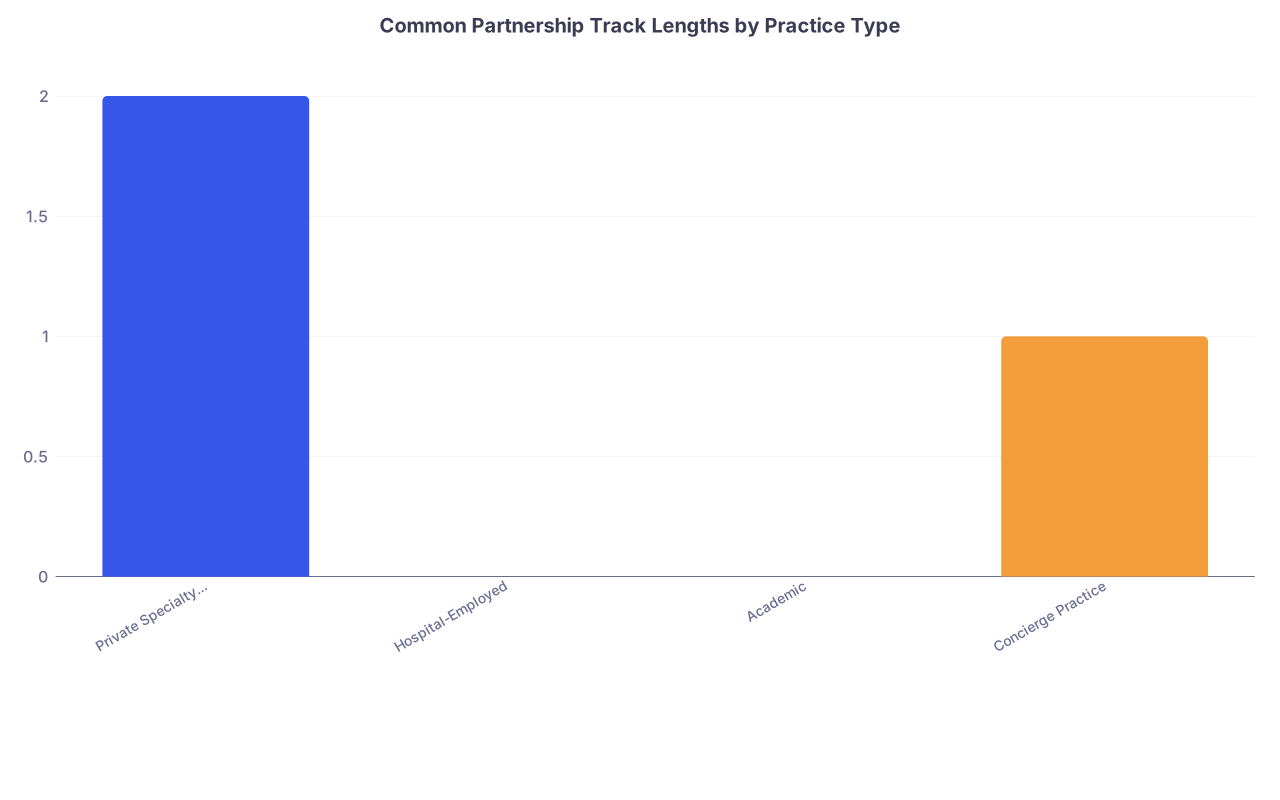
| Category | Value |
|---|---|
| Private Specialty Group | 2 |
| Hospital-Employed | 0 |
| Academic | 0 |
| Concierge Practice | 1 |
Hospital-employed and academic setups usually do not have a true equity partnership track in the private practice sense. Titles like “Senior Physician,” “Associate Professor,” “Medical Director” feel like promotion but do not give you ownership economics. Different animal entirely.
The huge lifetime income swings are almost all in private practice and independent group settings: radiology, anesthesia, EM groups, ortho, cards, GI, derm, large primary care groups, etc.
If you get those tracks right, your entire financial trajectory changes. If you misunderstand them, you can spend a decade doing partner‑level work for non‑partner pay.
The Real Money Is in the Spread, Not the Salary
This part almost no recruiter explains clearly, but every seasoned partner thinks about constantly.
As an employed physician, your “fair” comp is usually 40–55% of what you personally generate after overhead. The group keeps the rest. That “rest” is the spread. That’s where equity lives.
Once you’re a true partner, your income is tied to that spread.
Example from a real GI group I know:
- New hires: guaranteed $350k, then RVU/collections based, usually ending around $450k
- Partners: average $800–900k, some over $1M in strong years
Same clinic. Same building. Same nurses. Same call schedule. That $350–450k difference? That’s equity economics. Owning the spread from ancillaries, technical fees, midlevels, imaging, endoscopy center, real estate, lab.
Now stretch that difference out over 25 years:
- If you stay employee‑style forever at ~$450k
- Versus become partner at say $800k average over time
That’s $350k/year times 25 years = $8.75 million in extra gross earnings before taxes. Even after higher tax brackets, you’re talking multiple millions in additional net worth.
This is why partnership details matter more to your lifetime income than your starting salary.
But here’s the catch: groups design partnership tracks to capture your spread as long as they can without losing you. Some pretty aggressively.
How Groups Quietly Tilt the Track in Their Favor
There are patterns I see over and over when reviewing contracts and listening to partners off the record in closed meetings.
1. The “Eligibility” Shell Game
The contract often says something like:
“Physician will be eligible for consideration for partnership after two years of employment.”
That word “eligible” does a lot of work.
Actual internal criteria might include:
- Vague “cultural fit”
- Arbitrary production thresholds that can be shifted year to year
- Unwritten expectations about referral patterns, subspecialty focus, or politics
- Unstated partner votes (often supermajority, sometimes unanimous)
I’ve literally heard, “We never partner someone we don’t know well socially.” That is not in any legal document.
If your contract does not specify:
- Objective criteria (RVUs, collections, quality metrics)
- Timeline (review by X date, decision by Y date)
- Process (who votes, what percentage needed, what happens if you’re denied)
…then “2‑year track” means “we’ll see if we feel like it.”
2. The Moving Goalpost Production Target
Some groups set a revenue/production bar for partnership, but here’s the trick: they can adjust overhead allocation, call burden, or patient distribution in ways that make it very difficult for you to hit that bar.
I’ve seen this play out:
Year 1: You’re hungry, you take every add‑on, your numbers look great.
Year 2: They add another associate. Referral volume gets split. Suddenly you’re “underperforming,” even though your work ethic didn’t change.
Technically, you didn’t hit the partnership threshold. Practically, they engineered mediocre numbers by changing the inputs.
3. The “Half Partner” Mirage
This is more common in larger multi‑specialty groups and some radiology/emergency groups:
They’ll give you a fancy new title—“junior partner,” “senior associate,” “track shareholder.” You get a slight bump in profit sharing, maybe some token voting rights.
But the real power and real money are still with the founding partners or senior tier. You think, “I made it!” They think, “We just locked them in for longer without giving up much.”
Ask explicitly:
Does “partner” here mean equal share and equal vote with senior partners? If not, what exactly is different?
The Buy‑In: Where Lifetime Math Lives or Dies
This is where physicians either quietly win or quietly bleed.
The buy‑in is what you pay to get access to equity. It can be:
- A one‑time lump sum
- Payroll deduction over several years
- A haircut on your collections for a set period
- Or some mix of all three, plus loan guarantees or capital accounts
The number itself is almost meaningless out of context. $300k could be a steal or a scam. You have to tie it to cash flow.
| Scenario | Buy-In | Pre-Partner Income | Partner Income | Payback Time |
|---|---|---|---|---|
| A - Strong GI group | $300k | $450k | $900k | <1 year |
| B - Mediocre cards group | $250k | $500k | $600k | 2.5 years |
| C - EM group, weak contracts | $150k | $400k | $450k | 3+ years |
In Scenario A, you’d be insane not to buy in if the risk is reasonable. You recoup your buy‑in in less than a year and then enjoy the spread for decades.
In Scenario C, you might be paying $150k for an extra $50k/year that may erode with hospital contract renewals. That’s not obviously worth it, especially if the group is losing leverage.
Here’s what partners usually talk about among themselves, not with you:
- How can we price the buy‑in so we’re not “giving away” the practice too cheaply?
- How much future upside are we comfortable sharing?
- Can we increase the buy‑in next year for new associates to capture more of the value we’ve built?
- Will this buy‑in discourage weaker candidates from even trying for partnership?
I’ve been in those conversations. The tension is real: they want strong docs to stay, but they do not want to slice the pie into 30 equal pieces if 10 of those are dead weight.
So they design a buy‑in that screens for commitment and pain tolerance. That’s the subtext.
The Document You Haven’t Seen Yet: Shareholder / Operating Agreement
The contract they send you first is usually the employment agreement. That’s your salary, benefits, duties, termination.
The partnership economics live in a different document:
- Shareholder agreement (if corporation)
- Operating agreement (if LLC)
- Partnership agreement (if actual partnership)
Most new hires never see this until right before buy‑in. Huge mistake.
This is where you find out:
- How profits are actually split (equal shares vs production‑based vs hybrid)
- Who owns ancillaries, imaging, surgery centers, labs, and real estate
- How votes work (one person, one vote? weighted by shares?)
- What happens if you’re fired, disabled, or die
- How your equity is valued when you leave (this one is massive)
Ask — in writing — during recruitment:
“If I complete the partnership track, will I be signing the same shareholder/operating agreement that current partners are under? May I review a copy now, with redacted names if needed?”
If they refuse, be very cautious. That’s like being offered a house without seeing the HOA rules or property lines.
The Exit Trap: Valuation and Buy‑Out
This is the quiet, late‑career landmine.
You think partnership is all about the upside now. You’re not thinking about what happens when you are 55 and burned out, your spouse wants to move states, or a hospital system buys your group.
But the senior partners who wrote the original documents were absolutely thinking about this.
They usually structure things to:
- Protect the group from cash flow shocks when someone leaves
- Discourage early exits
- Favor those who stay until a “liquidity event” (e.g., sale to PE or hospital)
Common mechanisms:
- Book value equity: Your shares are bought back at some accounting value, not market value, often excluding goodwill. Translation: you’ve built a very valuable practice, but on paper your equity is worth less than you think.
- Multi‑year payout: Your buy‑out is paid over 3–7 years, often contingent on continued practice profitability.
- Discounted early exit: If you leave before X age or Y years of partnership, your buyout is reduced.
I’ve seen a very profitable multispecialty group in the Midwest where partners made $750k+ for years, but the shareholder agreement valued their equity at book value of about $200k when they left. The “real” market value if sold to PE would have been several million per partner.
Who captured that spread when they eventually sold? The last cohort in, not the ones who built it.
This is why you do not only ask, “What do partners make now?” You also ask, “How is equity valued if I leave, retire, or if we sell to a third party?”
Private Equity: The Silent Clock on Your Partnership Plans
In many specialties, private equity is the elephant in the room. Dermatology, GI, anesthesia, radiology, ophtho, urology, even primary care in some markets.
Here’s the candid version: by the time you’re being recruited, in a lot of groups the partners already have PE term sheets or at least banker conversations. They might not tell you outright, because uncertainty scares recruits.
What this means for your lifetime income:
- If a sale happens before you’re a full partner, you might get a retention bonus, maybe an employment agreement bump, but you will not participate meaningfully in the equity sale.
- If a sale happens after you’re a full equity partner, you get your share of the sale proceeds, which can be 1–3x your annual income in a lump or staged payout.
I’ve seen senior partners walk with $1–3 million each in a PE sale while the associates—who were working similar hours in the same clinic—got a $50k “transition bonus” and a smile.
Nobody is obligated to make that fair. They are allowed to say, “You were not a partner yet. That’s the deal.”
If you’re entering a group in a “hot” specialty and they talk vaguely about “exploring strategic options,” assume there’s a real clock on when you need to get to full partnership if you ever want to touch that equity event.
The Non‑Compete and “Golden Handcuffs”
You cannot talk about partnership tracks and lifetime income without talking about non‑competes. Because this is the stick that enforces the carrot.
Groups know you’re more docile when you feel trapped.
Common pattern:
- They give you a decent salary, RVU bonus potential, nice colleagues, “track” talk.
- The non‑compete covers a ridiculous radius (15–25 miles in urban settings, county‑wide or region‑wide in rural).
- They invest heavily in building your panel under the group’s name.
- By the time you realize partnership is fuzzy or stingy, all your patients are tied to a practice you can’t easily leave without moving or starting from scratch across town.
I’ve seen associates quietly eat years of sub‑partner comp because they had kids in local schools, a spouse with a local job, and a non‑compete that made leaving almost impossible without detonating their personal life.
From the group’s perspective, this is rational. They’d rather have a motivated, handcuffed associate than a partner taking full equity share, if they can pull it off.
From your perspective, that non‑compete is not just about “can I moonlight.” It’s leverage in your partnership discussions. Weak non‑compete = stronger bargaining position. Strong non‑compete + vague partnership terms = you’re volunteering to be underpaid for years.
What Savvy Recruits Quietly Do Differently
You can’t fix every power imbalance, but you can stop walking in blind.
Here’s how the sharp applicants operate—the ones who end up on the winning side of these deals.
They talk to current and former associates
Not just the partner assigned to woo you. They find:
- The associate one year ahead of them on the track, and ask, “Are you actually on pace? Has anything changed since you signed?”
- The associate who left, if they can track them down, and ask, “Why did you really leave? What surprised you about the partnership process?”
You’d be amazed how candid people are once they’re out.
They insist on real numbers, not adjectives
They don’t accept “Our partners do very well” as an answer.
They ask:
- “What was the average W2 or K‑1 income for partners over the last 3 years?”
- “What’s the range—from 25th percentile to 75th—for partner income?”
- “What’s the typical collections multiple we pay for buy‑in?”
- “How much did the last partner who left receive as a buy‑out, and over what time period?”
And they shut up and let the awkward silence work.
They get the right lawyer involved, at the right stage
You probably know you should have a lawyer review your contract. Here’s what people miss: you want one who has actually seen partnership deals in your specialty, not a generic employment attorney.
A lawyer who’s reviewed 20+ GI or radiology partnership tracks in your region knows which groups consistently treat associates fairly and which ones have a reputation for “stringing people along.”
They will never put that in writing, but they will absolutely hint at it on the phone.

| Step | Description |
|---|---|
| Step 1 | Associate Offer |
| Step 2 | Employee Path |
| Step 3 | Request Agreements |
| Step 4 | High Risk - Negotiate or Walk |
| Step 5 | Assess Buy In and Payout |
| Step 6 | Marginal Economics |
| Step 7 | Strong Partner Track |
| Step 8 | Accept and Plan for Partnership |
| Step 9 | Track to Equity? |
| Step 10 | Clear Criteria? |
| Step 11 | Payback < 3 years? |
The Quiet Math You Should Run Before You Sign
You do not need a full financial model. But you should at least run a back‑of‑the‑envelope comparison of lifetime trajectories.
Two questions matter more than all the rest:
- If I stay an employee here or in a similar role for 20–25 years, what’s my realistic income path?
- If I make partner here and the group stays stable, what’s my realistic income path, including buy‑in and possible buy‑out?
Even with conservative assumptions, the gap can be staggering.
Take a simple example:
Employee path:
- Start at $350k, growth to $450k, then inflation‑type raises to $500k over 10–15 years. Call it $475k average over 25 years.
Partner path:
- Two years at $350k–400k average, then 23 years at $800k average, minus a $300k buy‑in in year 3.
Rough math:
- Employee: 25 × $475k = $11,875,000 gross
- Partner: (2 × $375k) + (23 × $800k) – $300k
= $750k + $18,400,000 – $300k
= ~$18,850,000 gross
Difference: about $7 million before taxes.
Even if I’m off by 20%, this isn’t noise. This is whether you retire at 55 with options or are hustling to patch holes at 68.
Most residents I talk to spend more time negotiating an extra $10k on their starting salary than they do interrogating the partnership economics that swing seven figures over time. That’s backwards.
Years from now, you won’t remember exactly how much your first offer paid or how nervous you were on that first negotiation call. You will absolutely feel whether you chose a path that gave you real ownership or kept you permanently on the outside, doing partner work for employee pay.
The unspoken rules are simple once you’ve seen them: equity lives in the spread, documents matter more than promises, and the people already at the table wrote the rules to protect themselves first. Your job is not to fight that. Your job is to see it clearly and choose—deliberately—whether stepping into that track actually changes your lifetime income the way they’re implying, or just changes your title.