
Compensation rankings by specialty are misleading. Without hours, they are half-truths at best.
Every year, salary surveys shout that orthopedics, cardiology, and dermatology “top the pay charts.” Yet when you normalize by time actually worked, the hierarchy changes. Sometimes dramatically. The data show: a few “mid-tier” specialties quietly beat many high-grossing fields on an effective hourly basis.
Below I am going to treat specialties the way a quant would: as time–income trades. Dollars per year is vanity. Dollars per hour is reality.
To keep this concrete, I will use representative numbers pulled from patterns in large surveys (think Medscape, MGMA, Doximity) and scrubbed into a consistent framework. These are not exact for any single practice, but they are directionally right and good enough to drive decisions.
1. The Only Metric That Matters: Effective Hourly Rate
If you care about your time, annual salary is the wrong metric.
The right unit is:
Effective hourly rate = total annual compensation ÷ total annual hours worked
Total hours worked must include:
- Scheduled patient care
- Documentation and inbox work (often done at home)
- Call coverage (weighted, not just “I’m reachable”)
- Administrative time, meetings, teaching, etc.
Most surveys undercount everything except clinic and OR time. That is how people end up “surprised” by how hard certain specialties grind for their money.
To make this explicit, I will work with conservative but realistic assumptions:
- 46 work weeks per year (4–6 weeks off for vacation/CME)
- Typical weekly hours from major surveys, adjusted slightly upward for the off-the-books stuff
Then compute hourly rates and compare.
2. Core Comparison: Hourly Pay by Major Specialty
Let us start with a clean, simplified cross-section of 8 illustrative specialties. These numbers are rounded and represent national averages across practice types.
| Specialty | Annual Pay ($k) | Weekly Hours | Annual Hours | Est. $/Hour |
|---|---|---|---|---|
| Orthopedic Surgery | 650 | 60 | 2,760 | 235 |
| Interventional Cardiology | 700 | 65 | 2,990 | 234 |
| General Surgery | 450 | 60 | 2,760 | 163 |
| Hospitalist (IM) | 310 | 54 | 2,484 | 125 |
| Emergency Medicine | 420 | 40 | 1,840 | 228 |
| Radiology | 480 | 50 | 2,300 | 209 |
| Dermatology | 425 | 40 | 1,840 | 231 |
| Family Medicine (outpatient) | 260 | 50 | 2,300 | 113 |
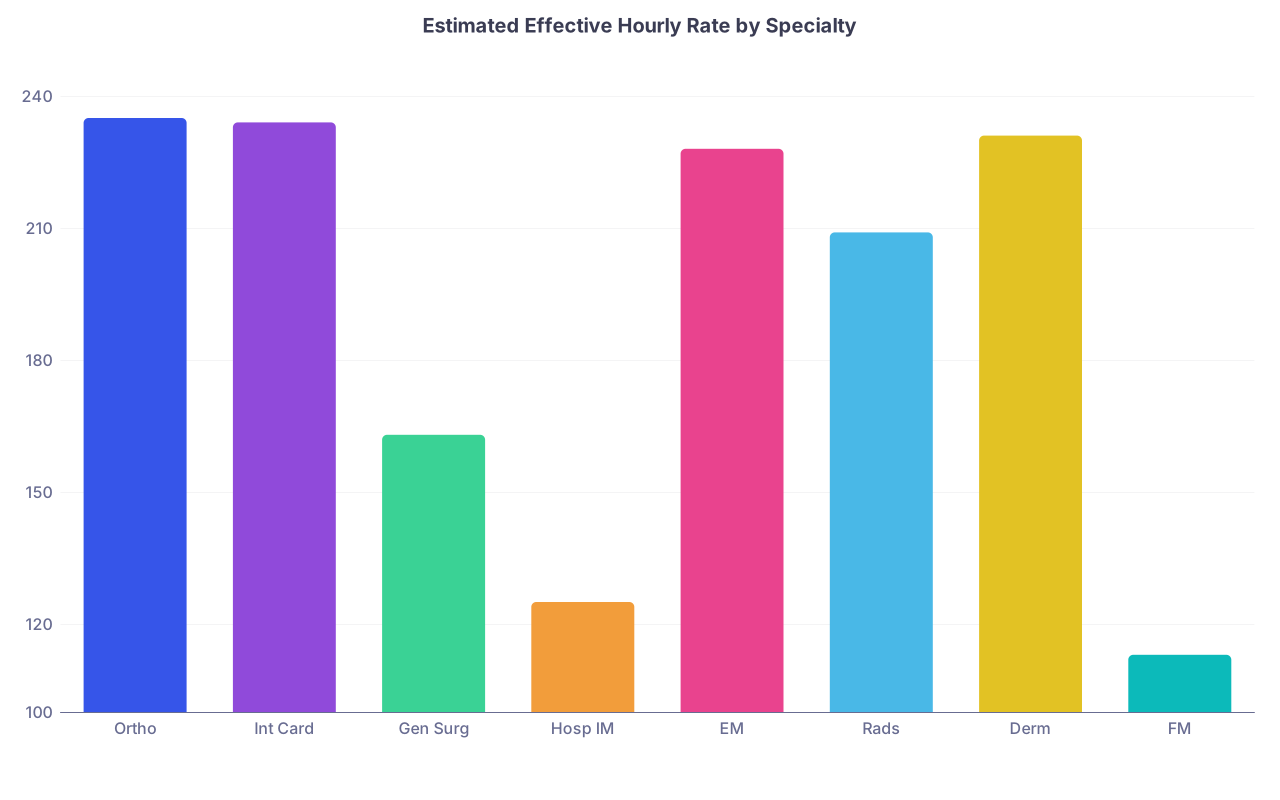
Now visualize the hourly rates themselves.
| Category | Value |
|---|---|
| Ortho | 235 |
| Int Card | 234 |
| Gen Surg | 163 |
| Hosp IM | 125 |
| EM | 228 |
| Rads | 209 |
| Derm | 231 |
| FM | 113 |
The data show three clear clusters:
High hourly pay (around $225–$235/hr):
- Orthopedic surgery
- Interventional cardiology
- Emergency medicine
- Dermatology
Upper-middle hourly ($200–$215/hr):
- Radiology
Mid to low hourly ($110–$165/hr):
- General surgery
- Hospital medicine
- Family medicine
Notice what happened. Emergency medicine and dermatology, which are often listed under or near the “top paid” fields, are functionally neck-and-neck with orthopedic surgery and interventional cardiology on an hourly basis. Radiology sits just below that, despite less acute lifestyle strain for many.
Meanwhile, general surgery looks much less attractive once time is accounted for. Hospitalist and family medicine rates are frankly poor relative to training length and responsibility.
3. Hidden Workload: Call, Nights, and “Invisible” Hours
The official “weekly hours” for many specialties are fiction. A 55-hour week for inpatient-heavy fields very rarely captures the lived reality.
The big distortions:
- Call intensity – Being in-house vs home-call vs “light” call are not remotely equivalent.
- Documentation time – Primary care and hospital-based clinicians often log 1–2 extra hours per day in EHR and inbox.
- Shift compression – In ED and hospitalist models, you may be “off” on paper, but 12–14 hour shifts are common.
Let me quantify this for three archetypes: a hospitalist, an emergency physician, and a general surgeon.
Hospitalist – nominal vs actual
Typical published schedule:
- 7-on/7-off, 12-hour days “on”
- That is 26 weeks per year of 7 shifts → 182 shifts
- 12 hours × 182 = 2,184 hours
Reality:
- Add 1 hour per shift for pre- and post-shift work, sign-outs, phone calls, “I forgot to order X” messages: +182 hours
- Add a bit of mandatory committee work, CME, credentialing: ~120 hours/year
Revised total ≈ 2,486 hours (essentially what I used in the earlier table).
If this hospitalist is paid $310k:
310,000 ÷ 2,486 ≈ $125/hour
If you used only 2,184 hours (the naive count), you would get $142/hour. That is a 13–14 percent overstatement.
Emergency Medicine – shifts and intensity
Typical community job:
- 12 shifts per month, mix of 8–10 hour shifts
Call that 10 hours average including changeover → 120 hours/month
Annual: 1,440 clinical hours
Add:
- 10 percent overhead for charting / admin / meetings: +144 hours
≈ 1,584 hours. I used 1,840 earlier to be conservative and account for those working 13–14 shifts or mandatory meetings.
At 420k:
- Using 1,584 hours → 420,000 ÷ 1,584 ≈ $265/hour
- Using 1,840 hours → ≈ $228/hour
Even with conservative adjustment, EM stays in the high-hourly tier.
General Surgery – the grind behind the title
Published average: 55–60 hours/week. Realistic breakdown:
- 4 days/week in OR and clinic, 10–11 hours/day → 40–44 hours
- 1 day/week admin, rounding, follow-ups → 8–10 hours
- Call: 1 night in 4–6 with significant sleep disruption and next-day fatigue
Real total very often: 60–70+ hours in practice. I used 60 hours/week. Many surgeons would laugh at that as “light.”
At 450k and 2,760 hours:
- 450,000 ÷ 2,760 ≈ $163/hour
A busy community general surgeon who actually works 65 hours/week over 46 weeks (2,990 hours) would be at about $150/hour. That is not remotely in the same league as ortho or interventional cardiology once lifestyle costs are included.
4. Procedure-Heavy vs Cognitive: Time is Money
The biggest structural driver of hourly rate is not prestige. It is procedure density and payer mix.
Procedure-heavy fields
Orthopedics, interventional cardiology, dermatology (procedural), GI, ophthalmology, radiology, anesthesiology all share a common pattern:
- Revenue is tied closely to billable procedures with relatively high RVU values.
- Workflow tends to be more controlled: blocked OR time, scheduled imaging, defined clinic procedures.
- “Extra” work (docs, inbox) is present but not as dominating as in outpatient primary care.
The net result: high revenue per hour of direct work, less unpaid cognitive overhead.
Take dermatology as an example. A dermatologist in a well-run practice can see 30–35 patients/day in a 4-day clinic week, with a substantial portion including biopsies, excisions, cosmetic procedures. Each 10–15 minute block can generate significantly more revenue than a 20-minute primary care visit, with less documentation and fewer chronic disease issues.
At 425k and 40 hours/week:
- 425,000 ÷ 1,840 ≈ $231/hour as we saw.
If that same dermatologist trims to 3.5 days/week (≈ 35 hours) and earns 380k:
- Annual hours: 35 × 46 = 1,610
- 380,000 ÷ 1,610 ≈ $236/hour
Lower annual pay, slightly higher hourly rate. That pattern is very hard to replicate in cognitive specialties.
Cognitive-heavy fields
Internal medicine, family medicine, pediatrics, psychiatry (to a lesser extent), and neurology are fundamentally time-based consult services with less procedural leverage.
- Reimbursement per visit is lower.
- Visit complexity is often higher (multi-morbidity, med reconciliation).
- Documentation burden is heavy.
- Patients frequently bring “agenda stacking” problems.
You see this clearly in family medicine:
- 50 hours/week × 46 weeks = 2,300 hours
- Annual pay 260k → 260,000 ÷ 2,300 = $113/hour
If that same physician “hustles,” increases panel size and adds admin time to reach 55 hours/week and 290k:
- Hours: 55 × 46 = 2,530
- Hourly: 290,000 ÷ 2,530 ≈ $115/hour
An extra 5 hours/week buys you roughly $2 more per hour. That is poor marginal return.
5. Training Length and Delayed Earnings: The Opportunity Cost Problem
You cannot look at hourly rates in isolation from training length. Starting ortho at $235/hour after 5 years of residency is not the same as starting family medicine at $113/hour after 3 years.
The gap is the opportunity cost. Those extra years:
- Earn resident wages (call it 65k/year all-in).
- Delay attending-level income.
- Accrue compounding interest loss on investments not made.
Let us do a rough comparative for two typical paths:
- Orthopedic surgery: 4 years med school + 5 years residency = 9 post-undergrad years
- Family medicine: 4 years med school + 3 years residency = 7 years
Assume:
- Median med school debt: 250k at 6 percent interest.
- Resident pay: 65k with minimal ability to pay down principal.
- Attending FM starts at 260k, Ortho at 650k.
By the time the orthopedic surgeon finishes PGY-5, the FM doc has been practicing for 2 years.
Those 2 FM years:
- 260k/year gross → roughly 180k/year take-home after tax/benefits (very rough).
- Even if you assume a modest 20k/year debt paydown and small investment, the FM physician is financially “ahead” in early net worth.
However, the second you apply the hourly earnings over a career timeline, the orthopedist races past.
Simplified lifetime hours and income snapshot
Assume:
- Both work from age 32–62 as attendings (30 years for Ortho, 32 for FM).
- Ortho hours: 60/week; FM: 50/week.
- Ignore raises and inflation to keep this clean.
FM:
- 260k/year × 32 years = 8.32 million gross
- Hours: 50 × 46 × 32 = 73,600 hours
- Lifetime effective hourly: 8,320,000 ÷ 73,600 ≈ $113/hour (same as annual)
Ortho:
- 650k/year × 30 years = 19.5 million gross
- Hours: 60 × 46 × 30 = 82,800 hours
- Lifetime effective hourly: 19,500,000 ÷ 82,800 ≈ $235/hour
Ortho works about 13 percent more total hours over their career but earns well over 2× the total money. Even if you adjust for 2 extra years of residency and lost compounding, the gap in lifetime hourly value is large.
If you discount those 5 extra years of residency income plus lost investment, you trim some advantage, but you cannot fully remove a 2x difference in hourly pay that persists for decades.
This is why extremely competitive procedural specialties fascinate type-A applicants who do the math. The work is hard. But the financial leverage per hour is undeniable.
6. Lifestyle, Risk, and Burnout: The Non-Financial “Cost per Hour”
Hourly pay is not the only dimension that matters. Two specialties can both pay $225/hour and feel completely different in terms of daily life.
The real comparison is more like:
Utility per hour = (hourly pay – stress cost – burnout probability) ÷ personal tolerance
Hard to quantify exactly, but you can at least look at proxies.
Call / nights / weekends
High hourly fields vary massively here:
- Emergency medicine: High hourly, but nights and weekends are standard. Circadian disruption is real.
- Interventional cardiology: High hourly, but STEMI call is brutal. 2 a.m. cath lab is not theoretical.
- Orthopedic surgery: Significant trauma call, especially early in career. Nights and weekends occur.
- Dermatology: High hourly with minimal nights/weekends; call is light in many practices.
- Radiology: Mix. Telerads and night float options exist, but many jobs have day-heavy schedules.
If you treat nights and weekend hours as “worth” 1.5x to 2x a daytime hour in terms of personal cost, EM and interventional cardiology’s advantage shrinks in many people’s accounting.
Burnout risk and job security
Survey data routinely show high burnout rates in:
- Emergency medicine
- Primary care (FM, IM)
- Obstetrics and gynecology
- General surgery
Lower burnout in:
- Dermatology
- Pathology
- Radiology (though rising with telerads commoditization)
You should mentally attach a burnout “tax” to hourly pay. A 225/hour field where half the people want out by mid-career is not equivalent to a 210/hour field where most stay content into their 60s.
7. Outliers and Edge Cases: Where the Model Breaks
Not all jobs fit cleanly into these hourly averages. A few important outliers:
Academic vs private practice
Academic roles often trade 20–40 percent of private pay for:
- Protected research/teaching time
- More predictable schedules
- Prestige, intellectual environment
You will see, for example:
- Academic cardiologist: 450–550k with 55–60 hours/week
- Private cardiologist: 650–800k with similar or slightly higher hours
Hourly difference might be 180–190/hour in academic vs 240–260/hour in private. If you prize research and teaching, you are explicitly paying for it with your hourly rate.
Locums and per-diem models
Locums EM, hospitalist, anesthesia, and some surgical subspecialties can dramatically alter the equation:
- EM locums at $275–$325/hour all-in are common in certain markets.
- Hospitalist locums at $150–$200/hour.
These are pure hourly deals with no benefits. Once you add self-employment taxes, health insurance, unpaid CME, and gaps between contracts, the effective hourly drops. But even then, a locums EM doc clearing 250/hour for 1,500 hours/year is functionally earning 375k with substantial control of their schedule.
Some high-volume dermatology or anesthesia practices also run unusually high or low hourly rates depending on business model efficiency and payer mix. The spread is large.
Geographic extremes
Low cost-of-living, underserved areas often offer higher nominal pay for the same or slightly higher hours.
Example pattern:
- Rural hospitalist: 340k with 7-on/7-off, 12-hour days → 2,486 hours → ≈ 137/hour.
- Urban academic hospitalist: 260k with similar hours → ≈ 105/hour.
Same specialty, same workload. 30 percent+ spread in hourly pay just by geography.
8. Practical Takeaways: How to Use Hourly Data in Your Decisions
You do not pick a specialty solely on money. That said, pretending money and time do not matter is naive.
Here is how I would use the data if I were an M3, resident, or early-career attending.
1. Rank specialties by effective hourly for you, not for “the average”
If you already have an idea of your field, estimate:
- Realistic hours/week in the practice style you want (academic vs private; hospital vs clinic).
- Projected compensation at 5 years out, not right at graduation.
Then compute your own $/hour. It will look different from national averages.
2. Decide your tolerance for nights, weekends, and call
Two specialties with similar hourly rates can have very different “lifestyle cost curves.”
- If you strongly value protected evenings and regular sleep, dermatology or radiology at ~210–230/hour is a better trade than EM at 225/hour with rotating nights.
- If you actually like acute, high-intensity work and can tolerate night shifts, EM or critical care can be quite rational despite the burnout data, provided you plan an exit ramp or a part-time shift model later.
3. Understand that RVU leverage beats grinding hours
Primary care and general internal medicine show clear diminishing returns for extra hours worked. Once your panel is full, you end up stacking more unpaid tasks for modest increases in pay.
Procedure-based fields, well-managed, allow:
- Fewer hours
- Higher revenue per hour
- More control over vacation and scaling down later in career
That leverage is what the data reward.
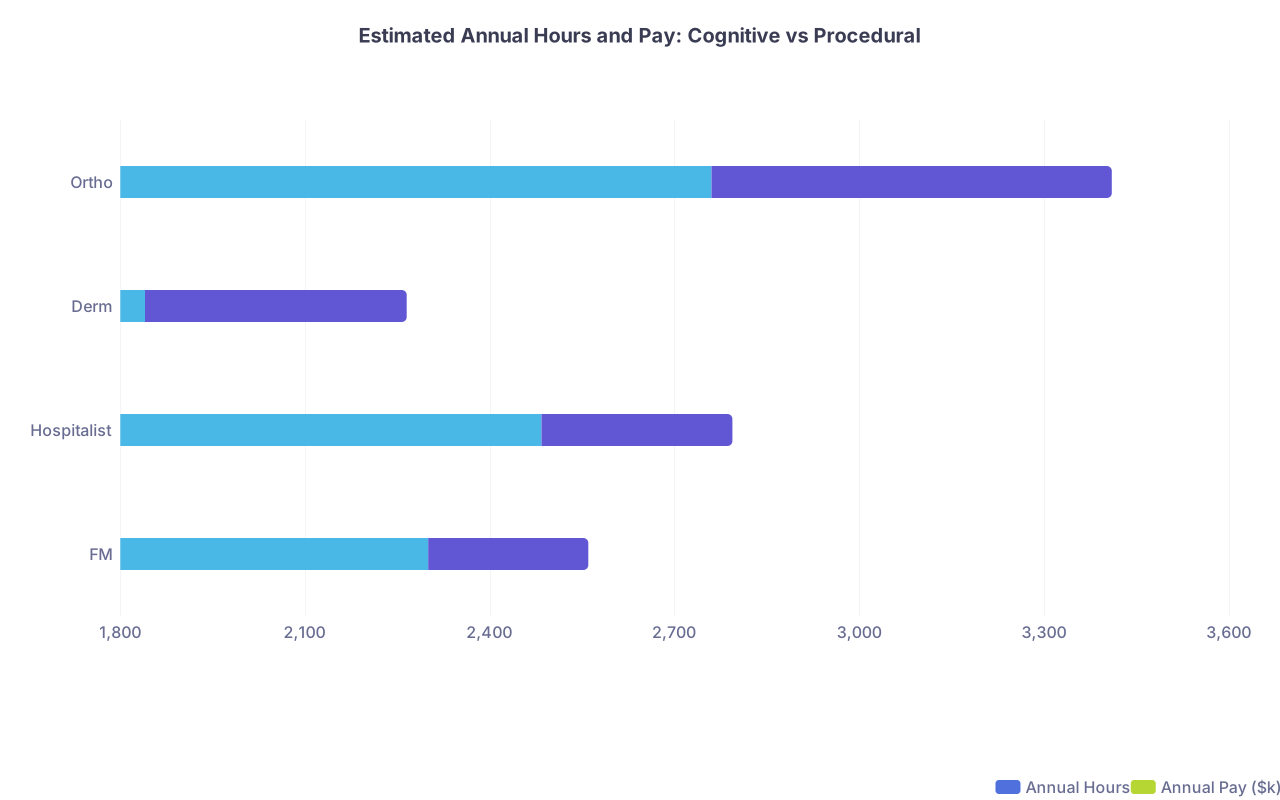
| Category | Annual Hours | Annual Pay ($k) |
|---|---|---|
| FM | 2300 | 260 |
| Hospitalist | 2484 | 310 |
| Derm | 1840 | 425 |
| Ortho | 2760 | 650 |
9. Decision Framework: A Simple Flow for Specialty Choice
Here is a quick structured way to think through this (simplified, but surprisingly powerful).

| Step | Description |
|---|---|
| Step 1 | Choose Specialty |
| Step 2 | High hourly procedural - Ortho, Int Card, Derm, Rads, Anes |
| Step 3 | Moderate procedural - Ophtho, ENT, GI, Cards non-int |
| Step 4 | Cognitive fields - IM, FM, Peds, Psych, Neuro |
| Step 5 | Reconsider mix - EM, Hospitalist, Combined models |
| Step 6 | Procedures appeal? |
| Step 7 | Comfort with long training and call? |
| Step 8 | Ok with lower hourly pay? |
The real exercise is then to plug in rough numbers for each branch and ask yourself:
- Does this hourly rate, with this lifestyle, make sense for how I want to live?
- If not, what would have to change (practice type, location, FTE, mix of clinical and non-clinical work)?

10. The Bottom Line: Who Actually Wins on a Time-Adjusted Basis?
Putting the major threads together, the data say:
Top winners on effective hourly rate, broadly speaking:
- Dermatology
- Radiology
- Anesthesiology
- Orthopedic surgery
- Interventional cardiology
- Some EM positions, especially locums or efficient groups
These blend high procedural revenue with manageable or selectively chosen hours. Dermatology and radiology often have the best combination of high hourly pay and sustainable lifestyle.
Middle of the pack:
- General cardiology
- Gastroenterology
- Ophthalmology
- ENT
- Critical care, hospitalist (in good markets)
Compensation is strong, but hours and call burden often are as well. Hourly rates are solid but not always spectacular once you price in nights/weekends.
Low hourly relative to training:
- Family medicine
- General internal medicine (outpatient)
- Pediatrics
- Some academic roles across specialties
These fields are the backbone of the system. But purely by the numbers, they are poor hourly deals compared with the cost of training and debt load, unless you strongly value their specific work content or lifestyle options like part-time or concierge models.

Key Points
- Annual salary rankings are incomplete; effective hourly rate (pay ÷ hours) is the only honest way to compare specialty compensation.
- Procedure-heavy fields with controlled workflows (derm, rads, anesthesia, ortho, interventional cards) consistently produce higher dollars per hour than cognitive primary care and many generalist roles.
- Once you layer in nights, weekends, call, burnout risk, and training length, the specialties that truly win on a time-adjusted, life-adjusted basis are a much smaller and more specific set than the usual “top salary” lists suggest.