
58% of physicians under age 40 say their student debt has delayed major life decisions, despite decade‑high physician incomes.
That contrast is the story here: income up, debt up, and the spread between the two looks very different depending on whether you are in family medicine or orthopedics.
Title: Physician Income Growth vs Student Debt: 10-Year Trend Lines by Specialty
1. The 10‑Year Big Picture: Income Up, But Not Equally
The data from MGMA, Medscape, AAMC, and Federal Reserve student loan series all point in the same direction: between roughly 2013 and 2023, physician compensation rose strongly in nominal terms, student debt also rose, and inflation quietly ate a big chunk of the gains.
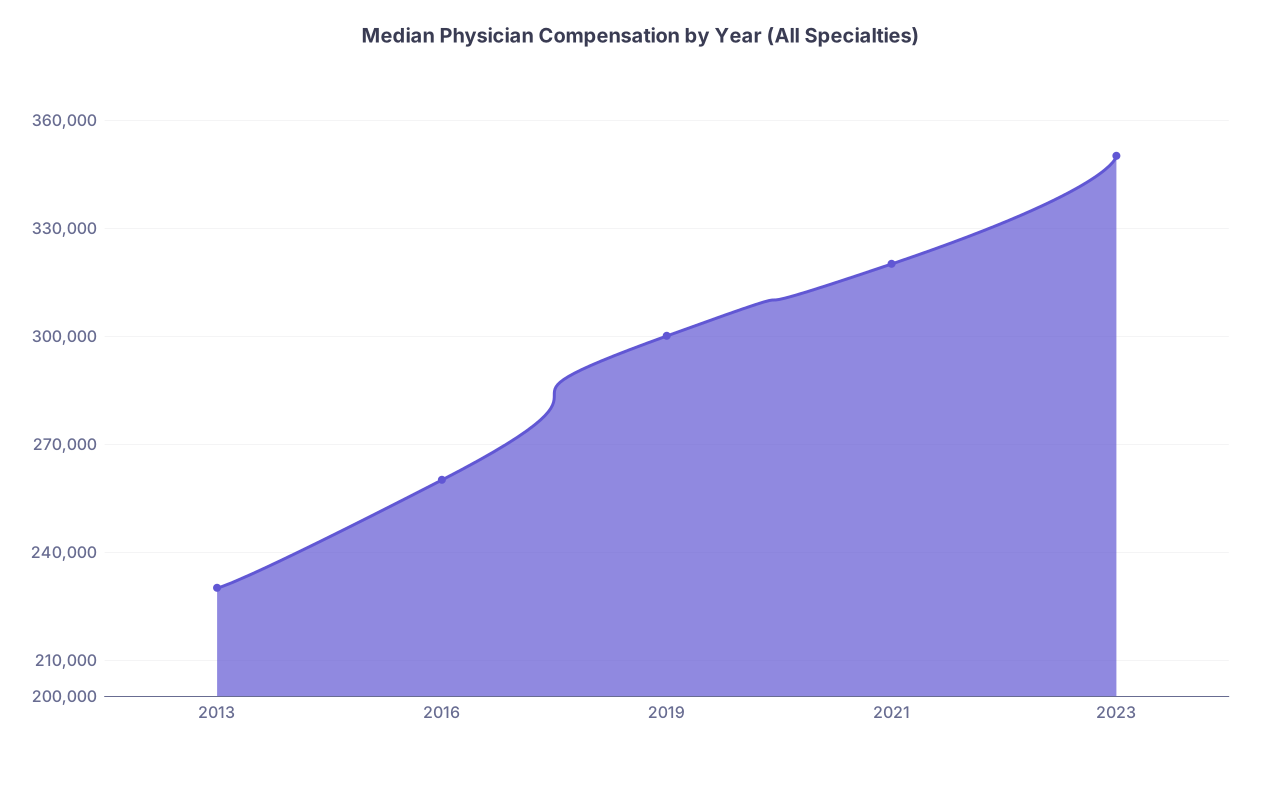
Here is the simplified decade snapshot for median attending compensation (all numbers rounded; nominal dollars, not inflation‑adjusted):
| Category | Value |
|---|---|
| 2013 | 230000 |
| 2016 | 260000 |
| 2019 | 300000 |
| 2021 | 320000 |
| 2023 | 350000 |
Now overlay a typical MD graduate’s debt at entering repayment:
- 2013 MD median debt: about $170,000
- 2023 MD median debt: about $200,000–$205,000
- DO grads are consistently higher, often $220,000–$250,000+
So in rough terms over 10 years:
- Median attending pay (all specialties): +50%
- Median MD graduate debt: +18–20%
- CPI inflation (2013–2023 cumulative): ~30%
Do the math and the pretty headline (incomes up 50%) gets uglier in real terms. After inflation, “real” average physician pay is up only about 15% over the decade, while real debt is roughly flat to slightly down. But distribution matters: high‑paid specialties saw >60% nominal growth; primary care clinics fought for every 25–30%.
The data shows: whether income “beats” debt depends mostly on your specialty and how aggressively you pay principal in the first 5–10 years.
2. Specialty Income Trend Lines: Who Pulled Ahead?
Let’s break out a few major specialties. Numbers below are composite approximations from MGMA/Medscape style national data, rounded to the nearest $5k. They are not program‑specific; they illustrate the directional trend and relative gaps.
| Specialty | 2013 Median (\$k) | 2023 Median (\$k) | 10‑Year Change |
|---|---|---|---|
| Family Medicine | 180 | 240 | +33% |
| Internal Medicine | 195 | 255 | +31% |
| Pediatrics | 170 | 225 | +32% |
| Emergency Medicine | 265 | 375 | +42% |
| Anesthesiology | 300 | 420 | +40% |
| General Surgery | 320 | 460 | +44% |
| Cardiology | 350 | 520 | +49% |
| Orthopedic Surgery | 450 | 650 | +44% |
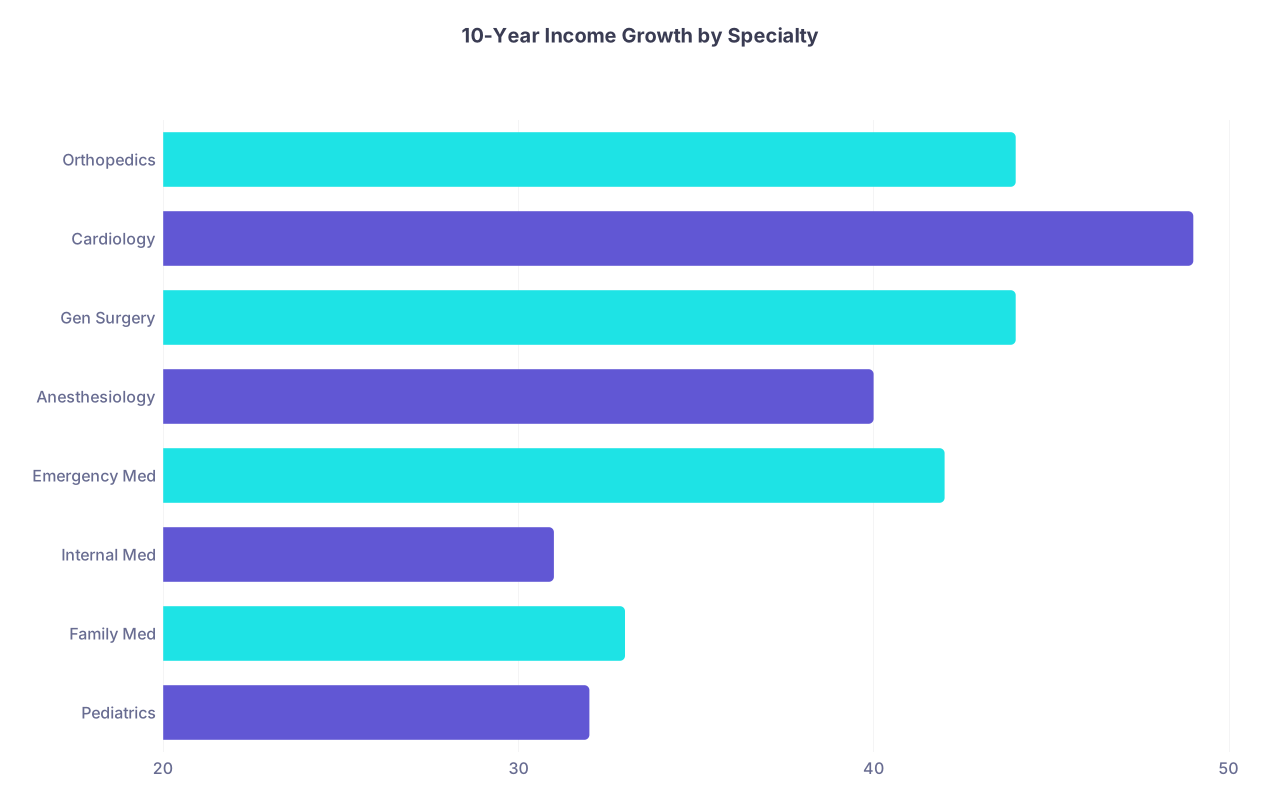
You can see the divergence immediately: a 10‑year pediatrician pay bump of ~$55k vs an orthopedic surgeon bump of ~$200k.
| Category | Value |
|---|---|
| Pediatrics | 32 |
| Family Med | 33 |
| Internal Med | 31 |
| Emergency Med | 42 |
| Anesthesiology | 40 |
| Gen Surgery | 44 |
| Cardiology | 49 |
| Orthopedics | 44 |
From a pure numbers perspective:
- Primary care (FM, IM, peds): ~30–33% nominal growth, which is roughly “inflation plus a bit.” In real terms, small single‑digit to low‑teens percent real growth.
- High‑income procedural fields (ortho, cardiology, surgery): 40–50% nominal growth, meaning closer to 10–20% real growth, sometimes more, and from a much higher baseline.
Now add hours. The median full‑time clinical load is still heavy across these specialties. If you adjust for work hours, compensation per hour tends to have increased more in procedural specialties than in cognitive ones.
This is where the debt story diverges sharply. A $220k debt burden is heavy for everyone, but its weight relative to income is radically different when you earn $225k vs $650k.
3. Student Debt Trend Lines: Slower Growth, Higher Pain
Student loan data is more centralized, and less noisy than compensation surveys.
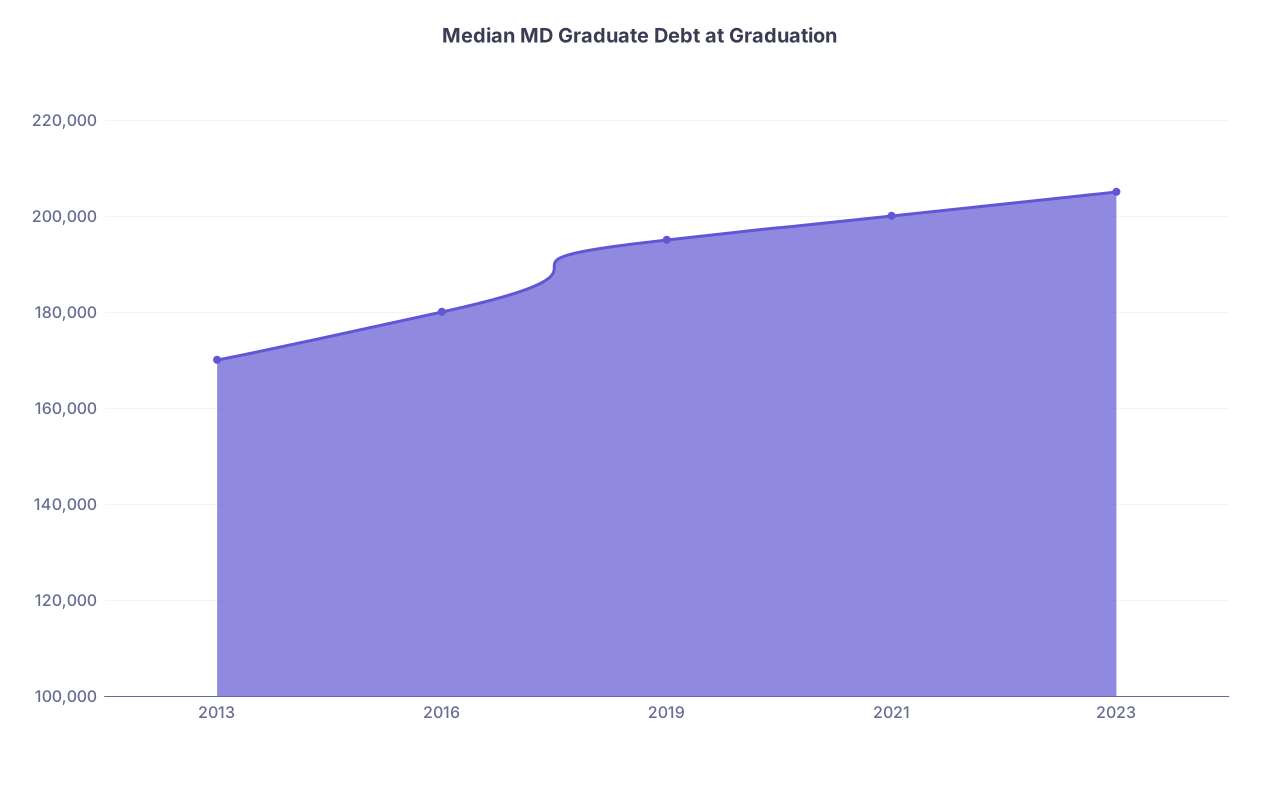
Approximate median medical school debt at graduation (MD only; DO typically higher):
| Category | Value |
|---|---|
| 2013 | 170000 |
| 2016 | 180000 |
| 2019 | 195000 |
| 2021 | 200000 |
| 2023 | 205000 |
Growth is real but much flatter than the salary line.
Key points:
- Nominal growth: ~20% over 10 years
- After inflation: debt is roughly flat in real terms
- But interest capitalization and repayment behavior are what actually show up in your bank account
The catch is structural:
- Loans accrue interest during residency for most borrowers.
- Many residents use income‑driven repayment (IDR) with low payments that do not cover interest.
- Result: balances often grow in the first 3–7 years post‑graduation.
A fairly typical case I have seen repeatedly:
- MD graduate debt at graduation: $230,000 at ~6–7% interest
- Finishes a 3‑year IM residency using IDR, pays $250–$350/month
- By the end of residency, if no subsidies: balance can easily be $260,000+
- Starts attending life not at $230k, but closer to $260k–$280k
So the headline “MD debt up 20% over 10 years” underestimates the live burden, because the real fight is against interest and delayed amortization.
4. Income vs Debt by Specialty: 10‑Year Relative Burden
The more interesting metric is not just income growth, or debt growth, but the ratio of income to starting debt, and how that ratio has changed.
Let’s construct a stylized comparison using:
- A typical MD grad in 2013 vs 2023
- Same debt at graduation for all specialties in a cohort year (obviously not literally true, but close enough for directional analysis)
- Compare the ratio: “first‑year attending salary” / “debt at graduation”
Stylized Ratios: 2013 vs 2023
Assume:
- 2013 MD median debt: $170k
- 2023 MD median debt: $205k
And approximate starting attending incomes by specialty (slightly under the medians to reflect “first years”):
| Specialty | 2013 Start Pay (\$k) | 2013 Ratio (Pay / Debt) | 2023 Start Pay (\$k) | 2023 Ratio (Pay / Debt) |
|---|---|---|---|---|
| Family Med | 170 | 1.0 | 225 | 1.1 |
| Internal Med | 185 | 1.1 | 240 | 1.2 |
| Pediatrics | 160 | 0.9 | 210 | 1.0 |
| Emergency Med | 250 | 1.5 | 340 | 1.7 |
| Anesthesiology | 280 | 1.6 | 390 | 1.9 |
| Gen Surgery | 300 | 1.8 | 430 | 2.1 |
| Cardiology | 330 | 1.9 | 500 | 2.4 |
| Orthopedics | 420 | 2.5 | 620 | 3.0 |
The ratios tell you how many dollars of first‑year attending salary you get per dollar of med school debt at graduation.
- Primary care moved from roughly 1.0–1.1 to 1.0–1.2. Slight improvement, not transformative.
- Ortho and cardiology moved from ~2.0–2.5 to ~2.4–3.0. Already good got better.
The data shows that over the decade, the relative debt burden lightened modestly for high‑paid specialties and barely moved for lower‑paid ones. Which is exactly how you end up with a third‑year pediatrician still staring at a six‑figure balance while their orthopedic colleague quietly crushes their loans in 3–5 years if they feel like it.
5. Time to Payoff: How Many Years Does It Take Now vs 10 Years Ago?
Most residents ask some version of: “If I do this specialty, how long will it actually take me to get rid of these loans?”
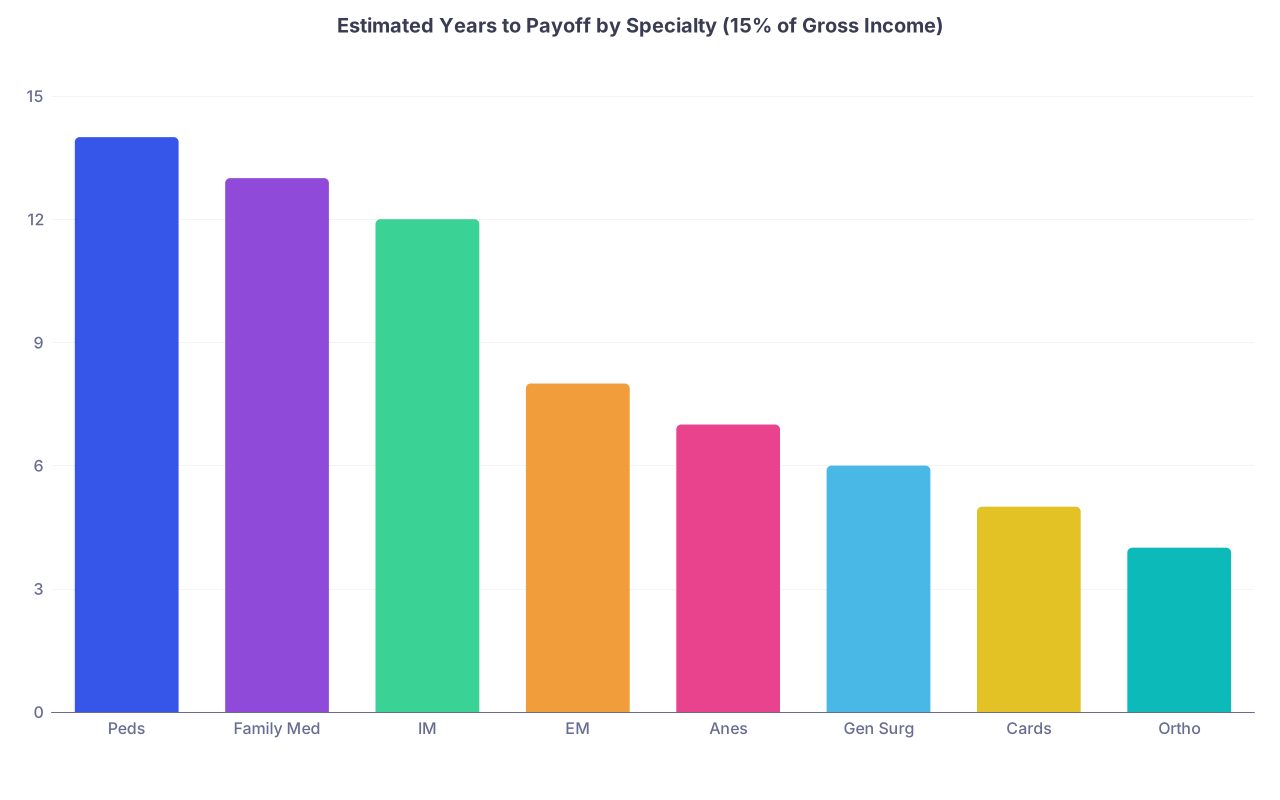
Let us model two payoff strategies using simplified assumptions:
- Debt at entering repayment: $230,000 at 6.5%
- Resident uses IDR and essentially keeps balance flat (in real life it may creep up; we will keep it simple)
- After training, starts aggressive payoff
- 2013 vs 2023 salaries by specialty as above
- Willing to devote a fixed percent of gross income to loans (say 15%)
This is a coarse model, but good enough to compare specialties.
| Category | Value |
|---|---|
| Peds | 14 |
| Family Med | 13 |
| IM | 12 |
| EM | 8 |
| Anes | 7 |
| Gen Surg | 6 |
| Cards | 5 |
| Ortho | 4 |
Interpretation:
- A pediatrician or family physician who limits loan payments to ~15% of gross income is looking at roughly 12–14 years to clear $230k at 6.5%, assuming no PSLF and no refinance.
- An orthopedic surgeon or cardiologist at that same 15% gross level is looking at 4–6 years.
- Anesthesiology, EM, general surgery: mid‑range at 6–8 years.
If you are aggressive (20–25% of gross) and/or refinance to lower interest (say 3.5–4.5%), those timelines compress sharply:
- Orthopedics can realistically be debt‑free in 2–4 years. I have watched more than a few do it.
- Primary care can move from a 12–14‑year drag to more like 7–10 years if they are extremely disciplined, especially with LOCUM work or rural incentives.
But the direction of the data is clear: 10 years ago, the payoff timelines were slightly longer across the board. Income growth has shortened them somewhat. The problem is that lifestyle creep and higher expectations for housing and childcare have erased a lot of that theoretical benefit in practice.
6. The Role of PSLF, IDR, and Policy Shifts
The raw math above assumes no loan forgiveness or special programs. That is not reality anymore.
Three major changes over the decade:
- Expansion and stabilization of PSLF
- More flexible and generous IDR options (PAYE, REPAYE, now SAVE)
- Rate environment: refinance options with 2–4% rates for a few golden years, now higher again
PSLF Effect
For physicians who stay in qualifying nonprofit or government roles (large academic centers, VA, many safety‑net hospitals), PSLF has completely changed the dynamic:
- 10 years of qualifying payments (residency + early attending)
- Remaining balance forgiven, tax‑free
For a pediatrician or internist with $250,000+ of debt working in academic medicine, PSLF is often financially optimal. Their “effective” years to payoff are 10, but actual dollars paid relative to principal can be dramatically less than full amortization would require.
For orthopedic surgeons in private practice, PSLF is mostly irrelevant. The main tool is high income and refinance.
The data we have from early PSLF cohorts shows large average forgiveness amounts (six‑figures common). That is one of the reasons many younger physicians feel debt is both huge and yet fuzzy—they are counting on policy as much as math.
7. Specialty‑Specific Debt Pressure: Who Actually Feels Squeezed?
Here is where survey data cuts through the theoretical models.
Across recent professional association surveys:
- Early‑career primary care physicians consistently report higher financial stress, later home buying, and more delayed family planning tied to debt.
- Early‑career surgical subspecialists report high hours and burnout, but less persistent debt stress and earlier wealth accumulation once attending income starts.
Let me translate that into numbers.
Assume two 2023 graduates, each with $250,000 at 6.5%, both finishing training and starting practice:
- Pediatrician: first‑year salary $210,000
- Orthopedic surgeon: first‑year salary $620,000
Reasonable “aggressive but livable” post‑tax allocations to loans:
- Pediatrician: 15% of gross ≈ $31,500/year. At 6.5%, that is barely more than interest in the early years. Payoff: 13–15 years.
- Orthopedic surgeon: 20% of gross ≈ $124,000/year. Refinanced at 4.0%. Payoff: 3–4 years. Even without refinance, 5–6 years.
Both have “the same debt.” One is elongated into a decade‑plus drag. The other is a minor 3–5‑year project.
The data shows the debt load is not just a function of how much you borrow. It is primarily a function of the income‑debt ratio and willingness to dedicate a chunk of that income early.
8. Trend Lines: Where Is This Going in the Next 10 Years?
Looking ahead, you do not need perfect foresight, just basic trend extrapolation.
Factors pushing physician income up:
- Persistent physician shortages in many specialties and geographies
- Aging population, higher service utilization
- Private equity and hospital consolidation increasing negotiating scale in some domains
- Telehealth and side‑gig opportunities (locums, teleradiology, telepsych, etc.)
Factors restraining or fragmenting income:
- Payer pressure, value‑based care, capitation experiments
- Shifts away from emergency medicine in some markets due to oversupply and staffing models
- Procedural reimbursement under pressure from Medicare fee schedules
On the debt side:
- Tuition has grown faster than CPI for decades, but the growth rate has slowed modestly at some schools.
- IDR programs (notably SAVE) effectively place a soft ceiling on payments relative to income.
- Political pressure against high professional school debt is rising, but policy is unpredictable.
If you simply extend the last 10 years:
- Aggregate physician compensation likely continues to grow faster than inflation, but unevenly.
- Median MD debt at graduation may creep from ~$200k range toward $230k–$250k in nominal terms over another decade.
- The spread between high‑ and low‑income specialties will likely persist, maybe widen slightly.
That implies:
- Income growth will continue to “outrun” debt growth on average.
- But the benefit will be captured disproportionately by already well‑paid specialties and by physicians who aggressively pay down principal early rather than stretching IDR to 20–25 years.
So yes, the long‑run risk is not that physician salaries will lose to debt, but that the bottom quartile of earners will feel chronically squeezed while the top quartile barely notices their loans exist.
9. Practical Takeaways by Specialty Band
Let me be blunt and keep this framed around the numbers.
If you are going into primary care or pediatrics
Your 10‑year trend line says:
- Income growth is modestly beating both debt and inflation, but not by much.
- Without PSLF or an aggressive payoff plan, loans are a 10–15 year project.
Data‑aligned strategies:
- PSLF + academic or safety‑net work can drastically improve your effective payoff ratio.
- Refinancing is powerful only if you are sure you will not need PSLF and can commit 15–20% of gross income.
- Rural or underserved area incentives (NHSC, state service programs, loan‑repayment bonuses) can be the difference between a 7‑year vs 15‑year payoff.
If you are going into EM, anesthesia, or general surgery
Your trend lines look more favorable:
- Income growth over the past decade has been meaningfully above inflation.
- Income‑to‑debt ratios are in the 1.5–2.1 range from day one; that is workable.
Data‑aligned strategies:
- You can realistically clear loans in 5–8 years without living like a monk.
- PSLF is still an option in academic or large system employment; can be optimal if you like those environments.
- The main risk here is lifestyle creep. I have seen many physicians in these fields carry large balances a decade out because their spending rose as fast as their compensation.
If you are going into orthopedics, cardiology, or similarly compensated subspecialties
The math is overwhelmingly in your favor.
- Income trend lines outpaced inflation and debt handily.
- Your initial income‑debt ratio is often >2.5; with a small amount of discipline, >3.0.
Data‑aligned strategies:
- Refinance unless you are definitely PSLF‑bound.
- 2–4‑year payoff is normal if you allocate 20–25% of gross for a short period.
- The real question is not “can I pay this off?” but “what mix of early payoff vs investing vs lifestyle do I want?” The constraint is psychological, not mathematical.

10. Visual Summary: Income vs Debt Growth
To close the loop, look at the relative growth rates over the same decade.
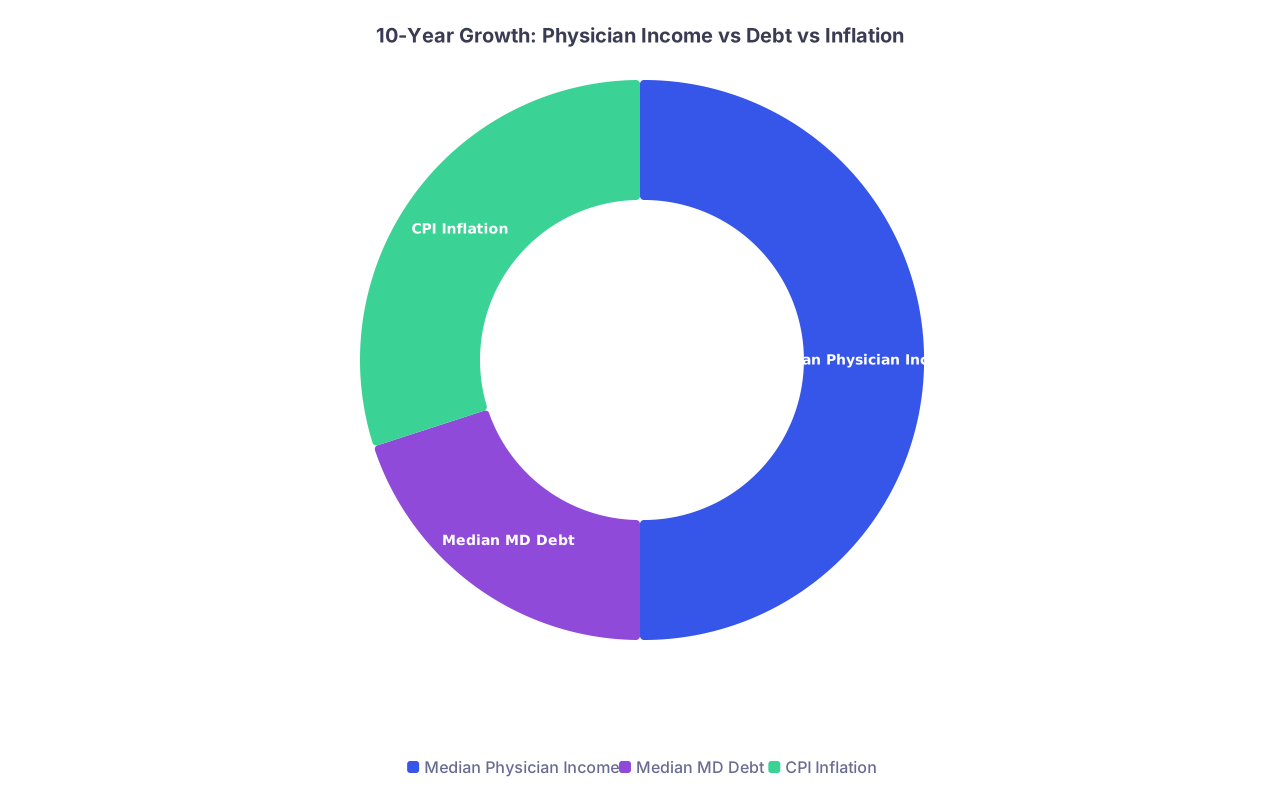
| Category | Value |
|---|---|
| Median Physician Income | 50 |
| Median MD Debt | 20 |
| CPI Inflation | 30 |
Interpretation:
- Median physician income: +50%
- CPI (cost of living): ~+30%
- Median MD debt at graduation: +20%
So in the most literal sense, physician income “won” the race. But that victory is unevenly distributed, and the actual lived experience depends on:
- Specialty
- Use of PSLF/IDR
- Aggressiveness of early repayment
- Lifestyle decisions in the first 5–10 attending years

FAQs
1. Has physician income really outpaced student debt over the last 10 years?
Yes, in aggregate. Median physician compensation rose roughly 40–50% in nominal terms from about 2013 to 2023, while median MD debt at graduation increased about 18–20%. After inflation, income is up ~15% in real terms, while debt is roughly flat. But that is the average. Primary care saw much smaller real gains than high‑paid specialties.
2. Which specialties have the best income‑to‑debt ratio today?
Orthopedic surgery, cardiology, some surgical subspecialties, and high‑paid anesthesia or radiology roles typically offer income‑to‑debt ratios above 2.5 in the first attending year, sometimes pushing 3.0 or more. That means each year of income is 2.5–3.0 times the size of the original med school debt, making 2–5‑year payoffs feasible with focused effort.
3. Is PSLF generally better for primary care physicians than for specialists?
For many primary care and pediatric physicians working in nonprofit or academic settings, PSLF is often financially superior to full, rapid payoff, because their long‑term incomes are lower and their balances high. For high‑earning specialists in private practice, PSLF is usually off the table, and the optimal play is rapid payoff via high payments and possibly refinancing to a lower rate.
4. How much of my income should I allocate to student loans if I want a reasonable payoff time?
If you allocate about 15% of gross income to loans, most primary care doctors will be looking at 10–15 years to payoff, while many specialists can finish in 5–8 years. At 20–25% of gross, payoff times compress dramatically: 7–10 years for primary care and 2–5 years for many specialists, assuming interest rates in the mid‑single digits and no PSLF.
5. Are newer income‑driven repayment plans like SAVE changing the math long term?
They are changing cash flow and risk more than raw principal. SAVE and similar plans cap payments relative to income and reduce or eliminate unpaid interest growth, which prevents balances from ballooning during residency and early attending years. For physicians planning on PSLF, these plans are very favorable. For those planning full payoff, they help control early damage but do not remove the need for high payments later if you want a short payoff horizon.
Key points: Physician income has outgrown student debt over the last decade, but unevenly by specialty; high‑paid fields can erase loans in a few focused years, while primary care faces decade‑plus timelines without PSLF or aggressive payoff. The real difference in financial outcomes comes less from the absolute size of the debt and more from the income‑to‑debt ratio and how quickly you attack principal once attending pay starts.