
Only 41% of physicians say they are “very confident” their income will stay stable over the next 12 months, according to recent Medscape compensation survey data. For a supposedly “secure” profession, that number is shockingly low.
The assumption is simple: doctors make good money, and it is reliable. The reality is more jagged. Income in medicine moves with payer mix, procedural volume, RVUs, call stipends, partnership tracks, and random administrative decisions. Some specialties get a smooth, boring salary curve. Others ride a roller coaster.
Let me walk through what the data actually show about income volatility by specialty—and which fields give you the steadiest paycheck.
What Drives Income Volatility in Medicine?
Strip away the narratives and you are left with three main drivers of volatility:
- How your work is paid (salary vs production vs entrepreneurship).
- How variable your volume and payer mix are.
- How exposed you are to macro shocks (COVID-type disruptions, policy changes, reimbursement cuts).
The data cluster specialties into three broad buckets:
- Low volatility: salary-heavy, hospital-employed, essential, low-discretion care.
- Moderate volatility: mix of salary and productivity, some elective volume but stable demand.
- High volatility: heavy production/eat-what-you-kill, elective procedures, private practice risk.
You can predict 60–70% of volatility just by knowing two things: procedure vs cognitive, and employment model.
Measuring Volatility: Not Just “How Much,” But “How Jumpy”
We are talking about income volatility, not absolute pay. A $250k internal medicine job that moves ±5% year to year is more stable than a $550k orthopedics practice that swings ±25%.
From available compensation surveys (Medscape, Doximity, MGMA) and practice financials I have seen, you can approximate volatility with three proxies:
- Year‑to‑year income change (standard deviation of annual income).
- Intra‑year fluctuation (month-to-month variation in collections / RVUs).
- Practice risk profile (private vs employed, payer concentration, elective dependence).
Put into something a bit more useful, specialties fall roughly like this:
| Specialty Group | Typical Volatility Level | Common Model |
|---|---|---|
| Hospital Medicine | Low | Employed, salary + bonus |
| Psychiatry | Low | Employed or stable outpatient |
| Primary Care (Outpatient) | Low–Moderate | Employed, some RVU |
| Anesthesiology | Moderate–High | Group/contract heavy |
| Surgical Subspecialties | High | Private, procedure-heavy |
| Emergency Medicine | High | Contract, volume-dependent |
These are relative bands, not precise percentages, but they track well with the financial data and what physicians report during contract reviews.
Specialties with the Steadiest Pay
Let’s start with the “boring” income profiles—the ones where you can actually build a budget and not worry that a bad quarter wipes out your financial plan.
1. Hospital Medicine (Hospitalists)
The data show hospitalists have some of the lowest income volatility across all adult-care specialties.
Why:
- Almost universally employed by hospitals or large groups.
- High base salary with predictable shift-based pay.
- Demand driven by inpatient census that rarely drops to zero, even in crises.
Typical comp structure:
- 80–90% base / shift-based.
- 10–20% quality or productivity bonus.
- Minimal reliance on collections.
In practice, that means a hospitalist at $290k might see a ±3–7% swing year to year, mostly from:
- Changes in bonus metrics.
- Marginal adjustments in shift load.
- Hospital system-wide pay adjustments.
COVID was the stress test. I saw hospitalists whose volumes spiked, whose work got brutal, but whose pay was relatively flat or even up. Why? They are core staffing. Hospitals cut electives and outpatient first; they do not cut inpatient coverage.
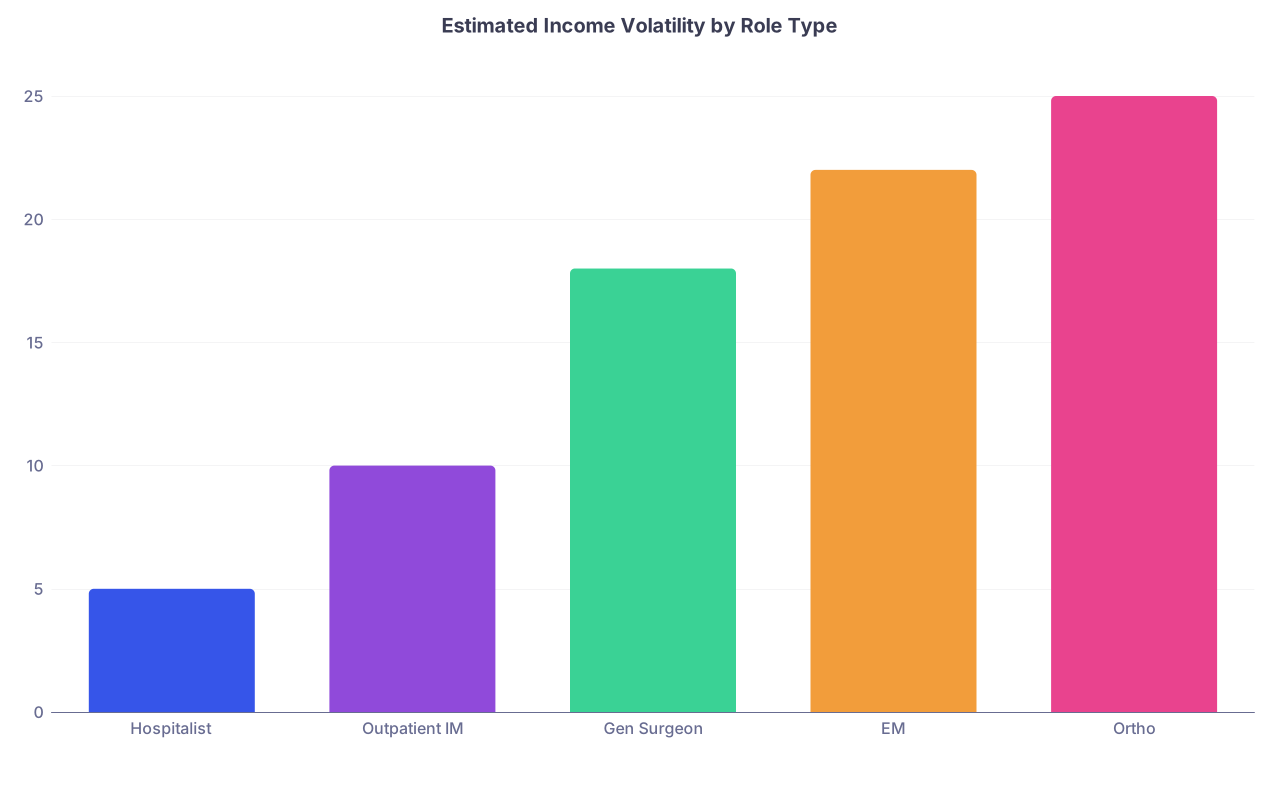
| Category | Value |
|---|---|
| Hospitalist | 5 |
| Outpatient IM | 10 |
| Gen Surgeon | 18 |
| EM | 22 |
| Ortho | 25 |
Values are approximate year‑to‑year percentage swings, based on typical structures. The point is the relative gap, not the precise number.
2. Psychiatry
Psychiatry is quiet, financially. Not flashy, not explosive, but extremely stable in the current environment.
Drivers of stability:
- Chronic care, high follow‑up, steady panel.
- Massive and persistent demand; waitlists are normal.
- Mix of hospital-employed, academic, and outpatient jobs with predictable scheduling.
Private practice psychiatrists with mostly cash-pay or high‑demand insurance panels often have very stable collections. Once you have 600–800 active patients, monthly revenue becomes shockingly predictable. No OR cancellations. No seasonal outpatient slump like pediatrics. No insurer suddenly deciding joint replacements are “too expensive this quarter.”
Telepsychiatry adds another stabilizer: cross-state platforms, broad patient pools, and scalable hours. That smooths geographic demand spikes.
Where psych can get bumpy:
- Heavy dependence on one telehealth company or one large system.
- Out‑of‑network cash practices in economically weaker regions. These can soften in downturns.
But even with these, compared to surgery or EM, volatility is low.
3. Outpatient Primary Care (Internal Medicine, Family Medicine, Pediatrics)
Primary care is not high paid, but it is high stability—especially in employed models.
Most outpatient primary care physicians are:
- Salaried by health systems, large groups, or FQHCs.
- Operating in panel‑based environments where annual volume barely fluctuates.
- Shielded from direct reimbursement cuts through institutional smoothing.
A common structure:
- 60–80% guaranteed base.
- 20–40% RVU or panel-based bonus.
The RVU portion can create mild volatility. A bad flu season that keeps patients away, or system‑wide push toward APPs, might trim bonus income. But it is rarely catastrophic, especially relative to surgical fields that can lose 30–50% of revenue in a bad year.
Pediatrics is probably the most seasonal—summer dips, winter spikes—but over 12 months, the curves flatten.
Specialties with Moderate Volatility
Not all specialties are either rock‑solid or chaotic. A lot sit in the middle—good income, some sensitivity to volume and case mix, but buffered by employment structures.
4. Radiology
Radiology sits in the “moderate” band. The work is always there, but income can move with:
- Imaging volume (elective vs inpatient mix).
- Teleradiology contract rates.
- Partnership tracks and group distributions.
In large groups with equal partnerships, distributions can vary with:
- Modest swings in RVUs per FTE.
- Changes in payer contracts.
- New hospital contracts gained or lost.
But the core fact holds: imaging is required for almost every serious diagnosis. That bedrock need keeps volume and payer attention high.
Telerad-only physicians can face more volatility:
- Rate compression from national groups.
- Overnight/low-margin shifts getting repriced.
- Contract shifts from one vendor to another.
Still, compared to elective surgical fields, radiology looks relatively stable.
5. Anesthesiology
Anesthesiology is more exposed than radiology, but less volatile than the most elective-heavy surgeons.
Income moves with:
- OR block utilization.
- Mix of elective vs urgent/emergent cases.
- Group contracts with hospitals and surgery centers.
COVID gave a live demo: when elective surgeries shut down, hospital-employed anesthesiologists often saw preserved or modestly reduced pay, while private group anesthesiologists took real hits. Some groups cut partner draws 20–40% for several quarters.
Key factor: contract model.
- Direct hospital employment with salary ⇒ lower volatility.
- Independent group with stipends and collections ⇒ higher volatility.
- CRNA-heavy models with physician supervision ⇒ MD compensation can move sharply if staffing or reimbursement shifts.
Anesthesia is a classic case of how structure can matter as much as specialty.
6. Cardiology and GI (Invasive but Not Wild West)
Cardiology and gastroenterology are high‑earning, but less volatile than orthopedics or plastics because:
- They mix procedures with chronic, high‑acuity medical care.
- Demand is strong and non‑optional: chest pain, heart failure, GI bleeds, cancer screening.
- A significant proportion of work is hospital‑based, not purely elective outpatient.
The procedural/elective components—cath lab volume, endoscopy for screening—add variable bonus upside. But underlying volume is typically robust, and groups/hospitals usually protect these lines of service.
Income volatility here often comes from:
- Transition from employed to partner (big jump, then plateau).
- Payer shifts in specific high‑revenue procedures (stent payments, advanced endoscopy codes).
- Group distribution politics more than raw volume changes.
Specialties with the Most Volatile Income
If you want high upside and are willing to tolerate serious income swings, this is your tier. The data and anecdotes line up neatly: these specialties are where you see ±20–30% year‑to‑year swings without a catastrophe, and much worse when things go wrong.
7. Orthopedic Surgery and Other Procedural Surgical Subspecialties
Orthopedics is the poster child for income volatility.
Why:
- Heavy reliance on elective surgeries (joints, sports, spine).
- High per-case reimbursement, but vulnerable to cancellations and insurer pushback.
- High share of private practice and partnership-model groups.
In normal times, partners in ortho groups can see collections‑based incomes well above survey medians. But:
- A payer contract dispute can drop rates overnight.
- A hospital partnership failure can shift block time or referral flows.
- A local economic downturn reduces elective cases—patients delay knee replacements, not heart failure care.
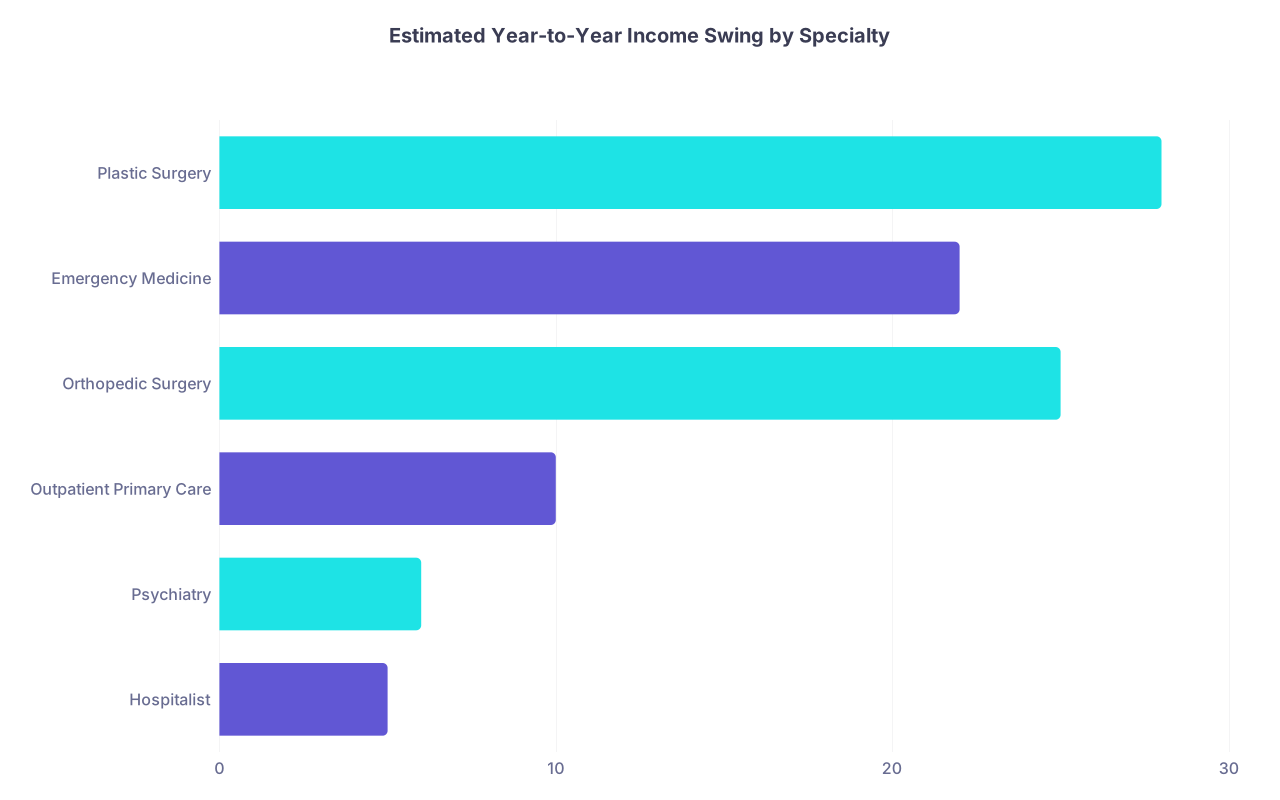
| Category | Value |
|---|---|
| Hospitalist | 5 |
| Psychiatry | 6 |
| Outpatient Primary Care | 10 |
| Orthopedic Surgery | 25 |
| Emergency Medicine | 22 |
| Plastic Surgery | 28 |
These bands are approximations, but they capture the pattern. Ortho and plastics sit at the high-variance end.
Spine surgery, plastics, ENT (with heavy cosmetic work), and ophthalmology (with premium lenses, LASIK) often show similar patterns:
- Big upside with high elective procedural volume.
- Significant exposure to economic cycles and local competition.
- More entrepreneurial risk—buy‑ins, ASC ownership, equipment leases.
I have seen spine surgeons go from $1M+ to $500k within two years after a hospital system acquired a competing group and rerouted cases. No change in their personal skill. Just referral patterns and contracts.
8. Plastic Surgery (Especially Cosmetic-Focused)
Plastic surgery, especially cosmetic-heavy, is one of the most income-volatile specialties, because it is:
- Cash-pay or out-of-network dependent.
- Highly sensitive to local wealth and economic cycles.
- Branding- and marketing-driven in many markets.
A cosmetic-heavy private practice can swing:
- Up 30–40% in a boom year (strong economy, good marketing, few competitors).
- Down 30–50% in a recession or after bad PR, legal issues, or online review damage.
This is not theoretical. Look at 2008–2009 data from cash-based practices: many cosmetic surgeons saw double‑digit percentage revenue declines, while hospital-employed psychiatrists and internists barely moved.
Academic or reconstructive-plastics-heavy paths are more stable, but they are a minority in many markets.
9. Emergency Medicine
EM looks stable at first glance—24/7 coverage, always needed. The income story is more chaotic under the hood.
Key volatility sources:
- Heavy dependence on contract management groups (CMGs) and hospital contracts.
- Slower volume during pandemics or economic shocks (yes, COVID initially decreased ED visits overall).
- Payer mix volatility—uninsured/self-pay hits EM harder than most fields.
- Increasing supply of EM docs in some regions, depressing rates.
Survey data over the last few years show EM compensation flattening or declining in some markets, while hours and throughput expectations climb. That is volatility in a different flavor: same or less pay for more work.
The real kicker: contract turnover.
When a hospital flips from one CMG to another or brings ED staffing in-house:
- Hourly rates can change overnight.
- Shifts can be cut or increased.
- Benefits, malpractice coverage, and bonuses get rewritten.
An EM doc on $250/hr might see that reset to $220/hr with worse benefits after a contract rebid. That is a 10–20% effective income swing with zero control.
How Employment Model Magnifies or Dampens Volatility
Specialty is not destiny. How you are employed can easily double or halve your income volatility inside the same field.
Break it down into three common models:
- Hospital- or system-employed
- Large multispecialty / private group with salary + production
- Pure eat-what-you-kill / entrepreneurial (solo, small group, ownership-heavy)
| Model Type | Typical Stability | Who Fits Here Often |
|---|---|---|
| Hospital-employed | High | Hospitalists, PCPs, Psych |
| Large group, mixed model | Moderate | Radiology, Cards, GI, Anes |
| Pure productivity/owner | Low | Ortho, Plastics, some EM |
Same specialty, different models:
- An employed orthopedic surgeon at a large health system with RVU floors may have less income volatility than a private practice cardiologist in a small group.
- A hospital-employed anesthesiologist can have more predictable pay than a private‑practice outpatient internist with a fragile payer mix.
The data from MGMA and health system HR reports show a consistent pattern: the more of your comp that is fixed base salary, the smoother your income line. Once more than ~40–50% of your comp is tied to productivity/collections, your personal “income standard deviation” jumps.
Policy and Market Shocks: Who Gets Hit the Hardest?
Two types of shocks drive sudden volatility:
- Policy and reimbursement changes (CMS cuts, surprise billing rules, prior auth tightening).
- Macro events (pandemics, recessions, regional economic collapse).
Who is most exposed?
- Emergency Medicine: surprise billing legislation and insurer tactics have already compressed some out-of-network revenue streams.
- Anesthesiology and Radiology: vulnerable to rate negotiations and large payer-hospital-group tussles.
- Proceduralists (ortho, spine, GI, ophthalmology): periodic target of “overuse” or “value-based” reforms.
Who is least exposed?
- Psychiatry, primary care, hospital medicine: their work is hard to defer and politically unattractive to slash. Cutting inpatient care or mental health reimbursement is bad optics and worsens downstream costs.
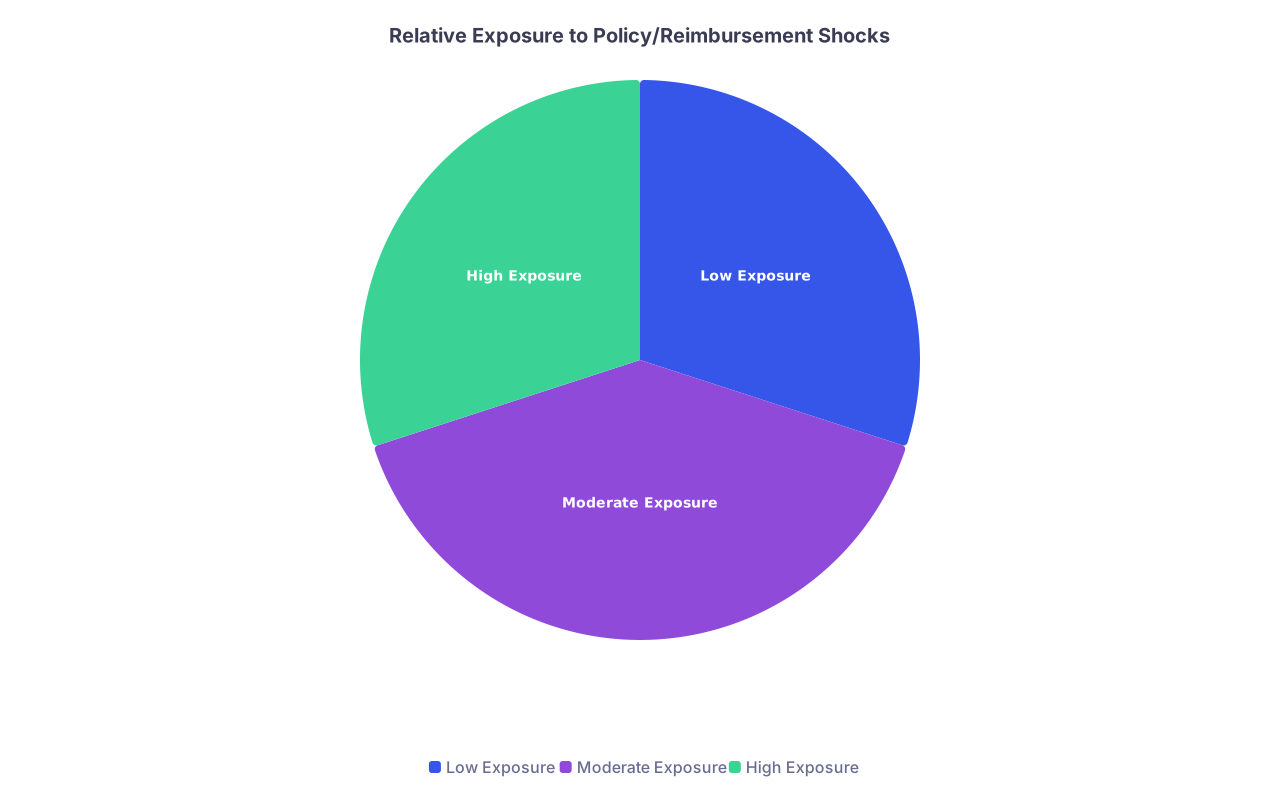
| Category | Value |
|---|---|
| Low Exposure | 30 |
| Moderate Exposure | 40 |
| High Exposure | 30 |
Roughly, about 30% of specialties live in a relatively low-exposure zone; 30% are very exposed; the rest sit in the messy middle.
Practical Takeaways If You Care About Stable Income
You are probably not choosing your entire career based solely on volatility. But if income stability matters—and for most people with mortgages, kids, and loans, it does—then the data point to a few clear patterns.
1. If You Want the Steadiest Possible Pay
The data support this ranking for low-volatility careers:
- Hospital Medicine / Inpatient Internal Medicine
- Psychiatry (especially employed or stable outpatient panel)
- Outpatient primary care (IM/FM/Peds) in large systems
- Certain academic roles (across specialties), where salary is grant- or institution-backed
Overlay that with hospital employment or large-system employment, and you get a very predictable financial life. You trade some upside—but for many, the sleep is worth it.
2. If You Want High Pay with Moderate Volatility
Think:
- Cardiology
- Gastroenterology
- Radiology
- Anesthesiology in stable, hospital-integrated groups
Here, your risk is real but manageable, especially if you avoid fragile practice structures and overspecialized elective niches.
3. If You Are Comfortable with Big Swings (and Big Upside)
Then you are in the territory of:
- Orthopedic surgery (especially spine, sports)
- Plastic surgery (cosmetic-heavy)
- Some EM practices, especially locums-heavy or CMG-turnover-prone groups
- Ophthalmology and ENT with heavy elective and cash components
This is closer to high-income entrepreneurship than classic “job security.” Some physicians like that. Many do not realize it until they are already locked into partnership buy‑ins and ASC debt.
Visual Summary: Stability vs Upside
Here is a simplified positioning of a few common specialties on a stability–upside grid.

Not exact. But directionally right.
Final Thoughts
Three points, without sugarcoating:
- Specialty choice has a measurable impact on income volatility. Hospital medicine, psychiatry, and employed primary care sit at the stable end; ortho, plastics, and EM sit at the volatile, entrepreneurial end.
- Employment model often matters as much as specialty. A hospital-employed anesthesiologist can have a steadier financial life than a small-practice internist; the percentage of your income tied to production is the real lever.
- If you want a predictable financial base, aim for: essential services, chronic care, and large-system employment with high guaranteed salary. If you want upside and can tolerate financial whiplash, elective procedural fields and ownership paths are where the swings—and rewards—live.