
The biggest financial leaks in a physician’s career are not bad investments. They are bad moonlighting decisions.
You can be clinically excellent and still get quietly exploited by sloppy agreements, vague expectations, and “that is just how we do it here” moonlighting culture. I have watched smart residents and attendings work themselves into exhaustion for checks that barely justify the lost sleep and malpractice risk.
Let me walk you through the common moonlighting errors that get physicians underpaid or overworked—so you do not become the next cautionary story in the call room.
1. Treating Moonlighting Like “Extra Shifts,” Not a Business
The first and most expensive mistake: thinking moonlighting is just “some extra shifts for extra cash.”
It is not. It is a business relationship. With:
- Contractual risk
- Malpractice exposure
- Tax consequences
- Long-term career and credentialing impact
But here is what I actually hear:
- “They just emailed me the schedule, I start next week.”
- “The rate seemed fine, so I did not bother negotiating.”
- “It is through a friend, so I am sure they will treat me fairly.”
That kind of casual approach is exactly how you end up working like a partner but getting paid like a trainee.
Red flags you are treating it too casually:
- No written contract. Just emails or text messages.
- You cannot clearly state your compensation formula in one sentence.
- You do not know who is billing for your work.
- You have no idea what happens if they suddenly cut your shifts or cancel last minute.
Do not moonlight on trust and vibes. You need:
- A written agreement (even if short)
- Clear compensation structure
- Defined scope of practice
- Termination and cancellation terms
- Documentation of who provides malpractice and at what limits
If a site resists basic written clarity, that is not “laid back.” That is a liability trap.
2. Accepting “All-In” Hourly Rates That Are Quietly Terrible
“All-in rate $150/hr. Easy gig.”
That line has trapped a lot of residents and junior attendings.
You must dissect the rate. Break it down. Understand what the “all-in” is replacing.
Common pieces that get quietly bundled into an “all-in” number:
- Base clinical pay
- Call coverage / home call availability
- Built-in overtime
- Holiday differentials
- Weekend pay differentials
- Administrative or documentation time
- Travel, lodging, and meals (for locums-like setups)
So that shiny $150/hr might actually be a discount rate once you factor what you are giving up.
Here is how you sanity-check it.
| Scenario | Effective Rate Reality |
|---|---|
| $150/hr, frequent 24-hr calls with no extra call pay | Often closer to $100–120/hr when divided by total time tied up |
| $200/hr, in-house nights, high volume, no scribe | Looks good, but charting after shift can drop effective rate by 10–20% |
| $110/hr, home telemedicine shifts, low intensity | Might beat “higher” in-house rates when you factor zero commute |
| $130/hr, rural ER, you cover admits + floor calls | Two jobs for one rate—effective rate drops sharply |
| RVU-based with weak payer mix, low RVU rates | Can end up below $90/hr equivalent, sometimes worse |
A decent rule: if the work is high-risk, high-intensity, or significantly disruptive to sleep and family life, you should be getting a premium, not a discount.
Mistake to avoid: Comparing headline hourly rates without calculating:
- Real hours committed (including pre-shift, post-shift, and call-back)
- Unpaid documentation time
- Commute time
- Sleep disruption and next-day productivity (especially if you have a day job)
If you do not calculate your effective hourly rate, you are guessing. And guesses are usually wrong in the employer’s favor.
3. Ignoring Malpractice Coverage Details (Until a Claim Hits)
This one can ruin you financially.
I have lost count of how many moonlighters say, “Yeah, they cover malpractice,” and stop there. That is not due diligence. That is blind faith.
You must know:
- Claims-made or occurrence policy
- Limits (per claim / aggregate)
- Who pays for tail coverage when you leave
- Exactly which activities are covered
Here is where physicians get burned:
- Moonlighting under a different entity than their main job, assuming main coverage extends. It often does not.
- Doing procedures or high-risk cases that fall outside the contractually listed scope. Insurer declines coverage when things go bad.
- Claims-made policy with no tail. You leave. Lawsuit shows up 18 months later. You are exposed.
Essential malpractice questions to get answered in writing:
- Are you covered by the employer’s malpractice policy or a separate one?
- What are the coverage limits? (Common: $1M/$3M; some states higher)
- Is the policy claims-made or occurrence?
- Who is responsible for tail coverage if the relationship ends?
- Does coverage apply at all sites you will work (including offsite, telehealth, nursing homes)?
- Are you required to carry your own separate policy?
If the answer to any of these is vague, incomplete, or “we have never had a problem with that,” do not start until it is clear and written.
That is not being difficult. That is being an adult with a medical license.
4. Overcommitting Hours and Underestimating Fatigue
The second most common moonlighting mistake: thinking you can live on four hours of sleep indefinitely because “it is just for a few months.”
I have watched residents stack:
- 60–70 hr/week primary training schedule
- 12–20 hr/week moonlighting
- Board exam prep on top
Then they wonder why they are making charting mistakes, getting short-tempered with staff, or missing early sepsis.
Sleep debt does not care about your student loans.
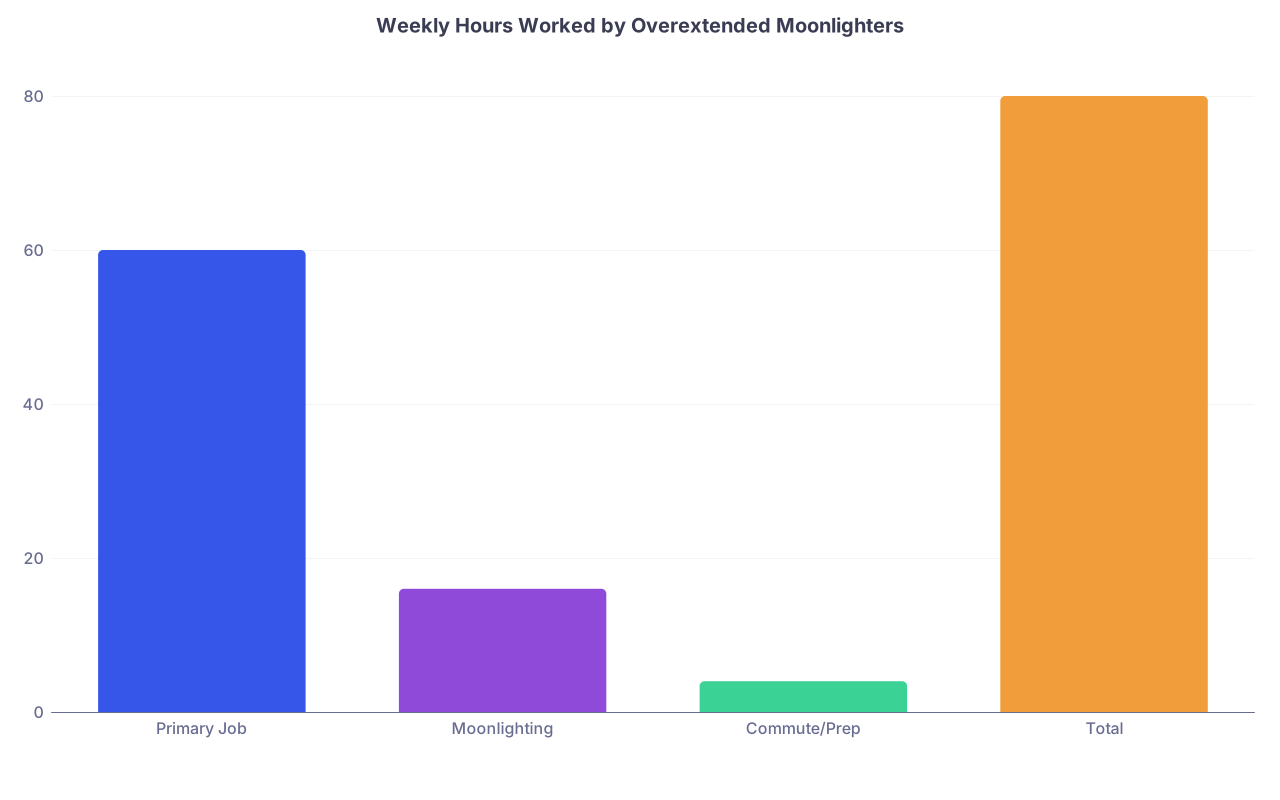
| Category | Value |
|---|---|
| Primary Job | 60 |
| Moonlighting | 16 |
| Commute/Prep | 4 |
| Total | 80 |
Eighty-hour weeks are not theoretical. They are typical for many residents before moonlighting. Add moonlighting and you are in dangerous territory.
Signs you are overcommitted:
- You regularly finish a moonlighting shift then go straight into your primary job without meaningful rest.
- You are behind on notes constantly, both at your main job and moonlighting site.
- You are short with nurses or consultants in ways that are not your baseline.
- You make small but frequent errors—missed allergies, incomplete med recs, near-misses.
And here is the financial lie: Many physicians think “I need this extra income now.” Then they burn out, reduce FTE, or fail to max out long-term comp because they are wrecked. Short-term cash, long-term cost.
You must set hard limits before you see the money:
- Maximum number of moonlighting shifts per month
- No back-to-back nights + day shifts without 8–10 hours off
- No violating ACGME or institutional duty-hour rules if you are still in training
If the numbers only work when you abuse your body and your license, the numbers do not work.
5. Failing to Understand RVU-Based Moonlighting Pay
RVU-based moonlighting can be a trap if you do not understand the math.
I have seen offers like this:
- “$60 per RVU, average doc collects $220/hr”
- “Productivity-based—sky’s the limit!”
Then the new moonlighter discovers:
- Tons of uninsured or Medicaid patients
- Chronic documentation issues
- Pre-coded templates that underbill
- Hospitalist or ED culture that offloads low-RVU, high-time patients to moonlighters
On paper, RVU pay can look impressive. In practice, it turns into 8–10 hours of chaos for a mediocre check.
Key questions for RVU moonlighting:
- What is the average RVU/hr for moonlighters at that site (not “our top earners”)?
- What is the payer mix? (Commercial vs Medicare vs Medicaid vs uninsured does matter indirectly, through hospital culture and documentation pressure.)
- Who handles coding? Are you expected to self-code?
- Are there documentation templates optimized for RVU capture?
- What has been the actual average hourly take-home (not just “potential”)?
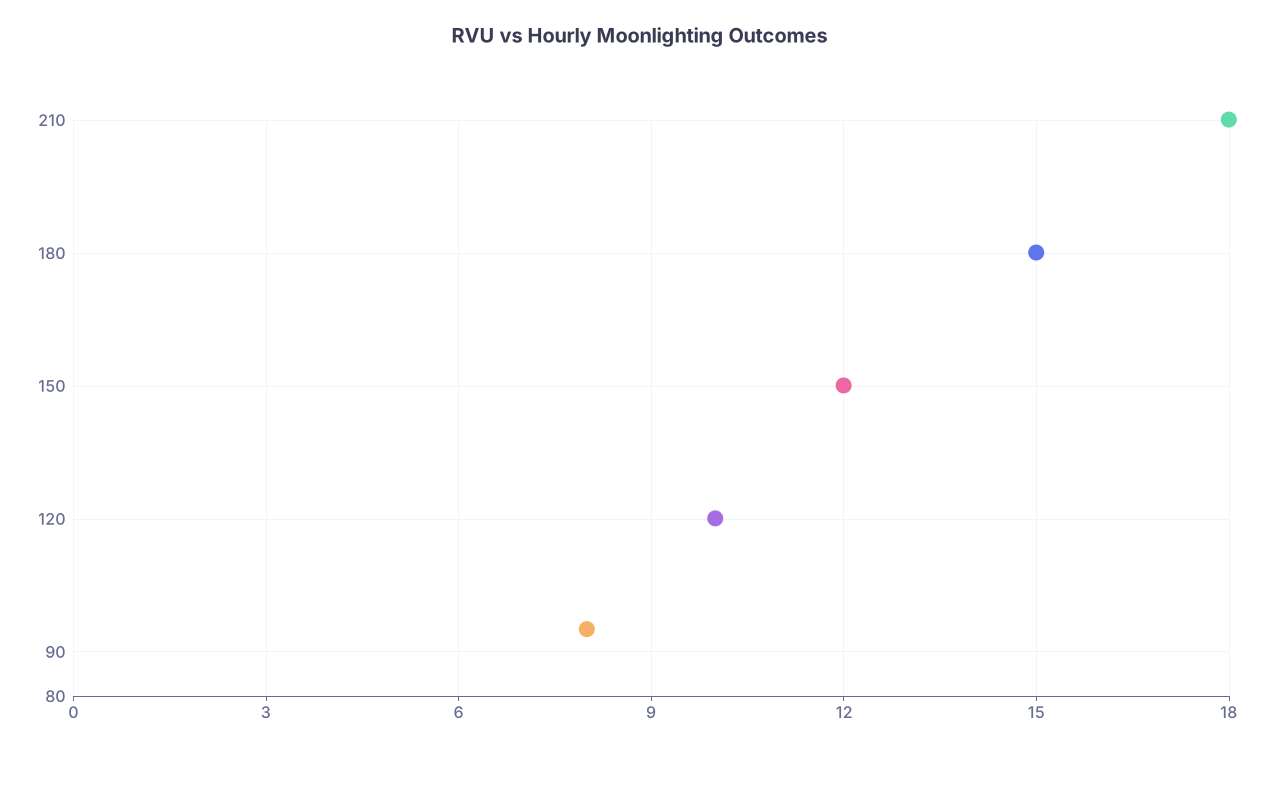
| Category | Value |
|---|---|
| Site A | 15,180 |
| Site B | 10,120 |
| Site C | 18,210 |
| Site D | 8,95 |
| Site E | 12,150 |
In that scatter:
- X-axis: RVUs per hour
- Y-axis: Effective dollars per hour
That bottom-left cluster—low RVUs, low $/hr—that is exactly where naïve moonlighters end up when they do not ask questions.
If you cannot see historical data on real hourly outcomes, you are taking a blind risk. Sometimes it is worth it. Often it is not.
6. Letting Admin Creep Expand Your Scope for Free
Moonlighting is supposed to be: “You do X. We pay you Y.”
Over time, it quietly becomes: “You do X + Y + Z + ‘help with a few things’ for the same rate.”
I have seen:
- “While you are here, can you also cover ICU cross-cover?”
- “We lost a midlevel; can you handle their triage for a bit?”
- “Can you review these outside records and write a summary?”
And the rate never changes.
This is scope creep. And if you do not stop it, you will be doing a full attending’s job (or two) on a moonlighting wage.
You need boundary lines:
- What service(s) are you covering?
- Are you admitting, rounding, discharging, or just cross-covering?
- Are procedures expected? Which ones? For what pay?
- Are you responsible for supervising APPs? Precepting? Teaching?
When they add work, you add expectations:
- “That is outside what we agreed for this rate. I am happy to discuss expanding my role if we adjust compensation accordingly.”
If you cannot say that sentence, you are volunteering for free.
7. Ignoring Tax Structure and Letting the IRS Take a Bigger Cut
This is where even financially savvy physicians get sloppy.
Moonlighting is rapidly taxed. Often at your top marginal rate. If you treat it like casual W-2 income, you can easily give away 37%+ to federal alone, plus state.
More mistakes I see:
- Not tracking expenses (mileage, licensing fees, CME related to that work, etc.).
- Doing 1099 work but not using any business structure, no estimated tax payments, and then getting hammered in April with penalties.
- Not coordinating moonlighting income with retirement contributions (solo 401(k), SEP-IRA) to reduce taxable income.
If your moonlighting is 1099, you are running a small business whether you like it or not. That can work in your favor, but only if you treat it like one.
Basic tax protections:
- Separate bank account for moonlighting 1099 income.
- Setting aside 25–35% of each check for taxes immediately.
- Working with a CPA who understands physician moonlighting. Not TurboTax at 1 a.m. the night before the deadline.
- Exploring retirement and HSA options tied to that income.
You are working brutal hours. Do not donate an extra five figures to the IRS purely from poor structure.
8. Overlooking Credentialing, Licensing, and Policy Conflicts
Here is a subtle legal landmine: moonlighting that conflicts with your main employer’s policies or your training program’s rules.
This can blow up your job, not just your side gig.
Common problems:
- Your primary contract has a non-compete or outside work restriction that you never read carefully.
- You moonlight at a competing hospital or telehealth service.
- Your residency program requires written approval for moonlighting; you “forgot” to get it.
- You work beyond duty hour limits, and an adverse event exposes that in the investigation.
I have seen residents pulled from moonlighting with 24 hours’ notice because GME or legal finally realized what they were doing. Sometimes after months of building financial dependence on that income.
Minimum checklist:
- Read your main employment / training contract for:
- Non-compete clauses
- Outside employment clauses
- Duty hour policies (for trainees)
- Get written approval if required. Verbal OKs evaporate when there is a problem.
- Track your total work hours in a simple log (yes, manually) in case you ever need to show you were not violating duty hour or hospital policy.
If your main employer finds out you violated policy after a complaint or bad outcome, they will protect themselves first. You will be on your own.
9. Staying in Bad Moonlighting Gigs Because of Sunk Cost
Once physicians start a moonlighting job, they often stay too long.
Why?
- “I already trained there; I know the system.”
- “The staff are nice; I do not want to leave them hanging.”
- “It is a hassle to find something else.”
Those are emotional reasons to tolerate:
- Below-market pay
- Unsafe staffing ratios
- Dysfunctional administration
- Constant schedule changes that wreck your life
You should reevaluate each moonlighting gig at least annually:
- Is the effective hourly rate still worth it?
- Has the volume, acuity, or expected responsibilities increased without pay adjustment?
- Are there safer or better-paying alternatives now that you have more experience?
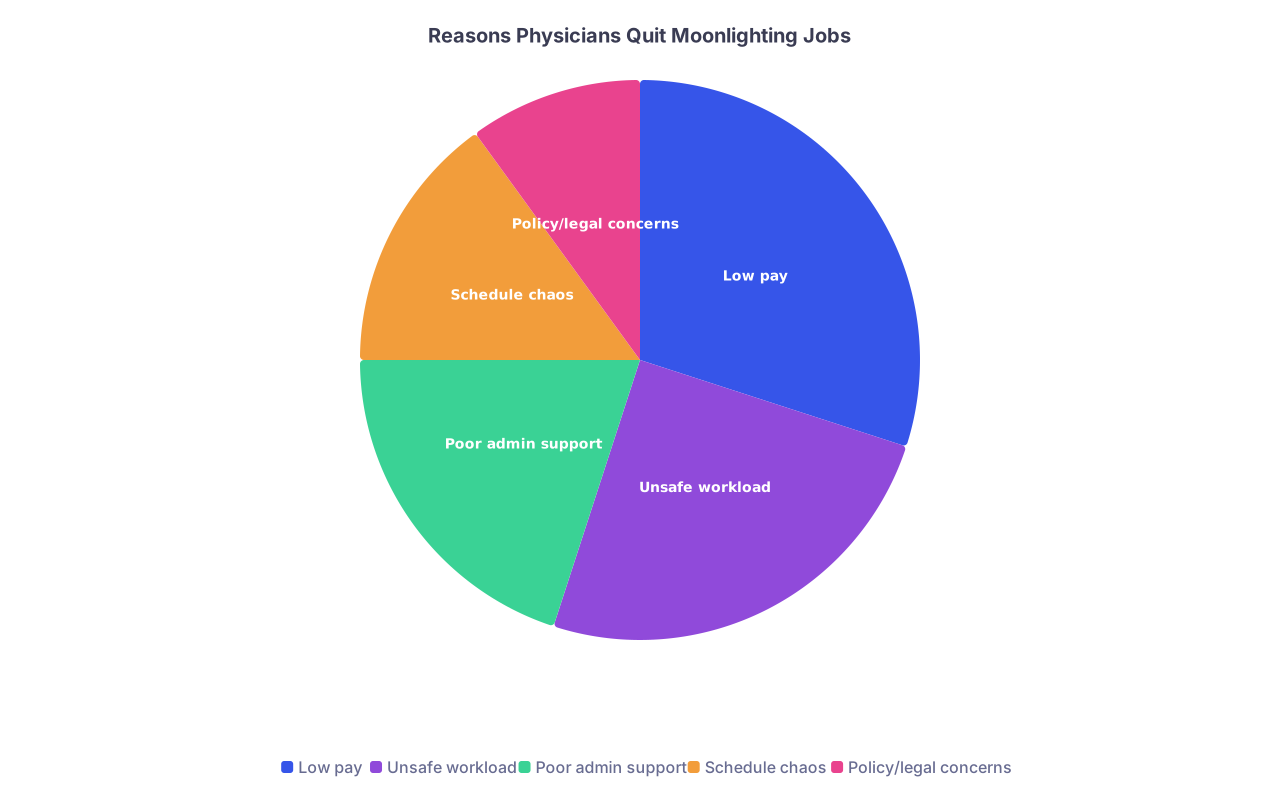
| Category | Value |
|---|---|
| Low pay | 30 |
| Unsafe workload | 25 |
| Poor admin support | 20 |
| Schedule chaos | 15 |
| Policy/legal concerns | 10 |
Do not stay in a bad gig because of inertia. You protect your time and your license by being willing to walk when the math or the risk no longer makes sense.
10. Not Matching Moonlighting to Your Long-Term Career Strategy
The last mistake is more subtle but still expensive: treating moonlighting as random cash instead of strategic income.
Ask yourself:
- Does this work build skills or reputation in my chosen field?
- Does it burn bridges with potential future employers or referral bases?
- Does it expose me to types of patients or practice environments I never want to be associated with long-term?
Examples:
- A future academic cardiologist spending all moonlighting time at a chaotic low-resourced urgent care, building no relevant connections.
- A future outpatient internist doing heavy inpatient nocturnist moonlighting that wrecks their daytime energy and delays board prep.
- A surgeon taking poorly paid rural ER call where they are pressured to operate outside their comfort zone.
Moonlighting that pays well and aligns with your future is a win. Moonlighting that pays “okay” but drains your energy and adds zero to your CV is a slower, softer loss.
FAQ (Exactly 3 Questions)
1. Is moonlighting as a resident always a bad idea?
No. It can be very helpful if you are senior enough, have solid clinical judgment, and pick a well-structured, reasonably paced gig. The danger is stacking too many hours, taking on work above your training level, or doing it without program approval or malpractice clarity. If you are PGY-2 or below in a field like IM, EM, or anesthesia, I would be extremely selective and conservative. Graduating with your license intact and your brain un-fried is worth more than a few thousand extra dollars.
2. What is a “good” moonlighting rate right now?
It varies heavily by specialty, region, and intensity. A low-acuity telemedicine shift at $110/hr might be excellent. A high-acuity in-house ICU night at $160/hr might be insulting. The only honest way to judge is to compute effective hourly rate (including unpaid time and call burden), compare to your main job’s effective rate, and factor risk level. If you are not sure, ask peers already working there what they actually take home per shift and how destroyed they feel afterward.
3. Do I really need a lawyer to review a moonlighting contract?
Not always, but you do need someone who actually understands physician contracts—this can be a contract-savvy colleague or a healthcare attorney. For simple, short-term, low-risk gigs under your employer’s umbrella, you might get by with careful reading and good questions. For independent 1099 work, multiple sites, or anything involving noncompetes, RVU structures, or unclear malpractice, I strongly prefer you pay a few hundred dollars now rather than tens of thousands later when something goes wrong.
Key points to remember:
- Treat moonlighting like a business relationship, not casual extra work—get clarity on pay, scope, and malpractice in writing.
- Protect your effective hourly rate and your body; overwork, vague RVU deals, and scope creep are how you end up underpaid and overexposed.
- Align moonlighting with your long-term goals and legal realities, and be willing to walk away the moment the risk-reward balance tilts against you.