
The way most physicians think about extra work is financially sloppy.
“$2,000 for a locums day? Sounds good.”
That is not analysis. That is vibes.
Let me break this down specifically: if you do not know your true marginal hourly rate and your true after-tax take-home per extra shift, you are guessing with your time, your family, and your health.
We are going to fix that.
1. Core Concept: Marginal vs Average Physician Income
Your W‑2 or 1099 income tells you your average pay.
What you actually need for decision-making is your marginal pay:
- Average income: Total annual income ÷ total hours worked
- Marginal income: Additional after-tax money you keep for one more hour of work (or one more shift, or one more locums block)
Those are very different numbers.
A simple baseline example
Hospital-employed hospitalist:
- Base salary: $300,000
- Expected shifts: 15 shifts / month = 180 shifts / year
- Average clinical day: 12 hours (be honest, not what HR says)
Total hours: 180 × 12 = 2,160 hours
Average hourly rate:
- $300,000 ÷ 2,160 ≈ $139/hour
That number is mostly useless when deciding whether to pick up:
- A 4‑hour evening in the ED
- A 12‑hour extra hospitalist shift
- A weekend locums gig at another site
What matters is:
- How much extra pay for that extra block of time?
- What taxes apply to that incremental money?
- What extra costs (commute, childcare, burnout, malpractice tail risk, etc.) attach to it?
Your decision rule should be:
“I do not work extra for less than $X after-tax per hour of my real time.”
We are going to calculate that X.
2. Building the Marginal Income Formula
Strip away the fluff. For any extra work unit (hour, shift, locums day), the core formula is:
Net marginal income per unit
= (Gross pay per unit
− Incremental taxes
− Incremental fixed costs)
÷ True hours spent
Let’s define the pieces.
2.1 Gross pay per unit
This is the contract or offer number:
- Hourly rate for picking up a shift
- Flat fee for a 12‑hour shift
- Daily rate for locums
- RVU-based incremental compensation above a threshold
Example structures:
- Extra shift: $2,000 / 12‑hour shift
- Locums: $2,400 per 10‑hour day
- Overtime call: $250/hour (minimum 4 hours)
Fine. Those are just starting numbers.
2.2 Incremental tax rate (the part everyone hand-waves)
Marginal tax is not just “my federal bracket.” For most physicians in the U.S. with clinical income, the incremental tax on more work typically includes:
- Federal income tax (marginal bracket: often 32–37%)
- State income tax (0–13.3% depending on where you work)
- Payroll taxes:
- W‑2: Social Security (if under the wage base), Medicare, plus 0.9% Additional Medicare for high earners
- 1099: Self-employment tax (both halves of FICA), with partial deduction
For realistic numbers, a high-earning physician’s effective marginal rate on extra dollars is often in the 42–52% range, depending on state and whether W‑2 or 1099 and where they are with Social Security.
You need a working marginal tax estimate for decision-making. It will not be perfect, but it should be honest.
Rules of thumb (U.S.):
- W‑2 in no‑tax state, top bracket: ~40–45% marginal
- W‑2 in high‑tax state, top bracket: ~45–50%
- 1099 in high‑tax state, top bracket: ~45–52% marginal on incremental income
If that surprises you, that is why your “$2,500 shift” does not show up as $2,500 in your bank account.
2.3 Incremental fixed costs
Extra work often has hidden costs per shift/day:
- Commuting (gas, tolls, parking)
- Hotel / short-term housing (locums)
- Childcare coverage
- Extra licensing / credentialing / malpractice (for locums or moonlighting)
- Food on the road
- Professional fees (LLC setup, accounting for 1099 gig)
You do not need surgical precision, but you must at least plug in reasonable estimates per extra shift.
3. The Real Per-Hour Calculation (Including Hidden Time)
The biggest lie in physician compensation is the “shift length.”
A “12‑hour” shift might actually be:
- 30 minutes early to prep and pre-chart
- 12 hours on the clock
- 45 minutes finishing notes and calls after
- 30 minutes commute each way
Total time tied up:
0.5 + 12 + 0.75 + 1 = 14.25 hours
If you only divide pay by 12, you are lying to yourself.
So the actual formula becomes:
Net marginal hourly rate
= (Gross pay per shift − Incremental taxes − Shift-specific costs)
÷ Total real hours consumed by that shift
Now let’s actually do the math in different scenarios.
4. Scenario 1: Extra Shifts as W‑2 Hospital Employee
Assume:
- Specialty: Hospitalist, employed
- Base salary: $300,000 for 180 shifts / year
- Additional shifts: paid at flat $2,000 per 12‑hour shift
- Location: 35% federal + 5% state marginal bracket (40% total income tax)
- On W‑2; Social Security already maxed from base income; 2.35% Medicare total
So incremental tax on another $2,000:
- Income tax: 40% of $2,000 = $800
- Medicare: 2.35% of $2,000 ≈ $47
- Total incremental tax ≈ $847 (about 42.3%)
Real take-home from the extra shift:
- $2,000 − $847 ≈ $1,153
Now include small fixed costs:
- Extra parking and meals: say $50
- Total net: $1,153 − $50 = $1,103
Time reality:
- 0.5 hr pre-chart
- 12 hr shift
- 0.75 hr wrap-up
- 1 hr commute round-trip
Total: 14.25 hours
Net marginal hourly rate:
- $1,103 ÷ 14.25 ≈ $77/hour
Your base job’s “average” nominal hourly rate was $139.
Your extra shift’s true net marginal rate is $77/hour.
That is the kind of mismatch that leads to physicians feeling like, “I’m working more and it is not moving the needle.” Because it literally is not, in a proportional way.
5. Scenario 2: Moonlighting / Locums as 1099
Now let us take a typical locums-like setup.
Assume:
- Specialty: General IM or FM, outpatient locums
- Daily rate: $2,400 per 10‑hour day
- Charting: 1 additional hour after clinic
- Commute + logistics: 1 hr each way = 2 hrs
- Total time per “10‑hr” day: 10 + 1 + 2 = 13 hours
Tax situation:
- You already make $300,000 W‑2 at your main job (so near/at top federal bracket)
- This locums gig is 1099 (independent contractor) income
- Federal bracket: 35%–37%
- State: 5%
- Self-employment tax: 15.3% on portion below Social Security cap, then 2.9% + 0.9% on Medicare portion above; realistically 3.8–11% incremental depending on income level and Social Security status
Let’s use a realistic “all-in” 47% marginal tax on this 1099 incremental income.
Incremental tax on $2,400:
- 47% of $2,400 = $1,128
Net after-tax:
- $2,400 − $1,128 = $1,272
But 1099 also means deductible expenses. Suppose per day:
- Mileage/hotel/food averaged: $100
- Share of licensing/credentialing/malpractice: $50 per day
Total incremental non-reimbursed costs: $150.
Yes, those are deductible, but to keep it straightforward, account for them pre-tax as costs and recognize your tax is technically slightly less; for decision purposes, you can shortcut by just subtracting post-tax.
Rough approach:
- Treat that $150 as money leaving your pocket either way.
- So effective net cash in your bank per day ≈ $1,272 − $150 = $1,122
Now divide by real time:
- $1,122 ÷ 13 ≈ $86/hour
So this 1099 locums day is paying you around $86 actual net per hour.
Compare that with the extra W‑2 shift’s ~$77 in the first example. Not a huge difference once you are honest with the arithmetic.
6. Comparing Common Options Side by Side
Here is where physicians begin to see reality. What sounds lucrative often compresses after tax and time reality.
| Work Type | Gross Example | Approx Net Marginal / Hr |
|---|---|---|
| Extra W‑2 shift (in-house) | $2,000 / 12 hr | ~$75–85 |
| 1099 locums day (regional) | $2,400 / 10 hr | ~$80–95 |
| Premium holiday / weekend shift | $2,800 / 12 hr | ~$100–115 |
| Low-paying PRN moonlighting | $120 / “hour” | Often <$60 actual |
| High-efficiency telemedicine | $140 / scheduled hr | $90–130 (if high volume) |
These are ballparks, but they track what I see when we do real numbers with attendings.
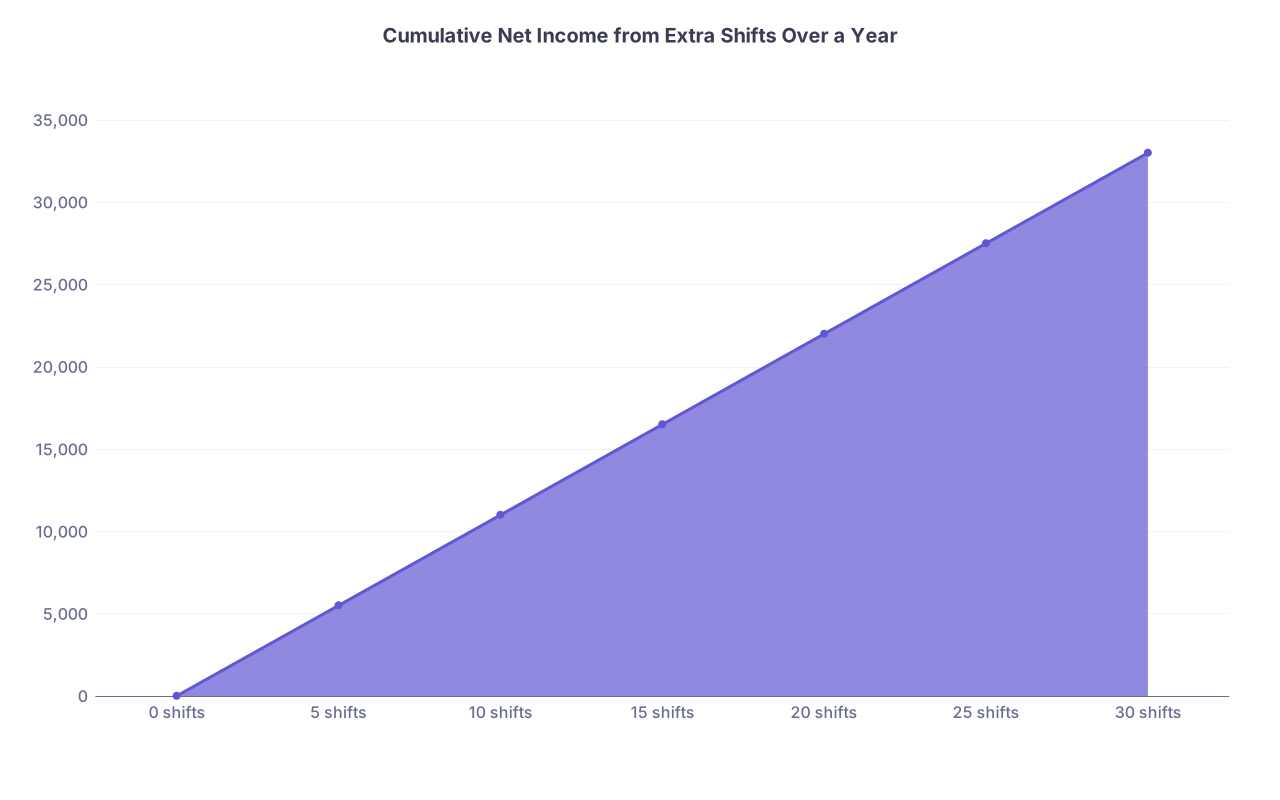
7. Modeling Marginal Income Over the Year
You also need to understand cumulative effect: your first extra few shifts in a year may be taxed slightly differently than your 40th. But for most attending-level physicians already in high brackets, increments are consistently heavily taxed.
Still, visualizing the impact over time is useful.
| Category | Value |
|---|---|
| 0 shifts | 0 |
| 5 shifts | 5500 |
| 10 shifts | 11000 |
| 15 shifts | 16500 |
| 20 shifts | 22000 |
| 25 shifts | 27500 |
| 30 shifts | 33000 |
In this example:
- Each extra shift nets ~$1,100 after tax and costs (similar to Scenario 1)
- 30 shifts (roughly 2.5 extra shifts per month) gives ~$33,000 extra net for the year
That sounds impressive until you realize:
- 30 extra shifts × ~14 hours/shift = 420 additional hours
- $33,000 ÷ 420 ≈ $79/hour
And 420 extra hours is more than 10 additional 40‑hour weeks of your life. On top of a full-time clinical job.
8. Typical Pitfalls in Physician Marginal Income Thinking
I see the same mistakes repeatedly. Let me call them out bluntly.
8.1 Ignoring total time
“I get $150/hour for moonlighting.”
Reality:
- Scheduled: 8 hours
- Show up 15–20 minutes early
- Stay 45–60 minutes charting after
- Commute each way: 30–45 minutes
Your 8‑hour block might really be 10+ hours.
$150 × 8 = $1,200 gross. After tax maybe ~$650. Over 10 hours = $65/hour.
8.2 Comparing gross, not net
Locums companies love to brag “$250/hour!”
If your primary job is in a no-income-tax state and your locums is in a high-income-tax state where you now owe tax there too, your effective marginal rate on that money is much higher than you think.
You must always adjust for:
- Federal
- State (both home and work states when different)
- Payroll / SE tax
- Travel and lodging costs
8.3 Forgetting phaseouts and cliffs
Extra income can:
- Phase out certain child tax credits or deductions
- Increase IRMAA surcharges for Medicare premiums (for older physicians)
- Push you into higher effective tax rates on certain thresholds
For a young attending this effect might be mild. For a 60‑year‑old married cardiologist thinking “I’ll clean up with locums before retirement,” the IRMAA and tax games matter.
8.4 Double-counting retirement benefits that don’t exist
Extra W‑2 shifts often do not come with extra retirement match. Your employer 403(b) match is typically tied to base salary / regular hours, not moonlighting.
Extra 1099 work? You may be able to shovel more into a solo 401(k) or SEP‑IRA, yes. But you need to model that explicitly, not assume “I am saving all pretax.”
9. Step-by-Step: How to Calculate Your Own Marginal Rate
Let me give you a concrete, repeatable process.
Step 1: Define the work unit
Example: “One extra Sunday 12‑hour hospitalist shift at my main job.”
Write down:
- Offered pay for that unit (e.g., $2,300 flat for the shift)
Step 2: Log the real time for one actual instance
Do it once carefully:
- Time you leave home
- Time you walk in
- Start clinical work
- End of clinical work
- Final chart complete
- Back home
You will likely be surprised. An advertised 12 hours might routinely be 13.5–14.5 door-to-door.
Use that time.
Step 3: Estimate your marginal tax rate
Two approaches:
Quick and dirty:
- Take last year’s tax return: Total tax ÷ taxable income = average rate.
- Add 10–15 percentage points for marginal impact if you are already a high earner.
Cleaner:
- Use an online marginal tax calculator with your filing status and state.
- Plug current income. Then add $10,000. See the change in tax.
- (Tax with +$10k − baseline tax) ÷ $10k = practical marginal rate.
Use that number for your “extra work” decisions.
Step 4: List incremental costs per unit
Include:
- Extra commuting / parking
- Childcare
- Food
- For 1099/locums: license costs amortized per day, hotel per night, rental car, extra malpractice if not covered
Rough is fine; it just needs to be non-zero.
Step 5: Run the marginal math for that unit
Formula:
Net per unit =
Gross pay − (Gross pay × marginal tax rate) − incremental costs
Then:
Net hourly =
Net per unit ÷ total real hours
Do this for every kind of extra work you are considering. You will instantly see which ones are actually worth it.
10. Locums-Specific Wrinkles (Where People Miscalculate)
Locums and 1099 moonlighting are where the math gets both interesting and messy.
10.1 Travel-heavy vs local locums
A common trap:
You see $2,400/day for a rural site 4 hours away. They cover flight and hotel, so you mentally treat gross as “pure income.”
Reality:
- Travel day before: effectively burned, maybe 4–8 hours of real time
- Travel day after: same
- Work days: 10 hours on site + 1 hour charting + 1 hour daily commuting if not directly attached
If you do a Friday–Monday 4‑day block:
- 2 “travel days” with little or no pay
- 4 workdays with pay
Total time:
- 2 days × ~6–8 hours of travel/admin per day = 12–16 hours
- 4 days × ~12 hours per day = 48 hours
- Total = ~60–64 hours
Total gross pay:
- 4 workdays × $2,400 = $9,600
Taxes (say 47%): net ≈ $5,088
Out-of-pocket (meals, incidentals, credentialing share): say $300
Net ≈ $4,788
Per-hour net:
- $4,788 ÷ ~62 hours ≈ $77/hour
That “$2,400 per day” gig is now paying you roughly the same net hourly as a decent in-house extra shift.
Where locums gets better is:
- Minimizing unpaid travel days, or
- Doing longer blocks so travel is amortized across more shifts, or
- Local 1099 locums where you drive 30 minutes and sleep in your own bed
10.2 Expense deductions and retirement
Yes, 1099 income lets you:
- Deduct legitimate business expenses
- Open a solo 401(k) or SEP-IRA and shield a chunk of that income from tax
But two points:
- Retirement contributions defer tax; they do not erase it
- You need to be actually willing to save that money, not just spend all the extra
If you consistently use locums income to max a solo 401(k), then the effective marginal tax on that contribution piece might drop to near zero in the current year. That changes the math and can make locums more attractive than W‑2 extra shifts. But only if you are disciplined enough to route that money into retirement.
11. Breaking Down “Good” vs “Bad” Extra Work
Let me blunt: not all extra work is created equal.
11.1 “Good” extra work (financially)
- Pays a significant premium over your base effective hourly
- Minimizes unpaid time (commute, travel, admin)
- Offers predictable volume and acuity (so your hour is not crushed by chaos)
- Has meaningful tax or retirement advantages (1099 with aggressive retirement funding)
- Does not carry a disproportionate medicolegal risk profile
11.2 “Bad” extra work
Patterns I have seen repeatedly:
- “$120/hour” ED moonlighting 40 minutes away that turns into 11–12 real hours for 8‑hours pay
- “Light telemedicine” that is billed as 4 hours but you chart on 20 patients after for free
- “Easy clinic coverage” that is actually double-booked with no MA support
- Locums in a disaster clinic where you are functionally risking your license for an extra $500 over what you could make at home
If your calculated net marginal hourly is below your own internal threshold (say, $80–100), and the work is high-stress, hard pass.
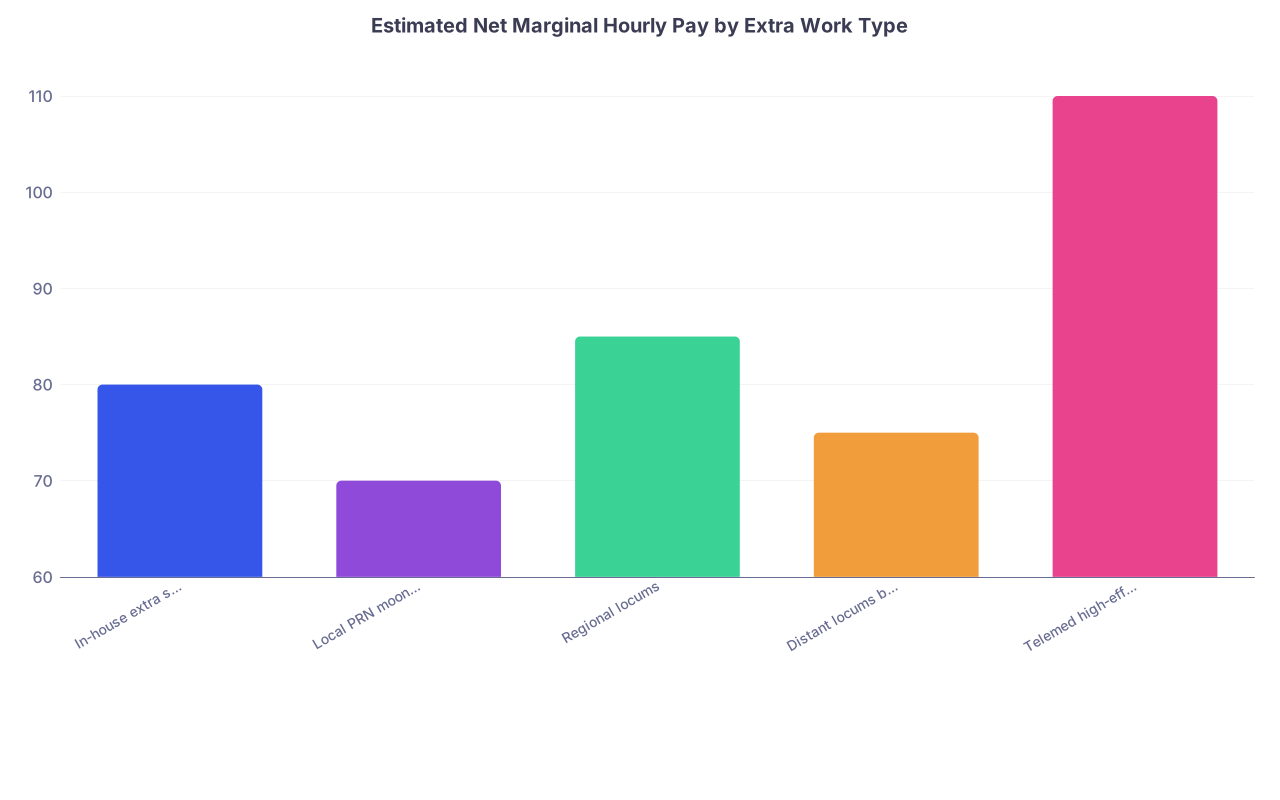
12. Visualizing the Tradeoffs
It often helps to see where various options cluster.
| Category | Value |
|---|---|
| In-house extra shift | 80 |
| Local PRN moonlighting | 70 |
| Regional locums | 85 |
| Distant locums block | 75 |
| Telemed high-efficiency | 110 |
Again, these are conceptual. But the pattern is what matters:
- Very few realistic options net you >$120/hour consistently after tax and time
- A lot of them cluster in the $70–95/hour band
Once you see that, mindlessly stacking more shifts starts to look less glamorous.
13. How to Use This Math for Real Decisions
Let us tie this together with practical decision rules.
13.1 Set your “walk-away hourly” number
Example: you decide:
“Given my baseline income and life, I only pick up extra clinical work that nets me at least $100/hour real, after-tax, after-cost.”
Now, when:
- The group offers you a holiday shift for $2,400, you run the numbers:
- After tax ~ $1,300
- After some costs $1,200
- 14 hours real time → ~$86/hour
You say no.
- A telemed company offers $140 per scheduled hour, 4‑hour blocks, no commute, and you can reliably see and close charts in scheduled time:
- 4 hours door-to-door
- $560 gross; assume 45% tax = $308 net → $252 after small costs
- $252 ÷ 4 = $63/hour – too low, you decline
But if a premium telemed gig with volume-based comp yields $220/hour gross, 45% tax, 4 hours actual time:
- $220 × 4 = $880 gross
- 55% net ≈ $484 net (assuming some retirement sheltering)
- $484 ÷ 4 = $121/hour
Now it meets your threshold.
13.2 Look at annual life impact, not just single shifts
If you routinely take:
- 2 extra shifts/month (24/year) at net ~$80/hour, 14 hours/shift = 336 hours
- That is almost 2 months of 40‑hour workweeks, for maybe $26–28k net
Ask yourself plainly:
Is adding two months of work worth $26k at your current life stage?
Sometimes the answer is yes. Often, it is not.
13.3 Compare marginal work to alternatives
You should also compare extra clinical work to:
- Building a side skill (e.g., coding, consulting niche, expert witness work) that could eventually pay you $200–400/hour limited time
- Fixing your personal financial leaks (refinancing debt, cutting lifestyle bloat)
- Simply doing nothing and lowering burnout so you can last more years at your base salary
Once you accept that most extra clinical work pays you well under $100/hour net, it opens the door to more creative options.
14. Put Your Own Numbers to Work
You do not need a PhD in finance. You need a simple spreadsheet with:
Columns:
- Work type (in-house shift, locums site A, moonlighting clinic, telemed contract)
- Gross pay per shift/day/block
- Real hours per unit (door-to-door)
- Marginal tax rate (your best estimate)
- Incremental costs per unit
- Calculated net/hour
Then rank them.

| Step | Description |
|---|---|
| Step 1 | Extra work offer |
| Step 2 | Estimate real hours |
| Step 3 | Calculate after tax income |
| Step 4 | Subtract extra costs |
| Step 5 | Compute net hourly |
| Step 6 | Consider nonfinancial factors |
| Step 7 | Decline |
| Step 8 | Accept selectively |
| Step 9 | Net hourly meets target? |
| Step 10 | Burnout / schedule ok? |
That flow looks simple. In reality, the hard part is being honest with the hours and setting a real threshold.
With this framework, you are no longer guessing whether an extra shift or locums weekend “is worth it.” You can quantify it. You can rank opportunities. You can match your work to your real financial and life priorities.
The next rational step, once you have your marginal numbers, is to integrate them into a broader plan: how much extra income you actually need, what you are using it for (debt payoff, early retirement, aggressive investing), and when to stop. That is where this kind of shift-level math connects to your long-term financial independence trajectory—but that is a separate conversation, and it deserves its own deep dive.