
The biggest myth about locum tenens compensation is that “$X per hour” tells you anything useful. It does not.
If you only look at the headline rate, you will get burned. Sometimes by thousands per week.
Let me break this down the way recruiters and staffing companies actually think about it: bill rate, pay rate, stipends, margins, and all the little ways costs get shifted onto you if you are not paying attention.
1. The Core Locums Rate Structures: How You Actually Get Paid
Locums compensation usually gets framed as an hourly number. That is only the visible tip of the structure.
You will see a mix of:
- Straight hourly rates
- Daily rates (with or without call)
- Shift rates (ED, hospitalist, anesthesia, ICU)
- Plus or minus call pay
- Plus or minus overtime/after-hours differentials
Recruiters often toss these terms around like they are interchangeable. They are not.
Hourly vs daily vs shift rates
Here is how these most commonly look in practice:
Hourly: “$220/hour, 8-hour day, no call.”
You bill for every hour you are physically present working (and sometimes for call hours as well).Daily: “$2,000/day, 8a–5p, clinic, no call.”
Fixed payment per day, regardless of whether you are slammed or sitting.Shift-based: “$2,400 per 12-hour ED shift, 7a–7p” or “$3,000 per 24-hour in-house call.”
Again, fixed per block rather than per hour.Hybrid: “$1,800 per weekday, plus $250/hour after 5 pm for call-backs.”
Common with surgery, OB, anesthesia, some subspecialties.
The trick: your effective hourly rate changes dramatically based on how the contract counts hours, call, and overtime.
| Structure Type | Example Rate | Typical Use Case |
|---|---|---|
| Hourly | $220/hr | Outpatient clinic, hospitalist with clocked hours |
| Daily | $2,000/day | Office-based specialties, low-acuity inpatient |
| 12-hr Shift | $2,400/shift | ED, ICU, nocturnist |
| 24-hr In-house | $3,000/shift | OB, anesthesia, rural hospital coverage |
| Daily + Call | $1,600/day + $400/call | Surgery, cards, mixed consult-call models |
Converting everything to an effective hourly rate
If you want to compare jobs honestly, you absolutely must convert to an effective hourly rate.
Example:
- Offer A: $2,000 per 24-hour in-house call, busy OB with 8–10 deliveries per 24 hours.
- Offer B: $210/hour for 12-hour L&D shift, no off-site call, similar volume.
Offer A: $2,000 / 24 = $83.33/hour.
Offer B: $210/hour × 12 = $2,520 per shift = $210/hour.
You would be shocked how many OBs happily accept $2,000/24 “because it sounds big” and then work 16 hours straight on their feet.
Same drill for “daily rate, light call” packages:
- Weekday clinic: $1,800/day, 8a–5p, 1:3 home call
- On call days, you might be at the hospital late, plus constantly on your phone. Still $1,800.
If you’re realistic and say that “call days” feel like 12–14 hours of work, your real hourly drops fast.
The RVU trap (why you should almost always say no)
Occasionally, you will see “locums” deals that include RVU-based compensation, especially if:
- The group is trying to convert you to permanent
- They want “productivity alignment”
- They are used to RVU-only employed contracts
For true locums, an RVU-heavy structure is usually a bad deal. You carry the risk of:
- Dysfunctional scheduling
- Low volume
- Bad payer mix
- Unreliable support staff
…without the upside of partnership, equity, or long-term stability.
Reasonable hybrid: a guaranteed base day/shift rate plus RVU bonus above a high, clearly stated threshold. If there is no guaranteed floor, I call that a red flag.
2. How Agencies and Hospitals Think: Bill Rate vs Pay Rate
You need to understand one thing most physicians never see: the gap between what the hospital pays and what you receive.
That gap is the agency margin.
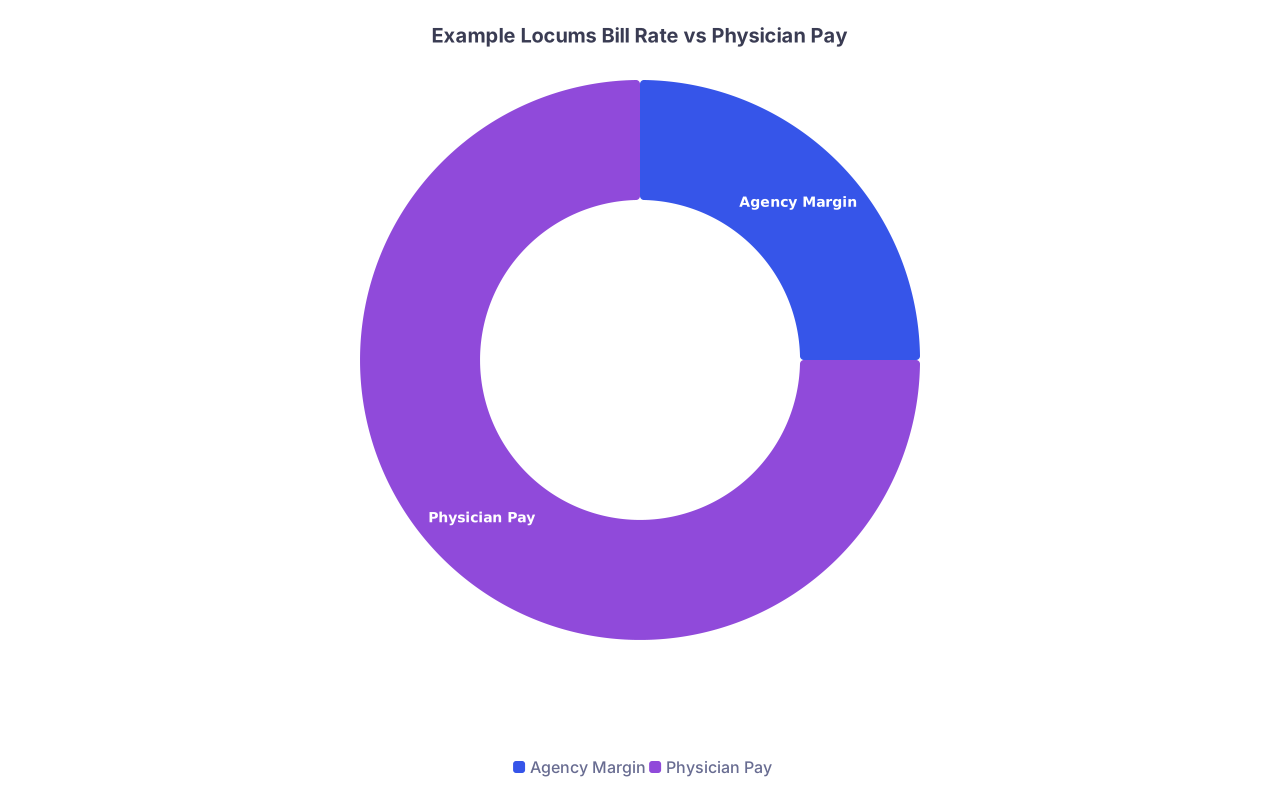
| Category | Value |
|---|---|
| Agency Margin | 25 |
| Physician Pay | 75 |
Here is the usual structure:
- Hospital/clinic pays the agency a “bill rate”
- Agency pays you a “pay rate”
- Difference = agency’s margin (which can be 20–50% or more, depending on specialty and desperation level)
Example:
- Hospital bill rate: $300/hour
- Agency pay rate: $210/hour
- Agency margin: $90/hour → 30%
Now, I am not saying agencies should work for free. They build relationships, handle credentialing, carry malpractice, deal with collections, front the cash, take non-payment risk. That has a value.
But if you do not have a sense of the spread, you have no leverage.
How do you sniff this out?
You ask targeted questions:
- “Where did this rate start with the hospital?”
- “Is there any room on the bill rate?”
- “Have other physicians on this assignment earned more previously?”
Then you listen. Recruiters slip up more than you think. I have literally heard: “We started at $300 bill, but we can get you to $220.” That tells you their margin can stretch.
3. Travel Stipends and Housing: The Money People Forget to Count
Travel and housing can quietly make or break a locums deal. The cash value of these extras can easily be equivalent to a 10–20% bump in your “rate,” or the opposite if they are miserly.
Most common setups:
- Agency-arranged travel and housing
- Physician-arranged travel/housing with reimbursement or stipend
- Hybrid (they do flights, you do housing, etc.)
Flights, mileage, and rental cars
Watch for these details:
Flights: coach vs. economy plus vs. nothing specified. You will almost always get standard coach. If you are flying cross-country every week, that matters. Try to consolidate travel and do longer blocks to reduce punishment.
Mileage: typical is IRS mileage rate if you drive your own car (changes yearly, ~60 cents/mile). Some places cap total reimbursable miles.
Rental car: some agencies cover a car; others push Uber/Lyft or shuttle. For rural gigs, you need a car. Period. Build that into your negotiation.
Trap: “We cap total travel reimbursement per assignment at $X.” On a long cross-country assignment, that cap can quietly erase a big chunk of your real compensation.
Housing: furnished vs stipend vs “good luck”
You will hear three broad approaches:
- Fully arranged, furnished housing (apartment, hotel, extended stay)
- Flat housing stipend per week/month
- Reimbursement up to “reasonable costs” (vague by design)
Each has pros/cons.
Agency-arranged housing:
- Pros: zero time spent hunting; no cash outlay; no dealing with leases.
- Cons: you have very little control over quality or location; they may choose the cheapest option.
I have seen physicians placed in:
- Extended-stay hotels right off a highway with constant noise
- 40 minutes from the hospital in traffic
- Housing without basics like blackout curtains or decent kitchen setup
Stipend/reimbursement:
- Pros: control and flexibility. You can pick exact neighborhood, amenities, privacy level.
- Cons: you carry the admin burden and sometimes the risk if they decide your costs were “above normal.”
You need explicit language:
- Dollar cap per month/week
- Utilities included or not
- Whether deposits and cleaning fees are reimbursable
- Whether they cover Airbnb/VRBO (some do, some do not)
| Option | Control | Admin Burden | Typical Value |
|---|---|---|---|
| Agency-arranged | Low | Very low | Moderate |
| Fixed stipend | High | Moderate | Variable |
| Full reimbursement | High | High | High (if generous) |
4. Per Diem, Meals, and Incidentals: Small Line Items, Big Impact
Daily per diem and incidentals can quietly add up to the equivalent of a few extra dollars per hour. Or not, if they do not exist.
Common structures:
- IRS per diem for meals/incidentals (varies by city; higher in major metros)
- Flat daily stipend: e.g. $40/day or $50/day
- No per diem, with the rationale that your rate “already accounts for it”
If you are doing true travel locums—living away from home, not just driving across town—a reasonable per diem matters. Think:
- Breakfast on the road
- Hospital cafeteria (which is never as cheap as administrators pretend)
- Groceries if you are in a hotel room without a proper kitchen
- Laundry, parking, minor extras
Ask specifically:
- “Is there a daily per diem for meals and incidentals?”
- “Is this paid as a non-taxable stipend or as taxable wages?”
This brings us to tax structure.
5. W‑2 vs 1099 Locums: The Tax Side of Compensation
Here is where many physicians get tripped up. You see a $230/hour 1099 contract and a $210/hour W‑2 contract and instinctively chase the larger number.
Not so fast.
W‑2 locums (employee model)
Some large staffing firms and health systems hire locums as W‑2 employees:
- They withhold taxes for you
- They may provide some benefits (401k, health insurance, etc.)
- All income is wages; stipends and per diems may be structured as non-taxable but more often flow through payroll in a simple way
Upsides:
- Simple tax filing
- No quarterly estimated payments
- Possible access to group benefits
Downsides:
- Less flexibility with deductions
- Lower headline rates (because the agency carries more cost on their side)
1099 locums (independent contractor)
Here:
- You are paid gross, no taxes withheld
- You handle quarterly estimated tax payments
- You bear full responsibility for your own health insurance, disability, retirement contributions
- You can also deduct legitimate business expenses: CME, licensing, part of travel, home office, etc.
This is where many physicians either make a lot of extra value or create a tax mess.
1099 is powerful if:
- You treat locums like a real business (separate accounts, track expenses, get a CPA who understands physician IC work).
- You maximize retirement options (solo 401k, SEP IRA, possibly defined-benefit plan if your income is high enough).
1099 is dangerous if:
- You spend every paycheck as if it is take-home.
- You ignore quarterly estimated payments.
- You have no idea what is deductible and what is not.
The key point for compensation comparison: a 1099 rate must be meaningfully higher than a W‑2 rate to be equivalent, because you must self-fund:
- Employer half of FICA/Medicare
- Health insurance premiums
- Malpractice (sometimes)
- Retirement (unless you plan to save nothing, which would be absurd)
General rule of thumb: a 1099 rate that is only 5–10% higher than a W‑2 alternative is not actually better once you account for those.
6. Malpractice, Tail, and Other “Hidden” Costs
Malpractice coverage in locums is usually “claims-made” and provided by the agency. That is the sales pitch. The reality is more nuanced.
Questions you must ask:
- Is malpractice occurrence-based or claims-made?
- Who covers the tail if it is claims-made?
- Policy limits? (Common: $1M/$3M, sometimes higher in litigious states.)
- Any specialty-specific exclusions that matter for you?
If the policy is claims-made and the agency promises “we cover tail,” ask for that in writing. I have seen situations where doctors switched agencies, and both agencies argued over who should cover tail for overlapping assignments. You do not want to be caught in that crossfire.
If you are doing 1099 locums where you buy your own malpractice:
- Get quotes for your specialty before you agree to a given rate.
- Build the cost of coverage and tail into your mental minimum acceptable hourly.
Licensing, credentialing, and CME
These are not huge line items per month, but they are non-trivial over the year.
Typical payers:
- State license fees: sometimes reimbursed, sometimes not.
- DEA: usually reimbursed.
- Hospital credentialing fees: usually on the hospital/agency, but confirm.
- CME: some agencies provide small stipends; many do not.
You want in writing:
- Which licenses will be reimbursed, and at what timing.
- Whether they pay upfront or after proof of payment.
- Whether reimbursement is conditioned on completing a certain duration of assignment.
If you buy a $800 compact-state license and then the assignment evaporates before you start, you will regret not clarifying that up front.
7. Non-obvious Time Costs: Commute, Turnover, Call, and Charting
Now we get into the stuff that silently eats your hourly and makes some locums gigs miserable despite decent pay.
Commute and travel time
If you are flying in:
- Door-to-door time from home to assignment is real time.
- Early Monday flight + late Friday return still uses evenings and recovery time.
If you are driving:
- Daily 45-minute rural commutes both ways? That is 7.5 hours per 5-day week unpaid.
You need to ask:
- “Where exactly is the housing relative to the hospital?”
- “Is there staff parking or is it a 15-minute shuttle?”
Turnover, staffing, and workflow
You are not just being paid for your license. You are being paid to walk into someone else’s operational dysfunction and keep things afloat.
Variables that change your real compensation:
- Number of patients per day / per shift
- Call-back rates at night
- Availability of midlevels / scribes / residents
- EMR quality and support (Epic with real training vs. local Frankenstein system)
- How far behind they are when you arrive (weeks of backlog vs. mild understaffing)
Two jobs, both $220/hour:
- Job 1: 16 outpatient visits/day, good MAs, scribe, Epic, stable team, minimal after-hours charting.
- Job 2: 26–30 visits/day, no scribe, understaffed, constant portal messages, weak EMR, poor templates, 2–3 hours of nightly chart catch-up.
On paper, same rate. In lived experience, radically different.
This is why experienced locums physicians interrogate:
- “How many patients per day do your current doctors see?”
- “What does a typical call night look like in numbers, not adjectives?”
- “Any backlog or special projects I am expected to clean up?”
If the answers are hand-wavy (“busy, but manageable”), assume it is worse than average.
8. How to Evaluate and Negotiate a Locums Offer Rationally
Let’s pull this together into a concrete framework.
Step 1: Build a pro forma for one typical week
For each offer, estimate:
- Hours physically at the hospital/clinic
- Realistic hours on call that feel like “work”
- Travel/commute overhead
- After-hours charting catch-up
Then calculate:
Total compensation for the week (rate × hours + stipends + per diems + any bonuses)
÷
Total realistic hours spent on the job (including “invisible” time)
That is your real hourly.
Step 2: Price in hard costs you bear personally
If you are 1099:
- Malpractice (pro-rated weekly)
- Licenses (amortized over expected assignment life)
- Health insurance premiums
- Retirement contributions you want to make
- Tax overhead (self-employment tax share)
Does not have to be perfect. Ballpark is fine. But do it.
Step 3: Decide your minimum acceptable real hourly
You cannot negotiate intelligently without a walk-away number.
This is not “the lowest I will ever take for any job.” It is:
“For a job with this call/volume/travel expectations, the real minimum that makes it worth it.”
If your pro forma shows:
- Real hourly = $120 for a grind-your-soul job
- You know you can land a $150 real hourly for something tolerable
…you stop haggling and move on.
Step 4: Negotiate specific, not vague
Bad: “Can you do any better on the rate?”
Better: “Given the 1:3 home call and the volume you described, I am looking for at least $250/hour inclusive of all duties. Is there flexibility in the bill rate from the facility side?”
Ask also:
- “If you cannot increase the hourly, can you increase travel or housing stipend?”
- “Can we structure part of this as non-taxable per diem for M&I?”
- “Can we increase the weekend call rate instead of the base?”
You are trying to shift dollars to parts of the package that matter most for your life and your taxes.
9. Red Flags That Signal a Bad Locums Compensation Deal
Let me be blunt. If you see these patterns, you should be skeptical:
- Very low transparency on call expectations: “Call is usually light.”
- No written confirmation of tail coverage.
- “We do not offer per diem; your rate is already high.”
- Housing described only as “close” and “comfortable,” with no actual details.
- Refusal to discuss bill rate or acknowledge its existence.
- RVU-only “locums” without guaranteed base.
- Punitive cancellation clauses only on your side (you pay them if you cancel, but they owe you nothing if the hospital cancels).
Physicians who accept these conditions subsidize the system. You do not need to be one of them.

| Step | Description |
|---|---|
| Step 1 | Receive Offer |
| Step 2 | Clarify Rate Structure |
| Step 3 | Estimate Weekly Hours |
| Step 4 | Include Travel and Call |
| Step 5 | Add Stipends and Per Diem |
| Step 6 | Calculate Real Hourly |
| Step 7 | Negotiate Improvements |
| Step 8 | Decline and Move On |
| Step 9 | Accept with Written Terms |
| Step 10 | Above Your Minimum? |
| Step 11 | Meaningful Changes? |
FAQs (Exactly 6)
1. How do I know if my locums rate is “good” for my specialty and region?
You benchmark against multiple data points, not just what one recruiter says. Talk to 2–3 agencies, ask about similar assignments in the same state, and push for specifics: “What are your current rates for hospitalist shifts in [state] with no call?” Cross-check with colleagues who have recently done locums. High-demand specialties (anesthesia, EM, radiology, psychiatry, certain surgical subspecialties) should command a substantial premium over local employed salaries once you include stipends and tax advantages.
2. Is it better to have the agency arrange travel and housing or take a stipend and do it myself?
If you value simplicity and do not want to spend hours hunting for places, agency-arranged is fine, as long as you insist on basic standards and distance limits in writing. If you are picky about where you live and are willing to put in the time, stipends can be financially better and lifestyle-better, especially on longer assignments. The longer the assignment, the more I prefer stipends and personal control.
3. Are 1099 locums always better financially than W‑2 locums?
No. 1099 can be better if the rate premium is large enough and you actually use the flexibility: strong retirement contributions, careful deduction of legitimate business expenses, good tax planning. If the 1099 premium is small and you are bad about quarterly tax payments, a W‑2 structure with slightly lower headline pay can leave you in a stronger net position and with fewer headaches. Many mid-career physicians underestimate the administrative load and discipline required for 1099.
4. What hidden clauses in locums contracts should I watch for that affect compensation?
Look carefully at cancellation policies (both sides), minimum guaranteed shifts, floating to other sites, and non-compete/non-solicitation language that might block you from later taking a better direct contract with the same hospital. Some contracts quietly allow the facility to cut your shifts or cancel blocks with minimal notice and no financial penalty. That destroys your effective rate if you are flying in and booking housing. You want explicit guarantees or cancellation fees in your favor.
5. Can I negotiate higher travel or housing stipends instead of a higher hourly rate?
Often yes, and sometimes this is easier than moving the hourly. Facilities may have rigid internal pay rate caps but more flexibility on “expenses.” You can say: “If your hourly ceiling is firm, can we increase the weekly housing stipend to $X and add a $Y/month travel allowance?” Also, if structured properly, parts of those stipends may be non-taxable, which can make them more valuable than the same dollars in W‑2 wages.
6. How many locums agencies should I work with at once to maximize my compensation?
Two to three is usually the sweet spot. One agency limits your options and leverage, and you end up taking whatever they have. Ten agencies is chaos and guarantees duplicate submissions and headaches. With 2–3, you can compare real offers, see rate ranges for similar work, and play them off each other a bit without drowning in calls. Just be clear with each recruiter that you expect transparency if multiple agencies are staffing the same facility, so you do not get double-submitted and blacklisted.
Key points to remember:
- Ignore the headline hourly rate until you have converted everything—call, travel, stipends, charting time—into a real hourly number.
- Treat locums as a business transaction: understand bill vs pay rate, tax structure, malpractice, and who is actually bearing which costs.
- Negotiate specifics in writing, especially around call, housing, travel, and cancellation; vague promises will always resolve in the hospital’s favor, not yours.