It’s midnight. You’re sitting at your desk with a half-finished Anki deck open, but you’re not actually thinking about renal phys. You’re thinking about that stupid number you saw in your loan portal: $287,000 disbursed so far, with at least another year to go. You did the math. You’ll be at or over $300K by graduation.
And now your brain’s stuck on the same loop:
What if my future salary isn’t actually enough? What if after taxes and loans and everything, I’m basically just… not allowed to have a life?
Let me say this upfront: a typical physician salary can cover $300K+ in loans. But whether it feels survivable vs soul-crushing depends on:
- Your specialty
- How you handle the first 5–10 years out
- Whether you pretend the loans don’t exist until it’s too late
I’ll walk through this like a neurotic person who’s run the numbers too many times. Because, honestly, that’s me.
First, the ugly math: what does $300K+ actually turn into?
The part that’s making you nauseous is that $300K isn’t really $300K. Because interest exists. And interest is rude.
Assume:
- Principal: $320,000
- Weighted interest rate: ~6.5% (pretty typical for federal grad loans)
- Standard 10-year plan (no fancy maneuvers, no forgiveness)
Over 10 years, your required monthly payment is roughly in the $3,600–$3,800 range. Total paid: somewhere in the $430K–$460K range.
So that $320K is actually closer to “half a million dollars of your future life” when you include interest.
That’s the part that makes your chest tight. Not the principal. The total.
Now, the question you really care about: is a physician salary big enough that those numbers don’t destroy you?
Short answer: yes, but only if you don’t behave like you’re rich the second you finish residency.
Reality check: what do physicians actually make?
Let’s ground this a bit.
| Stage | Typical Salary Range |
|---|---|
| Residency (PGY1–3) | $60K–$80K |
| Fellowship | $70K–$90K |
| Early Attending (Primary Care) | $200K–$260K |
| Early Attending (Hospital-based IM/Neuro/etc.) | $250K–$350K |
| Early Attending (Surgical/Procedural) | $350K–$600K+ |
Let’s use a conservative, not-flashy example:
- You go into internal medicine or peds
- You land a job at ~$230K–$250K starting
- You still have $320K in loans by the time you’re an attending
On $240K salary:
- Federal + state + payroll taxes might take ~30–35% depending where you live (higher in CA/NY, lower in TX/FL)
- That leaves maybe ~$155K–$165K take-home per year
- Roughly $13K–$14K per month in your bank account
Then your standard 10-year loan payment of ~$3.7K/month hits. That’s about a quarter of your net income gone immediately.
You can technically live on the remaining ~$9–10K/month. That sounds like a lot right now when you’re eating Trader Joe’s frozen meals, but with:
- Rent or mortgage
- Car + insurance
- Disability and life insurance (which you really do need)
- Retirement savings
- Maybe childcare
- Actual life (food, travel, emergencies, etc.)
…that $9–10K starts to feel a lot smaller than Instagram makes “doctor life” look.
So yes, your salary can cover it. But the margin between “this is tight but okay” and “I feel crushed every month” is thinner than people assume.
The residency problem: the quiet killer is interest
Everyone focuses on the attending years, but residency is where a lot of the damage happens.
During residency:
- You’re making $60–$75K
- Your loans are usually in some kind of income-driven repayment (IDR) or maybe still in deferment/forbearance
- Interest is quietly stacking up
Let’s say you finish med school at $320K. You do a 3-year residency + 3-year fellowship. That’s 6 years of low payments while 6.5% interest accumulates.
Rough ballpark? Your $320K can easily creep up into the $380K–$420K range by the time you’re done, depending how aggressive you are with payments.
That’s the part that freaks people out: you didn’t even “do anything wrong.” You just… trained.
Here’s the sanity part though:
- If you’re pursuing PSLF (Public Service Loan Forgiveness), those residency years aren’t wasted financially, they’re gold.
- If you’re not doing PSLF, those years are the time to at least stop the bleeding, even if you can’t meaningfully pay down principal yet.
PSLF vs No PSLF: two totally different worlds
This is where your anxiety should branch into two scenarios.
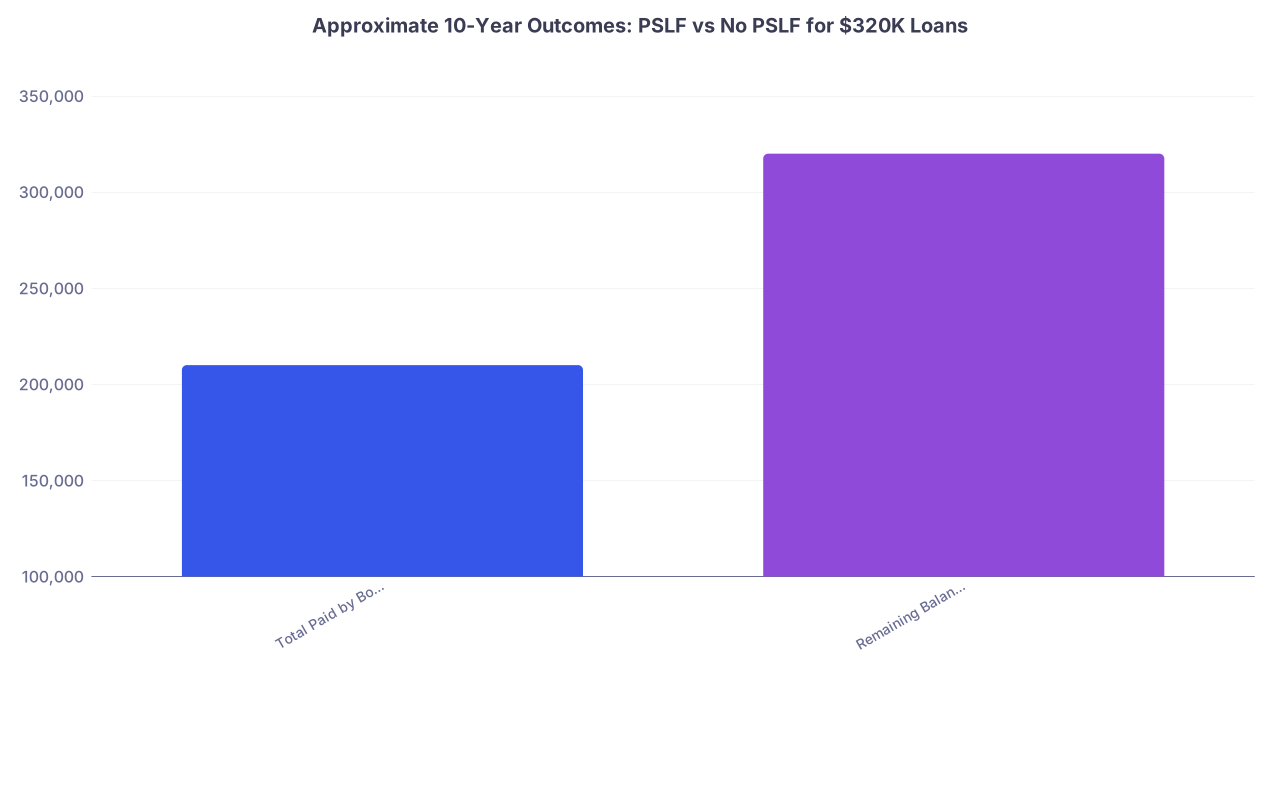
| Category | Value |
|---|---|
| Total Paid by Borrower | 210000 |
| Remaining Balance Forgiven or Paid | 320000 |
That bar chart is rough, but here’s the idea:
Scenario 1: PSLF (you work for a qualifying nonprofit / academic / VA)
PSLF basics:
- 120 qualifying payments (10 years) on an IDR plan
- You must be full-time at a qualifying employer
- Remaining balance forgiven tax-free at the end
What this looks like emotionally:
You spend:
- 3–6 years residency/fellowship at a teaching hospital (usually PSLF-eligible)
- 4–7 years as an attending at a nonprofit hospital, academic center, VA, FQHC, etc.
Your monthly IDR payments are based on your income, not the full amortized amount.
During residency, that might be a few hundred bucks a month.
As an attending, maybe $1.5K–$2.5K/month, depending on plan, income, and family size.
Total out-of-pocket over 10 years might be ~$150K–$250K. Then a chunk of your original $300K+ gets wiped.
So yes, in a PSLF path, your attending salary more than covers your loans. The anxiety point here is not “can I afford it?” but “am I really going to bank my life on a government forgiveness program not changing?”
I’ve seen people hedge by:
- Saving aggressively in a “forgiveness hedge fund” in case PSLF dies
- Then using that money later for down payments/retirement once they actually get forgiveness
Overkill? Maybe. But it helps some people sleep.
Scenario 2: No PSLF (private practice, for-profit, uncertainty)
Here the question gets sharper: can your salary cover $300K+ without forgiveness?
Yes. But you cannot live like a TV doctor in the first 5 years.
Let’s pretend:
- You finish with $380K after training interest
- You’re an attending at $300K/year in a medium COL city
- You decide you hate being in debt and do a 5–7 year payoff instead of 10+
That means:
- You’re throwing maybe $5K–$7K/month at loans
- You refinance to a lower rate (if it makes sense and you’re not going for forgiveness)
- You live like an upper-middle-class person, not like a cardiologist influencer
Here’s what I’ve actually seen colleagues do:
- Drive a used car for 4–5 years
- Delay big house purchase until loans are gone or way down
- No insane vacations every 2 months
- Still eating out, still living like a human, just not “I’m a doctor, I deserve everything now” energy
And they’re out of $300K+ in 5–8 years. Then suddenly their $300K salary feels like a totally different world.
What will your life feel like during those payoff years?
Let’s stop pretending this is all spreadsheets and “it’ll be fine.”
If you’re like me, what you’re actually afraid of is this:
“I’m going to be 35, exhausted, with kids, and still feel broke.”
Some real talk:
- You will not feel rich in residency. You’ll feel underpaid for the hours you work. You’ll also survive.
- Your first year as an attending will be emotionally weird. Your paycheck will look huge compared to residency, but then you see taxes + loans + insurance and suddenly it doesn’t feel as huge.
- If you’re aggressive about loans early, you might feel behind your non-med friends on houses, savings, etc. That comparison will mess with your head if you let it.
But here’s the flip side no one tells you clearly:
Even with $300K+ in loans, as a physician you have something most people don’t—high, stable earning power for decades. You can fix mistakes. You can catch up. You can build wealth after the debt is gone.
The risk is less “I can’t afford my loans” and more:
- I lifestyle-creep everything away
- I refuse to look at the numbers until it’s a disaster
- I sign a bad contract in a high-COL city and never reevaluate
Things that make $300K+ in loans survivable vs miserable
Here’s where your choices matter more than the raw loan number.
Things that help a lot
Matching your first attending job to your debt reality
Example: high-paying hospitalist job in a moderate COL city for 3–5 years, not immediately chasing that “dream coastal city” job at half the pay.Actually running numbers before you sign anything
Not vibes. Not “it’s fine, I’ll be a doctor.” Real budgets.Understanding IDR vs refinance vs PSLF early
Not 2 years into attending life when interest and regret are both higher.Letting your lifestyle lag behind your income
If your spending grows slower than your income, debt melts. If it grows faster, debt becomes your roommate.
Things that hurt, a lot
- Buying the $70K car your first attending year because “I earned it”
- Giant private school tuition for multiple kids while paying minimums on six-figure loans
- Ignoring disability insurance because it’s “too expensive” (and then being terrified of getting hurt or sick)
- Assuming “future me will figure it out” without a plan
You don’t have to be perfect. Just… not reckless.
Example timelines: what does this look like for real people?
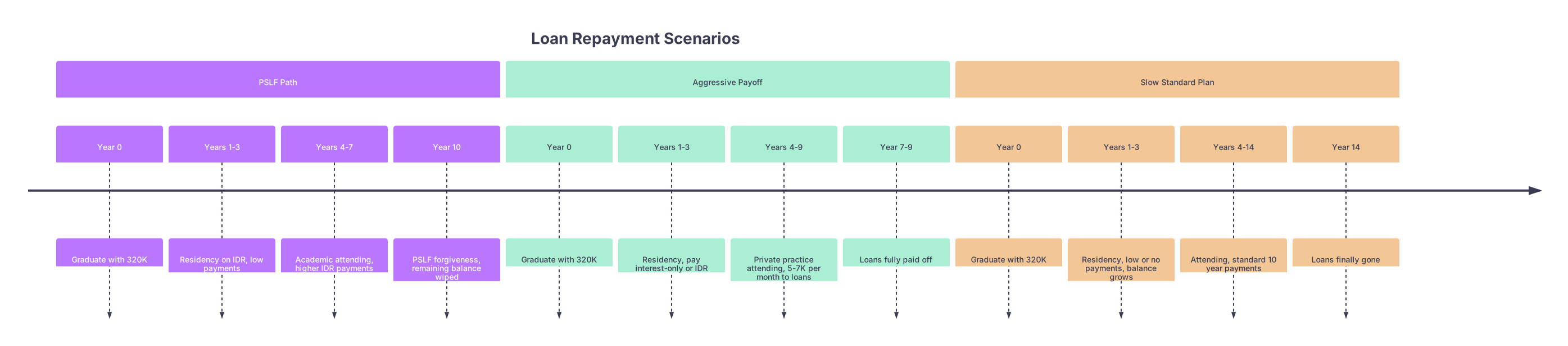
| Period | Event |
|---|---|
| PSLF Path - Year 0 | Graduate with 320K |
| PSLF Path - Years 1-3 | Residency on IDR, low payments |
| PSLF Path - Years 4-7 | Academic attending, higher IDR payments |
| PSLF Path - Year 10 | PSLF forgiveness, remaining balance wiped |
| Aggressive Payoff - Year 0 | Graduate with 320K |
| Aggressive Payoff - Years 1-3 | Residency, pay interest-only or IDR |
| Aggressive Payoff - Years 4-9 | Private practice attending, 5-7K per month to loans |
| Aggressive Payoff - Year 7-9 | Loans fully paid off |
| Slow Standard Plan - Year 0 | Graduate with 320K |
| Slow Standard Plan - Years 1-3 | Residency, low or no payments, balance grows |
| Slow Standard Plan - Years 4-14 | Attending, standard 10 year payments |
| Slow Standard Plan - Year 14 | Loans finally gone |
None of these are fantasy scenarios. I’ve watched all three happen:
- The PSLF person who paid like $200/month in residency, $2K/month as faculty, and had six figures forgiven in year 10.
- The private practice doc who went insane on loans for 6 years and then suddenly had $8K extra every month.
- The “I’ll just do the standard plan” person regretting every year of interest but still… fine.
All three covered $300K+. The emotional experience was very different.
Okay, but what if everything goes wrong?
This is the anxiety brain talking, so let’s feed it and then calm it down.
Worst-case spirals people worry about:
- What if I can’t match into a high-paying specialty?
- What if PSLF changes?
- What if I get sick and can’t work?
- What if I end up in a low-paying job with high COL and no way out?
Harsh truth:
- If you finish med school and residency in anything that lets you practice independently in the US, you are still in the top tiny percent of earning potential. Even at the lower-paid end of the physician spectrum, $180K–$220K is not poverty.
- Loan systems are messy, but they’re built on the assumption that people exactly like you exist: highly indebted professionals who still need to eat.
And bluntly:
- Income-driven repayment means your payment scales with your income. Worst case, you don’t pay $3–4K/month; you pay a few hundred while making less and stretch the timeline or aim for long-term forgiveness.
- Disability insurance (properly set up) is exactly for the “what if I get sick and can’t work” nightmare. Yes, it costs money. So does going broke.
You’re not trapped. You just don’t get the “I don’t think about money ever” fantasy. But almost no one actually has that anyway.
What you can actually do now while still a student
You don’t have to fix $300K today. You can’t. But you can make your future self’s life a lot less horrible:
- Know your real loan numbers: principal, interest rate, projected capitalization at graduation. Not just “a lot.”
- Learn the difference between REPAYE/SAVE, PAYE, IBR, and standard plans. You don’t need to be an expert, just enough to not be blindsided.
- Start thinking about PSLF vs no PSLF as an actual fork, not a vague idea.
- When you rank residencies, don’t pretend cost of living and institutional PSLF eligibility don’t matter. They do.
- Practice living slightly below your means now. Not suffering—but not maxing cards because “future doctor will pay it off.”
You can be scared and still be strategic. Honestly, that’s probably the best combination.
FAQ (exactly 4 questions)
1. Is $300K+ in med school loans a reason not to go into medicine?
If you hate medicine or you’re only doing this for money, yes, the debt is a very good reason to reconsider. The job is too hard and the debt too big to do this for the wrong reasons. But if you actually want to be a physician and you’re willing to be intentional with your finances, $300K+ is scary but manageable. Plenty of doctors with worse numbers are okay. Not thriving every second, not living some fake glamorous life, but okay—and later, actually comfortable.
2. Will I ever be able to buy a house or have kids with this debt?
Yes, but probably not as fast as your brain (or your family) wants. The typical pattern: small starter place or keep renting during early attending years while you hit loans hard or commit to PSLF, then a more realistic house 3–8 years in. Kids are more about your support system and emotional bandwidth than the loans, but the loans will affect how you live with kids—daycare vs nanny, private vs public school, etc. It’s about tradeoffs, not absolute impossibility.
3. Should I pick a specialty mostly based on salary because of my loans?
I think that’s a bad idea. You’re going to be doing this job exhausted at 3 a.m. for decades. If you hate it but picked it because it pays $100K more, that’s a pretty awful trade. That said, it’s not crazy to let compensation and lifestyle be tiebreakers between things you genuinely like. Choosing EM vs IM vs hospitalist vs outpatient primary care with some awareness of financial implications is smart. Selling your soul for RVUs is not.
4. What if I don’t understand any of this loan stuff and it just makes me want to shut down?
That’s normal. Almost nobody in med school fully understands it; they just click whatever box the financial aid office suggests. Start with tiny steps: know your total, your interest rate, and whether you’re likely PSLF-eligible based on your career goals. Then, when you’re closer to graduation and again in late residency, either use a reputable student loan calculator or pay a vetted student loan planner once. One or two good sessions can replace years of vague dread and bad decisions.
Key points to keep in your head:
- A typical physician salary can absolutely cover $300K+ in loans—but your choices in the first 5–10 years matter more than the raw debt number.
- PSLF vs no PSLF is a massive fork; know which path you’re on early and act like it.
- You’re allowed to be scared of the number and still move forward. Fear doesn’t mean it’s impossible; it just means you need a plan.