
What if you sign that first attending contract, realize you’re underpaid by six figures… and it permanently wrecks your financial future?
That’s the nightmare running in the background, right? You’ll be the idiot who accepted a lowball offer, locked yourself into a bad deal, and now you’re forever behind your co‑residents who “knew their worth.”
Let’s walk through that fear properly. Because some of what you’re scared of is exaggerated… and some of it is very real.
How Much Damage Can One Low-Paying First Job Actually Do?
Let me answer the scary part first: yes, a badly underpaid first attending job can set you back. Sometimes by a lot. But “set back” is not the same as “ruined forever.”
I’ve seen people in:
- EM making $240k when colleagues in the same state are at $350–380k
- Primary care on $170k base with insane RVU targets, while others are at $230k with better bonuses
- Surgical subspecialists taking $300k when market is $450–500k because they were desperate to stay in one city
They all felt the same thing you’re probably feeling: “I messed up. I’m already behind.”
Let’s quantify this a bit so your brain stops spinning in the abstract.
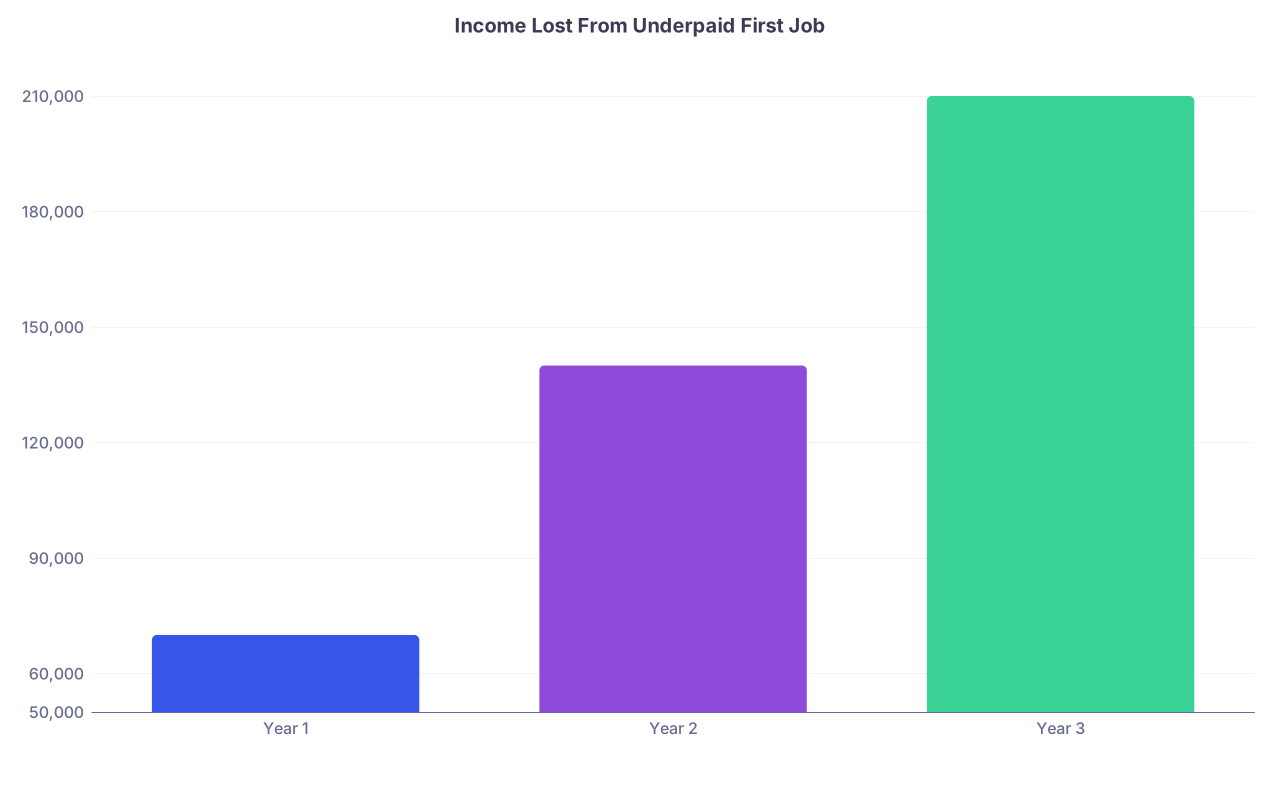
Say market pay for your specialty in your region is around $300k. You sign at $230k because you didn’t know any better, you were scared of not finding a job, or you just wanted out of training.
You’re underpaid by about $70k per year.
Stay 3 years in that job without correcting it?
$70k x 3 = $210,000 of lost gross income.
And that’s before you even factor in what those missing dollars could’ve done if invested.
| Category | Value |
|---|---|
| Year 1 | 70000 |
| Year 2 | 140000 |
| Year 3 | 210000 |
That number is ugly. No way around it.
But here’s the part your anxiety usually skips:
You’re not frozen at that salary forever. You’re not locked into a “low earner” timeline like some cursed RPG. You have levers to pull later. And physicians, even ones who start low, usually have a ridiculous amount of room to recover compared to most professions.
The bigger risk isn’t that your first job underpays you.
The bigger risk is that you:
- Don’t realize it
- Get comfortable
- Normalize it
- Stay too long
That’s where the financial damage turns from “annoying but fixable” into “massive opportunity cost.”
How to Tell If You’re Actually Underpaid (Not Just Paranoid)
Here’s what makes this so stressful: you don’t get a big red banner that says “YOU ARE BEING UNDERPAID.” You get vague numbers, recruiters saying “competitive,” and your co-residents mysteriously going quiet about exact offers.
So your brain fills the gap with catastrophe. “Everyone else is making double and won’t tell me.”
Let’s drag this out of the emotional fog and into reality.
You’re probably being underpaid if:
- Your base salary is 10–20%+ below MGMA/AAMC regional medians for your specialty
- Multiple co-residents in similar markets are making $50–100k more
- Your bonus structure looks generous on paper but is tied to chaotic RVUs you’ll never realistically hit
- They refuse to let you show the contract to an attorney or say weird things like, “None of our other doctors had a problem with this”
Here’s a simplified comparison just to see where things often land:
| Scenario | Base Salary | Likely True Market | Gap |
|---|---|---|---|
| Lowball primary care job | $170,000 | $230,000 | $60k |
| Reasonable academic IM job | $210,000 | $230,000 | $20k |
| Community hospital IM job | $250,000 | $250,000 | $0 |
| High-paying rural IM job | $300,000 | $260,000 | -$40k |
If you’re in the first row type situation, yeah, you’re underpaid.
If you’re in the “off by $10–20k” zone? That’s annoying, but not life‑altering. That’s inside the noise level of call differences, benefits, malpractice coverage, and random bonuses.
Most people secretly worry they’re in the first row when they’re actually much closer to the middle ones.
Still, let’s assume your worst fear is true: you did accept a meaningfully underpaid job.
Now what?
The Real Financial Consequences (Beyond Just the Yearly Salary)
The immediate thought is “I’m making $X less per year.” But the downstream effects are what scare you.
Because it’s not just the current income. It’s what that income is supposed to be doing.
Your first 5–10 years out of training are where you:
- Attack student loans
- Build your retirement foundation
- Maybe buy a house
- Possibly start a family
- Get disability and life insurance
- Learn basic investing (hopefully)
When your starting salary is low, the fear is that:
- You’ll be stuck in IDR payments forever instead of actually paying off loans
- You’ll save too little early, and compound interest won’t “have time” to work
- Your lifestyle will inflate based on a low starting point, and you’ll get trapped
- You’ll never “catch up” to colleagues who started strong
Here’s the thing almost no one tells you: doctors massively overestimate how fragile their financial trajectory is.
Yes, compounding matters. Yes, early investing helps a lot. But you’re not a 24‑year‑old making $45k with no path to higher income. You have a specialized skill that people are constantly short of.
Your income is very adjustable over a 30‑year career.
What matters more than the first 2–3 years is:
- How long you stay underpaid
- Whether you course‑correct with intention
- Whether you avoid the trap of “I’m underpaid but I also spend like crazy because I’m miserable”
If you take a low job, live semi‑reasonably, then switch to fair or above‑market pay after 2–3 years? You absolutely can recover.
If you take a low job, get burned out, cope with spending, never negotiate, and stay 10–15 years? That’s harder. Not impossible, but you’ve dug a much deeper hole.
How Hard Is It to Recover? The Honest Answer
Let me be blunt: recovering from an underpaid first job is emotionally hard, logistically annoying… but mathematically very doable.
Emotionally hard because:
- You’ll compare yourself to co-residents who “did better”
- You’ll feel stupid for not knowing market rates
- You’ll worry every new offer is secretly another scam
- Your brain will replay, “If I’d just negotiated X back then…”
Logistically annoying because:
- Moving jobs often means credentialing delays
- There’s ramp-up time building a new panel or volume
- You might have to move cities or accept less “prestige” for more pay
But from a numbers standpoint?
You have levers:
- Move from underpaid area to higher‑pay region (yes, including rural)
- Switch from academic to community (if you want)
- Add extra shifts, telemedicine, urgent care per diem
- Negotiate RVU rates or base salary at renewal
- Move to a group with better partnership track, ancillaries, or profit sharing
Consider this: you under-earn by $70k/year for 3 years. That’s $210k gone.
Then you:
- Go to a better-paid job that’s $80k/year higher than your old one
- Work a few extra shifts for +$20k/year for 3–5 years
Now you’re outperforming your previous self by $100k/year for, say, 5 years.
$100k x 5 = $500k additional gross over five years.
You’ve not only erased the $210k shortfall, you’ve overshot it.
Is it ideal? No. Would it have been nicer to nail it from year one? Of course.
But are you doomed because you were underpaid early? Brutally, honestly: no.
The Part No One Wants to Hear: The Bigger Threat Is Lifestyle Creep
You know what ruins more doctors financially than a low first salary?
Lifestyle creep at any salary.
I’ve seen the $450k cardiologist who’s broke. I’ve seen the $200k pediatrician who’s quietly a millionaire in their 40s. The difference wasn’t the first job. It was choices.
The scarier scenario isn’t:
“I made $210k less over 3 years and then fixed it.”
The scarier scenario is:
“I was underpaid, felt deprived, and the moment I got a raise or changed jobs, I immediately upgraded everything.”
- New luxury car
- Giant mortgage
- Private school
- Expensive vacations to “make up for residency”
Then it doesn’t matter that you fixed the salary. You just moved the goalposts. You never let income translate into net worth.
If you’re anxious about being underpaid, you’re actually already ahead of a lot of attendings who aren’t thinking about this at all. You’re at least conscious something might be off.
That anxiety is annoying, but it’s also an early warning system.
What You Can Do If You Realize You’re Underpaid
Let’s say you’re already in the job. Contract signed. You start seeing the numbers, talk to colleagues, peek at MGMA, and suddenly your stomach drops.
Okay. Deep breath. You’re not trapped forever.
Here’s a realistic path out, without pretending it’s all magical and easy.
Confirm the reality, not the panic story.
Talk to: co-residents, older attendings you trust, maybe a physician contract lawyer or a compensation consultant. Don’t base your conclusion on one internet comment or a Facebook group rumor.Check your contract for term and renewal.
Are you locked into a 3‑year term with punitive tail coverage? Is there a no‑cause termination clause with 60–90 days notice? Can you renegotiate at year 2–3?Decide: renegotiate vs. leave.
Sometimes you can say, “Look, here’s regional data, my productivity, and fair market value. This offer is X% under market. We need to fix this.” Sometimes they’ll work with you. Sometimes they won’t. If they stonewall, that’s data. Not a failure.Use time strategically, not passively.
While the contract runs down, you can:- Pay down some debt
- Build a small emergency fund so you’re not trapped
- Keep your lifestyle moderate so you have options
Next time, you’re not walking in blind.
You’ll:- Ask for actual numbers from multiple offers
- Get your contract reviewed
- Benchmark using MGMA/AAMC, specialty societies, and real colleagues
- Be willing to walk away

| Step | Description |
|---|---|
| Step 1 | Realize you are underpaid |
| Step 2 | Gather market data |
| Step 3 | Discuss with trusted mentors |
| Step 4 | Attempt raise or adjustments |
| Step 5 | Plan job change |
| Step 6 | Improve pay and reassess |
| Step 7 | Search and compare offers |
| Step 8 | Sign better contract |
| Step 9 | Adjust savings and debt payoff |
| Step 10 | Renegotiate possible |
The hardest part is not the math. It’s the shame and second‑guessing.
You’ll feel behind. You’ll feel like everyone else played the game better. But the reality? A ton of doctors screw up their first contract. They just don’t announce it at grand rounds.
Don’t Confuse a Bad Start With a Bad Ending
Your brain likes straight lines. “I started low, so I’ll always be low.”
Real careers look more like jagged hills. Mediocre first job. Better second job. Maybe a burned‑out detour. Then a higher‑pay, more sustainable role once you’ve figured out what you’re doing.
Here’s the thing I’d want burned into your head:
You have an insanely valuable skill. That is leverage. Even if your first job underpays you, you are not stuck at that number for life.
You might start slow, but you are not permanently sentenced to “the poor doctor tier” because of one contract signed in a haze of PGY‑3 exhaustion.
Your power isn’t in never making a mistake. It’s in refusing to stay in one once you see it.
| Category | Underpaid then corrected | Fair from the start |
|---|---|---|
| Year 1 | 230 | 280 |
| Year 3 | 250 | 310 |
| Year 5 | 320 | 340 |
| Year 10 | 380 | 380 |
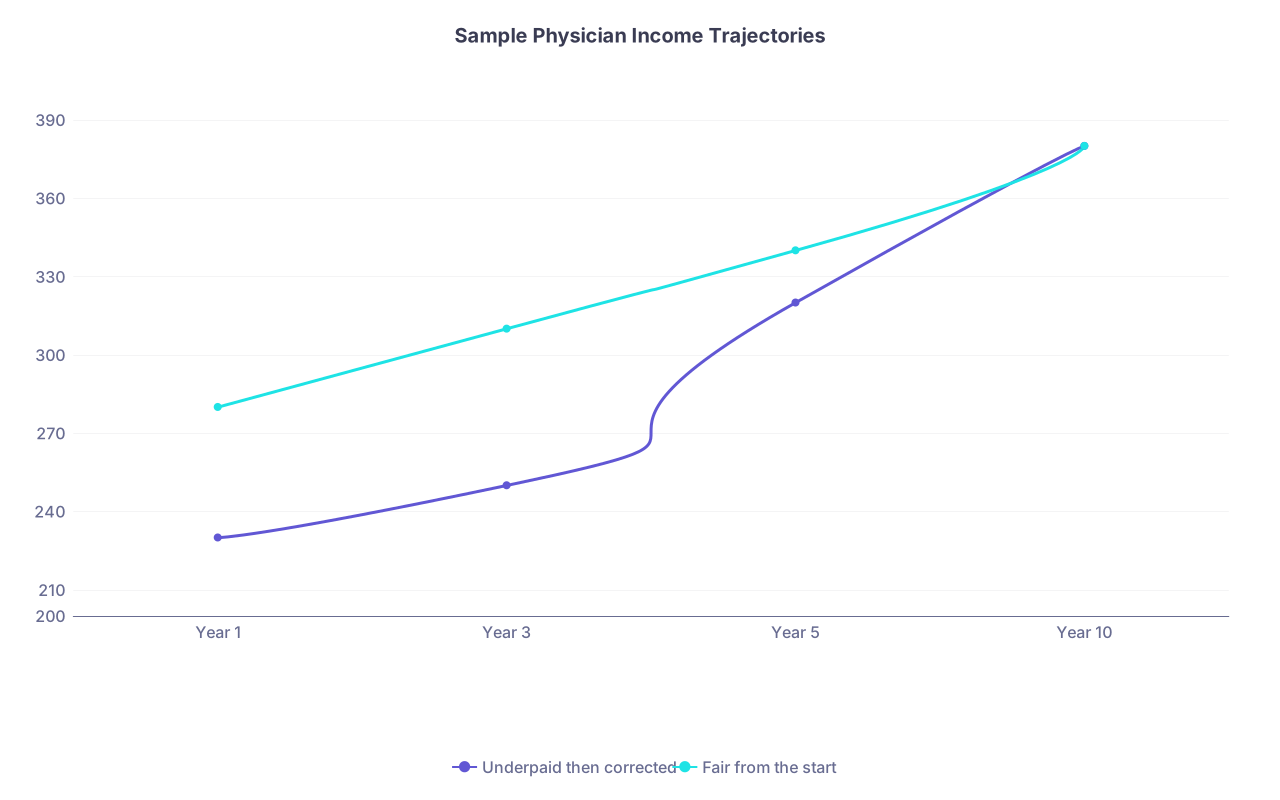
See that? The person who was underpaid early and then corrected? By year 10, they can be in the same neighborhood as the person who started “right.” The gap closes if you’re intentional.
FAQ (Exactly 4 Questions)
1. If I’m underpaid in my first job, is it better to stay and gain experience or leave quickly?
If the pay is mildly under market but the environment is supportive and you’re learning a lot, staying 2–3 years can be fine. The experience and references are worth something. If the pay is way under market and the environment is toxic or exploitative, leaving sooner is usually better. One underpaid year you learn from is survivable. Five underpaid, burned‑out years is where the damage snowballs.
2. Will being underpaid in my first job permanently anchor my future salary offers lower?
Not if you don’t let it. You don’t walk into the next negotiation saying, “Well, I was making $190k, so anything is fine.” You walk in with market data: regional MGMA, what peers are getting, your productivity, and a clear ask. The next employer cares far more about what they have to pay to fill the role than what you randomly accepted before.
3. How long is “too long” to stay in an underpaid job before the damage gets serious?
There’s no magic number, but here’s my honest rule of thumb: underpaid 1–3 years with active plans to fix it? Annoying but easily recoverable. Underpaid 5–10 years with no correction while lifestyle creeps up? That’s when you start genuinely losing out on hundreds of thousands to millions in lifetime wealth. The key isn’t the exact number of years; it’s whether your trajectory changes.
4. If I fix my salary later, can I still “catch up” on retirement and loans?
Yes, but you’ll need to be deliberate. A typical attending career is 25–30+ years. If you under‑earn the first 3–5 but then jump significantly and use that extra to aggressively save and pay down debt, you can absolutely end up in the same place or even ahead of someone who started a bit higher but never increased savings. You’ll just need to avoid the trap of raising your spending every time your income rises.
Key points:
- A low‑paying first job can set you back, but it doesn’t permanently destroy your financial future unless you stay underpaid for too long and let lifestyle creep swallow everything.
- Your ability to recover depends less on the exact first salary and more on whether you course‑correct, negotiate, or change jobs once you realize you’re underpaid.