
What actually happens the first year you miss your RVU target and your chair pulls up your “productivity report” on a shared screen in a tiny office?
Because that’s the nightmare, right? Not the abstract idea of “RVUs” or “bonus structure,” but:
- Do they cut your salary?
- Do you get fired?
- Do they label you “low producer” and you’re screwed for every future job?
Let’s walk straight into the worst-case scenarios you’re spiraling about and sort out what’s real, what’s rare, and what you can actually do if you’re behind.
First: What RVU Targets Really Mean (Not the Sales Pitch Version)
You’ve probably been told something like: “Base salary plus RVU-based bonus once you exceed 5,000 RVUs a year.” Sounds fine until you realize you have no idea what 5,000 actually looks like in day-to-day life, and you’re six months in, staring at a report that says “1,600 RVUs,” and your stomach drops.
Here’s the ugly truth no one explains clearly during recruitment dinners:
- Your base salary is usually guaranteed for a certain term (often 1–3 years).
- Your RVU target is how they justify that base + any bonus + your long‑term compensation.
- Missing your target usually does not equal “automatic termination.”
- But it does affect bonus money, future contract renewals, and how they “value” you in the system.
Most contracts are built around a few basic patterns:
| Model Type | Base Salary | Bonus Trigger |
|---|---|---|
| Straight base + bonus | High | Above RVU target |
| Lower base, high upside | Moderate | Aggressive RVU tier |
| Pure productivity | Low/None | All RVU-based pay |
| Academic hybrid | Moderate | RVU + mission work |
The fear is: “If I miss my target, they’ll say I’m overpaid and I’ll be on some kind of hit list.”
Sometimes they will say that. But it’s usually more complicated and slower than your anxiety tells you.
What Actually Happens If You Don’t Hit Your RVU Numbers
Let me be blunt: in most employed models (hospital, big group, academic), missing your RVU target one year is:
- Annoying to admin
- Costly for you (lost bonus)
- Rarely catastrophic
But repeated underproduction vs. contract targets over several years? That’s where the real problems start.
Here’s how it usually plays out in real life.
1. The “You Didn’t Hit Bonus” Phase
First consequence: your bonus disappears or shrinks.
If your contract says:
- Base: $260,000
- RVU target: 5,000
- Bonus: $50 per RVU above 5,000
And you hit 4,200 RVUs?
You just don’t get that bonus. That’s it, for that year.
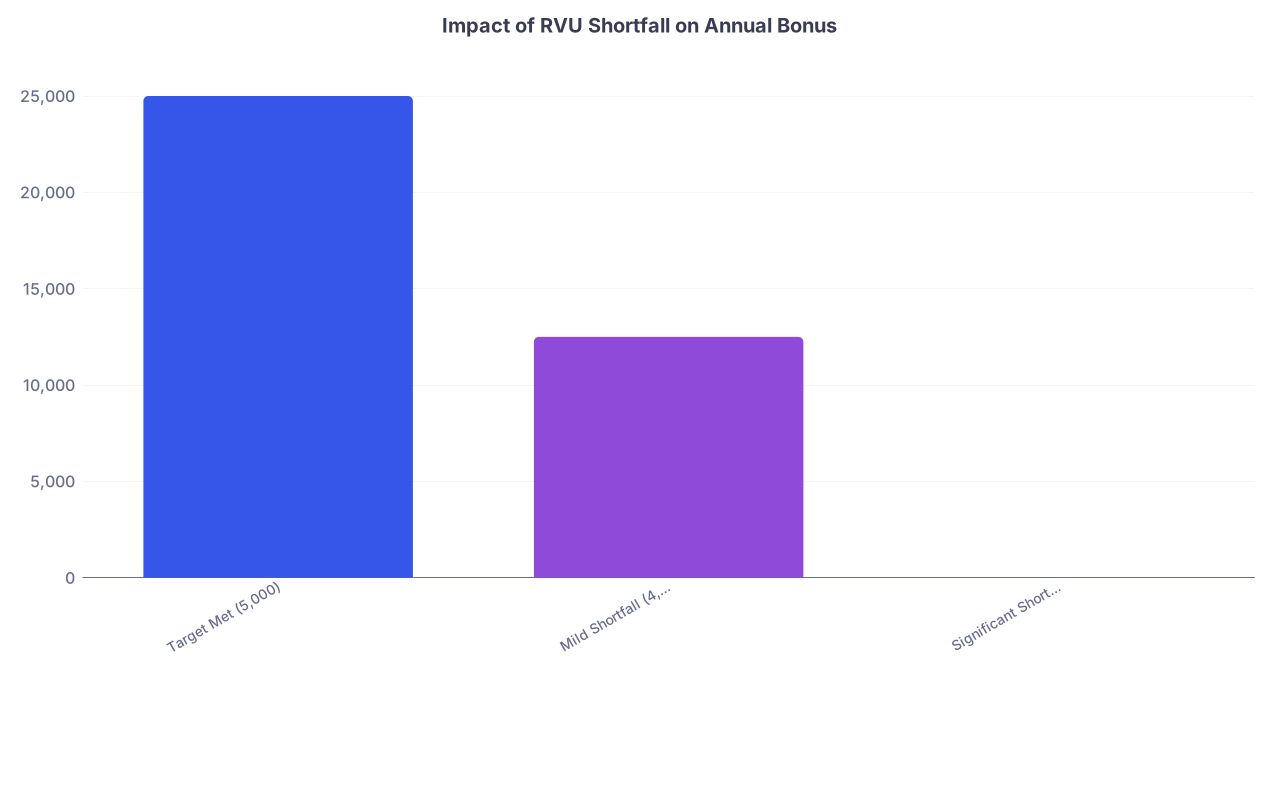
| Category | Value |
|---|---|
| Target Met (5,000) | 25000 |
| Mild Shortfall (4,500) | 12500 |
| Significant Shortfall (4,000) | 0 |
That feels awful, especially when people around you are bragging about $40–60k bonuses. But loss of bonus ≠ you’re about to be fired.
Most systems treat that as, “Okay, they didn’t overproduce this year.”
2. The “Productivity Conversation” Phase
If you’re repeatedly under target or significantly low (say you’re hitting 60–70% of your target), then you’ll start getting:
- “Check‑in” emails
- “Can we review your clinic template?” meetings
- “Access to more new patients” promises (sometimes real, sometimes fantasy)
These meetings usually sound like:
- “We’re concerned you’re not reaching expected productivity for your FTE.”
- “Let’s look at your schedule utilization.”
- “Are there barriers to access—referrals, scheduling, support staff?”
Try to remember: this phase is uncomfortable, but it’s still “fixable” territory. They’re signaling: we want your numbers higher, not “pack your stuff.”
3. The “Your Compensation Isn’t Supported by Your RVUs” Phase
This is the one your brain is probably catastrophizing about at 2 a.m.
After year 1–3, when your guarantee period ends, the system starts looking at your RVU production vs. your salary. A lot of contracts say some version of:
“Compensation may be adjusted based on prior year wRVU production using a conversion factor of $X per wRVU.”
Translation: if they’re paying you as if you produce 7,000 RVUs and you keep producing 4,000, they’ll push to rebase your salary.
This can look like:
- “Your renewal base will be $220,000 instead of $260,000.”
- “We’re moving you to a pure productivity model at $50/wRVU; last year you produced 4,000 so that would have been $200,000.”
- Or, more passive‑aggressive: “We’re not renewing under the current structure.”
This is where missing RVUs really starts to hurt: not just this year’s money, but the baseline for all future years.
4. The Extremes: Performance Plans and Non‑Renewal
Actual firing just for low RVUs is less common than your brain thinks. But you may see:
- A performance improvement plan (PIP): “We expect X RVUs in Y months, with these changes in your schedule.”
- A non‑renewal of your contract at the end of the term.
- A quiet push‑out: subtle hints that this “may not be the right fit” and “have you thought about other opportunities.”
Are there places that just cut people quickly? Yes. Usually:
- Small private groups under intense financial pressure
- Toxic leadership that equates value only with RVUs
- Places already looking for an excuse to replace you
But the usual path is slower: bonus loss → difficult meetings → contract rebase → eventually, a decision whether you stay under their new terms or move on.
Is It Always Your Fault? The Stuff You Don’t Control (But Get Blamed For)
What makes this so brutal is half the variables driving RVUs are barely under your control.
You can be:
- Seeing a reasonable number of patients
- Working full days
- Staying late on notes
- Doing “good medicine”
…and still not hit “their” target because:
- New patient referrals are being funneled to a senior partner.
- Front desk keeps leaving half your template blocked.
- You’re in a saturated market where volume is low.
- The practice is mis-coded or undercoding across the board.
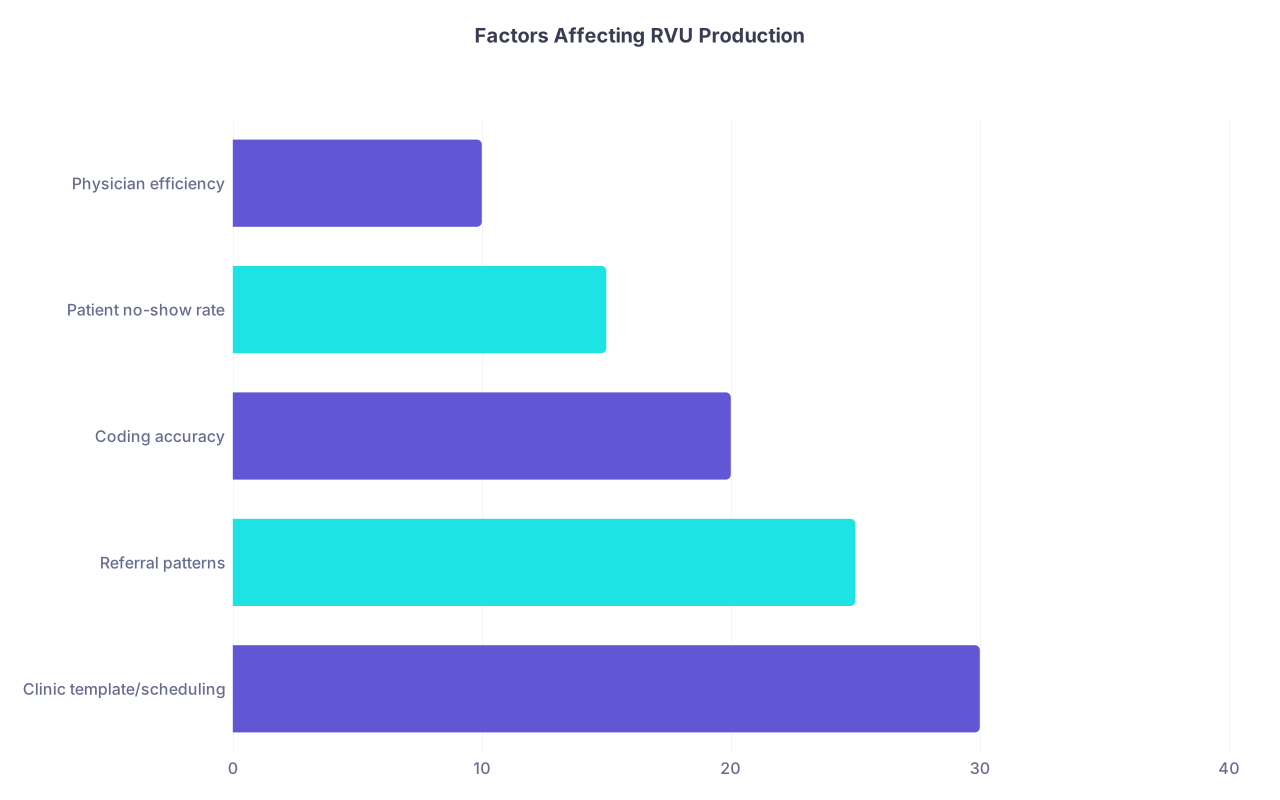
| Category | Value |
|---|---|
| Clinic template/scheduling | 30 |
| Referral patterns | 25 |
| Coding accuracy | 20 |
| Patient no-show rate | 15 |
| Physician efficiency | 10 |
I’ve seen junior docs labeled “low producers” when:
- Their clinic had the most no‑shows because it was hardest to park near.
- Their scheduler was shared with someone “more important” and kept blocking their spots.
- They weren’t allowed to add same‑day visits while others were.
And admin doesn’t always care about nuance. They see: RVUs low → revenue low → problem.
So you have to protect yourself.
How to Protect Yourself When You’re Behind on RVUs
If you’re already behind or terrified you will be, here’s what I’d actually do. Not the fluffy “work hard and communicate” nonsense.
1. Get Your Actual Numbers. Not Vibes.
Stop guessing. Request clear data. Ask for:
- Your year‑to‑date RVUs
- Annualized projection (“At current pace, you’re on track for X RVUs/year”)
- Comparison to others in your specialty in the same system
If they refuse to share or give you only vague answers? Red flag. You’re flying blind while your compensation depends on it.
2. Compare to Contract and MGMA Benchmarks
You want three numbers:
- Your contract target RVUs
- Your current/projected RVUs
- MGMA (or similar) median RVUs for your specialty
| Specialty | MGMA Median RVUs | Typical New Grad Target |
|---|---|---|
| IM (outpatient) | ~4,500–5,000 | 4,500–6,000 |
| FM (outpatient) | ~4,800–5,200 | 4,500–6,000 |
| Gen Surg | ~7,000–8,000 | 6,000–8,500 |
| Cards (non-int) | ~9,000–10,000 | 8,500–11,000 |
If your contract target is way above median for your specialty and market, that’s not a “you” problem. That’s a bad contract or unrealistic expectation problem. Which matters a lot if they use it later to justify cutting your pay.
3. Audit Your Clinic Template and Access
If you’re behind, look at boring, unsexy mechanics:
- How many bookable slots do you actually have per day?
- How many are being held for nonsense (meetings, admin, imaginary add‑ons)?
- Are you getting new patient slots or just follow‑ups?
- What’s your no‑show and cancellation rate?
This is where a lot of RVUs “leak.”
If you should have 18–20 patients/day but your schedule regularly has 10–12, of course you’re drowning in anxiety. You literally don’t have the volume to hit the target.
Document this. Save screenshots. Save reports. If someone later says “you just weren’t productive enough,” you want proof that the deck was stacked.
4. Get Your Coding Reviewed
Under‑coding can slaughter your RVUs even when your days are packed.
Ask billing/compliance to review:
- A random sample of your charts
- Your E/M levels vs complexity
- Procedure coding patterns
If they find you’re under‑coding by 10–20%, your RVUs might jump without you changing your actual work.
It’s infuriating how often no one teaches you this, then blames you for not hitting arbitrary numbers.
5. Don’t Sign a Renewal Blind
When your contract renewal comes up and your RVUs are low, they may say:
- “We’re just aligning pay with your productivity.”
- “This is standard for the system.”
Don’t just panic‑sign.
You need:
- A lawyer who does physician contracts, not generic employment.
- Clarity on non‑compete, because if they rebase you to a salary you can’t live with, you might need to leave.
- Data on whether anyone at your site actually hits the “expected” RVUs.
If literally no one is hitting target, they’re using fake numbers.
What If I Never Hit My RVU Targets?
Here’s the big fear behind all of this: “If I don’t hit these targets, it means I’m a bad doctor and will always be financially behind.”
Not true.
It might mean:
- You’re in the wrong practice model (RVU‑obsessed system when you’re slower‑paced, more thorough, or procedural light).
- You’re in the wrong market (too many docs, not enough patients).
- You’re in a place with garbage infrastructure (scheduling, referrals, coding).
You have options:
- Academic centers that value teaching/research and tolerate lower RVUs.
- Salaried models where RVUs matter less (VA, some FQHCs, some hospitalist gigs).
- Joining or building a practice that doesn’t worship productivity metrics above sanity.

| Step | Description |
|---|---|
| Step 1 | Low RVUs |
| Step 2 | Consider new job/market |
| Step 3 | Optimize schedule/coding |
| Step 4 | Renegotiate fairly |
| Step 5 | System realistic? |
| Step 6 | Improved? |
Needing a different setup doesn’t mean you failed. It means you’re not a machine, and you want a career that doesn’t eat you alive.
Short-Term Coping: What to Do If You’re Panicking Right Now
If you’re already mid‑contract and spiraling:
- Get your actual RVU numbers and projected year‑end total.
- Ask directly: “Is my employment or contract renewal in jeopardy based on current RVUs?” Make them say it.
- Document issues: blocked templates, no referrals, high no‑shows, admin decisions that limit volume.
- Quietly talk to a physician contract lawyer about worst‑case scenarios so you know your rights.
- Start looking at other jobs early if your gut says this place is not fixable. It’s not betrayal. It’s self‑preservation.
Your brain is probably screaming: “If I move jobs, everyone will think I failed.” Most of the time, nobody cares. Everyone’s too busy worrying about their own RVUs.
FAQs: RVU Panic Edition
1. Can they actually fire me just for not hitting RVU targets?
They can non‑renew or terminate according to your contract, but in practice, most hospital systems don’t walk in mid‑term and say, “You’re below 4,000 RVUs, you’re out.” What they usually do is:
- Let the contract term finish
- Use low RVUs to justify a lower renewal offer or a move to pure productivity
- Quietly discourage you from staying
You need to read your contract: look for “for cause” vs “without cause” termination and notice periods. That tells you how fast they could act if they wanted to.
2. If I miss my RVU target one year, am I labeled forever?
No. People underperform one year for all kinds of reasons: maternity leave, illness, bad staffing, new program ramp‑up. Most systems look at trends, not a single data point. The real red flag is multiple years significantly below target with no clear external reason.
What does stick in your file? Repeated notes from admin about “productivity concerns” with no documented attempts to improve or address system issues. So document your side.
3. Will another employer see my RVU history and judge me?
Most future employers don’t get your actual internal reports. They ask you and sometimes your references. You can frame it like:
- “Clinic volume and infrastructure limited productivity; I was consistently booked but had constrained templates.”
- “Target RVUs were significantly above market median for my specialty.”
If your story makes sense and you’re not obviously dodging, people understand. Everyone’s seen absurd RVU expectations somewhere.
4. How do I know if my RVU target is unreasonable?
Compare three things:
- Your target vs MGMA median RVUs for your specialty.
- Your colleagues’ actual numbers in the same system.
- Whether anyone at your site reliably hits target without being utterly miserable.
If your target is 20–30% above median and nobody at your location ever hits it, that’s not “stretch.” That’s fantasy. And admin using that as a stick later is gross, but not rare.
5. Is it ever smart to accept a pure productivity (all RVU) contract?
It can be, but only if:
- Volume is actually there (proof: current physicians’ RVUs, not promises).
- You have control over scheduling, referrals, and staffing.
- The conversion factor ($/RVU) is high enough to compensate for risk.
If you’re an anxious, risk‑averse person who hates variability in pay? A pure productivity model will chew your nervous system up. Guaranteed.
6. I’m already behind this year. Is it even possible to catch up?
Sometimes. If your issue is coding/throughput, you can see a meaningful bump over the next 3–6 months by:
- Cleaning up your schedule templates
- Adding a few high‑RVU visits/procedures per week
- Fixing under‑coding
If the problem is no patient volume, you’re not going to magically triple your RVUs in Q4. At that point, your focus shifts from “heroic catch‑up” to “documenting the structural problems and planning your next move.”
Key takeaways:
- Missing your RVU target is usually a bonus problem and long‑term contract issue, not an instant‑firing event.
- A lot of “low RVU” stories are actually system, market, and contract problems dressed up as personal failure.
- Get your data, protect yourself with documentation and legal review, and don’t be afraid to walk away from a setup that was never designed for you to succeed.