
The fear that you’ll pick the “wrong” specialty and quietly ruin your financial future is massively overblown—and also, not crazy at all.
You’re not imagining it. The money gap between specialties is real. It’s big. And if you already know you’re drawn to something like pediatrics, family medicine, psychiatry, or academics, it can feel like you’re signing up to be the broke doctor forever while your ortho and derm friends buy houses with windows bigger than your whole apartment.
Let’s walk straight into that fear instead of sugarcoating it.
How Bad Is the Pay Gap Really?
You’ve probably seen the Medscape charts. They’re not lying.
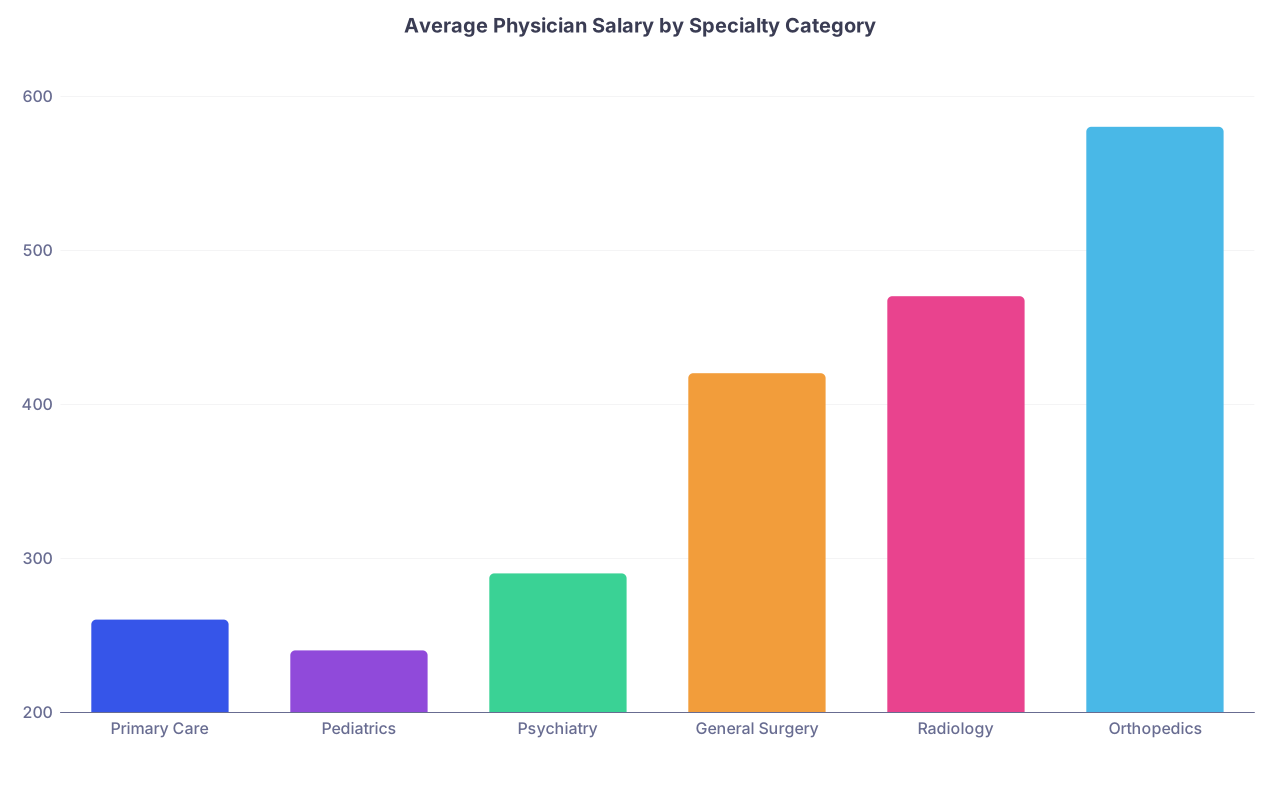
| Category | Value |
|---|---|
| Primary Care | 260 |
| Pediatrics | 240 |
| Psychiatry | 290 |
| General Surgery | 420 |
| Radiology | 470 |
| Orthopedics | 580 |
Numbers vary by source and year, but the pattern is the same:
- Primary care / peds / psych: roughly $220k–$320k
- Mid-tier specialists (IM subspecialties, anesthesia, EM, hospitalist, OB/GYN): $320k–$450k
- High earners (surg subspecialties, rads, gas in some markets, derm, ortho): $450k–$700k+
Someone in ortho can literally make double what a pediatrician makes in many settings. Over a career, that’s millions of dollars difference.
So yes, if your only question is “Will I end up with less lifetime money if I pick a low-paying specialty?” the answer is: obviously, yes.
But that’s not really what you’re asking.
You’re asking:
Will I:
- struggle to pay loans?
- feel constantly stressed about bills?
- never be able to buy a house?
- regret not picking a higher-paying specialty every time I Venmo my student loan servicer?
That’s a different question. And that answer is a lot less scary than your 3 a.m. brain is telling you.
What “Low-Paying” Actually Feels Like in Real Life
Here’s the thing no one tells you clearly in med school: the problem usually isn’t that low-paying specialties pay too little. It’s that doctors often build lifestyles that assume they’re making more than they do.
Most young attendings I’ve seen in “low-paying” fields run into trouble because they:
- buy a $900k house 6 months out of residency
- take on two car payments at ~$700/month each
- private school for kids from day one
- never actually track spending
- pay minimums on loans and just “hope” it’ll work out
At $240k–$280k as a pediatrician or family doc in many markets, that lifestyle with $300k–$400k of loans gets tight fast. So yes, you can feel broke making $250k. If you spend like a $500k person.
But if you:
- live like a normal-upper-middle-class human instead of a flexing doctor for the first 5–7 years
- are aggressive and intentional with debt (PAYE/REPAYE/SAVE, PSLF, or refinancing with a plan)
- avoid the “I deserve this, I’ve suffered enough” spending spiral
You’re going to be solid. Not yacht money. But very, very okay.
The Loan Nightmare: Can a Low-Paying Specialty Actually Handle It?
This is the big anxiety monster, so let’s drag it into the light.
Say you match into pediatrics or family med, and your situation looks like a lot of people:
- Loans: $300k–$400k at ~6–7%
- Residency/fellowship: 3 years, maybe 6 if you sub-specialize
- You’re looking at those balances growing during training and thinking: I will die with this debt
That’s not how it usually plays out if you’re even halfway intentional. Rough, real-world sketch:
Scenario 1: Low-paying specialty + PSLF
Let’s say:
- You do peds, psych, IM, FM, etc.
- You work at an academic center, county hospital, VA, FQHC, or large non-profit hospital.
- You enroll in an income-driven repayment plan (SAVE, etc.).
- You make 10 years of qualifying payments (residency + early attending years).
- The rest is forgiven tax-free.
Yes, people are actually getting PSLF now. I personally know hospitalists, psychiatrists, and pediatricians who have had $150k–$400k wiped away after 10 years. The early horror stories were mostly due to bad servicing and poor communication, not that PSLF was fake.
Does that mean PSLF is “guaranteed forever”? No. The government can be… the government. But they aren’t going to retroactively screw people who are already in qualifying plans and jobs; that’s political suicide and a logistical mess. Worst case, they change things for new borrowers.
If you’re even open to working in academic or non-profit settings, PSLF makes a “low-paying” specialty a lot less terrifying.
Scenario 2: Low-paying specialty + private practice / non-PSLF job
Okay, what if you don’t want academic life. You want private practice psych, outpatient peds, or suburban family med. No PSLF.
Is it still survivable with big loans? Yes—if:
- You don’t try to pay them off in 3 years while also buying everything.
- You either:
- Refinance once your income is stable and aggressively pay them off in 7–10 years, or
- Stay on an IDR plan long-term and accept that loans are a line item in your budget like taxes.
The anxiety trap is believing it has to be:
“I either have to be debt-free in 3–5 years or I’ll be crushed forever.”
That thinking is what drives people into higher-paying specialties they don’t even like. They’re trying to escape the feeling of being trapped, not the math.
Lifestyle: The Hidden Variable No One Wants to Hear About
Here’s the part where I sound like a parent, but I’ve seen too many people wreck themselves financially to pretend it doesn’t matter.
Two pediatricians in the same city making $240k can have completely different lives:
- One is drowning, stressed, always saying “I can’t afford anything.”
- The other has a stable house, maxes retirement accounts, takes vacations, and is on track to be work-optional by their 50s.
The difference isn’t the specialty. It’s choices like:
- renting for a few years vs immediate big mortgage
- driving a reliable used car vs leasing a luxury one
- actually knowing where money goes vs swiping and hoping
Most “low-paying” specialties still put you firmly in the top 5–10% of income in the general population. Your brain keeps comparing you to the ortho and derm crowd, but the real comparison is: do regular people live decent lives on way less money than this? Yes. All the time.
Your financial anxiety is valid. But the solution isn’t “pick a specialty you don’t like so you can afford a bigger house at 32 instead of 36.”
What You Actually Give Up with a Low-Paying Specialty
Let’s be painfully honest. There are things you probably do give up or at least delay:
- The giant dream house right away
- Private school + luxury cars + fancy vacations all at once, early in your career
- The “I paid off $400k of loans in 4 years” flex posts
You may have to:
- live in a more modest neighborhood
- take longer vacations less often
- be more intentional about childcare / school choices
- think about COL when you choose your job (peds in SF vs peds in a midwestern town are not the same reality)
But you’re not giving up:
- ever having a house
- ever having kids
- ever traveling
- any hope of saving for retirement
You’re mostly giving up early maximal consumption.
If that sounds depressing, ask yourself this: Will owning a huge house at 32 really make you feel better about doing a specialty you hate for 30 years?
Because I’ve talked to people who went that route, and they’re not exactly thrilled. “Golden handcuffs” is not just a cute phrase. It’s real. Once your life is built around that bigger income, switching is hard.
The Emotional Trap: Money vs Misery
Here’s where the anxiety gets really vicious: it makes you think there’s some perfect decision where you get:
- zero financial stress
- full career satisfaction
- perfect work-life balance
- geographic freedom
- and no trade-offs
That decision doesn’t exist. For anyone. In any specialty.
So your brain latches onto something simple and fake: “If I just pick a high-paying field, at least I won’t have to worry about money.”
Except:
- You’ll still worry about money. I know attendings making $500k who feel broke.
- You might also:
- hate call
- hate the procedures
- hate the culture
- feel stuck because you “can’t afford” to walk away
Then you’ve traded one anxiety (debt/lifestyle) for another (regret/burnout). And unlike debt, burnout is harder to refinance.
Concrete Trade-Offs: Low vs High Paying Specialties
Let’s put some of this in a simple snapshot. Not perfect, but directionally right.
| Factor | Lower-Paying (Peds/FM/Psych) | Higher-Paying (Ortho/Derm/Rads) |
|---|---|---|
| Typical Income | $220k–$320k | $450k–$700k+ |
| Lifestyle Flexibility | Often higher | Varies; sometimes lower |
| Debt Feels Heavy? | Yes, if lifestyle is high | Yes, if lifestyle is very high |
| Burnout Risk | More from system pressure | More from workload/expectations |
| Financial Freedom Speed | Slower unless very frugal | Faster if not overspending |
This is not “pick low-paying, suffer forever” vs “pick high-paying, be free.” It’s picking a set of constraints and then living inside them intelligently.
Location, Side Gigs, and Other Levers You’re Forgetting About
You’re acting like “specialty” is the only dial you can turn. It’s not. Other levers matter just as much:
Geography
A pediatrician in a midwestern or southern town with a lower cost of living can end up way better off financially than a radiologist paying San Francisco prices. COL will crush or save you faster than specialty sometimes.Side income
Tele-psych, locums, doing some urgent care shifts as FM, writing, consulting, medical-legal work—doctors in lower-paying specialties can meaningfully add $20k–$80k a year if they want to.
No, you shouldn’t build your whole life on a side hustle. But it’s a lever.Job structure
W2 vs 1099, partnership track vs employed, academic vs private, RVU-based vs salary—all that affects your real earning potential way more than a simple “this specialty is low-paying” label.Spouse/partner income
If your partner works and makes a decent salary, that changes the entire equation. Nobody says this out loud, but it’s just true.
These knobs are adjustable long after you pick a specialty. You are not locking in your entire financial fate as an MS4.
A Quick Reality Check Timeline
Sometimes seeing it as a timeline helps.
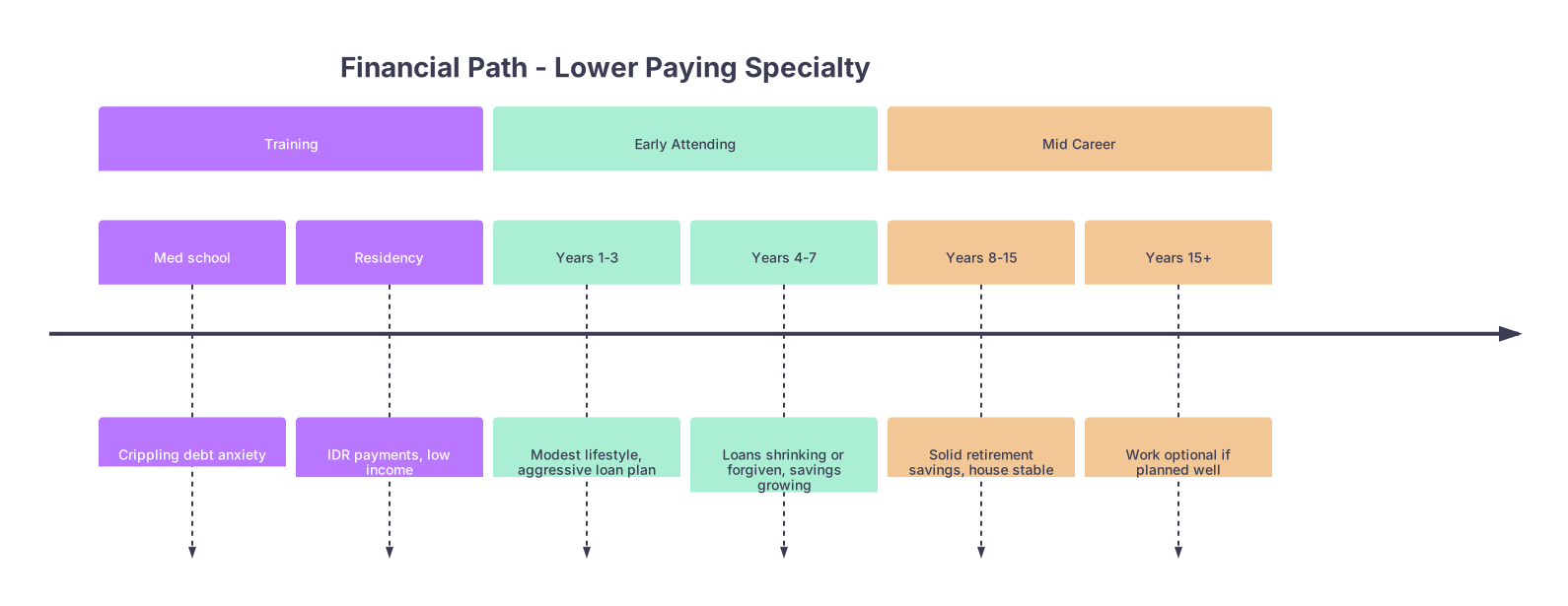
| Period | Event |
|---|---|
| Training - Med school | Crippling debt anxiety |
| Training - Residency | IDR payments, low income |
| Early Attending - Years 1-3 | Modest lifestyle, aggressive loan plan |
| Early Attending - Years 4-7 | Loans shrinking or forgiven, savings growing |
| Mid Career - Years 8-15 | Solid retirement savings, house stable |
| Mid Career - Years 15+ | Work optional if planned well |
This is assuming you’re not reckless and not obsessively frugal. Just… reasonable and aware.
Is it guaranteed? No. Life happens. Divorce, illness, job changes. But that’s true in every specialty.
So How Worried Should You Be?
You should be:
- aware that the income difference is real and permanent
- realistic about your loans and cost of living
- honest about whether you want PSLF, academic life, or flexibility
- willing to say no to lifestyle creep, especially early
You should not be:
- paralyzed into picking a specialty you hate just because it pays more
- telling yourself you’ll be “poor” at $250k+
- assuming low-paying = lifelong financial stress
- assuming high-paying = no financial stress
If you choose a low-paying specialty and:
- plan your loans intentionally (IDR, PSLF, or refinance with a strategy),
- live below your means for the first 5–7 years out,
- steadily invest (401k/403b, Roth, maybe a brokerage account),
you will not be ruined. You will almost certainly be fine. Like… actually fine. House, kids if you want them, trips, retirement, normal life fine.
And if you pick a high-paying specialty just to calm your money anxiety but you secretly hate it, that’s its own trap.
Bottom Line
Three things to walk away with:
- Low-paying specialties are financially workable if you’re intentional about debt, lifestyle, and location—they’re not a sentence to lifelong struggle.
- Your biggest risk isn’t “too little income,” it’s building a lifestyle that assumes you’re richer than you are, no matter the specialty.
- If you truly love a lower-paying field, it’s usually a better long-term trade to take it and live smart than to chase money into a specialty that makes you miserable.