
The comforting lie about “do what you love and the money will follow” falls apart fast when you add $300k of loans and two kids.
You’re not crazy for wondering if you’re walking straight into a financial trap.
You’re looking at a modest-paying specialty (peds, family, psych, maybe heme/onc in academics), you want kids, and the loan balance is… obscene. Everyone keeps saying, “You’ll be fine, doctors do well,” but no one’s answering the actual question running through your head at 2 a.m.:
Will I actually be financially secure? Or am I signing up for a lifetime of barely catching up?
Let’s walk through this like adults who’ve looked at the numbers, not like Instagram “doctor influencers” posting pictures next to Teslas with #hustle in the caption.
The Math You’re Afraid to Do (But Probably Already Did Once at 3 a.m.)
You’ve probably done some back-of-the-envelope calculation like:
- Loans: $250k–$500k
- Modest specialty salary: $220k–$280k (primary care / peds / psych in many areas, maybe more with time but not derm money)
- Kids: daycare, college, random kid emergencies that magically cost $900 each time
And then your brain goes: “There’s no way this adds up.”
Let me be blunt: it can add up, but not the way people casually suggest when they say, “You’ll just pay it off fast.”
For most people in modest specialties with big loans + kids, the realistic paths to security are:
- Some form of income-driven repayment (IDR) + forgiveness
- Or aggressive payoff, but with lifestyle sacrifice that will feel brutal if you expect the “doctor life” early
- Or a hybrid: IDR for a while, then refinance and attack once your income jumps or your spouse’s income stabilizes
The thing that makes this all so mentally awful is you’re not just doing math. You’re imagining:
- Saying no to vacations your co-residents take
- Living in a smaller, less “doctor-looking” house
- Forgoing private school or fancy extracurriculars for your kids
- Working more hours or chaos jobs to make the money work
Your brain hears “primary care + PSLF + two kids” and translates it directly to “permanent low-grade stress.”
But here’s the harsh truth that’s actually a bit freeing: for most modest specialties, financial security is possible, but “doctor luxury” as sold on social media is not. Not unless you make different trade-offs later (location, side gigs, academic vs. private, etc.).
What “Financial Security” Really Means for a Modest Specialty
Forget the Instagram version of rich. Strip it down.
Financial security, realistically, is:
- Not being one emergency away from panic
- Not drowning under loan payments you can’t meet
- Being able to support your kids without constant guilt
- Slowly building savings and retirement so you’re not working until death
What it’s not (for most modest specialties with big loans and kids):
- A big new-build house in a hot metro plus luxury car by year 2 out of residency
- Full-time private school for three kids in a HCOL city
- Constant travel, expensive hobbies, and upgrades every year
You’re probably not even asking for all that. You just don’t want to feel like a highly educated hamster on a wheel.
Let’s put some numbers on the table, because vague reassurance is useless.
| Item | Conservative Estimate |
|---|---|
| Gross salary (primary care) | $230,000 |
| Take-home after tax/benefits | ~$140,000–$150,000 |
| Student loans (IDR/PSLF) | $1,200–$2,000/month |
| Mortgage or rent | $2,000–$3,000/month |
| Childcare for 1–2 kids | $1,000–$2,500/month |
Those numbers are not fantasy. I’ve seen attendings’ budgets that look like this. It’s tight, but not impossible. It just doesn’t feel like what you were promised.
Loans: The Monster in the Room That You’re Tired of Thinking About
You’re picturing this scenario: $350k at 7%, and some calculator tells you the “standard” payment is like $4k/month for 10 years. You immediately think: “That’s literally impossible with kids. So I’m doomed.”
You’re not paying the 10-year standard plan. That thing is basically a scare tactic.
In reality, modest specialty + kids usually equals one of three routes:
- PSLF + IDR (public / academic / nonprofit job)
- Long-term IDR with eventual taxable forgiveness
- Refinance + aggressive payoff (requires either lower debt or higher income / lower COL)
Here’s what your anxious brain probably doesn’t trust yet:
IDR is designed for people like you. It’s not cheating. It’s not failure. It’s one of the only reasons medicine is still borderline viable with the tuition insanity.
Let’s put rough ranges to calm the catastrophizing:
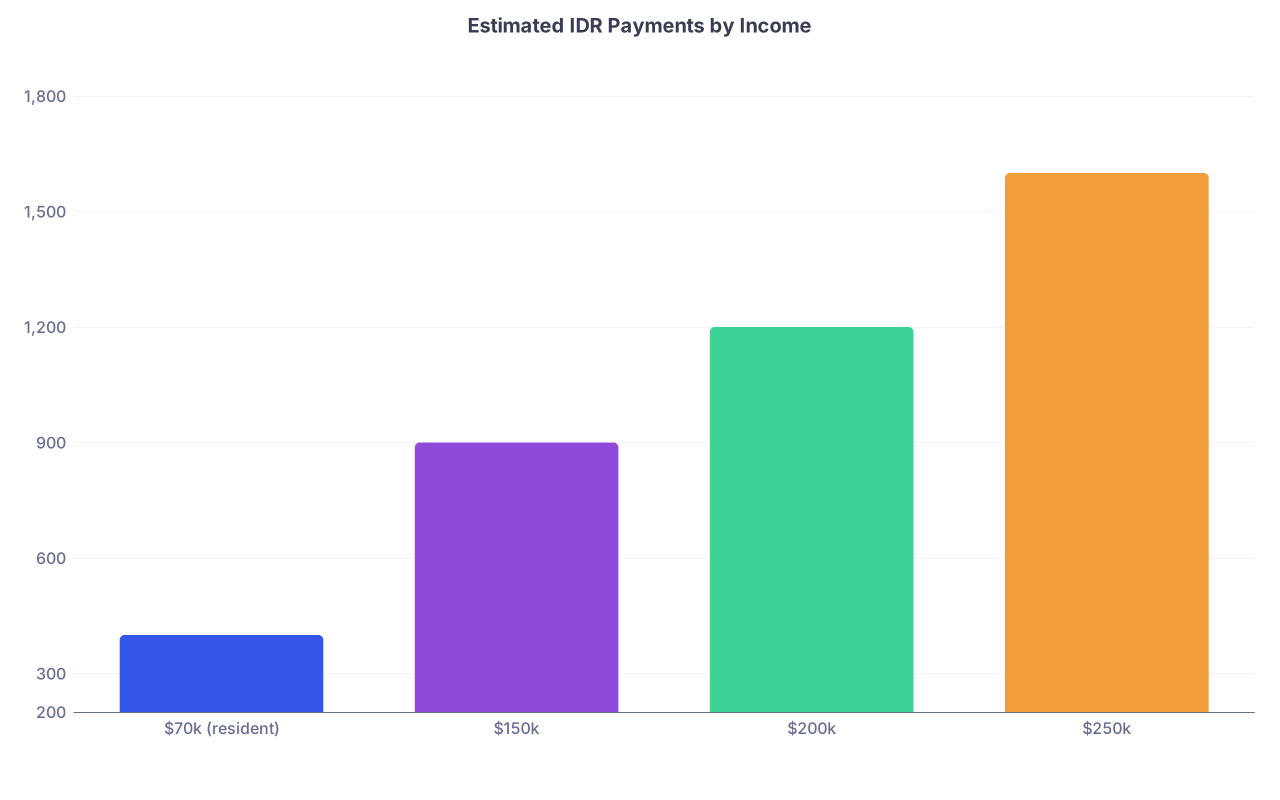
| Category | Value |
|---|---|
| $70k (resident) | 400 |
| $150k | 900 |
| $200k | 1200 |
| $250k | 1600 |
Those are approximate monthly payments on newer SAVE-style plans for someone with high debt. They are not $4,000/month. Yes, it stretches things out. Yes, the idea of 20–25 years of payments sucks.
But here is the uncomfortable but liberating reality: you do not have to fully pay off $400k+ of loans in 10 years to have a stable life, especially in a modest specialty.
If you choose PSLF (working at qualifying employers) and your balance gets wiped at 10 years of payments, your effective “cost” of med school may be far below the headline number. The trade-off is less pay compared to some private jobs. But you get loan relief, plus pension-ish benefits sometimes.
If you go the taxable forgiveness route (20–25 years), yeah, you’ll probably owe a “tax bomb” in the end. That’s scary on paper. But:
- You have 20+ years to plan and save for it
- Your kids will be older, childcare costs lower
- Your income (even in modest specialties) is usually higher than early-career years
Is it perfect? No. Does it mean you’re never actually “done” with loans until your 40s or 50s? Yep. That’s reality. But “annoying long-term payment” is different from “lifelong financial doom.”
Kids in the Middle of All This: Are You Being Irresponsible?
This is the part nobody talks about honestly.
You’re not just worried about you being broke. You’re terrified of:
- Short-changing your kids because of your career choice
- Not being able to afford decent housing or safe neighborhoods
- Having to say no to things they need because your loans are eating everything
- Resenting medicine because it made starting a family feel financially risky
Also, there’s this nasty voice: “Maybe I shouldn’t have kids at all. Maybe that’s irresponsible with this much debt.” I’ve heard that from more than one med student. It’s dark, but it’s honest.
Here’s my blunt view: starting a family in medicine is rarely financially “perfect.” But people in modest-paying non-medical fields do it all the time with far less income and more job insecurity.
Your reality will probably look like this:
- You absolutely can have kids and be a doctor in a modest specialty
- You’ll make trade-offs: smaller house, fewer activities, maybe public over private school
- Daycare will feel like getting punched in the face each month for several years
- Eventually, daycare costs drop, your income stabilizes, and you actually start to feel the doctor advantage
You’re living in the brutal overlap of:
- Peak training years (low pay, no time)
- Peak fertility/relationship pressure
- Peak loan anxiety (because the balance is largest and feels fake and monstrous)
No surprise it feels like a trap. It’s not. It’s a bottleneck.
The Modest Specialty Paycheck: Are You Screwing Yourself Long-Term?
There’s this underlying fear: “If I don’t pick a high-paying specialty, I’m wrecking my financial future and my kids’ future.”
That’s not quite true, but it’s also not entirely fantasy. Income matters. A family medicine doc at $220k has less margin for error than an anesthesiologist at $450k.
But here’s something I’ve seen that might help you breathe:
Plenty of modest-specialty attendings are:
- Living in normal houses
- Driving reliable, not-flashy cars
- Paying into 401k/403b/457b
- Saving a bit for college
- Actually taking a week or two of vacation
No, they’re not swimming in money. But they’re not destitute. The ones who are really struggling almost always hit one of these:
- Extremely high cost-of-living city and modest salary
- Massive lifestyle creep right out of training (big house, cars, etc.)
- No plan for loans—just denial and minimum random payments
- Single-income households with 3–4 kids and no childcare help
Income isn’t everything. You also have levers:
- Location (small city / rural often = higher pay, lower COL)
- Mix of clinical work (urgent care, nights, telehealth, etc. for extra income)
- Academic vs. private
- Partner income (if applicable)
You’re not locked into one salary number forever. But you do need to be realistic: if you choose pediatrics in San Francisco with $450k loans, two kids in daycare, and you want a house in a “good school district,” it’s going to feel tight bordering on insane. That’s not your personal failure. That’s math.
A Very Imperfect but Honest Path to “Okay, We’re Going to Be Fine”
Let me sketch a path that I’ve seen work for people in your situation. Not glamorous. But stable.
During school / residency
- Accept that you’re not paying loans aggressively now. IDR, deferment, or whatever the best of the terrible options is.
- Live like a student. Not because it’s morally virtuous, but because every dollar you don’t borrow is a dollar that won’t grow into a monster later.
- If you have kids during training, accept that this will suck financially. It’s survival mode, not optimization mode.
Early attending (first 3–5 years)
- Pick a job that either:
- qualifies for PSLF and feels sustainable
- or pays enough (with decent COL) that you can meaningfully attack loans if you refinance
- Absolutely no huge lifestyle jump in the first 1–2 years. I’m talking: used car, modest housing, keep fixed expenses reasonable.
- Figure out a written plan: IDR to PSLF with a projected end year, or refinance with a specific payoff timeline.
- Pick a job that either:
Mid-career (5–15 years out)
- Childcare costs start to drop as kids age
- You can adjust your job: maybe a bit more pay, side gig, leadership role
- You start to actually build savings, not just tread water
Is any of this what you imagined when you thought “doctor”? Probably not. But is it financial security? Yes. The boring, adult version.
The One Thing You Actually Need To Decide
You’re trying to answer the wrong question: “Will I be rich and comfortable and have kids and not feel stressed and do the exact specialty I love most?”
That’s not a real menu.
The real question is:
“Am I willing to accept a slower, less flashy financial life in exchange for doing a modest-paying specialty I actually care about, and having kids?”
If the answer is yes, then you need:
- A concrete loan strategy (PSLF vs refinance vs long-term IDR)
- A realistic expectation of lifestyle (especially first 5–10 years)
- Some flexibility on location and job type
If the answer is no—if you want high financial margin and less stress about money—you might genuinely need to consider:
- Higher-paying specialties (if you’re still early enough to choose)
- Or changing expectations: fewer kids, later kids, different city, more work hours
None of these options are morally better. They’re just trade-offs. You’re not selfish for wanting security. You’re not irresponsible for wanting kids and primary care.
You just have to stop pretending you can have everything at once with $400k of loans and a modest salary. That’s where the anxiety is coming from: the fantasy colliding with the math.

| Step | Description |
|---|---|
| Step 1 | Modest Specialty with Loans and Kids |
| Step 2 | Refinance and Aggressive Payoff |
| Step 3 | PSLF + IDR Plan |
| Step 4 | Long Term IDR and Forgiveness |
| Step 5 | Lower Lifestyle First 5 to 10 Years |
| Step 6 | Nonprofit or Academic Jobs |
| Step 7 | Plan for Tax Bomb Savings |
| Step 8 | Primary Goal |
FAQs (The Stuff You’re Probably Still Spiraling About)
1. If I have $400k+ in loans and choose pediatrics/family, am I basically financially doomed?
No, but you’re also not buying a McMansion at 32 without consequences. With IDR and/or PSLF, you can absolutely have a stable life, save for retirement, and raise kids. It will feel tight for a while, especially with childcare. The key difference between “doomed” and “okay” isn’t your specialty—it’s whether you pick a sustainable repayment strategy and avoid massive lifestyle inflation early on.
2. Is it irresponsible to have kids when I’m this deep in debt?
No. People with far less stable income and far less earning potential have kids every day. What would be irresponsible is pretending the costs don’t matter. If you want kids, you’ll need to be brutally realistic about housing, childcare, and your loan plan. That might mean delaying certain luxuries, moving to a more affordable area, or saying no to some things your peers say yes to. That’s not moral failure. That’s prioritizing your family.
3. Should I change specialties just for money?
Only if you can honestly see yourself doing that higher-paying specialty without burning out or resenting your life. Switching from pediatrics you love to ortho you hate purely for cash is a long-term misery strategy. A better way to think about it: if you’re on the fence between two fields and one pays dramatically more, then yes, that should factor in. But don’t force yourself into something that doesn’t fit you just to chase a number. A miserable $500k/year doc is not “more successful” than a content $250k/year doc with a sane life.
4. Is PSLF actually safe to rely on, or am I going to get screwed by policy changes?
Could the rules change? Sure. Governments do dumb things. But people have already successfully gotten PSLF forgiven under current rules, and there’d likely be grandfathering for existing borrowers if major changes happened. Is it 100% guaranteed? Nothing is. But it’s not some fantasy unicorn anymore, it’s a functioning program. If PSLF makes or breaks your plan, document everything: qualifying employer, qualifying payments, annual recertification. Have a backup idea (like saving a bit extra) for your own peace of mind.
5. Will I ever feel “ahead,” or is it just survival forever?
You will not feel ahead early. That’s the ugly part. The first 5–7 years out of med school, especially with kids, will feel like catch-up mode. But at some point—after daycare ends, after you’ve got a handle on loan strategy, after your salary stabilizes—you’ll notice two things: your non-physician friends are still fighting for raises and job security, and you have a stable, relatively high income. You might not feel rich, but you’ll feel… steady. And after years of anxiety, that actually feels pretty close to luxury.
Key points:
- Yes, you can have loans, kids, and a modest specialty and still reach real financial security—but not the flashy version of “doctor rich” you see online.
- Your outcome depends way more on loan strategy, location, and lifestyle choices in your first 5–10 attending years than on whether you picked family med vs. psych vs. peds.