
You are here
It’s 1:17 a.m. You’re staring at a spreadsheet instead of First Aid.
On one tab: median physician salaries. On the next: your loan balance projection after four years of med school, three to seven years of residency, maybe fellowship. The interest column looks like it’s laughing at you.
Your brain won’t shut up:
“Am I really about to give up my 20s, take on $300k+ of debt, work 80 hours a week… for a job that might cap out at $250–300k if I pick the wrong specialty or the market shifts?”
“Is this still financially rational, or am I walking into a sunk-cost trap dressed up as ‘calling’ and ‘noble profession’?”
Let me be blunt: you’re not crazy for asking this. The people who tell you “don’t think about the money, think about the patients” are either already on the other side of the training tunnel or they’re not the ones who are going to be paying your loans.
So let’s do what’s actually keeping you awake: run the hard numbers and then ask the awful question head‑on.
Can a physician salary still justify the training sacrifices?
The basic math: timeline, debt, and actual take‑home
First, the skeleton of what you’re signing up for. I’m going to keep this US‑centric because that’s where the data is clearest.
Assume you start med school at 22.
| Stage | Age Range | Income (Approx) |
|---|---|---|
| Medical school | 22–26 | $0 (living on loans) |
| Residency | 26–29/33 | $60k–$75k/year |
| Fellowship | 29–32/36 | $70k–90k/year |
| Attending | 30–70 | $220k–$600k+/year |
That’s the Instagram version. Looks fine on paper. But your brain is probably doing the darker version:
– Four years of negative net worth
– 3–7 years of “I make less than my college roommate in tech”
– Meanwhile, debt compounding at ~6–7% unless you get really aggressive or use PSLF
Let’s throw some real-ish numbers at it. I’m going to pick middle‑of‑the‑road assumptions, not “I matched ortho at HSS and married a dermatologist.”
Scenario: The average-ish MD route
Assumptions (these are very realistic right now):
- Undergrad + med school debt at graduation: $300,000
- Interest rate blended: 6.5%
- Residency: 3 years (IM/peds/FP)
- No fellowship (to keep this from becoming horror fanfic)
- Residency salary average: $65k → $70k → $75k
- Attending starting salary: $250k (primary care / hospitalist in a decent but not insane market)
- You do a standard 10‑year repayment starting your first year out as attending
Ignoring every small nuance and just doing the broad strokes:
During residency, if you’re on income-driven repayment, you’re probably not touching principal. Your balance might creep from $300k to maybe ~$330–350k by the end of three years, depending on plan and interest subsidies.
Then you finish residency at 29, with roughly:
- Debt: ~$330k+
- True earning power finally above zero
Now what does that loan actually cost you?
Let’s say you refinance to a 10‑year term at, say, 4.5% as an attending (not guaranteed, but plausible). That payment is roughly $3,400/month. About $40k/year after tax dollars going to loans.
So your $250k attending income:
- Federal + state + FICA etc will probably knock you down to somewhere around $155–165k take home depending on where you live and your deductions.
- Then subtract that ~$40k/year in loans.
You’re left with maybe $115–125k “real” money to live on for the first 10 years.
Which is… good. Objectively. But if your friends who skipped med school are 32, have no loans, and are making $180–220k in tech/finance/engineering with normal hours and no weekends, it doesn’t feel that luxurious.
So here’s the ugly question underneath all of this:
Did you just trade your 20s and 30s for a slightly above-average income starting late?
Let me show you why this feels so scary with a chart.
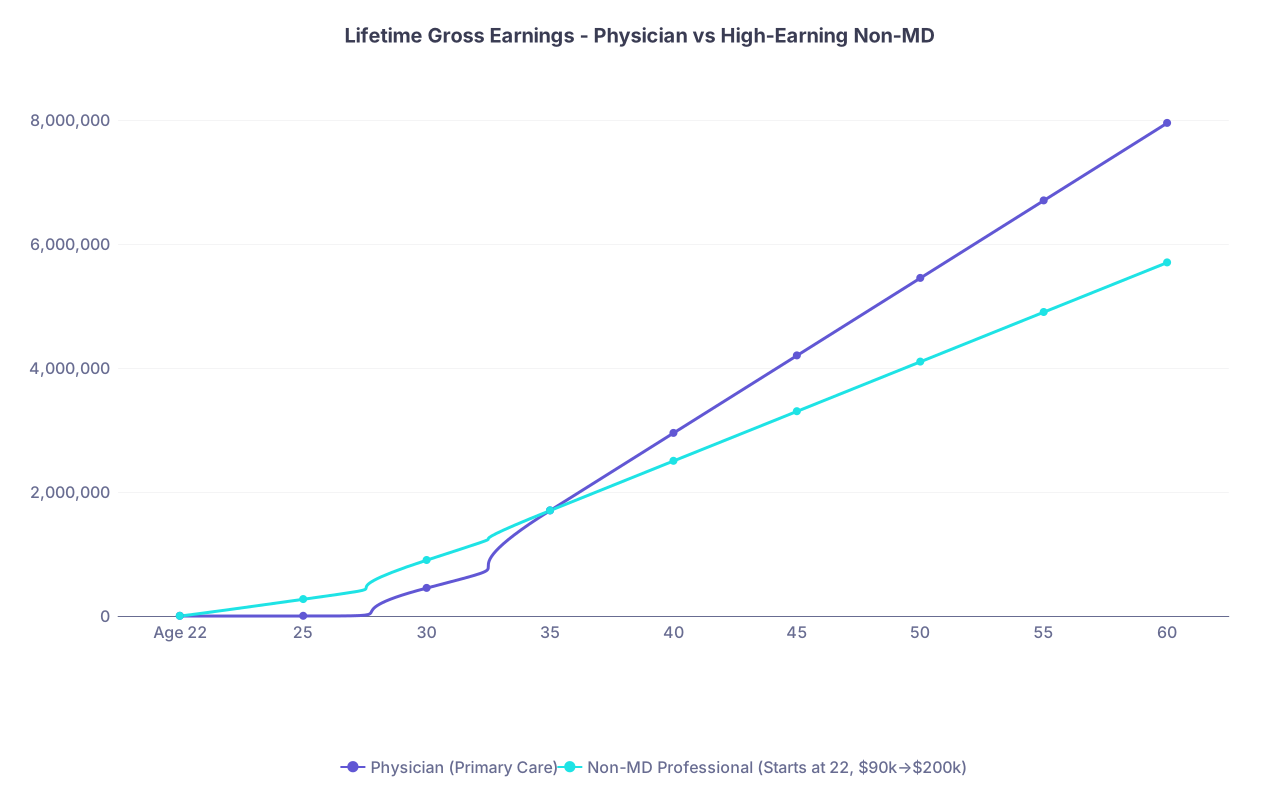
| Category | Physician (Primary Care) | Non-MD Professional (Starts at 22, $90k→$200k) |
|---|---|---|
| Age 22 | 0 | 0 |
| 25 | 0 | 270000 |
| 30 | 450000 | 900000 |
| 35 | 1700000 | 1700000 |
| 40 | 2950000 | 2500000 |
| 45 | 4200000 | 3300000 |
| 50 | 5450000 | 4100000 |
| 55 | 6700000 | 4900000 |
| 60 | 7950000 | 5700000 |
That’s gross earnings, not adjusted for debt, taxes, or investments. So yes, over a whole career, you out‑earn the non‑MD by a lot. But the gap doesn’t look massive until your late 40s. Which is exactly why you’re uneasy: the advantage shows up late, while the pain (debt, long hours, delay) hits early.
Where the sacrifices really bite: time, risk, and burnout
The money story would be easier if this were just: “suffer financially for a bit, then you’re rich.” It’s not. The non‑financial sacrifices are the part that make you question if the salary is “enough.”
You’re giving up your 20s. What is that worth?
You already know the bullet points: nights, weekends, holidays, weddings you miss, kids you might delay having, hobbies that evaporate.
The part no one really prices out for you is this: the optionality cost.
If you weren’t going into medicine, from 22 to 30 you could:
- Try 2–3 different careers with minimal consequence
- Move cities easily
- Change jobs or industries when bored
- Take a 6‑month gap year without imploding your future
Residency? You match into one specialty in one place and you’re locked there for years. Switching is possible, but it’s like changing planes mid‑flight: doable, but expensive and rare.
This lack of flexibility has a value. It just doesn’t show neatly in an Excel sheet.
The risk no one wants to put in their brochures
People talk about “average physician salary” like it’s guaranteed.
It isn’t.
There’s risk baked into this path that’s hard to acknowledge when “doctor” is supposed to be stable:
- You might not match your ideal specialty. Or not match at all the first time.
- You might match a low‑pay, high‑burnout field in a saturated market.
- Healthcare policy could keep shifting toward lower reimbursements (primary care has felt this for years).
- Corporate consolidation and RVU pressure can absolutely grind you down.
So when we say, “Is the salary enough to justify the sacrifice?” we’re not talking about a guaranteed $400k for life. We’re talking about a probability distribution.
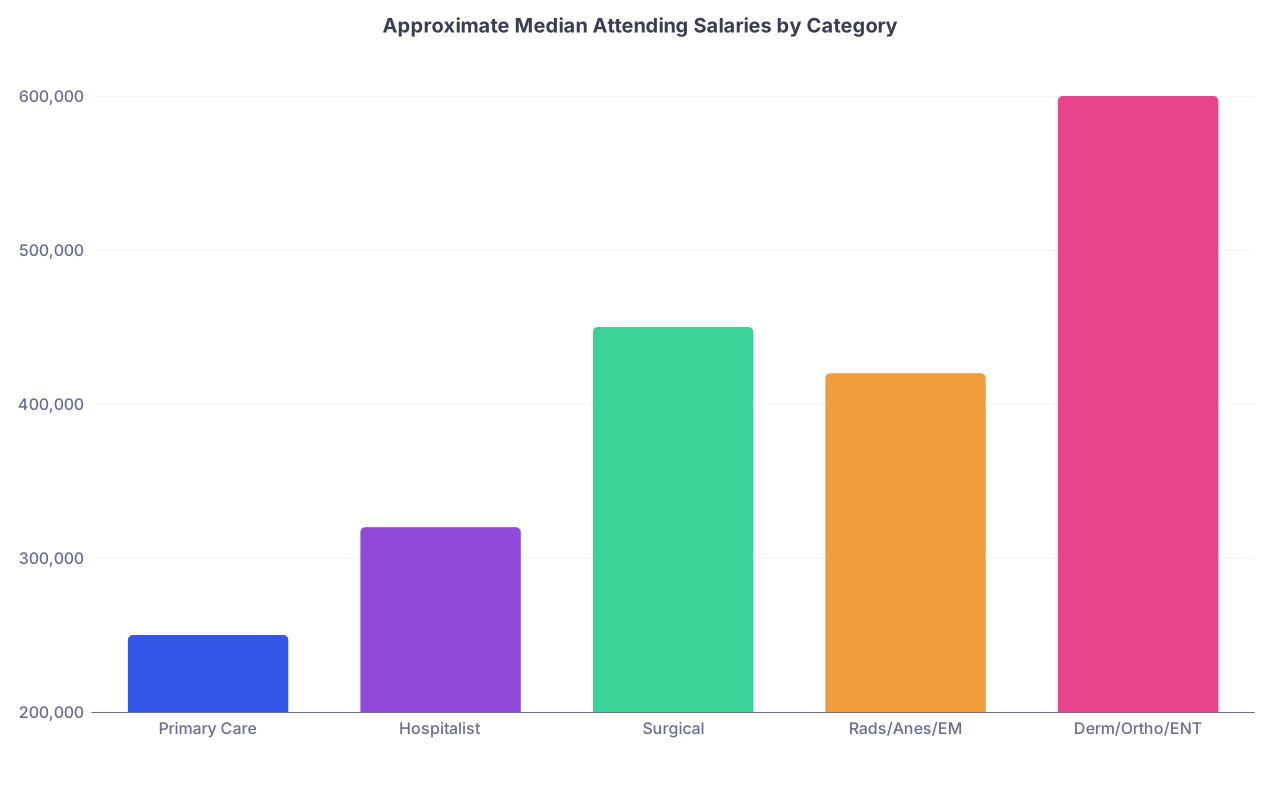
| Category | Value |
|---|---|
| Primary Care | 250000 |
| Hospitalist | 320000 |
| Surgical | 450000 |
| Rads/Anes/EM | 420000 |
| Derm/Ortho/ENT | 600000 |
That’s from recent compensation reports. But it hides the spread.
- There are primary care docs scraping to hit $200k in certain metros.
- There are ortho surgeons at $900k and others at $400k in oversupplied regions.
- EM is an absolute question mark in some markets right now with oversupply and corporate groups slashing hours.
You’re betting 10+ years of your life on not just getting into medicine, but landing in a reasonable corner of medicine.
So yeah, your anxiety is rational.
So… does it still “pay off” purely financially?
Let me answer this as directly as possible.
If you want a purely financial slam dunk? Medicine isn’t it.
If your only goal is “maximize money, minimize sacrifice” and you’re reasonably talented?
You can probably do better in:
- Software / data / AI
- Certain finance roles
- High‑end sales / business development
- Starting a business with some risk tolerance
Those paths usually:
- Start paying well by 24–26
- Have no mandatory 3–7 years of underpaid apprenticeship
- Don’t require seven-figure malpractice risk hanging over your head
If you’re mainly asking, “Will being a doctor make me super rich compared to other high‑skill careers?” the answer is: not automatically, not early, and not with less pain.
But that’s not quite the question most premeds are actually asking.
What you’re really asking is more like:
“Given the debt, the lost years, the training pain, and the uncertainty in healthcare… is this at least financially defensible if I actually want to be a physician?”
That’s different. And here I’ll be clear:
Yes. For most reasonable scenarios, the physician salary still outweighs the financial cost — if you actually want the job at the end.
Let’s compare two paths over a lifetime with more realistic assumptions.
Path A: Physician (primary care/hospitalist level)
- Start med school at 22, finish at 26
- 3‑year residency, attend at 29
- Average attending income: $260k–300k over career (starting lower, ending higher)
- $300k loans paid off by 40
By 60, your cumulative net earnings (after paying that $300k plus interest) are still comfortably higher than most white‑collar professionals if you keep working full‑time. The early hit hurts, but over 30 years it’s dwarfed by the extra earnings.
Path B: Non‑MD high earner (software, data, etc.)
- Graduate at 22, start at $80–100k
- Climb to $180–220k by mid‑30s, maybe higher with good moves
- No grad school loans beyond maybe $30–60k
Total career earnings absolutely can be competitive, especially if they invest well and avoid lifestyle creep. They also get an 8‑year head start on saving and investing, which compounds.
But you don’t end up in “I’ve ruined my life” territory as a doctor unless something really goes wrong (massive lifestyle inflation, toxic job, never paying down loans, or big mismatch between expectations and reality).
The salary is still enough to:
- Get you out of six‑figure debt
- Support a family
- Save aggressively for retirement
- Live a solidly upper‑middle to upper‑class life in most parts of the US
The real financial disaster scenarios I’ve actually seen look like this:
- $350–500k debt, chooses a low‑pay, high‑COL metro, doesn’t track spending, keeps deferring or using IDR without a plan → feels permanently broke
- Never learns basic personal finance, assumes “doctor = rich,” buys the big house and car straight out of residency → golden handcuffs, constant anxiety
- Matches into a fragile specialty in a saturated area, can’t find a stable job → income way below expectations
Those are real. But they’re not automatic.
Where the salary does justify things (and where it doesn’t)
Here’s where I land, and this is after watching a lot of people on both sides of the wall.
The salary justifies the sacrifice if:
- You’re honest that you want to practice medicine, not just have the “doctor” identity
- You’re willing to live like a resident for a few years after residency to crush loans and build a buffer
- You’re okay with never being the richest person in your college class, but being very financially secure
The salary gives you:
- Strong long‑term earning power, even in “average” specialties
- A huge safety net against poverty, joblessness, and total economic instability
- The ability to course‑correct: work locums, change practice settings, renegotiate, move states
And something no spreadsheet can capture cleanly: once you’re out, the combination of job security + relatively high income is… calming, if you’ve handled your debt decently. Most attendings I know who kept their fixed costs sane sleep much better at 40 than they did at 28.
The salary does not justify the sacrifice if:
- You’re already deeply ambivalent about medicine itself and are here mostly for income/prestige
- Your plan is: “I’ll be miserable for 10–15 years but it’s worth it because of the money”
- You fantasize a lot more about passive income, FIRE, and entrepreneurship than about patient care or clinical work
Because then all the non‑financial sacrifices hit full force, and the salary maxes out at “okay compensation for a life you don’t actually want.”
And that’s where people burn out hard. Not just tired. Regretful.
How to reduce the chance this becomes a financial nightmare
You can’t control reimbursement rates or the residency bottleneck. But you do have more control than it feels like right now.
A few levers that matter a lot:
- Total debt: The difference between $220k and $420k in loans is absolutely life‑changing. Cheap in‑state vs $70k/year private med school is not just a “nice to have” difference. It’s decisive.
- Specialty flexibility: You don’t have to chase derm for money, but if you know you’d be happy in two or three fields, keep an eye on both lifestyle and pay. There’s a reason EM’s uncertainty is freaking people out right now.
- Lifestyle lag: If you treat your first 3–5 attending years as “extended residency” for spending, you can nuke your loans and buy yourself long‑term freedom. If you go straight to BMW/house/privateschool-life, the salary stops feeling like a reward and starts feeling like handcuffs.
Here’s a very rough sense of how “crushing loans early” versus “coasting” plays out.
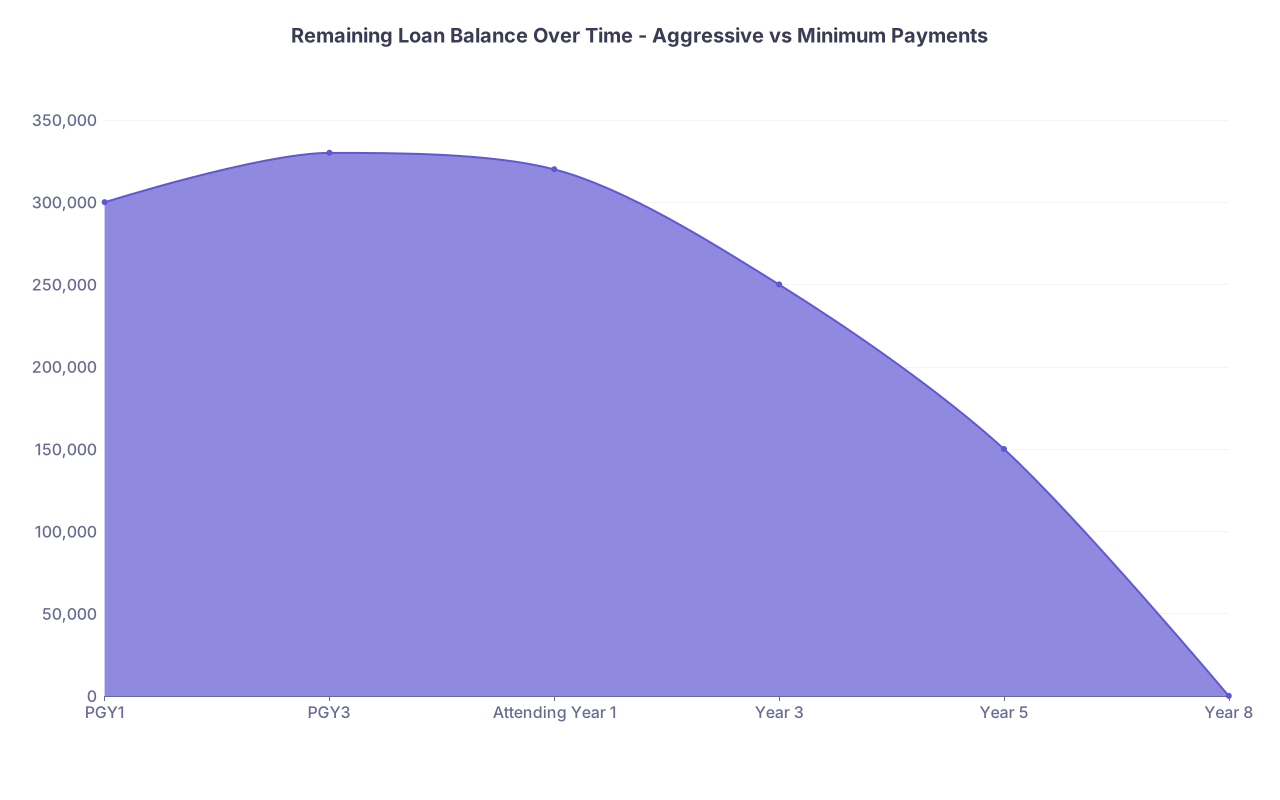
| Category | Value |
|---|---|
| PGY1 | 300000 |
| PGY3 | 330000 |
| Attending Year 1 | 320000 |
| Year 3 | 250000 |
| Year 5 | 150000 |
| Year 8 | 0 |
(That’s the aggressive payoff curve. The “just pay minimums on IDR forever and hope PSLF saves me” curve? It’s way flatter and way uglier for way longer.)
So… is it still “worth it”?
Here’s my honest, slightly harsh take.
If you’re looking for a clean, reassuring, “yes, don’t worry, it all works out and you’ll be rich,” you’re not going to get that from anyone who’s actually looked at the numbers lately.
Medicine is no longer this untouchable, obviously best‑ROI career path. You give up too much time, flexibility, and mental health for it to be a no‑brainer on money alone.
But if you strip away the premed panic and actually compare it to the real alternatives most people end up in — not the 1% FAANG engineers or hedge fund people — physician income is still very solid. Combined with the job security, it’s financially defensible and often quite good, as long as you:
- Keep your debt as low as humanly possible
- Don’t lie to yourself about how much you actually like clinical work
- Refuse to blow up your first decade of attending life with lifestyle inflation
The worst situation isn’t “I became a doctor and only make $260k.” It’s “I became a doctor for the money, I’m burned out, I owe $400k, and even the salary doesn’t feel like compensation for what I gave up.”
The best situation looks more like: “Yeah, training sucked, I missed a lot, but now I like my day‑to‑day enough, I’m paying off my loans, I can support my family, and I’m not terrified of losing my job or my health insurance.”
The physician salary can absolutely still justify the training sacrifices — but only if you’re brutally honest with yourself about why you’re doing this and you treat the money like a tool, not the whole point.
Do one concrete thing today: open your med school options list (or projected list if you’re pre‑apps) and add a column with “estimated debt at graduation.” Put the actual dollar amounts. If any school pushes that number above what you could realistically service on a $230–260k salary, cross it off or mark it in red. That single step will tell you more about whether this path will feel “worth it” than any motivational quote ever will.