
The fantasy that “doctors will always be fine” is dangerously outdated.
If you’re even half awake to what’s happening with prior auth, RVUs, Medicare cuts, and private equity, you’ve probably had this thought: What if reimbursement just… falls off a cliff in my specialty? Not a tiny 2% CMS cut. I’m talking 20–40% pay drops, contracts slashed, shifts evaporating, call pay disappearing.
You’re not crazy for worrying about this. You’d be naive not to.
Let’s walk through the actual worst cases, what they could look like in real numbers, and what you can do now, as a student or resident or early attending, so that a reimbursement crash is painful… but not life-ruining.
What a “Reimbursement Crash” Actually Looks Like (Not the Sugar-Coated Version)
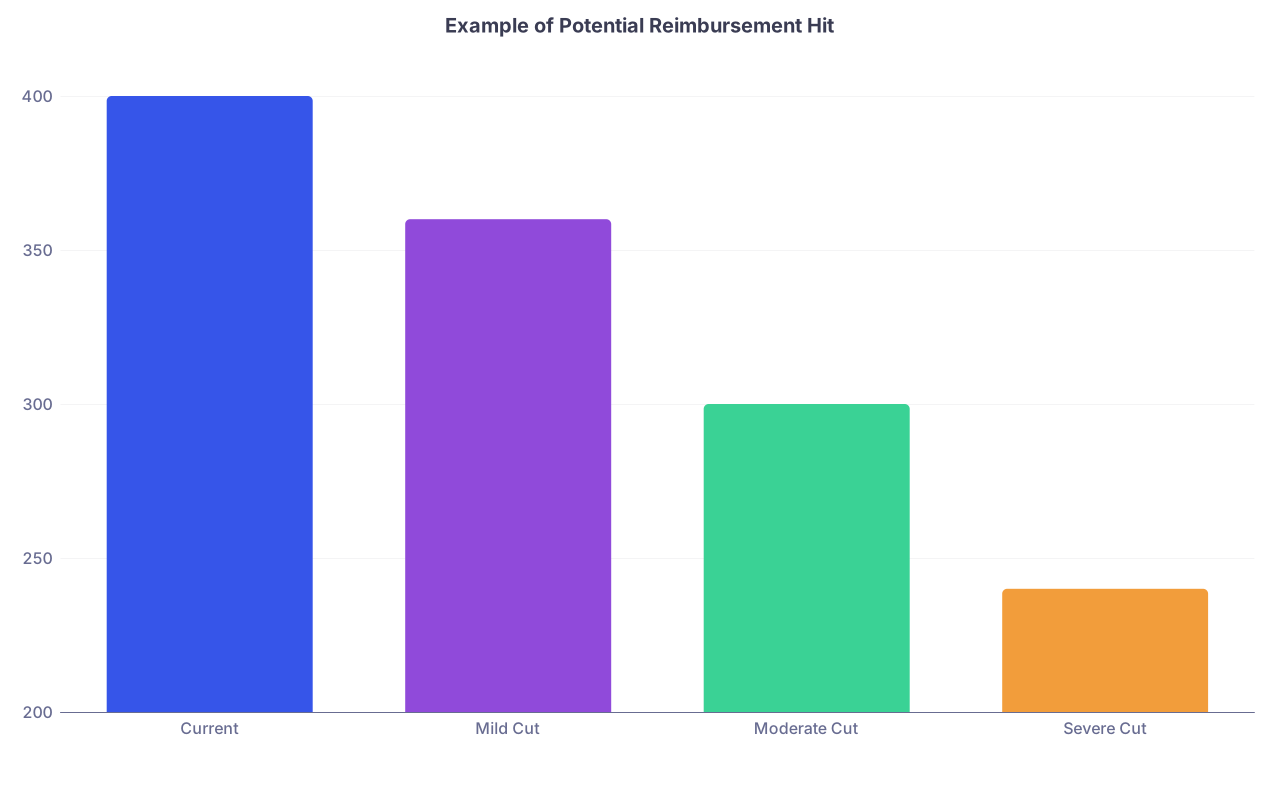
| Category | Value |
|---|---|
| Current | 400 |
| Mild Cut | 360 |
| Moderate Cut | 300 |
| Severe Cut | 240 |
Let’s talk about the nightmare you’re picturing at 2 a.m., not the rosy version attendings keep throwing at you.
Say you match into a currently “good” specialty:
- Outpatient cardiology
- EM at a community hospital
- Anesthesia in a mid-cost-of-living city
- Ortho as an employed surgeon
You’re expecting something like $350–500k once established. Now imagine:
- Payers slash reimbursement on key procedures or E/M codes.
- Your employer renegotiates contracts and lowers RVU rates.
- Hospital volumes drop because they’re diverting to APPs or telehealth.
- Call pay disappears because “it’s now part of your base comp.”
You’re suddenly being told: “Market conditions shifted. New contracts will be 25–35% lower.” And by the way, your non-compete means you can’t just jump across town.
So instead of $400k, it’s $260–300k.
On its own, that’s still a lot of money. But here’s where it becomes a real problem: you’ve built a life that needs $400k to not implode.
- $3,500+ per month in student loan payments
- $4–6k/month mortgage on the “doctor house”
- Two car leases
- Private school for kids
- Spouse not working (because everyone assumed “doctor money” would cover it)
Now a 30% income cut isn’t just “annoying.” It’s “we might not be able to make payments in 18 months.”
That’s the part nobody wants to say out loud.
The Real Financial Worst-Case Scenarios (Numbered, Nameable, and Very Uncomfortable)
These are the ones that keep people like you and me up at night.
1. The Income-Expense Trap
You lock into fixed expenses assuming a certain attending salary… and then reimbursement tanks.
Let’s put numbers on it.
| Item | Original Plan | After 30% Pay Cut |
|---|---|---|
| Gross income | $400k | $280k |
| Net (after tax ~35%) | $260k | $182k |
| Monthly take-home | ~$21,600 | ~$15,200 |
| Fixed monthly expenses | $16,000 | $16,000 |
| Leftover (best-case) | $5,600 | -$800 |
Negative $800/month before you even count vacations, gifts, emergencies.
That’s the “I’m a doctor and I still feel broke” scenario. It’s not theoretical. I’ve watched attendings sell their houses three years out of training because they built their life around a salary that vanished when their group renegotiated with a payer.
2. The Loan Catastrophe Scenario
You graduate with:
- $300–500k federal loans at 6–7%
- Maybe some private loans (worse)
- No meaningful savings because, well, med school and residency
You pick a field that used to make $350–400k. Ten years into your career, Congress + CMS + hospital contracts hollow that out. You’re making $220–250k in a high-COL city. Now you’re trying to:
- Pay $3–4k/month in loans
- Pay rent or a mortgage
- Save for retirement
- Support a family
Math starts not to work.
The worst version: you consolidated into private loans, lost PSLF options, and now can’t adjust payments flexibly. That’s when people start saying the quiet part: “I don’t know if I can do this for 20 more years.”
3. The Specialty Death Spiral
Some specialties are on thinner ice than others. Think:
- Primary care in saturated metro areas
- EM in certain markets with oversupply + contract groups
- Radiology in places with heavy telerad competition
- Anesthesia where CRNAs are aggressively replacing coverage
The nightmare version:
- You’re in a narrow specialty.
- That field gets hit hard by reimbursement changes.
- There’s no simple lateral move to another high-paying field.
- You’re 8–10 years post-training, deeply specialized, geographically anchored.
Now what? Retrain at 40? Take a 50% pay cut permanently? Move states? It feels like having your identity pulled out from under you, not just your paycheck.
How Much Could Things Actually Drop? (A Brutal But Honest Range)
Let me be direct: a total collapse to “you’re making $80k as a physician” in a normal, non-apocalypse world is unlikely.
What is completely realistic over a 10–20 year career:
- 10–15% decline: Common. You may not even notice if cost of living also shifts.
- 20–30% decline: Painful, absolutely possible in certain fields and markets.
- 30–40% in pockets: If you’re in the wrong place, wrong contract structure, wrong time? Yes.
Think like this:
- If your dream specialty only works financially if it always pays $450k+, you’re exposed.
- If your plan still works at $250–300k, you’re much safer.
- If your plan is built so you’d still be okay at $180–200k (not happy, but okay), you’re basically bulletproof.
How to “Worst-Case-Proof” Yourself While You Still Have Time
Here’s the part that should calm you down a little: you have way more control than it feels like, especially before you start signing big contracts and mortgages.
1. Choose Your Specialty With Eyes Wide Open
No, I’m not saying “only do derm, ophtho, or ortho.” That’s lazy advice.
I’m saying: price in risk.
- Highly procedure-dependent fields = more exposed to specific code cuts.
- Fields heavily employable by hospitals/CMGs = more contract risk.
- Fields with clear NP/PA replacement trends = more long-term pressure.
Does that mean don’t do EM, anesthesia, rads, primary care? No. It means: if you do, your financial plan needs to be more conservative.
Ask attendings who finished 10+ years ago:
- “How has your pay changed in real terms?”
- “What’s your biggest financial fear about your specialty?”
- “If you were me, what would you do differently financially?”
Listen closely to the weird silence after those questions.
2. Assume a Lower Income Than the Brochures Promise
This is the single most useful mental trick: plan your life around the 25th percentile income for your specialty, not the 75th.
| Specialty | Typical Range | Plan Using |
|---|---|---|
| EM | 250–400k | 250k |
| Cards | 400–650k | 400k |
| Anesthesia | 300–500k | 300k |
| IM outpatient | 200–300k | 200k |
| Ortho | 500–800k | 500k |
If your life still works at those numbers, reimbursement “crashes” become annoying, not existential.
3. Don’t Build a Life That Needs Your Max Earning Years
This one hurts, because everyone around you will be doing the opposite.
You know the script: PGY-3 → Tesla test drive → “starter” $900k house → furniture bought on payments → kids in private daycare “because we can afford it.”
Then a reimbursement cut hits and suddenly you can’t afford it, but all the contracts are signed.
A safer pattern:
- First 5 years attending: live like an upper-resident, not like a surgeon on TV.
- Channel the difference into:
- Student loans
- An emergency fund (6–12 months of expenses, not 1–2)
- Retirement accounts (because compounding is your friend and also your safety net)
Those first 5 years are leverage. You either buy freedom, or you buy a lifestyle that makes you a hostage.
Diversifying Your “Doctor Risk” (Yes, Even If You’re Still a Student)
This is where people roll their eyes and say, “I’ll deal with that when I’m an attending.”
That’s how you end up at 42 with one income stream, no exit plan, and a hospital CIO telling you: “Compensation models are changing.”
1. Build Skills That Translate Outside RVUs
You want optionality. That means things like:
- Teaching (med ed roles, course creation, board review teaching)
- Writing/communication (medical writing, content, consulting)
- Basic business/finance competency (so you can evaluate side ventures without getting scammed)
- Tech comfort (EHR optimization, informatics roles, digital health)
Do these make you rich quickly? No. But they give you option value. So if clinical pay tanks, you’re not stuck with zero other income levers.
2. Own Something That Isn’t Your Job
No, I don’t mean day trading.
I mean:
- Index funds (401(k), Roth IRA, taxable accounts)
- Maybe, later, real estate you can actually afford
- Any asset that generates income or grows without you doing procedures or notes
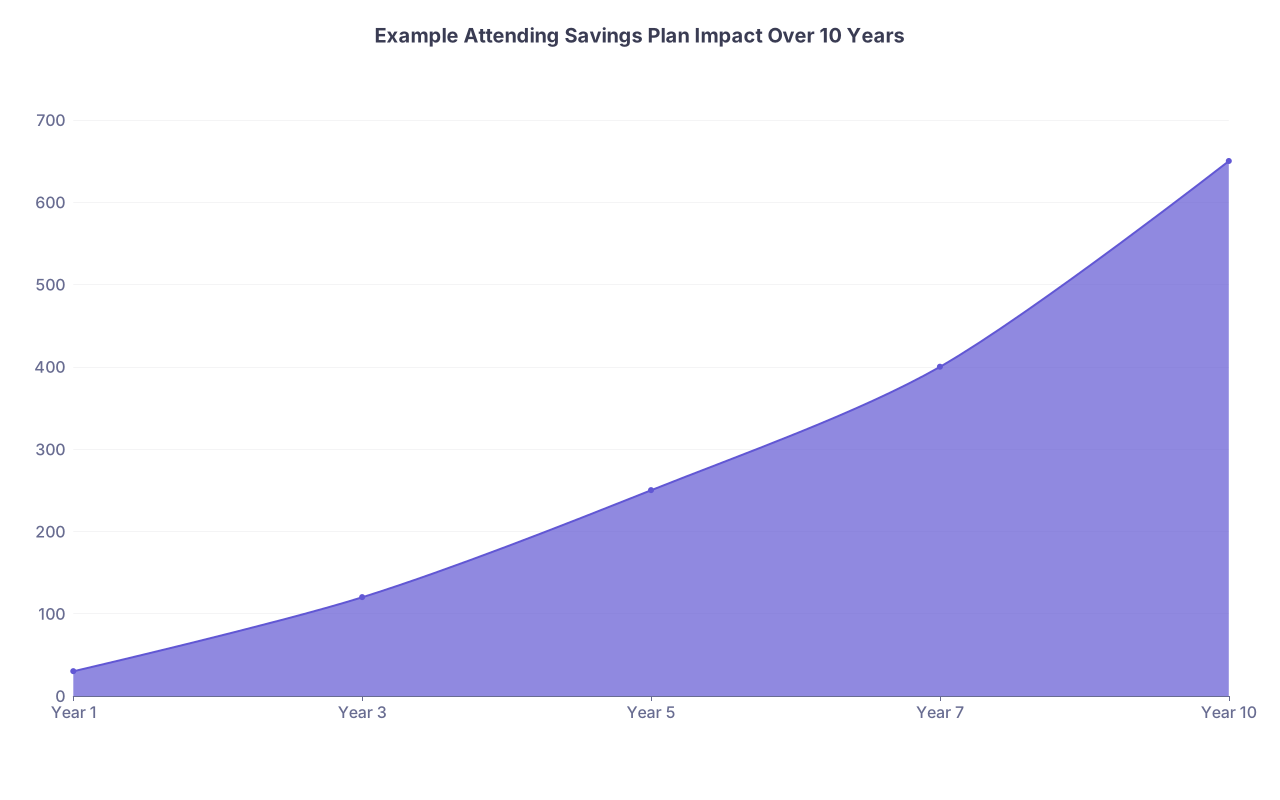
| Category | Value |
|---|---|
| Year 1 | 30 |
| Year 3 | 120 |
| Year 5 | 250 |
| Year 7 | 400 |
| Year 10 | 650 |
If you aggressively save/invest $3–5k/month for your first decade as an attending, you’re in a different category:
- Reimbursement cut? You’re annoyed, not desperate.
- Want to drop to 0.8 FTE? Plausible.
- Need to move to a lower-paying but saner job? Also plausible.
The worst financial horror stories I’ve seen are not people who made too little. It’s people who made a lot and saved nothing.
“Okay, But What If It Really Crashes?” — The Nuclear Scenarios
Let’s lean into your anxiety brain for a second.
What if:
- Your specialty gets undercut harder than expected.
- Your group dissolves or is bought out and your comp model gets gutted.
- You’re in a bad geographic area with limited alternative jobs.
- You have a family that can’t just pick up and move.
What then?
You still have levers. None are pleasant, all are better than financial ruin:
Geographic arbitrage
Move to a smaller city or different state where:- Cost of living is lower
- Your specialty is in higher demand Same or lower salary, but lower expenses → you survive.
Role shift
Move from:- Pure clinical → mixed clinical + admin/leadership
- High-intensity hospital work → outpatient, telehealth, or hybrid Admin roles can sometimes pay similarly while being less RVU-exposed.
Lifestyle cutbacks
Not glamorous, but real:- Sell the too-big house
- Downsize cars
- Public instead of private school It feels like failure only if your ego is attached to the “doctor lifestyle.” Financially, it’s survival.
Longer-term retraining
Extreme, but on the table:- Fellowship into a different niche with better stability
- Pivot to a related but more stable field (occasional, but it happens) The key is: this is much easier to stomach if you’re not also drowning in payments.
The Part Nobody Tells You: You Don’t Actually Need “Doctor Money” Forever
One quiet truth: if you handle your first 10–15 years reasonably well, you don’t need your income to stay sky-high forever.
Most of the disaster scenarios assume:
- High debt
- High fixed lifestyle costs
- Low savings rate
- Total dependence on one paycheck
Flip that:
- Debt aggressively paid down
- Modest fixed costs
- Consistent saving/investing
- Some secondary skills or income streams
Then a reimbursement crash becomes:
“I’m pissed and this is unfair, but I can cut my hours in my 50s and not die financially.”
Instead of:
“I’m 55, burnt out, still full-time, and I literally can’t retire because I need every paycheck to service the machine I built in my 30s.”
Quick Reality Check: Where You Are Right Now
If you’re:
Pre-med or med student:
Your power move is:- Pick specialty with eyes open, not purely on old salary numbers.
- Keep your personal burn rate low (don’t rack up lifestyle debt now).
- Learn basic personal finance early. Not in a “finance bro” way. Just enough to not get wrecked.
Resident or fellow:
Your power move is:- Don’t pre-spend your future attending salary mentally.
- Plan your first 5 years attending like a “financial residency” focused on safety.
- Choose contracts and jobs with flexibility, not just the biggest signing bonus.
Early attending:
Your power move is:- Freeze lifestyle creep for a couple of years.
- Crush high-interest debt.
- Build a real emergency fund and start investing so your future self isn’t defenseless.
FAQ (Exactly the Stuff You’re Afraid to Ask Out Loud)
1. Is it stupid to go into a “risky” specialty like EM or anesthesia now?
Not automatically. But it is stupid to go in thinking, “They make $400k, so I’ll be fine no matter what.” If you love the work, great—just plan as if your long-term comp might live at the low end of current ranges. If the only way your life works is with top-decile pay, that’s a problem.
2. What if I already know I’ll have $400–500k in loans? Am I just screwed?
No, but you lose margin for error. It means:
- You have to be more conservative with lifestyle.
- Your first decade out matters more.
- Programs like PSLF or academic/government work may deserve a harder look.
Huge debt plus a volatile specialty plus a high lifestyle is the disaster combo. Change at least one of those three.
3. Should I pick a specialty mainly for financial stability?
I wouldn’t pick “for money,” but I’d absolutely factor in stability. Two people equally happy with, say, rads vs IM? The one who pretends money and risk don’t matter is lying to themselves. If you’re miserable in your field, the best reimbursement in the world won’t fix that. But ignoring financial risk is just another way to burn out later.
4. How big should my emergency fund be if I’m worried about reimbursement cuts?
If you’re anxious (like we are), 3 months isn’t enough. Aim for 6–12 months of essential expenses in cash or very safe, liquid assets. Not 12 months of your inflated lifestyle—12 months of “we could live sanely if we had to cut back.”
5. What’s the biggest financial mistake young doctors make that makes reimbursement crashes so dangerous?
They lock in fixed costs immediately: giant house, new cars, private schools, recurring luxury expenses. All while paying minimums on loans and barely investing. Then when pay drops or life changes, there’s no slack. If you can resist that for just a few years, you’re way less fragile.
6. If reimbursement tanks, will I regret becoming a doctor at all?
Honestly? Some people will. Especially those who feel trapped and broke despite high incomes. But if you:
- Keep debt somewhat under control,
- Live below your means early,
- Save and invest consistently, you’ll almost certainly still have more options and stability than the average person. The regret usually comes from expecting the “doctor dream” to guarantee permanent financial comfort without any planning.
Open a note on your phone or laptop right now and write down one sentence:
“What would my life need to look like so I’d still be okay if my expected specialty income dropped by 30%?”
Then list three concrete things you can adjust (debt, lifestyle, savings, specialty choice). That’s the beginning of a real plan, not just late-night anxiety.