
The way most doctors read salary surveys is dangerously naïve.
You’re treating them like objective truth when, at best, they’re blurry averages with missing organs.
Let me walk you through how physicians repeatedly misread compensation data, sign bad contracts because of it, and leave six figures on the table over a career—without realizing the “data” they trusted was stacked against them from the start.
1. Treating Survey Medians Like Gospel (Instead of Blunt Instruments)
You’ve seen the headlines:
- “Average cardiologist salary: $XYZ”
- “Orthopedic surgeons earn $ABC on average”
- “Top-paying specialties ranked”
Here’s the first mistake: reading those numbers as the correct number you “should” be making.
They’re not. At best, they’re:
- Statistically rough
- Skewed by who actually answered
- Detached from key details of your own situation
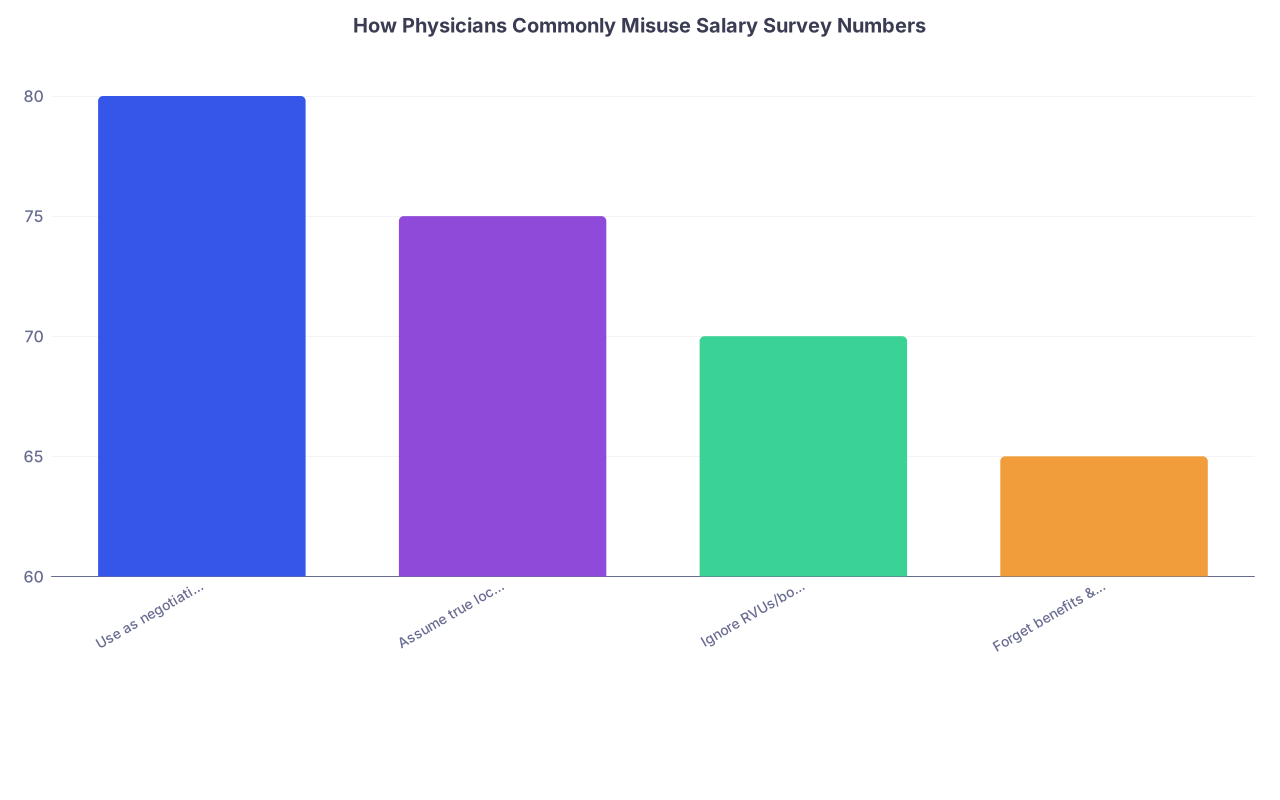
| Category | Value |
|---|---|
| Use as negotiation ceiling | 80 |
| Assume true local market rate | 75 |
| Ignore RVUs/bonus structure | 70 |
| Forget benefits & call burden | 65 |
The classic blunder? You pull a median number from MGMA, Medscape, Doximity, or AMGA and decide:
- “This is what I should be paid.”
- “Anything near this is fair.”
- “If they’re offering close, it must be competitive.”
You’re anchoring to a number that:
- Might come mostly from large systems while you’re joining a 3‑doc private group
- Might blend academic, employed, and private practice into one “median”
- Might include people with 20+ years’ experience when you’re a brand-new attending
Real example I’ve seen:
A hospital offers a new hospitalist $260k base. Medscape says average hospitalist salary is $300k, MGMA median is ~$310k. Recruiter says, “Remember, you’re new. This is a strong starting salary for the area.” Physician signs.
What they didn’t factor in:
- The MGMA median for hospital-employed hospitalists in that region was closer to $330k when including bonuses.
- The job’s “light call” expectation turned out to be 18 shifts a month, including nights.
- Quality and productivity bonuses were technically possible but almost never paid out based on historical department data.
On paper, they were “close to the median.” In reality, they were undercut.
How to not screw this up:
- Treat survey medians as rough orientation, not a standard of fairness.
- Always ask: “Median for whom exactly?”
- Setting (academic vs private vs hospital-employed)
- Region
- Experience level
- FTE vs part-time
- Assume the headline number is incomplete until you see the breakdown.
2. Ignoring Who Actually Responds (Selection Bias You Can’t See)
Here’s a dirty secret: most salary surveys reflect who was willing and available to answer, not a truly random sample of physicians.
Who tends to fill them out?
- Docs with strong opinions (very happy or very angry)
- People who actually open those emails
- Physicians in larger systems that have relationships with survey companies
- Folks with admin titles and time at a desk
The doctors who often don’t show up in big numbers:
- Super high earners in lean private practices who aren’t checking survey emails
- Older partners who don’t care about surveys or are suspicious of sharing income info
- Burned-out docs who ignore every nonessential message in their inbox
That skews the data. A lot.
| Source Type | Common Biases |
|---|---|
| Medscape-style | Self-selected, mix of all practice types |
| MGMA | Heavy on larger groups/systems |
| Doximity | Users skew younger, more urban |
| Specialty orgs | Members only, often academic-leaning |
So when you see:
- “Average EM salary: $X”
- “Primary care average: $Y”
You’re not looking at a divine number. You’re looking at who bothered to reply.
Mistake pattern I see a lot:
Doctor: “But Doximity says cardiologists are making $550k in this region.”
Recruiter: “Those are just rough estimates. Our comp is competitive.”
Doctor: “Okay, I guess this $480k offer is reasonable for starting.”
Reality: That $550k may:
- Include older partners taking home $800k blended into the pool with new grads at $400k
- Under-represent newer hospital-employed cardiologists under system caps
- Over-represent high-volume, procedure-heavy private practices you’re not joining
How to protect yourself:
- Use multiple sources. If MGMA, Doximity, and Medscape don’t even vaguely agree, treat the numbers with suspicion.
- Talk to real physicians in that specialty and region—not just one, and not just the one the recruiter picks for you.
- Beware “our comp is competitive.” That phrase is usually a red flag that they know you don’t have better data.
3. Forgetting the RVU and Productivity Trap Behind the “Average”
This one burns people badly.
You see:
- MGMA: “Median compensation for your specialty: $450k”
- Contract: “Base: $270k + productivity up to $450k+ potential!”
You think: “Great, I can hit the median if I work hard.”
You will not like what happens next.

The trap:
- The median compensation in surveys is almost always tied to a certain RVU volume.
- Many contracts quietly require RVUs above that median level before you come close to those survey numbers.
- Or worse, they pay you less per RVU than the groups represented in the survey.
Example structure I’ve seen on contracts:
- MGMA says: median 8,000 wRVUs → $450k total comp
- Your contract: base $270k + $40 per wRVU over 5,000
- This means to reach $450k, you’d need:
- Extra $180k / $40 per RVU = 4,500 RVUs over threshold
- Total: 9,500 RVUs, not 8,000
- This means to reach $450k, you’d need:
So you’re told you can hit the “median” with productivity, but the math requires you to work 20–30% harder than the docs behind that survey number.
And that’s assuming:
- They don’t abruptly cut clinic time
- They don’t over-hire and spread volume thin
- You actually control your schedule enough to hit those RVUs
How to not get ambushed:
- Ask directly:
- “What RVU level is this base salary modeled on?”
- “What is the RVU threshold and per-RVU rate?”
- “How many physicians here actually hit the bonus tiers in the last 2–3 years?”
- Compare:
- RVUs required in your contract
vs - RVUs that correspond to median comp in the survey
- RVUs required in your contract
If you need way more RVUs than survey medians to hit median comp, you’re not being offered “average.” You’re being offered below average pay for above average work.
4. Ignoring Non-Salary Money: Benefits, Call, and Ownership
Another predictable error: obsessing over the base salary line while ignoring everything else that sure looks like money but doesn’t get labeled as such.
You see:
- Job A: $380k base
- Job B: $350k base
You’re tempted to think Job A is obviously better.
Then you gloss over:
- Student loan repayment
- 401(k)/403(b)/457 match differences
- Health insurance premiums
- Malpractice (occurrence vs claims-made, tail coverage)
- Call burden (and whether it’s paid)
- Partnership track and buy-in vs “never-own-anything” employed
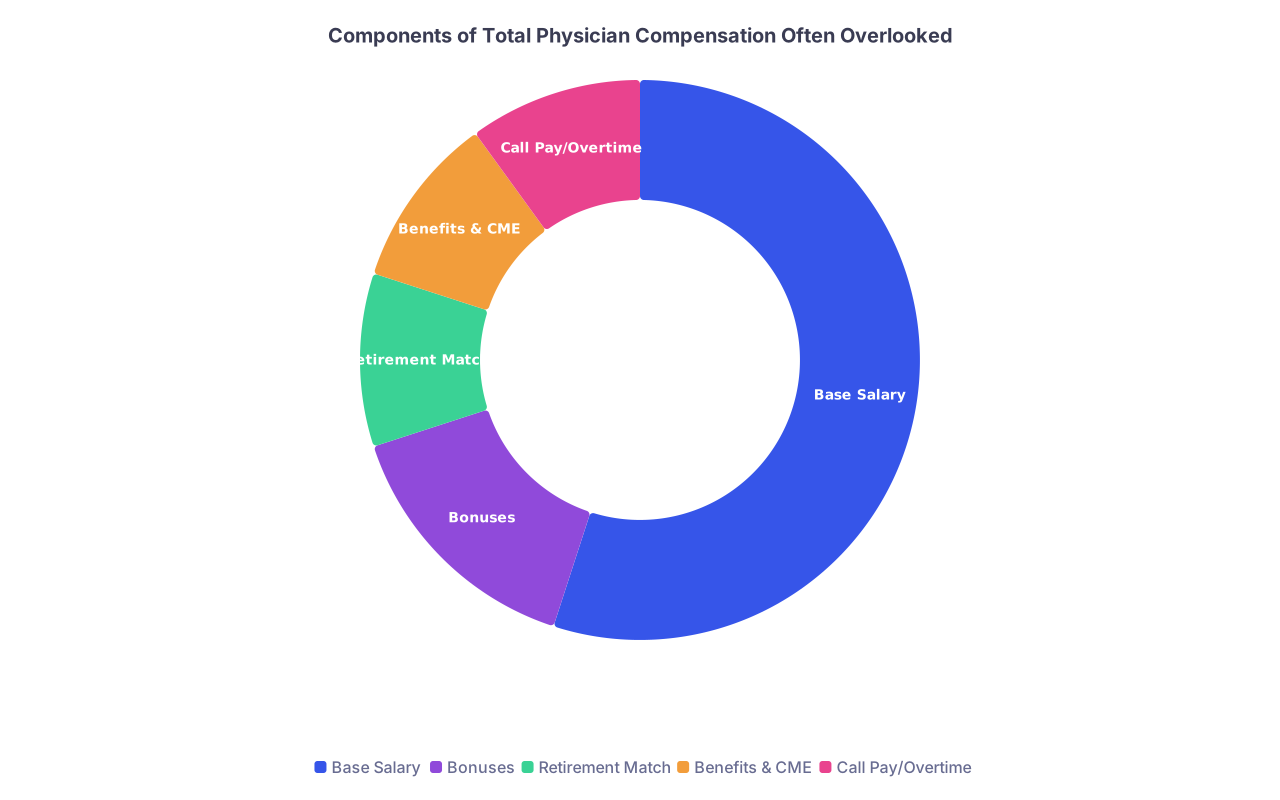
| Category | Value |
|---|---|
| Base Salary | 55 |
| Bonuses | 15 |
| Retirement Match | 10 |
| Benefits & CME | 10 |
| Call Pay/Overtime | 10 |
Real outcome I’ve seen:
- Dr. A takes $380k “higher salary” job.
- 1% retirement match, minimal CME, pays $900/month for family health insurance, unpaid call 1:4, no partnership, no ancillary bonuses.
- Dr. B takes $350k “lower salary” job.
- 6% retirement match, $5k CME, full family coverage paid, call is 1:6 with $1,000 per call night, clear 2-year partnership track with ancillaries worth another $100–150k once in.
By year 3, Dr. B is effectively making $450–500k+ all-in, while Dr. A is stuck at $380k nominal with worse lifestyle and weaker long-term benefits.
Both of them thought they were “near the survey average.” Only one actually understood total compensation.
How to stop looking only at the base:
- Build out a simple “total compensation” table for each offer:
- Base salary
- Typical bonus (ask what people actually earn, not the theoretical maximum)
- Call pay
- Loan repayment
- Retirement match (dollar value)
- Health benefits (what you pay out of pocket)
- CME, licensing, cell, etc.
- Partnership potential and realistic take-home after buy-in
- Compare those totals to survey numbers, not just the base.
If your total comp is far below what surveys suggest is median for your specialty/region, don’t shrug. It’s not “just how medicine is now.” You’re being underpaid.
5. Forgetting Geography and Cost of Living Reality
Another classic misread: treating a national median as if the U.S. is one giant homogeneous market.
It’s not. You know that, but doctors still ignore it with salaries.
The $400k median for your specialty means wildly different things in:
- Rural Midwest vs coastal California
- Low-tax vs high-tax states
- Places where docs are scarce vs saturated metro areas
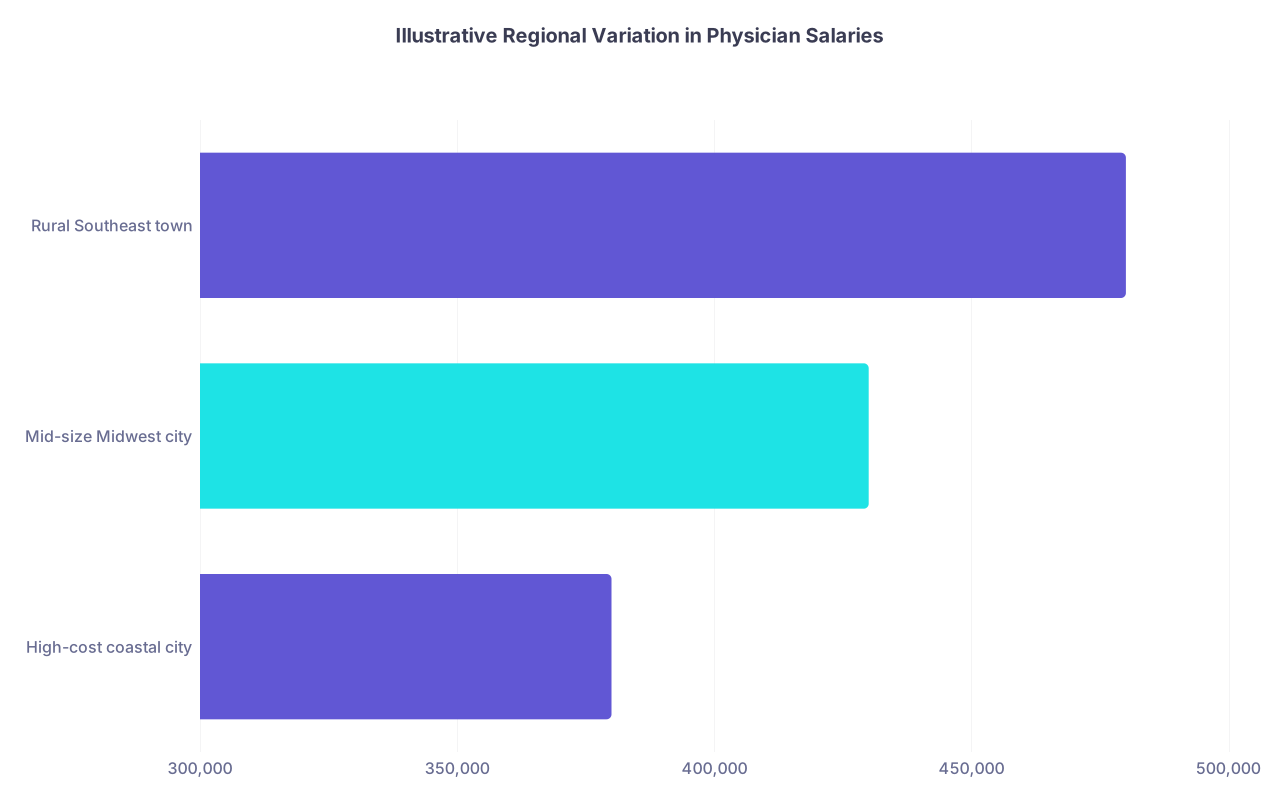
| Category | Value |
|---|---|
| High-cost coastal city | 380000 |
| Mid-size Midwest city | 430000 |
| Rural Southeast town | 480000 |
Mistakes I see:
- Accepting a slightly below-median salary in a high-COL urban area because “it’s close to the national median.”
- Rejecting significantly above-median offers in rural or secondary markets because “I don’t want to make more than average; I just want fair.”
- Not adjusting for state income tax—your effective take-home can swing tens of thousands for the same gross salary.
Here’s what you should do instead:
- Whenever you look at a national number, ask:
- “What’s the regional median?”
- “What’s the cost-of-living adjusted reality of this number?”
- A job at 10–15% below national median in a very high-cost city with high taxes? That is not “fine.” You’re effectively signing up to be underpaid twice—in salary and in purchasing power.
- A job 10–20% above national median in a low-cost, low-tax area? That can be a massive financial accelerator—even if it’s not your dream city.
Don’t pretend you’re immune to math. Your future self will care about whether your 10-year earnings were $3.5M or $5M.
6. Trusting Survey Methodology You’ve Never Seen
Most physicians have never once read the “methodology” section of a salary survey. They scroll straight past it. Huge mistake.
That’s where the bodies are buried:
- How many respondents?
- Which practice types?
- How are outliers handled?
- Are partner incomes separated from associates?
- Are bonuses, call pay, and benefits included or not?
Sometimes:
- The “average” is dragged down by a big chunk of academic physicians with low pay but excellent benefits.
- High-earning procedure-heavy groups are underrepresented.
- The “total compensation” number excludes certain bonus structures, or includes them in a way you’ll never realistically match.

| Step | Description |
|---|---|
| Step 1 | See salary survey headline |
| Step 2 | Assume number is correct for self |
| Step 3 | Ignore methodology and sample |
| Step 4 | Use number as negotiation anchor |
| Step 5 | Accept near median offer |
| Step 6 | Later realize RVUs, call, benefits misaligned |
If you’re going to quote surveys in negotiations, at least know what those numbers actually represent.
Concrete examples of methodological traps:
- Surveys that blend physician-owner and employed salaries into one “average”
- Surveys where “median” is based on a small sample in your exact region
- Surveys that estimate pay based on partial or self-reported numbers
Minimum due diligence:
- Read the methodology or at least the definitions page.
- Check:
- Sample size for your specialty
- Whether owners/partners are separated
- Whether numbers include or exclude bonuses
- Whether hours worked are factored at all
If the data is vague or the method is unclear, treat those numbers as loose reference points, not negotiation weapons.
7. Using Surveys to Justify Lowball Offers (and Believing It)
One of the more infuriating patterns: employers using survey data as a shield while carefully choosing which numbers to show you.
You hear:
- “Our offer is at the 50th percentile for your specialty.”
- “This is competitive for our market per MGMA.”
- “You’re actually above the median for new grads.”
Sometimes that’s true. A lot of times, it’s not.
Tricks I’ve seen:
- Using total compensation survey numbers and comparing them only to your base—ignoring that their bonus structure is weak or historically unpaid.
- Picking a lower regional percentile while lots of competing systems quietly pay more.
- Showing you an overall median that includes academic, VA, and half-time positions to justify a low base.
- Using outdated surveys from 2–3 years ago in a rapidly rising market.
You cannot just accept, “We’re at median per MGMA,” and stop there.
You need to respond with:
- “Show me which MGMA table you’re using—setting, region, and experience level.”
- “Is this number total compensation or base only?”
- “How does your wRVU requirement and per-wRVU rate compare to the groups behind that median?”
If they dodge or hand-wave, that’s a signal. They either:
- Don’t understand their own data
or - Are counting on you not understanding it
Neither is in your favor.
8. Better Ways to Use Salary Surveys (Without Getting Burned)
Surveys are not useless. They’re dangerous when you use them lazily.
Here’s how to use them correctly.
Use salary data to:
- Identify obvious red flags.
- If all major surveys say your specialty’s median is ~$450k and you’re being offered $280k with weak benefits, no partnership, and heavy call—this is not “just how healthcare is now.” It’s bad.
- Set broad negotiation expectations.
- You shouldn’t be at 25–30% below your peers for similar work unless there’s a compelling, conscious reason (less call, fewer hours, academic focus, etc.).
- Ask sharper questions.
- “I see MGMA regional median total comp around $X for hospital-employed physicians in this region. Can we walk through how your structure gets to that level with a realistic patient volume?”
Don’t use salary data to:
- Lock onto one “median” number as the Holy Standard
- Ignore your own priorities: call, lifestyle, geographic preference, family needs
- Let a recruiter or admin tell you what the data “really means” without you checking
You’re a physician. You’re used to interpreting lab values, imaging, and incomplete clinical information. Treat salary surveys the same way:
- Context-dependent
- Imperfect
- Nothing without clinical correlation (in this case: real-world physician experiences, actual contract terms, and realistic workload)
FAQ (Exactly 5 Questions)
1. Which salary survey is the most accurate for physicians?
None of them are fully “accurate.” MGMA is often considered the most detailed for group practice and hospital-employed settings, but it’s expensive and still limited by who reports. Medscape and Doximity are free and broad but heavily self-reported and more approximate. The smart move is to use multiple sources, plus real conversations with physicians in your specialty and region, rather than trusting a single dataset.
2. How far below the survey median should I walk away from an offer?
There’s no magic cutoff, but if your total compensation (base + realistic bonus + benefits + call pay) is more than ~15–20% below what several surveys suggest for your setting and region—and there’s no offsetting factor like incredibly light call, part-time FTE, or a clear partnership track—you should treat that as a serious red flag. At that point, you’re probably not “a little underpaid”; you’re being taken advantage of.
3. Are new grads always supposed to earn less than survey medians?
Not always. Many surveys blend new grads with mid-career and senior physicians, so yes, it’s common for starting salaries to be below the overall median. But “new grad” isn’t a pass for a hospital to underpay you by 25–30% indefinitely. A reasonable structure is: slightly lower starting base with either good bonuses, strong benefits, or clear ramp-up to competitive compensation within 2–3 years once your panel/volume is established.
4. How do I adjust survey numbers for cost of living and taxes?
Rough but useful approach:
- Look up COL indices for the cities you’re comparing.
- If you’re offered the same salary in a city with 30–40% higher COL, that’s effectively a pay cut.
- Factor in state income tax too—a $400k salary in a no-tax state can net you more than $430–440k in a high-tax state. When in doubt, ask a CPA to run a simple after-tax, after-expenses comparison for 2–3 realistic job scenarios.
5. What’s the best way to bring salary survey data into a negotiation without annoying the employer?
Skip the “I should make exactly $X because MGMA says so” line. Instead, use data to ask informed, non-hostile questions:
- “From what I’ve seen in MGMA and Doximity for this region, total comp for similar roles clusters around $Y. Can you help me understand how this offer compares when we include bonuses, call, and benefits?”
- “What RVU level and per-RVU rate are you using when you say this is competitive with MGMA medians?”
That shows you’re informed, not blindly demanding, and forces them to either justify the structure or reveal that it’s weaker than they implied.
Key takeaways:
- Salary surveys are blunt, biased tools—use them for range-finding, not precise targets.
- Never compare your base to survey total compensation and call it “close enough.” Run the full numbers.
- If you do not understand the RVU, bonus, and benefit structure behind an offer, you have no idea how it really stacks up to those “average” salaries everybody keeps quoting.