

What happens when you leave your $260,000 job for a $350,000 offer… and end up with less money left at the end of the month?
That happens more often than you think. I have watched physicians “upgrade” from:
- $240k → $320k
- $300k → $400k
…and then quietly admit six months later:
“I have no idea where the money is going. We feel tighter than before.”
They did not get unlucky. They made a predictable, avoidable mistake:
They chased the highest salary without doing the cost-of-living math.
This is the financial equivalent of ignoring the patient’s vitals because the CT looks impressive. Flashy, but dangerous.
Let’s walk through how physicians blow this repeatedly—and how you can stop yourself before you sign something you regret.
The Core Mistake: Looking at Salary in Isolation
The biggest trap: you compare only the top-line salary numbers.
You see:
- Job A: $260,000
- Job B: $340,000
…and your brain screams: “That is an $80,000 raise. I would be insane not to take it.”
Except:
- Job A: mid-sized city, low housing costs, modest taxes, 15-minute commute
- Job B: high-cost coastal metro, brutal taxes, private school pressure, 45–60 minute commute
On paper, Job B looks like a huge win.
In reality, once everything shakes out, you may:
- Pay double for housing
- Pay more in state and local taxes
- Burn more money in childcare, commuting, food, and lifestyle creep
- Lose time with family and sleep due to traffic and longer days
Your effective disposable income can shrink. By a lot.
Let me be blunt:
A “higher” physician salary in a high-cost city can function like a pay cut.
If you do not run the numbers, you will not see it until after the move. When you are stuck. With a new mortgage, new schools, new everything.
How Cost of Living Quietly Eats Your Raise
You need to assume that every extra dollar of salary is under attack from multiple directions.
Here are the usual culprits.
1. Housing: The Silent Pay Cut
Housing is the killer. I have watched physicians go from:
- $2,000/month mortgage → $5,500/month mortgage
- 1% property tax → 2.5–3%
They told themselves: “We are making more now. We can afford it.”
Then the escrow statements arrived.
Typical pattern:
- You move from a secondary city or rural area to a coastal metro
- “Normal” family home goes from $350k → $900k+
- Property taxes jump
- Insurance rates go up
- HOA fees show up out of nowhere
So your monthly housing might jump:
| Item | Low-Cost City | High-Cost Metro |
|---|---|---|
| Home Price | \$350,000 | \$900,000 |
| Down Payment (20%) | \$70,000 | \$180,000 |
| Monthly Mortgage | \$1,800 | \$4,600 |
| Property Taxes/mo | \$300 | \$1,000 |
| Insurance/HOA/mo | \$150 | \$350 |
Difference: $2,700+ per month.
That is $32,000+ per year—after-tax dollars.
So your “$80k raise” just lost $32k to housing before you even talk about taxes, childcare, or anything else.
2. Taxes: You Ignored the State Line
Ignoring state and local taxes is a rookie error, but physicians make it constantly.
Move from:
- Texas/Florida (no state income tax)
to - California, New York, New Jersey, Massachusetts
…and your state tax bill can jump by tens of thousands.
Typical scenario:
- Income: $350,000
- No state income tax vs ~9–13% marginal state tax
You easily give away $20,000–$30,000+ per year. Every year. Forever.
That is a mortgage payment. Or two 529 plans. Gone.
And that is before:
- City income taxes (e.g., NYC)
- Higher sales taxes
- Higher property taxes
You must run after-tax numbers, not just before-tax salary.
3. Childcare and Education: The Prestige Trap
If you have (or plan to have) children, high-cost metros often come with new “norms”:
- Private preschool “because the public options are impossible”
- Nannies instead of daycare because both parents commute
- Private K–12 in districts with mediocre public schools
I have heard this exact sentence from a hospitalist who moved to a large coastal city:
“We are paying more for daycare than we did for our entire rent back in residency.”
Numbers to keep in mind:
- Daycare in many big cities: $2,000–$3,000/month per child
- Nanny: $45,000–$70,000/year
- Private school: $20,000–$40,000/year per kid
Multiply that by 2–3 kids and your “raise” is gone.
4. Commuting and Time Costs
People treat time like it is free. It is not.
Longer commute usually means:
- More gas, tolls, car maintenance
- Maybe a second car upgrade “because safety” or “because traffic”
- Parking costs (yes, even for physicians, in some systems)
But the bigger loss is time:
- 30 extra minutes each way = 1 hour/day
- 5 days/week → 5 hours/week
- 50 weeks/year → 250 hours/year
That is more than six full workweeks of your life. Spent in traffic.
You will feel it in burnout, family tension, and your ability to moonlight or build side income.
5. Lifestyle Creep: You Become the Environment
You move to a wealthy, high-cost area. You think you will stay “simple.”
You will not. Not fully.
You absorb the local baseline:
- Other physicians’ houses, cars, vacations, private schools
- Restaurant culture (“everyone eats out here, the kitchens are tiny anyway”)
- Pressure from colleagues and even administration to “fit in”
You may not care about status, but your spouse might. Or your teenagers. Or your own subconscious.
Even if you resist 80% of it, the remaining 20% is expensive:
- Getting “just a slightly nicer” home in the same school zone
- Traveling “just once a year” to the same resorts your colleagues use
- Upgrading cars “because the old one looks out of place in the parking lot”
This is not theoretical. I have seen physicians who swore they would “live like residents” in a high-cost metro, and within two years they:
- Bought a huge house
- Enrolled kids in private school
- Leased two luxury vehicles
Their savings rate? Embarrassingly low for their income.
How to Actually Compare Physician Offers: Do the Math
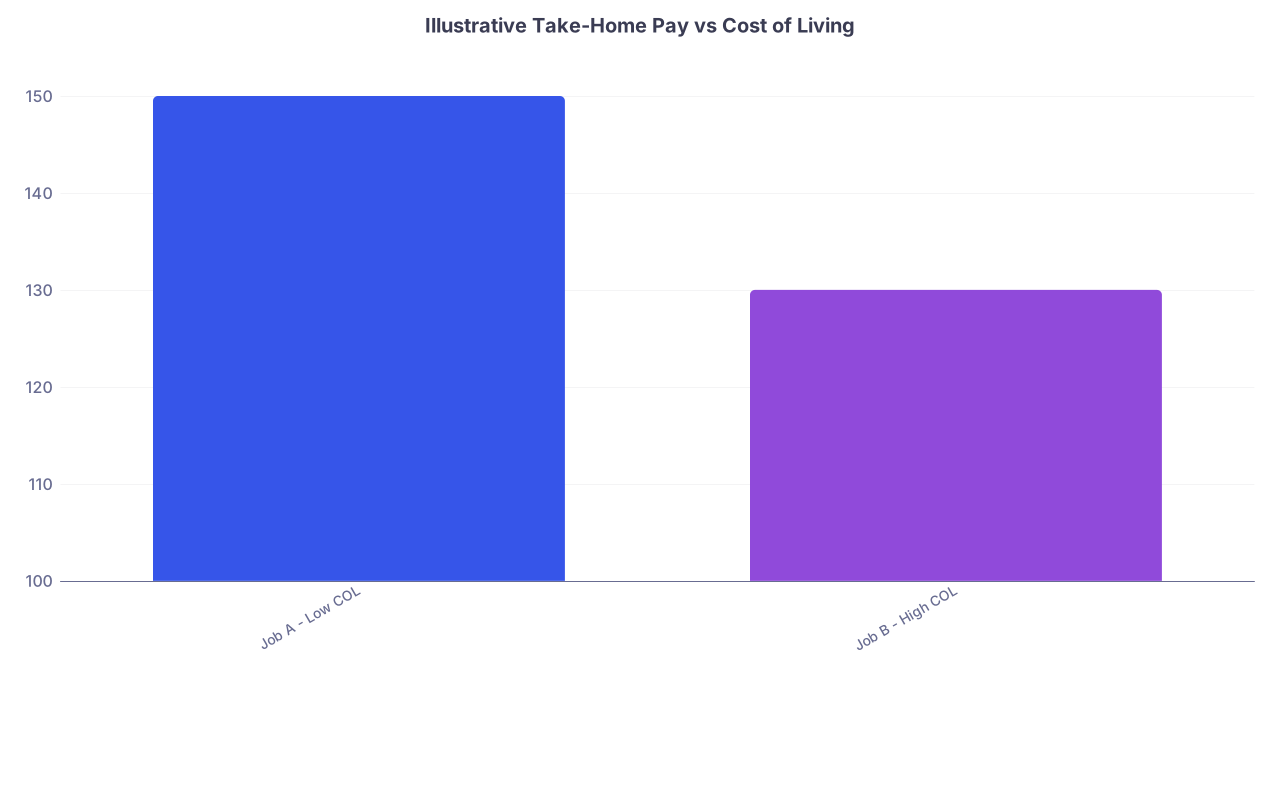
You avoid this trap by doing what almost nobody does: an after-tax, after-COL comparison.
Start with two jobs. Example:
- Job A: $260,000, low COL, no state tax
- Job B: $340,000, high COL, 9% state income tax
Now compare them the right way.
| Category | Value |
|---|---|
| Job A - Low COL | 150 |
| Job B - High COL | 130 |
(Values represent illustrative annual surplus after core living expenses, in thousands.)
Step 1: Use a Cost-of-Living Calculator (But Do Not Stop There)
Use at least two different tools (NerdWallet, Numbeo, etc.) to compare cities:
- Plug in your current city vs potential city
- Enter realistic numbers, not fantasy minimalism
- Look at housing, taxes, transportation, childcare, groceries
But do not blindly trust the single “X% higher” number.
You must plug in your lifestyle assumptions.
Step 2: Build a Side-by-Side Budget
Yes, a real monthly budget for both options. No, this is not overkill.
List, for each job/location:
- Rent/mortgage (realistic for area and school priorities)
- Property taxes
- Utilities (often higher in certain climates)
- Childcare and/or tuition
- Commuting costs (gas, train, parking, tolls)
- Groceries and eating out (assume higher in big coastal cities)
- Insurance (home, auto, malpractice if it varies)
- Professional fees and licenses
- Any expected help for extended family (common and often ignored)
Then ask:
- How much is left over each month for savings, investments, and debt payoff?
- Does the “raise” actually produce more investable dollars?
Step 3: Tax Reality Check
Estimate:
- Federal income tax (bracket differences at higher income)
- State income tax
- City/local taxes (where applicable)
- FICA/Medicare, etc.
You can do a rough check using an online paycheck calculator for each job’s salary and state.
You should be able to answer:
- “My all-in effective tax rate at Job A vs Job B is: ___% vs ___%.”
- “In dollars, that is approximately $X vs $Y in total annual tax payments.”
If the difference is double-digit thousands, and it usually is, it must be part of your decision.
Step 4: Calculate “Savings Rate,” Not Just Salary
Your financial health depends on savings rate, not raw income.
Ask for each job:
“What percentage of my take-home pay will I realistically save or invest each year?”
If:
- Job A → 30% savings rate
- Job B → 15% savings rate
Job B is a downgrade, even if the salary is higher.
If you want a mental shortcut:
The job that lets you save (and invest) the most real dollars with the least misery wins.
Not the one with the biggest number on the offer letter.
Non-Financial Costs People Pretend Are “Intangible”
Some “costs” do not show up in a calculator but still wreck your quality of life and, yes, your finances.
1. Burnout Risk
High-paying jobs in high-cost markets often come with:
- Higher RVU targets
- More competition
- Sicker patients and more bureaucracy
- Less schedule flexibility
If you flame out in 3 years, take a “break,” or cut back to part-time, that “higher salary” was a mirage.
Long-term earnings depend more on career longevity than short-term peaks.
2. Support System
Leaving a close family network for more money can backfire:
- No grandparents to help with childcare
- More paid help needed for basic life tasks
- Less emotional and practical backup when shifts go bad
You will be more tempted to outsource everything. That costs money. And sanity.
3. Spousal and Family Satisfaction
If your spouse hates the new city or your kids struggle in new schools, the home friction starts:
- Pressure to move back
- Reluctance to work extra shifts
- Stress spending (“we deserve this vacation, it has been rough”)
I have watched extremely well-compensated physicians blow through money because they were trying to compensate for family unhappiness. It is an ugly pattern.
A Simple Decision Framework You Can Steal
You do not need a PhD in finance. You need a basic framework.
Use this before signing any contract:

| Step | Description |
|---|---|
| Step 1 | Job Offer Received |
| Step 2 | Compare Base Salaries |
| Step 3 | Calculate After Tax Income |
| Step 4 | Build City A vs City B Budget |
| Step 5 | Reject or Renegotiate |
| Step 6 | Consider Non Financial Factors |
| Step 7 | Decide and Sign or Decline |
| Step 8 | Savings Higher in New Job |
| Step 9 | Lifestyle and Commute Acceptable |
| Step 10 | Burnout Risk Reasonable |
Here is the blunt rule:
If the extra pay does not clearly translate into:
- higher annual savings and
- an acceptable life outside of work
do not take it.
Or at least renegotiate until it does.
Quick Reality Examples
Let me give you three patterns I have seen repeatedly.
| Scenario | Looked Like | Actually Was |
|---|---|---|
| Midwest → Coastal Academic | Prestige + +\$80k pay | Higher taxes, higher COL, less saved |
| Rural → Big City Private Group | Better lifestyle image | Longer commute, more burnout |
| No-tax state → High-tax state | +\$100k bump | +\$30k taxes, +\$40k housing, net loss |
Do not be the fourth row on that table.
What You Should Do Before Signing Anything
Here is your pre-signing checklist. If you skip these, that is on you.
Run two cost-of-living calculations
Different sites, same cities, compare results.Build a conservative budget for each location
Do not assume your “ideal frugal life.” Assume how you will actually live.Estimate all-in taxes
Federal + state + local. Be honest about your bracket.Model savings rate
For each job:- Income after tax
- Minus realistic expenses
- What is left to save and invest?
Talk to physicians already there
Ask them:- “What surprised you about costs here?”
- “How much do people really save?”
- “If you moved here for the money, did it pan out?”
Check burnout signals in the contract
- RVU targets
- Call expectations
- Clinic load and support staff
- Non-compete clauses (which can trap you in a bad situation)
FAQs
1. Is it always a mistake to move to a high-cost city for a higher salary?
No. It is a mistake to do it blindly.
If:
- The salary is substantially higher,
- The after-tax, after-COL math still leaves you with more savings,
- You value the non-financial aspects (family, culture, academic opportunities),
- The burnout risk is tolerable,
then it can be a very smart move. The mistake is assuming “bigger salary” = “better life” without verification.
2. What is a quick rule of thumb to avoid getting burned by cost of living?
Two simple rules:
- Do not accept a higher-paying job in a much more expensive area unless it increases your projected annual savings by at least 20–30%.
- If you are crossing a state line into a high-tax state, assume you are losing at least one month of your salary each year to higher taxes and costs until you prove otherwise with real numbers.
If the raise does not clear those hurdles, think very hard before signing.
3. How do I handle an offer that pays more but clearly loses on cost of living?
You have three real options:
Use the math to negotiate:
Show them (in general terms) that after taxes and local costs, the compensation is not competitive, and request:- Higher base salary
- Signing bonus
- Loan repayment
- Housing or relocation assistance
Treat it as a “prestige” or “training” move:
If it clearly hurts you financially but offers rare academic or career opportunities, own that. Set a time limit (e.g., 3–5 years) and a clear exit or renegotiation plan.Walk away:
If it does not make financial sense and does not provide unique non-financial benefits, declining is not cowardly. It is adult decision-making.
Open a blank document right now and write down: Job A vs Job B – real annual savings.
Until you can put hard numbers next to those, you have no business chasing the higher salary.


