
How Many Job Offers Should You Collect Before Accepting a Physician Position?
How risky is it to sign your first attending contract when you’ve only seen one offer—and have no idea if you’re underpaid by $50,000 a year?
Let me be blunt: most physicians accept too early, with too little comparison, and leave a staggering amount of money and leverage on the table.
Here’s the direct answer you’re looking for, then we’ll unpack the details.
Ideal target:
You should aim to collect 3–5 real, written job offers before you accept a physician position.
Minimum that still makes sense:
At least 2 serious, written offers in hand before you sign anything.
Is it possible to sign with just one? Sure. But that’s like buying the first house you tour and assuming it was priced fairly. Sometimes you’ll get lucky. Often you won’t.
Let’s walk through exactly why 3–5 offers is the sweet spot, when fewer is acceptable, and how to make that actually happen without losing your mind.
Why 3–5 Offers Is the Sweet Spot
One offer tells you what they think you’re worth.
Three to five offers tell you what the market thinks you’re worth.
The gap between those two can be huge.
What multiple offers actually give you
Market reality, not vibes
You stop guessing whether $260k outpatient IM in your region is “good” when you can compare it to:- $285k with wRVU bonus and relocation
- $250k with big sign-on but weak benefits
- $300k in a less desirable location with call
Negotiation leverage
Saying “I have another written offer at $320k base” changes the conversation dramatically.
“I heard others are making more” doesn’t move the needle. Programs and groups ignore that.Clear view of trade-offs
You’ll see how different employers balance:- Base pay vs bonus potential
- Sign-on vs loan repayment
- RVU thresholds vs guaranteed salary
- Call burden vs compensation
- Partnership track vs employee model
You can’t see those patterns from a single data point.
Red flag detection
When 4 contracts have 60–90 day notice periods and standard non-competes, and 1 has a 12-month notice and draconian non-compete, that one stands out. Immediately.
When Fewer Offers Might Be Enough
Now, life is messy. Sometimes you’re not in a position to collect 5 offers, and pretending you always can is fantasy.
Here’s when 2 offers can be enough—and even 1 might be acceptable:
2 offers may be enough if:
- You’re tied to a very specific geography (spouse’s job, family care, kids in school), so options are inherently limited.
- You’ve already done locums or moonlighting in the area and have a strong sense of local rates.
- Both offers are reasonably competitive compared to MGMA/AMGA data and peers you trust.
- The top offer clearly matches your priorities (schedule, call, scope) and not just the raw salary.
1 offer might be acceptable if:
- It’s a hard-to-find, exact-fit role (e.g., niche subspecialty, unique academic role) and lines up perfectly with your goals.
- You already know the group very well: you’ve rotated there, done fellowship there, or incumbents are transparent about pay and workload.
- The compensation is clearly within or above 80–90th percentile for your specialty and region using real data (not “we think it’s competitive”).
- You’ve had the contract reviewed by a physician contract attorney, and the non-compete and exit terms are reasonable.
But here’s the catch:
If you’re signing with just one offer, you’re trading certainty for speed. Make that trade with your eyes open, not because you’re exhausted and just want the process over with.
The Real Question: How Many Quality Offers?
You don’t need 5 random, half-baked, verbal “we’d love to have you” conversations.
You need 3–5 serious, comparable written offers. That means:
- The employer has given you a draft contract or detailed term sheet (base, bonus structure, PTO, call expectations).
- They’ve made it clear you’re the candidate they want for this role.
- The offer has real numbers, not “we typically pay between…”
| Item | Real Offer? |
|---|---|
| Generic recruiter email | No |
| Verbal “we’d love to hire you” | No |
| Email with full compensation details | Almost |
| Draft contract / term sheet | Yes |
| Final contract ready to sign | Yes |
So the target isn’t “talk to 10 employers.”
It’s “walk away with 3–5 real, written offers you could sign tomorrow if you wanted to.”
How Long Should You Stay in the Market?
You’re balancing two clocks:
- Your fatigue clock – you’re sick of interviewing, traveling, and talking about your CV.
- The opportunity clock – offers in your specialty and region typically stabilize over a certain season.
Most residents/fellows do well if they:
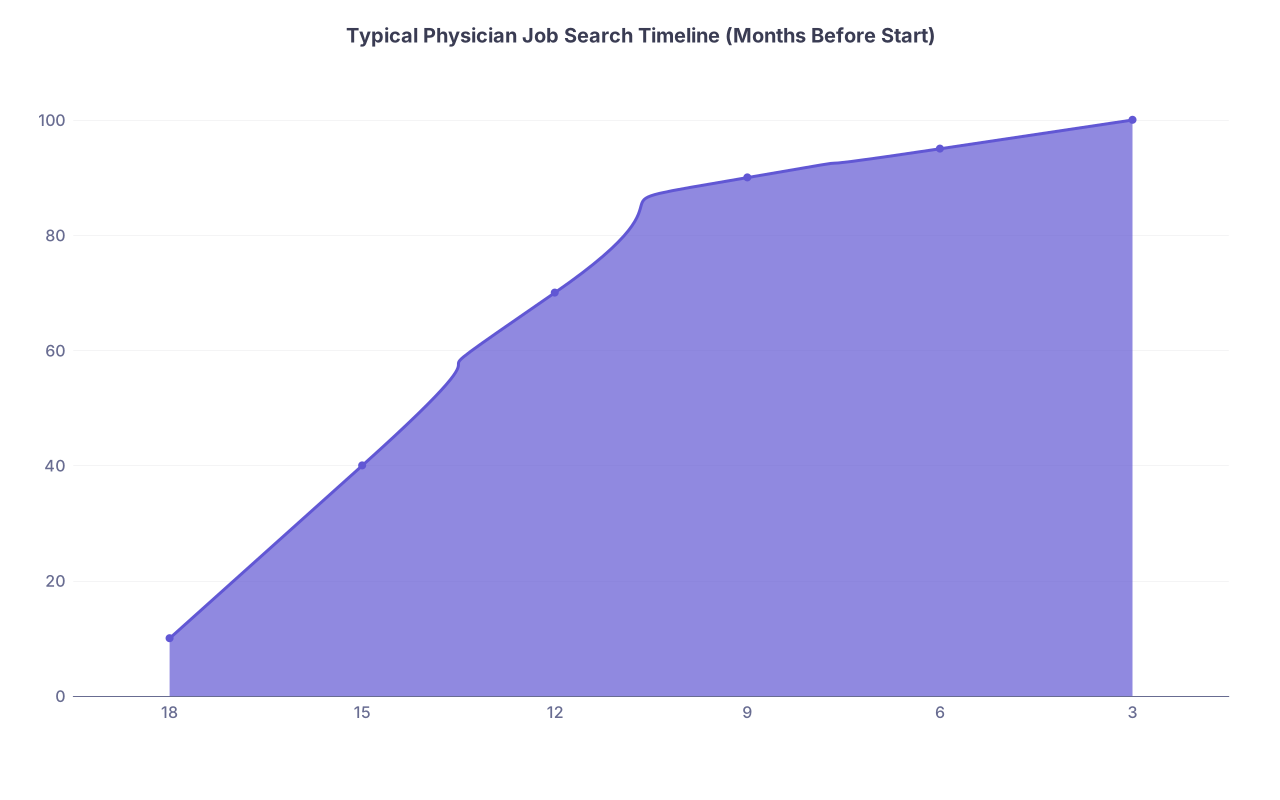
- Start serious searching 12–18 months before graduation.
- Spend 3–5 months actively interviewing.
- Accumulate offers over 2–4 months.
- Decide and sign 6–9 months before start date (earlier for very competitive or visa-dependent roles).
| Category | Value |
|---|---|
| 18 | 10 |
| 15 | 40 |
| 12 | 70 |
| 9 | 90 |
| 6 | 95 |
| 3 | 100 |
That curve? It’s roughly how your options and clarity grow. Early on, you’re just collecting data. Around 3–5 offers, you understand your market well enough to make a confident decision.
Specialty & Situation: How Many Offers Do You Really Need?
Different situations, different targets. Use this as a practical guide.
| Situation | Offers to Aim For |
|---|---|
| Highly competitive specialty (Derm, Ortho in big city) | 2–3 |
| Moderate demand (IM, FM, EM in decent metros) | 3–5 |
| High demand / shortage areas (Rural FM, Psych, IM) | 3–6 |
| Visa dependent (H1B/J1 needing waiver) | 2–4 |
| Very tight geography (family anchored) | 2–3 |
A few realities:
- Rural and underserved areas: You can often get 5+ offers without trying. Don’t sign the first $300k FM job if a $350–400k one with better loan repayment is down the road.
- Big coastal cities, popular suburbs: You might struggle to get 3 solid offers, especially in competitive specialties. That’s where a strong network and faculty connections matter more than raw volume.
- Visa situations: Don’t play chicken with time. You may need to accept with only 2–3 offers because immigration deadlines matter more than squeezing out another $15k.
How Multiple Offers Shift Your Negotiation Power
Here’s the part people underestimate. Having multiple offers doesn’t just give you choices; it changes your entire posture.
With 1 offer:
- You feel like you need them.
- You’re afraid to push too hard on salary, buy-out, or non-compete.
- You rationalize red flags because you’re tired.
With 3–5 offers:
You choose them. That mental shift alone changes how you negotiate.
You can say:
“Another group is offering $320k base with a 40-hour clinic schedule and 1:6 call. If we’re going to land here, we’d need to be closer to that compensation or lighten the call.”You can walk away from:
- Toxic culture vibes
- Vague bonus promises
- Scary non-competes
- 1:2 call with no extra compensation
That willingness to walk is your biggest leverage. Multiple offers make it real, not theoretical.
The Trap: “This One Seems Fine, I’ll Just Sign”
I’ve watched this pattern too many times:
- Resident/fellow gets first offer.
- It’s better money than they’ve ever seen.
- They’re overwhelmed with training and burned out on the job search.
- They tell themselves, “I can always renegotiate later” or “I’ll just move after a couple years.”
- Three years in, they’re locked into:
- A nasty non-compete radius
- Below-market pay
- A schedule they hate
And moving means uprooting kids, spouse, everything.
Is it survivable? Yes.
Was it avoidable with 2–3 more months of searching and a few more offers? Also yes.
A Simple Decision Framework You Can Actually Use
Let me make this concrete. Here’s a straightforward framework.
Step 1: Set your target
- If your market is decent and you have time → Aim for 3–5 offers
- If you’re constrained by geography/visa → Aim for 2–3 offers
Step 2: Decide your drop-dead date
Pick a date where, even if you only have 1–2 offers, you’ll decide anyway because of timelines (visa, school enrollments, spouse job search, etc.). That prevents endless drifting.
Step 3: Track offers like data, not emotions
Create a simple comparison of your top 3–5 offers.
| Factor | Offer A | Offer B | Offer C |
|---|---|---|---|
| Base salary | |||
| Bonus structure | |||
| Call schedule | |||
| PTO/CME | |||
| Partnership track | |||
| Non-compete |
Once you see them side by side, patterns jump out. You’ll see who’s lowballing, who’s overworking, and who’s actually fair.
How to Actually Get to 3–5 Offers Without Burning Out
This is where people screw it up: they either scattershot 40 applications or they only respond to the first recruiter email and call it a day.
You don’t need chaos. You need focused volume.
Aim for something like:
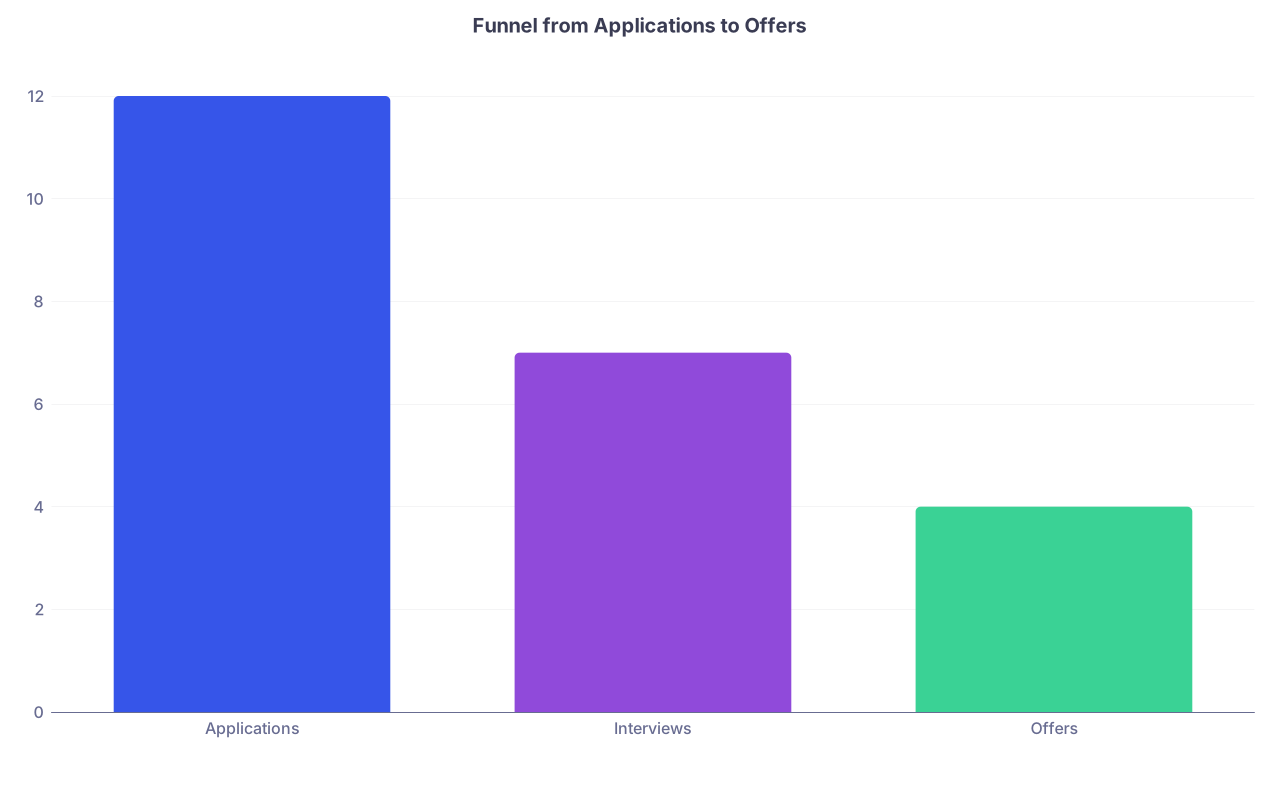
- 8–12 real applications (not just recruiter chats)
- 5–8 interviews
- 3–5 written offers
| Category | Value |
|---|---|
| Applications | 12 |
| Interviews | 7 |
| Offers | 4 |
Practical tactics:
- Use word of mouth: ask attendings where they’d actually work in your target city.
- Talk to 2–3 recruiters, but don’t let them box you into just their clients.
- Apply directly to health systems and large groups, not only private practices.
- Schedule interviews in clusters over 1–2 months so offers come in roughly together, not 6 months apart.
Don’t Forget: Multiple Offers Protect You Legally Too
This article’s under “Financial and Legal Aspects” for a reason. Compensation isn’t the only thing on the line.
When you can compare several contracts side by side, you’ll notice:
- Non-compete clauses: 10 miles vs 50 miles vs entire state
- Termination terms: 60-day notice vs 180-day notice vs insane penalties
- Malpractice coverage: occurrence vs claims-made with tail you have to buy
- Moonlighting restrictions: some forbid outside work entirely

| Step | Description |
|---|---|
| Step 1 | Receive Offer |
| Step 2 | Get Contract Draft |
| Step 3 | Compare to Other Offers |
| Step 4 | Negotiate Key Terms |
| Step 5 | Request Improvements or Decline |
| Step 6 | Legal Review |
| Step 7 | Decide to Sign or Walk |
| Step 8 | Competitive? |
Having 3–5 contracts on your desk makes bad terms painfully obvious. And gives you the ability to walk when needed.
Bottom Line: What You Should Do
Here’s the distilled version.
- Ideal: Collect 3–5 real, written offers before accepting a physician job.
- Minimum: Don’t sign with fewer than 2 offers unless your situation really forces it and you’ve done your homework.
- Reality check: Time, geography, specialty, and visa status may cap you at 2–3. That’s still far better than 1.
- Non-negotiable: Whatever number of offers you get, compare them systematically and get at least one contract reviewed by a physician-focused attorney.
You trained too long to sign the first “ok” deal thrown at you.
Today’s next step:
Open a blank document and write down your target number of offers (2, 3, 4, or 5) and your decision-by date. Those two numbers will control how aggressive you need to be with applications and interviews starting this week.
FAQ (Exactly 7 Questions)
1. Is it unethical to collect multiple job offers if I know I’ll only accept one?
No. Employers do this to you all the time—they interview multiple candidates for one spot. Your job is to find the best fit for you and your family. The only unethical move is stringing a group along after you’re 100% sure you won’t go there. Once you’ve decided against a place, withdraw promptly and professionally.
2. What if my top-choice job explodes the offer if I don’t answer in a week?
That’s a red flag. Serious employers give reasonable time to review and compare offers—typically 2–4 weeks for physicians. If they’re pushing for a 72-hour answer, you can push back: “I’m excited about this, but I need adequate time for legal review and to consider other ongoing processes.” If they still insist, that’s a preview of the culture: control and pressure.
3. How much more money can multiple offers realistically get me?
In many primary care and hospitalist roles, I’ve seen multiple offers translate to $20k–$50k/year more in base or structured bonus. In some surgical and procedure-heavy specialties, the difference in total comp can exceed $75k–$100k/year when you factor RVUs, call pay, and partnership tracks. But just as important: you can improve schedule, call, and non-compete terms, which matter as much as cash.
4. Do academic jobs require as many offers as private practice or employed roles?
Academics is different. The market is smaller and specialized. For many subspecialty academic positions, 2–3 real offers is actually very good. The key levers are protected time, promotion track, and expectations for RVUs vs research, not just salary. Still, one lonely offer shouldn’t be accepted blindly without at least seeing what one or two other institutions would do.
5. If I get a great first offer, should I still keep interviewing?
Yes—at least for a bit. Unless you have severe time or visa pressure, ride out a couple more interviews. Tell other groups honestly that you have an offer but are still finalizing your decision. You might confirm your first offer is excellent—or discover you were being underpaid or overworked compared to peers.
6. How do I avoid burning bridges when I decline an offer?
Be fast, clear, and respectful. A simple email or call: “Thank you again for the generous offer and the time you invested in meeting with me. After careful consideration, I’ve decided to accept a different position that’s a better fit for my family and long-term goals. I really appreciate the opportunity and hope our paths cross again.” That’s it. Don’t over-explain or negotiate after you’ve mentally moved on.
7. When should I bring up that I have other offers during negotiation?
After you’ve received a written offer and had a chance to review it. Then, as you negotiate, you can say: “I’m also considering another offer with X base and Y call schedule. If we can get closer to that structure, I’d be very excited to commit here.” Concrete comparisons are powerful; vague claims about “other interest” are not.