
The advice to “never choose a specialty based on salary” is lazy and wrong.
You absolutely should consider salary. You just shouldn’t let it drive the car. The right way to think about this is: salary is a constraint, not the compass.
Here’s a practical framework to use so you don’t screw this up for the next 30 years.
1. Start With the Real Question: “What Life Do I Want to Pay For?”
Don’t start with “Derm vs FM?” Start with: “What kind of life am I actually trying to fund?”
Rough categories:
- Location: HCOL coastal city vs Midwest vs rural
- Family plans: Single and happy vs 3 kids in private school
- Debt: $0 vs $400k at 7%
- Lifestyle tolerance: Prius and Costco vs Tesla and frequent international trips
- Retirement goals: Coast FIRE at 55 vs work forever part‑time
You don’t need a 20-page financial plan. You do need rough numbers.
Use this kind of mental back-of-the-envelope:
- Target household income that would feel “comfortable” at 40
- Your current or projected student loan total
- Whether you’re okay working more to earn more, or you’re very protective of your time
Then you ask: “What income range probably supports this life without constant financial stress?”
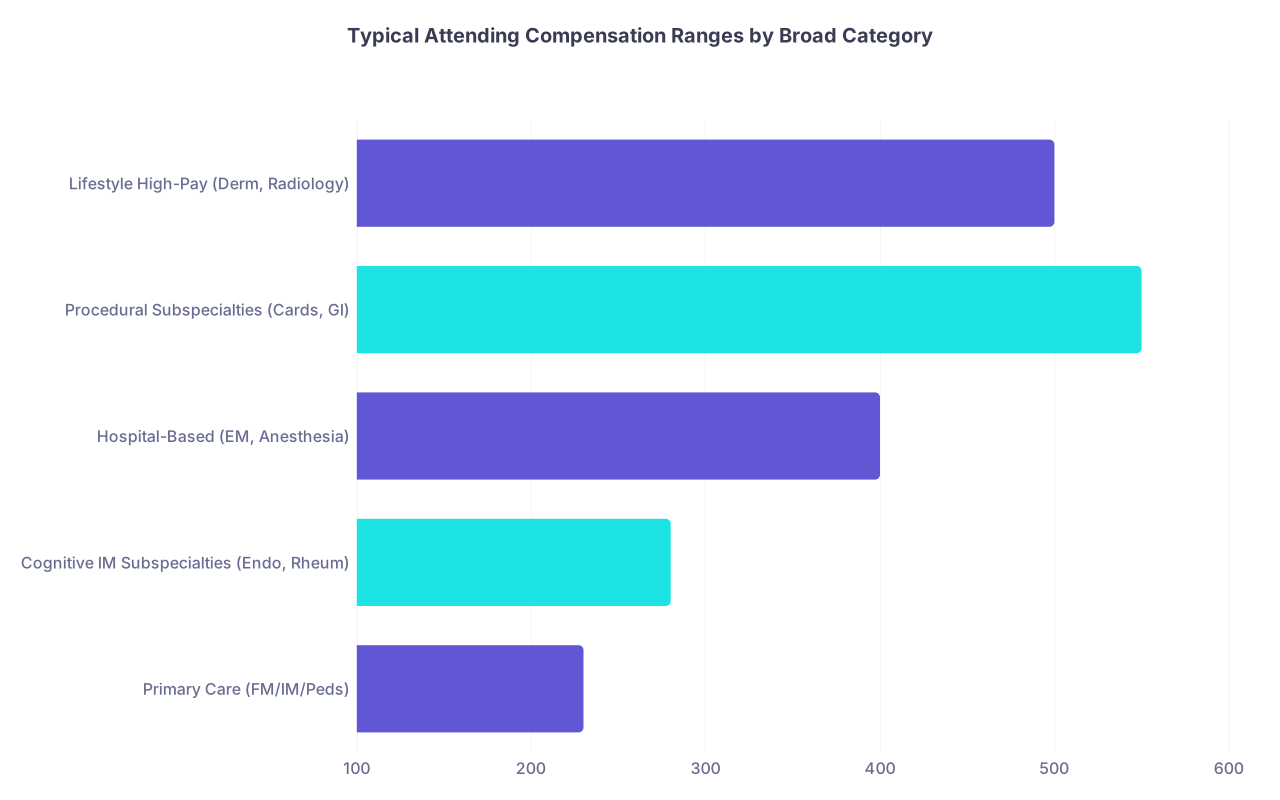
| Category | Value |
|---|---|
| Primary Care (FM/IM/Peds) | 230 |
| Cognitive IM Subspecialties (Endo, Rheum) | 280 |
| Hospital-Based (EM, Anesthesia) | 400 |
| Procedural Subspecialties (Cards, GI) | 550 |
| Lifestyle High-Pay (Derm, Radiology) | 500 |
These are rough national medians (in thousands, pre-tax). Geography, call, productivity, and private equity nonsense can swing them hard. But you can already see: some specialties give you more financial slack than others.
2. Money vs Misery: The Non-Negotiable Rule
Here’s the line you should not cross:
A higher-paying specialty is not “worth it” if the day-to-day work makes you miserable.
I’ve watched this play out:
- The med student who “chased ortho money” but hates the OR, hates saws, hates long cases. Ends up burned out, bitter, and trapped.
- The person who truly loves peds but gets scared by salary charts, jumps to anesthesia because “better money,” and spends residency trying to talk themselves into it.
You’ll spend 30+ years doing this, not 30 days.
So: salary can break ties between specialties you already like. It shouldn’t be the reason you pick work you dislike.
A good internal test:
“If this specialty paid the median doctor salary (say $300–350k), would I still rank it first?”
If the answer is “no, only if I’m making top 1%,” that’s a red flag.
3. The Decision Framework: 5 Steps That Don’t Lie
Use this like a checklist. No fluff.
Step 1: Define Your Financial Floor and Ceiling
Floor: “Below this income, I’ll constantly stress about money.”
Ceiling (optional but healthy): “Above this income, I’m not chasing more; I’ll prioritize time/flexibility.”
Example:
- Floor: $220–250k (covers loans, decent housing, retirement)
- Ceiling: $450k (past that, I’d rather cut hours)
Now compare specialties to that band. If a field consistently pays below your realistic floor in the places you want to live, that’s a real constraint.
Step 2: Reality-Check Lifestyle and Workload
Everyone lies to students about this. Go to actual attendings and ask pointed questions:
- “What time do you actually leave most days?”
- “How many nights of call a month, and how bad is it?”
- “If you had $20M tomorrow, would you keep doing this specialty full-time?”
If you keep hearing, “The money’s good but I wouldn’t do it again,” that’s a warning sign.
This is where high-pay doesn’t automatically equal high-happiness:
- EM: Good pay, but night shifts and burnout are real
- Ortho: Great pay, but very physical, long training, call-heavy
- Derm: Excellent pay + lifestyle, but hard to match, and some people hate clinic
Money can mitigate pain (more help at home, living closer to hospital, early semi-retirement). It does not fix doing work you fundamentally don’t like.
Step 3: Compare Training Length vs Payoff
Longer training = more years of resident/fellow pay plus delayed attending income.
| Path | Total Training Years (Post-MD) | Typical Median Salary (k) |
|---|---|---|
| FM / IM / Peds | 3 | 220–260 |
| EM | 3–4 | 350–420 |
| Anesthesia | 4 | 400–450 |
| Cards (IM + fellowship) | 6–7 | 550–650 |
| Derm / Radiology | 4 | 450–550 |
Things to think about:
- That extra 3–4 years of fellowship is expensive. Resident pay vs starting attending pay is a six-figure gap per year.
- But if you love the subspecialty and the long-term salary is significantly higher, longer training can absolutely be worth it.
- If you’re older, have kids, or are already heavily in debt, the opportunity cost hits harder.
A decent rule: if two options pay roughly the same long-term, shorter training usually wins unless you strongly prefer the longer path’s work.
Step 4: Assess Geographic Flexibility and Job Market
Some specialties are more “portable” than others. This matters more than people admit.
Questions:
- Do you need to live in a big city or coastal region?
- Are you okay going rural or community if jobs tighten?
- Is telemedicine or remote work appealing (psych, some FM, some radiology)?
Strong job markets + decent pay can offset lower headline salaries. Example: a rural FM doc earning $280k with cheap cost of living can be better off than an urban subspecialist earning $450k but drowning in housing and daycare costs.
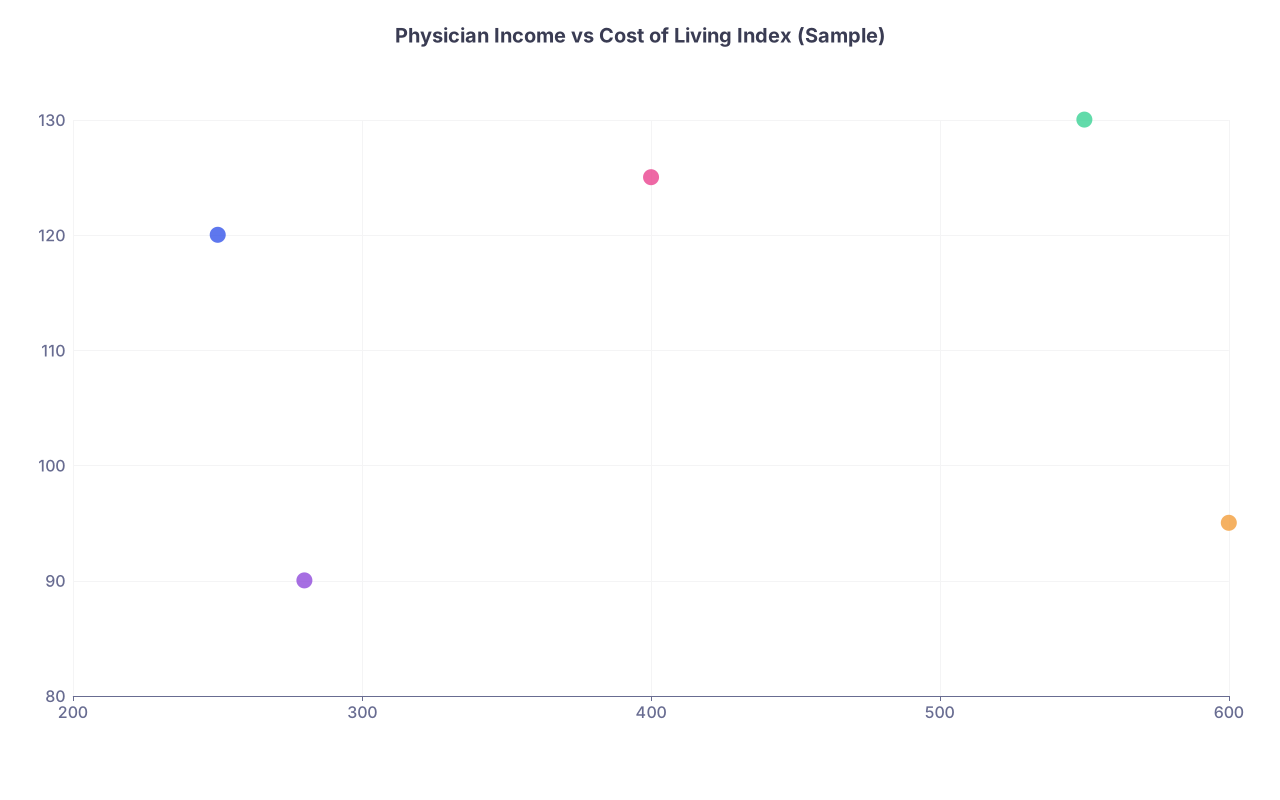
| Category | Value |
|---|---|
| Urban FM | 250,120 |
| Rural FM | 280,90 |
| Urban Cards | 550,130 |
| Rural Cards | 600,95 |
| Urban EM | 400,125 |
X-axis (first value): salary (k). Y-axis (second value): cost-of-living index (100 = baseline). Rural specialties often give you more real purchasing power than students expect.
Step 5: Run the “Debt + Timeline” Scenarios
Stop hand-waving your loans. Do the math.
Say you have:
- $350k at ~6–7%
- REPAYE/SAVE vs refinancing decisions after training
- Interest piling during residency
Now compare:
- Primary Care: Start attending at 30, making ~$240k, aggressive payoff in 10–12 years
- EM/Anesthesia: Start at 31, making ~$400k, payoff in 5–7 years
- Cards: Start at 34, making ~$600k, payoff in 3–5 years
If your debt load is massive, higher-paying specialties compress your financial stress timeline. That’s not greed. That’s math.
But you blend that with Step 2: If you hate the work, using debt as the only justification is a trap.
4. When Salary SHOULD Influence Specialty Choice
This is where I’ll be blunt: ignoring salary completely is naive.
These are real scenarios where money logically matters:
You’re non-traditional, starting residency in your mid-30s with family responsibilities.
Longer, low-paying paths may not be realistic unless you’re okay with big lifestyle constraints.You have $400–500k in loans and want kids, a house, and maybe one parent working part-time.
A $220k vs $450k attending income absolutely changes the pressure you live under.You strongly like multiple specialties more or less equally.
Here, salary (plus lifestyle and geography) should break the tie. If you genuinely enjoy FM and anesthesia equally, but anesthesia gives you double the income and flexible schedules, choosing FM “for purity” is not inherently virtuous. It’s just expensive.You care a lot about early partial retirement or part-time work at 50.
Higher-earning years in your 30s and 40s buy you that freedom if you actually save and invest.
What you don’t do is pick a high-paying specialty you actively dislike because “future me will be grateful.” Future you will be trapped.
5. How Much Does Specialty Choice REALLY Affect Lifetime Money?
Quick perspective:
- Most physicians, even in lower-paying specialties, are in the top 5–10% of earners nationally.
- The biggest determinants of your financial success are:
- How much you save
- How you spend
- How long you work
- How often you change jobs/locations
That said, specialty does change the base game. A few rough lifetime differences, simplified:
Assume:
- 30-year attending career
- No inflation, bonuses, etc. Just ballpark
| Specialty Type | Median Annual (k) | 30-Year Gross (Millions) |
|---|---|---|
| Primary Care | 250 | 7.5 |
| Hospital-Based (EM/Anes) | 400 | 12.0 |
| High-Pay Procedural (Cards/GI) | 600 | 18.0 |
| Lifestyle High-Pay (Derm/Rad) | 500 | 15.0 |
Even after taxes and lifestyle creep, the differences can be massive in absolute terms.
But here’s the catch: a burned-out cardiologist at 48 who quits medicine entirely may end up with less lifetime income than a content family physician who practices happily to 65.
So the smarter question isn’t “What specialty pays the most?” It’s:
“What specialty can I see myself doing long enough, with enough joy, to actually use the higher income?”
6. A Simple 2x2 Grid to Sanity-Check Your Choice
Put your options into this mental grid:
- X-axis: “How much do I enjoy the day-to-day work?” (Low to High)
- Y-axis: “Compensation relative to my financial needs?” (Low to High)
Ideal: High enjoyment, High compensation
Acceptable: High enjoyment, Moderate compensation
Danger: Low enjoyment, High compensation (golden handcuffs zone)
Risky/Unsustainable: Low enjoyment, Low compensation
If your top choice lives in the “Danger” box, you need a very good reason and a plan to avoid burning out.
Here’s a rough flow of how you should think:

| Step | Description |
|---|---|
| Step 1 | List Specialties You Like |
| Step 2 | Estimate Enjoyment 1-10 |
| Step 3 | Estimate Typical Pay Range |
| Step 4 | Check Against Financial Floor |
| Step 5 | Reconsider or Adjust Life Expectations |
| Step 6 | Assign Grid Box - Enjoyment vs Pay |
| Step 7 | Rank Higher |
| Step 8 | Deprioritize - Risk of Burnout |
| Step 9 | High Enjoyment? |
Not fancy. But it forces you to write down what you’re actually optimizing for.
7. Red Flags You’re Overweighting Salary
You’re probably leaning too hard on money if:
- Your favorite specialty during rotations is X, but you keep talking yourself into Y solely because “it pays better.”
- When you describe your top choice, you talk about income and schedule long before you talk about patients or clinical work.
- You’re planning to gut out a specialty you dislike for 10–15 years “then switch or retire early.” That almost never goes as cleanly as people think.
Flip side: you’re underweighting salary if:
- You say things like “I don’t care about money at all” while sitting on $350k in loans.
- You refuse to even look at salary data because “it’ll bias me.”
- You’re planning to live in a very expensive city and haven’t lined up the numbers.
You want something in the middle: clear-eyed, not obsessed.
FAQ: Salary and Specialty Choice
1. Is it wrong or “unethical” to choose a specialty partly for the money?
No. That’s moral theater. Wanting financial security, the ability to support a family, or to avoid money stress is rational. The ethical problem only shows up if you choose a specialty you dislike so much that it harms your care or you resent your patients. Choose something you can do well, for a long time, that also pays enough for your life.
2. Should massive student loans push me toward a higher-paying specialty?
They should influence your thinking, especially if your preferred path is one of the lowest-paying fields and you also want kids, a house, and to live in an expensive city. But debt alone shouldn’t override your genuine interest. You can manage big loans as a PCP—using federal programs, careful budgeting, maybe higher-paying geographies—if you’re deliberate.
3. How do I compare a shorter, lower-paying pathway vs a longer, higher-paying one?
Look at total career earnings + years of discomfort. A 3-year FM path vs 6–7-year cardiology with much higher pay is a classic tradeoff. Crunch scenarios: when would you break even, how much do you like each day-to-day, and how much do you care about the extra income vs the extra training years. If you feel neutral about the work, shorter training often wins. If you love the subspecialty, the long path can be worth it.
4. I like a lower-paying specialty but I’m scared about future regret. What do I do?
Run the numbers honestly for that specialty: typical salary in your target region, loan repayment options, sample budgets. If it supports a life you can accept—even if not flashy—you’re fine. Then build financial systems early: live below your means, avoid lifestyle inflation, and maybe use side options (urgent care shifts, telemed) if needed. Regret usually comes from money chaos + lack of planning, not the specialty itself.
5. What’s the single worst reason to choose a high-paying specialty?
“I don’t really like it, but I’ll just do it for 10–15 years, stack money, then quit.” That plan assumes you won’t burn out, your lifestyle won’t inflate, you won’t get trapped by golden handcuffs, and everything goes exactly right. It almost never does. If you don’t like the work now, doubling down for decades just for a bigger paycheck is a bad bet.
Key takeaways:
- Salary absolutely matters—but it’s a constraint, not the main compass.
- Choose the highest-paying specialty you genuinely enjoy enough to do for decades, not the absolute highest salary on paper.
- Run real numbers on debt, lifestyle, and geography, then let money break ties between specialties you already like—not drag you into work you hate.