
The worst salary advice physicians get is “just stay loyal and the money will come.” It will not. Not in this market.
If you care about keeping your compensation competitive, you cannot treat your first attending job like a 30‑year pension position. You have to assume that changing jobs—or at least meaningfully renegotiating—is part of your financial plan.
Here’s the direct answer you’re looking for.
The Short Answer: Every 3–5 Years, With One Big Asterisk
Most physicians should plan to re-shop their market value about every 3–5 years. That does not mean you must resign every 3 years. It does mean:
- Every 3–5 years, you should get serious external offers or at least informal numbers from recruiters.
- If your current employer will not come close to those offers, you should be willing to walk.
The asterisk: early in your career—years 1–6—changing employers once or twice can create the biggest salary jumps you’ll ever see. After that, the cadence can slow, but the “check your market” habit never should.
If you’ve been in the same job 7–10 years, never negotiated hard, and never looked at comparable offers? You’re almost certainly underpaid.
Why Changing Jobs Matters More Than “Annual Raises”
Your annual 2–3% “cost of living” bump is not a raise. It’s inflation protection—barely.
Actual pay movement for physicians happens in three places:
- New contracts with a new employer
- Major contract re-negotiations (not the auto-renew letter they send you)
- Changes in compensation model (e.g., RVU rate increase, new quality pool, buy-in to partnership)
Most large systems will never volunteer to raise your wRVU rate from $45 to $55 because you’re productive. But a rival system absolutely will offer $55–$60 to steal you.
And here’s the pattern I see over and over:
- Year 1–2: You’re cheap. Employers love you.
- Year 3–4: Your production climbs, your collections climb, your salary barely moves.
- Year 5+: You’re generating far more revenue than your contract assumed. If you don’t move or renegotiate, you are subsidizing the system.
Changing jobs (or threatening to with a real offer in hand) resets that imbalance.
How Often Should Different Types of Physicians Change Jobs?
Here’s the more nuanced breakdown by setting and specialty.
| Physician Type | Job Change / Major Renegotiation | Notes |
|---|---|---|
| Hospital-employed primary care | Every 3–5 years | Often underpaid without leverage |
| Hospital-employed specialist | Every 3–6 years | Big system-to-system jumps |
| Proceduralist in private group | 1–3 moves in first 10 years | Then more stable after partnership |
| Academic (traditional track) | Every 5–7 years or never | But negotiate hard with external offers |
| Locums-focused physician | Constant re-shopping | Expect multiple contracts/year |
Hospital-Employed (Primary Care and General Specialties)
You’re the most likely to be underpaid if you stay put too long.
You should:
- Benchmark annually.
- Get actual offers every 3–5 years.
- Expect that at least one employer change in your first 7 years will increase your total compensation 20–40%.
If you’re 7+ years in the same hospital-employed job without a real renegotiation, you’re leaving money on the table. Period.
Hospital-Employed Specialists (Cards, GI, Heme/Onc, Ortho, etc.)
Your leverage comes from:
- Your procedural volume.
- Your referral patterns.
- The threat of leaving and taking your volume with you.
These jobs tolerate slightly longer stints because:
- Signing bonuses and relocation packages are bigger.
- Your ramp-up period at a new place can be 12–24 months.
Still, every 3–6 years, you should see what a competing system would pay for your wRVUs.
Private Practice / Partnership-Track
Different game.
In private groups:
- Frequent job-hopping can look bad.
- The real “raise” is getting to partnership and participating in distributions, ancillaries, and equity.
Here, the smart cadence is:
- Be picky about the first job.
- If the partnership path is vague, constantly delayed, or financially unimpressive—change jobs early (years 1–3).
- Once you land in a good partnership, it’s reasonable to stay 10+ years if the economics hold up.
But if you’re a non-partner associate for 6+ years? That’s not “loyalty.” That’s a subsidy. Time to move.
Academic Medicine
Academia pays with:
- Title.
- Autonomy.
- Research time.
- Sometimes prestige.
It usually does not pay with peak market salary.
You don’t need to change institutions every 3 years. You do need to:
- Get external offers for faculty positions (or credible interest) every 5–7 years.
- Use them to negotiate promotion, protected time, or salary bumps.
If you’re content with lower salary in exchange for academic life, that’s valid. But even then, never assume your department will pay you fairly without external pressure. They almost never do.
What the Data and Market Actually Show
No one publishes “ideal job-change frequency” in JAMA, but you can see the pattern in compensation data and recruiter behavior.
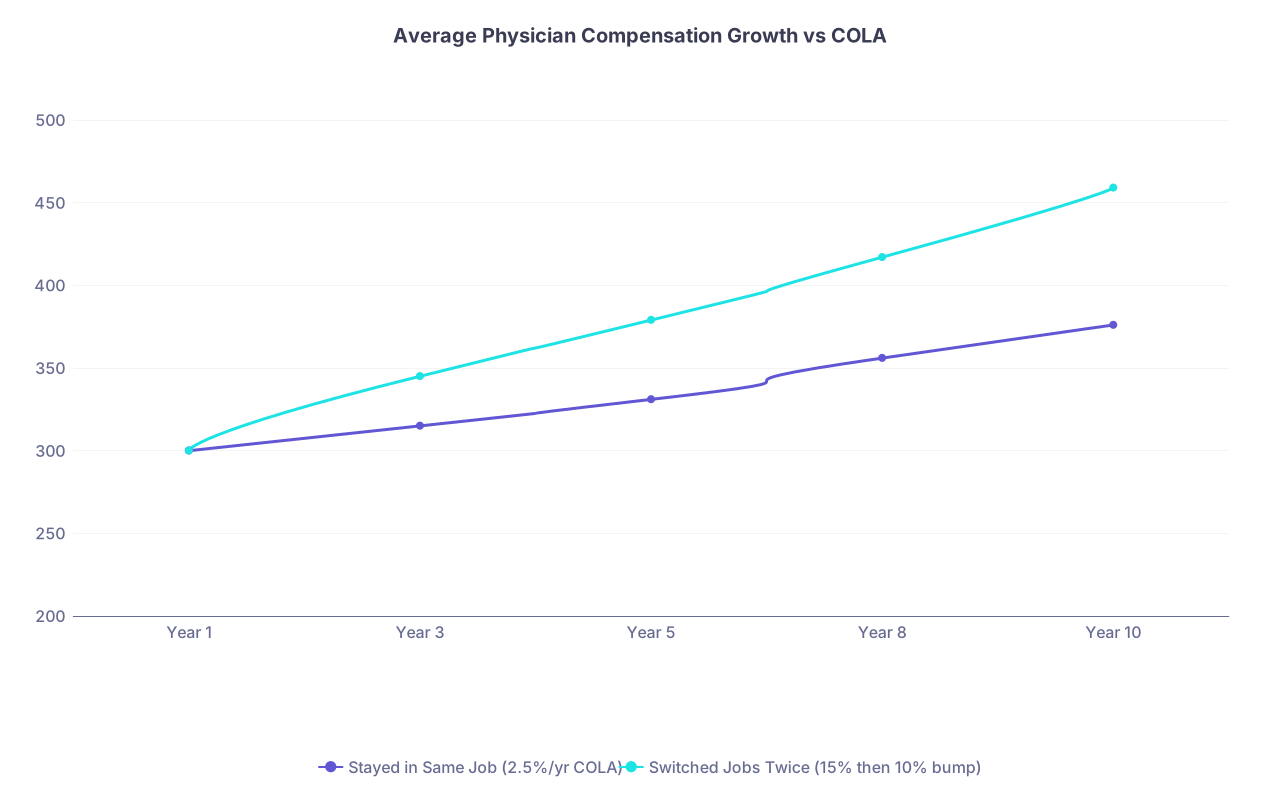
| Category | Stayed in Same Job (2.5%/yr COLA) | Switched Jobs Twice (15% then 10% bump) |
|---|---|---|
| Year 1 | 300 | 300 |
| Year 3 | 315 | 345 |
| Year 5 | 331 | 379 |
| Year 8 | 356 | 417 |
| Year 10 | 376 | 459 |
This is simplified, but the story holds:
- Staying in the same job with standard COLA gives you slow, predictable growth.
- Switching employers strategically (with serious bumps at year 3–4 and again at year 7–8) pushes your income curve meaningfully higher—often by six figures per year by mid-career.
Recruiters know this. It’s why your inbox is full of “we can offer $X more than MGMA median.”
You do not have to say yes to every pitch. But you’d be crazy not to at least find out your price.
How to Know It’s Time to Consider a Move
Here’s the practical decision framework I use when physicians ask, “Should I stay?”
You should strongly consider changing jobs if:
You have not had a material raise (10%+ in total comp) in 3–4 years, and:
- Your productivity has increased, or
- Market data has risen (MGMA/AMGA/Medscape, recruiter quotes).
Your compensation model is clearly misaligned with your work:
- Flat salary with high volume.
- RVU comp where your conversion factor is way below local offers.
- Slow or no bonus payouts despite good performance.
You’ve hit a promotion or equity ceiling:
- No partnership track.
- No real chance at leadership or program-building if that matters to you.
Your non-compete or restrictive covenants are about to trap you:
- It’s easier to move before you build a huge local panel that you’ll have to abandon.
- Sometimes the timing is “leave at year 2–3 before the golden handcuffs fully click.”
Another employer has already put a number on the table that’s 20–30% higher with similar workload and call.
At that point, if you stay, you’re choosing comfort over money. Which is okay—as long as you’re honest with yourself that it’s a choice, not “there are no better options.”
The Legal and Contract Side: Why Timing Matters
This is the part physicians routinely underestimate.
Your ability to change jobs without blowing up your life comes down to three contract features:
- Term and termination
- Non-compete and geographic restrictions
- Repayment obligations (signing bonus, relocation, loan forgiveness, tail coverage)
You cannot decide “I’ll just leave next month” without reading these.

| Step | Description |
|---|---|
| Step 1 | Review Current Contract |
| Step 2 | Assess Non-compete Radius and Duration |
| Step 3 | Low Legal Barrier |
| Step 4 | Consider Local Offers |
| Step 5 | Plan Regional or System Change |
| Step 6 | Collect Market Offers |
| Step 7 | Compare Pay, Lifestyle, Legal Risk |
| Step 8 | Negotiate Exit and New Contract |
| Step 9 | Use Offer to Renegotiate Stay |
| Step 10 | Any Restrictive Covenants |
| Step 11 | Can Work Elsewhere Locally |
| Step 12 | Net Benefit to Move |
A few hard truths:
- The best time to negotiate or change jobs is before your current contract auto-renews.
- Shorter initial terms (1–2 years) with clear without-cause termination give you more flexibility early, when salary jumps matter most.
- Non-competes rarely get better with time. Often, waiting just makes you more “anchored” to your current geography.
If your contract renews automatically every year with only 60–90 days’ notice to terminate, you should be looking at other offers 6–9 months before that date. Not 3 weeks before.
How to Use Job Offers Without Burning Bridges
You do not need to become a serial job hopper to keep your salary competitive. You do need to be willing to act like a free agent.
Smart physicians:
Gather data quietly
Talk to recruiters. Request comp ranges, not full applications. Ask colleagues in your region what they’re seeing.Get at least one concrete offer every few years
Even a non-local offer gives you a number: “We’d pay $280k base + $20/wRVU over 5,000 RVUs” or “partnership buy-in after 2 years with expected total comp $600k+.”Present it professionally to your employer
“I like working here and would prefer to stay. This is the range I’m being offered elsewhere. Can we get closer to this with my next contract?”Be ready to leave if they call your bluff
If you’re not actually willing to go, do not use an offer as leverage. Administrators can smell an empty threat.
Plenty of physicians use this cadence and stay in the same job 10+ years—but with compensation that tracks the market because they’ve repeatedly proven they have options.
What About CV Red Flags? How Much Moving Is Too Much?
You’re right to worry about looking unstable. There’s a line.
General rule of thumb:
- One job change in the first 3–5 years post-training: normal.
- Two job changes in the first 5–7 years: still defensible, especially with clear reasons (merger, broken partnership promise, spouse move).
- Three or more different employers in 5–7 years: now you’re explaining yourself in every interview.
If you’re planning to move more than twice in the first decade, your reasons had better be compelling and clearly documented. Think:
- System dissolution.
- Call burden dramatically changed from what was promised.
- Compensation plan got gutted.
If your story is, “I just kept chasing slightly better offers,” you’ll start to scare the better long-term employers.
Practical Timeline: A 10-Year Post-Training Example
To make this real, here’s a straightforward pattern I’ve seen work for many docs:
Years 0–2 (First job)
Learn, build volume, track your RVUs and collections. Realize what you actually want in a job (call, admin, academic vs private).Year 2–3
Seriously test the market. If your current offer is truly competitive and you’re happy, negotiate an improved contract and stay.
If not, switch. This is often your biggest leap.Years 3–6 (Second job or renegotiated first)
Focus on productivity, reputation, and maybe starting non-clinical income streams. Keep an eye on MGMA and recruiter chatter.Year 5–7
Re-shop the market. If your comp has kept pace and the job fits your life, lock in another 3–5 year deal.
If you’ve outgrown the role or the pay has lagged badly, consider a second move.Years 7–10+
By now, you should either:- Be in a partnership with upside, or
- Be in a stable employed role that you’ve renegotiated at least once, or
- Consciously choose a slightly under-market academic/low-burnout job for lifestyle reasons.
None of this requires hopping every 18 months. It does require being deliberate every few years.
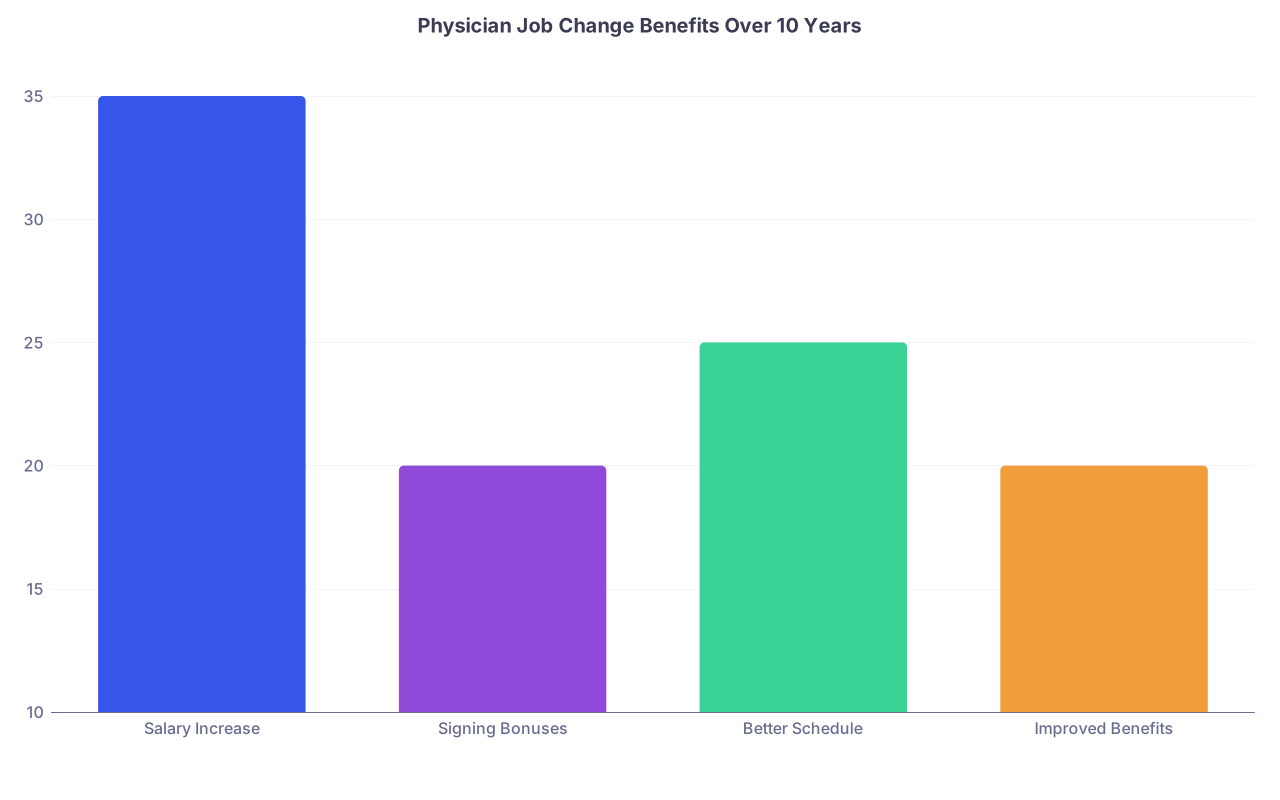
| Category | Value |
|---|---|
| Salary Increase | 35 |
| Signing Bonuses | 20 |
| Better Schedule | 25 |
| Improved Benefits | 20 |
(Values as rough percentages of why physicians report job changes in recruiter surveys—money leads, but conditions matter.)
FAQs: Physician Job Changes and Competitive Salaries
1. Is it risky to change jobs in your first 2–3 years out of training?
It can be, but staying in a truly bad or underpaying job is usually worse. One change in the first 3–5 years is very common and often financially transformative. Just make sure your second contract is more thoughtful—get the non-compete reviewed, pin down call expectations in writing, and understand how your productivity will be measured.
2. Can I keep my salary competitive without ever changing employers?
Yes—but only if you treat your job like a negotiable contract, not a marriage. That means: pulling external salary data, periodically entertaining offers, and forcing honest conversations with leadership. If your system has a history of underpaying and stonewalling renegotiations, then no, you probably cannot stay competitive long-term by just “staying loyal.”
3. How big should a salary bump be to justify changing jobs?
For a pure lateral move with similar schedule and call, I’d want to see at least a 15–20% increase in total comp or a major improvement in non-monetary factors (call dropping from 1:4 to 1:8, fewer weekends, etc.). If you’re moving for partnership potential or equity, the first-year salary might be similar or slightly lower, but the projected 3–5 year income should clearly beat your current path.
4. How do non-competes affect how often I can change jobs?
They don’t affect frequency as much as geography. A tight non-compete means each job change might require a bigger move—new city, new system, or different practice model. This is why it’s critical to negotiate your non-compete terms up front and to think ahead: if you’ll want to stay in your current city long-term, you may need to hop systems earlier before you’re fully locked into a radius that blocks all meaningful options.
5. What’s one thing I should do this year if I haven’t checked my market value in a while?
Pull out your current contract and your last two years of productivity data (RVUs, collections, or patient volume). Then, contact two recruiters and one colleague in another system in your specialty and region. Ask all three one simple question: “What are typical total comp and RVU rates for someone with my numbers right now?” That gives you a real benchmark—and a concrete starting point for either renegotiation or a strategic move.
Open your calendar and drop a 60-minute block sometime in the next 7 days labeled “Check my market value.” When that time comes, pull your contract, your recent numbers, and send three emails—to recruiters or contacts at other systems—asking what they’d pay for what you produce. That single hour will tell you whether you can afford to stay, or you’re overdue to move.