
Are Academic Appointments Worth the Pay Cut? How to Decide for Yourself
You just got the email.
“Congratulations, we’re excited to offer you a faculty appointment at the rank of Assistant Professor…”
You scroll straight to the bottom looking for the number. And there it is:
$235,000.
You know damn well your co-resident just signed for $325,000 at a community group across town. Maybe more with RVU bonuses.
Now you’re staring at your screen asking the real question:
Is the academic salary cut actually worth it, or are you just signing up to be underpaid because it sounds prestigious?
Let me walk you through how to answer that for yourself like a grown professional, not a starry-eyed trainee.
Step 1: Get Real About the Pay Gap (With Numbers, Not Vibes)
First thing: stop thinking “academics pay less” in the abstract. Put hard numbers to it.
In many specialties, the academic discount at the assistant professor level is in the ballpark of 15–35%, sometimes more in very competitive fields or high-paying metros.
Typical scenario for a generalist or bread‑and‑butter specialty (IM, peds, hospitalist, some surgical fields in non-ultra-competitive markets):
| Role | Academic Base | Private/Community Total Comp |
|---|---|---|
| General IM outpatient | $220–260k | $260–330k |
| Hospitalist (7 on/7 off) | $240–290k | $280–360k |
| General surgery | $300–400k | $400–550k |
| Cards/ GI / Ortho / etc. | Varies | Often 25–50% higher |
Then factor in the other side of the ledger:
- Academic: lower base, often state benefits (decent retirement match, sometimes pension), subsidized health insurance, maybe PSLF-qualifying employment.
- Private: higher base and bonus, but you may be buying your own disability, worse retirement match, and zero loan forgiveness.
You care about after‑tax, after‑benefit, after‑loan money, not just sticker salary.
Here’s the exercise I give people:
- Take your academic offer and add:
- Employer retirement match
- Any guaranteed bonus
- Loan forgiveness value per year (if PSLF or institutional repayment)
- Do the same for the private job.
- Look at the effective gap.
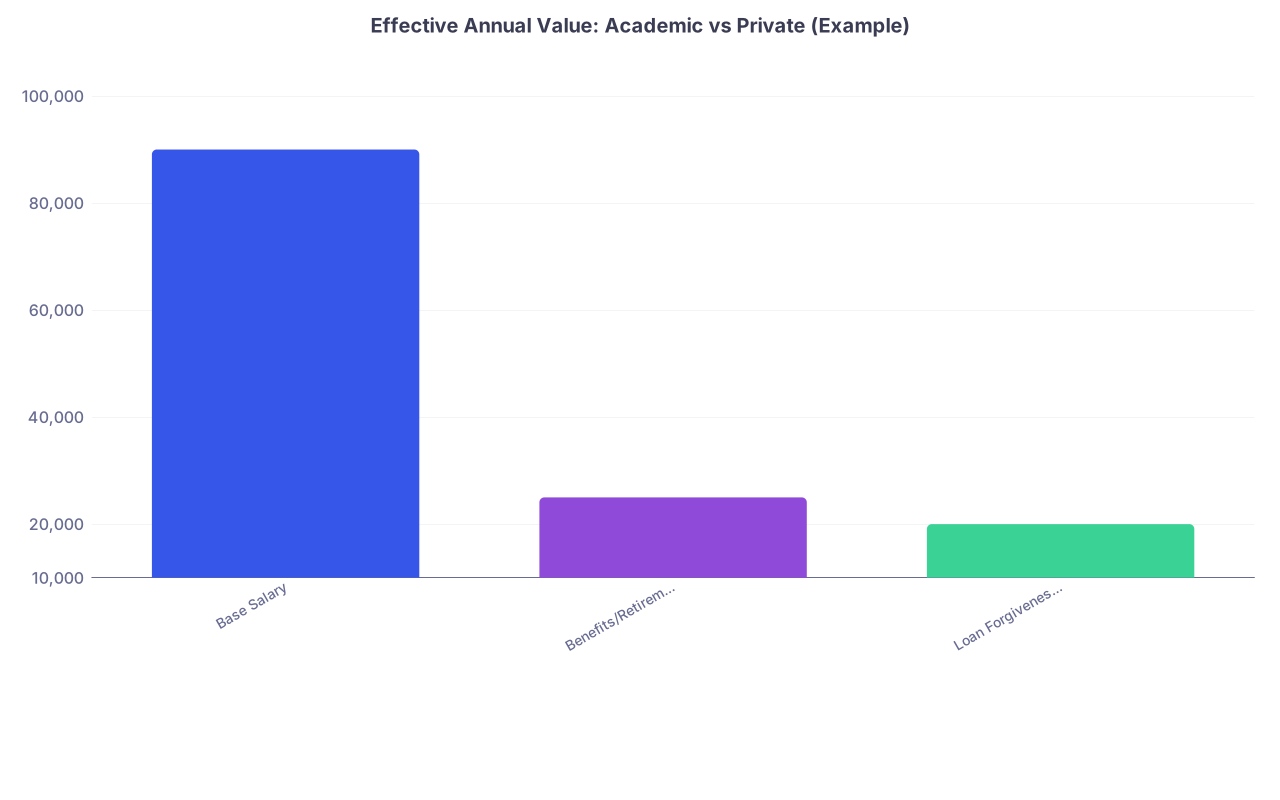
| Category | Value |
|---|---|
| Base Salary | 90000 |
| Benefits/Retirement | 25000 |
| Loan Forgiveness Value | 20000 |
That bar chart assumes the difference in those categories in favor of academics. In some cases, the “gap” shrinks from 100k headline difference to something more like 40–60k when you account for everything.
If, after doing this math, the effective gap is tiny (say < $30k/year), you’re not actually “taking a vow of poverty.” If it’s $150k+, year after year, that’s a real sacrifice.
Step 2: Map What You Actually Get For That Pay Cut
You’re not just buying prestige. Or at least you shouldn’t be.
Ask what the academic job buys you that a community or private job usually does not. Be ruthless. “We have conferences” doesn’t count.
Common real benefits of an academic appointment:
- Protected time.
True protected time, written into your contract, to do:- Research
- Teaching
- Quality improvement
- Admin/leadership
- Title and trajectory.
Assistant → Associate → Full Professor. Division chief, program director, chair. These ladders actually exist in academics. - Complex pathology and niche development.
If you want to be “the X person” (e.g., advanced heart failure, complex IBD, rare tumors), you don’t usually build that in a 3‑doc community group. - Institutional reputation.
Being at MGH, Mayo, Hopkins, UCSF, etc. opens doors. Speaking invites, guidelines work, consulting, industry collaborations. - Teaching impact.
If you honestly get energy from working with residents/fellows and shaping careers, that’s not a side perk. It is the job.
Where people go wrong: they say they “love teaching” but haven’t realistically asked what percentage of their day they want protected for non-RVU work. If you want 40–50% non-clinical time, it will cost you. Somewhere.
Step 3: Do a 10‑Year Money Projection (Not Just Year 1)
One of the biggest mistakes: only looking at year‑1 salary.
You need to compare 10‑year arcs, not first-year offers.
Typical pattern I’ve seen:
- Academics:
Lower start, small annual raises, maybe promotion bump at year 5–7, occasional retention bonus. - Private/employed:
Higher start, bigger early bonuses, possibly buy-in, sometimes plateau once “partner” or senior.
Make a simple 10‑year spreadsheet:
- Column A: Year 1–10
- Column B: Academic comp each year (base + predictable bonus + retirement match + loan help)
- Column C: Private comp each year (same components)
- Column D: Difference C – B
- Column E: Cumulative difference over time
Do not get fancy. Just be realistic.
Then ask: “What could I do with that cumulative difference?”
If the 10‑year difference is, say, $400k, that’s real but not necessarily life-changing if your spending is under control and you invest well.
If the 10‑year difference is $1.5–2M, that can move you from “comfortable” to “financially independent early.” Walking away from that is a much bigger call.
Step 4: Factor in Loans and PSLF Like an Adult, Not a Trainee
This is where academics sometimes quietly crush private practice for young attendings with giant debt.
Academic hospitals are often:
- 501(c)(3) nonprofits → PSLF eligible
- State systems with loan repayment programs
- Connected to federal/state rural/underserved forgiveness programs
If you’ve got $300k+ in federal loans at 6–7%, PSLF can turn an academic job into a six-figure effective raise for 10 years.
Example: $300k loan, 6.8%, on an income-driven plan:
- Academic job: PSLF after 10 years, total out-of-pocket maybe $150–180k, rest forgiven tax-free.
- Private job: you’re paying the whole $300k+ interest, likely $35–45k/year for a decade if you’re aggressive.
That “forgiveness” is untaxed under PSLF. That’s huge.
So run two scenarios:
- “I go academic and aggressively pursue PSLF/forgiveness.”
- “I go private and just pay it off.”
Often the shiny $350k private job is less impressive when you knock $40–50k/year off for loans and compare what’s actually left in your bank account.
Step 5: Be Honest About Your Day‑to‑Day Happiness Drivers
This is where I stop being polite.
If you don’t genuinely like:
- Explaining things to learners, repeatedly
- Having people watch you work, ask questions, slow you down
- Sitting in committees, doing QI, tweaking protocols
- Publishing, or at least willing to play that game if you want promotion
…then do not take an academic job just because you feel like you “should” or your mentors expect it. You will be miserable and underpaid. That’s the worst combo.
Flip side: if you’ll go insane doing:
- 25–30 identical clinic visits a day
- 18 shifts a month of pure RVU grind
- No residents, no fellows, no research, no academic meetings
…you’re the person academic medicine was built for. The pay cut becomes paying for a job that fits your brain.
Think about:
- What parts of residency energized you? Morning report? Tumor board? Teaching on rounds?
- What parts drained you? Billing arguments? Pure throughput pressure? Endless notes?
Then align:
- If your highlight was teaching on rounds, puzzling through weird cases, journal club — academics makes sense.
- If your highlight was flipping high volume days and walking out with an empty inbox — private/employed may actually fit you better.
Step 6: Look at Long‑Term Career Capital
Academic appointments buy career capital that you can cash in later, even outside academia.
Things that matter over decades:
- Name recognition in a niche: “the refractory epilepsy person,” “the robotic colorectal surgeon,” “the amyloid cardiologist.”
- Roles: program director, division chief, vice chair, CMO. Those roles usually begin in academic or quasi-academic systems.
- Publications and speaking: guidelines panels, invited talks, industry advisory boards. Often easier from an academic address.
This capital can become money later:
- Consultancy
- Medical legal work
- Industry roles (medical affairs, clinical development)
- Non-clinical leadership positions
So if you’re someone who eventually wants to:
- Work 0.5–0.7 FTE clinical
- Sit on boards
- Do industry/corporate work
then 5–10 years in academics can be an investment period, not a lifelong vow.
Think of it like a residency after residency for your career brand.
Step 7: Evaluate the Specific Institution, Not “Academics” in General
Academic jobs are not all the same. This is where I see people get burned.
Here are things that separate a good academic offer from a terrible one:
| Factor | Strong Academic Offer | Weak Academic Offer |
|---|---|---|
| Protected Time | Written, tracked, 20–40% non-clinical | “Sure, we value teaching” but 100% RVU |
| Promotion Path | Clear criteria, support, mentorship | Vague, political, rarely achieved |
| Compensation Plan | Transparent, fair, reasonable benchmarks | Opaque, moving targets, impossible RVU goals |
| Culture | Collaborative, supports scholarship | Burnout factory with residents as cheap labor |
If they’re offering you “0.3 FTE protected time” but your RVU target is the same as the full‑time clinicians — that’s not protected time. That’s unpaid overtime.
You should be asking very specific questions:
- “How many RVUs are faculty expected to produce at my rank?”
- “How many hours/week are truly off-limits for clinical add-ons?”
- “What percentage of recent assistant professors actually get promoted on time?”
- “Who will be my direct mentor, and what does that relationship look like?”
If they dodge or hand-wave these, assume the worst. Because I’ve watched too many people end up with 1.2 FTE work for 0.9 FTE pay in the name of “academic mission.”
Step 8: Put It All Together With a Simple Framework
You want a decision, not an abstract debate. Use a structured approach.
Create four buckets, score each 1–10 for each offer:
- Money & Debt
- Salary, bonuses, retirement, loan help, PSLF
- Lifestyle & Daily Work
- Schedule, call, commute, team, EMR, patient mix
- Meaning & Fit
- Teaching, mission, complexity of cases, alignment with your values
- Future Options
- Leadership paths, fellowship-type skill building, reputation, optionality
Throw it into a simple comparison:
| Category | Academic (1–10) | Private (1–10) |
|---|---|---|
| Money & Debt | 6 | 9 |
| Lifestyle | 7 | 6 |
| Meaning & Fit | 9 | 5 |
| Future Options | 8 | 6 |
Then ask yourself:
- Which category matters most for the next 3–5 years?
- Which matters most over 20+ years?
If you’re drowning in debt and your primary goal is rapid financial security, “Money & Debt” may deserve double weight for the first decade.
If you’re already relatively secure or have low expenses, “Meaning & Fit” and “Future Options” can legitimately outrank short-term dollars.
Step 9: Give Yourself Permission to Change Your Mind Later
The last trap: thinking this decision is permanent.
A few realities:
- Many physicians do 5–7 years in academics, build a name, then leave for private practice at much higher pay because their brand is now worth more.
- Some do the opposite: start private, pay off loans, then move into an academic or hybrid role when money stress decreases.
- Some cobble together hybrid setups: part-time academic, part-time community; or academic appointment with heavy outreach work in community sites.
So stop acting like this is marriage. It is not. It’s a job.
What you’re really deciding is:
- “What set of tradeoffs do I want for the next 3–7 years?”
- “What kind of career capital do I want to accumulate during that time?”
As long as you’re not signing some insane non-compete that boxes you in, you have options.
One Concrete Next Step
Do this today:
Open a blank spreadsheet (or a piece of paper if you’re old school) and write across the top:
- Academic Offer
- Private/Community Offer
Then fill in, line by line:
- Base salary
- Expected bonus
- Retirement match (in dollars)
- Loan forgiveness/repayment benefit
- PSLF eligibility (yes/no, and estimated value per year)
- Hours per week, nights/weekends, call burden
- True protected non-clinical time (hours/week)
Once you see real numbers and real time side by side, the fog lifts. You’ll stop asking “are academic appointments worth the pay cut?” in the abstract and start answering the only question that matters:
Is this academic job, for me, right now, worth what I’m giving up to take it?