
You just got your first attending offer. The email’s sitting open: base salary, bonus structure, RVUs, a few buzzwords you half-recognize from that one lunch talk with the contract lawyer.
And the thought in your head is simple:
“Is this actually good… or are they lowballing me?”
Let’s answer that directly. Field by field. With numbers. And with a clear framework so you can sanity-check any offer you see.
Step 1: The Only Definition That Matters
A “good” first attending salary is:
High enough for your specialty and region, relative to:
- Current market benchmarks (MGMA, Doximity, Medscape, etc.)
- The type of job (academic vs community vs private equity vs concierge)
- How much you’re working (wRVU targets, call burden, nights, procedures)
If you don’t anchor to those three, you’re negotiating in the dark.
So the goal here isn’t “what’s the magical number” but “what’s a fair range for your field and job type—and where does this offer sit inside that?”
Step 2: Quick Reality Check by Specialty Category
I’ll give you ballpark first attending base salary ranges for full-time work (not including bonuses, call stipends, etc.). These are blended from recent compensation surveys, recruiter data, and what I’ve seen in contracts across the country.
Yes, there are exceptions. But if you’re way outside these bands, something’s off.
| Specialty Category | Approx First-Year Base (USD) |
|---|---|
| Primary Care (FM, IM, Peds) | $210k–$280k |
| Cognitive IM Subspecialties | $260k–$340k |
| Procedural/High RVU IM (GI, Cards, Pulm/Crit) | $400k–$550k |
| Surgical Specialties | $350k–$600k+ |
| Hospital-Based (Anes, EM, Radiology, Path) | $350k–$500k |
| Psych & Psych-Adjacent | $260k–$350k+ |
These are starting or guaranteed bases for year 1–2, not peak career numbers.
Let’s break it down more concretely.
Step 3: Benchmarks by Major Field
I’ll assume “average” US cost-of-living and non-elite but solid job (community hospital, large group, or non-top-tier academic). Coasts and high-cost cities will skew some numbers, but often not as much as you’d hope.
Primary Care (FM, IM, Peds)
If you’re a new grad in family medicine, outpatient IM, or general peds:
- Decent first-year base: $220k–$250k
- Strong offer: $250k–$280k (or more in rural/underserved areas)
- Red flag low: Below $210k with no clear productivity upside
For outpatient clinics tied to hospitals, I regularly see:
- FM/IM: $230k–$260k base, 2-year guarantee
- Peds: $210k–$240k base
Community health centers often start a bit lower, but with loan repayment. If you’re at $200k in FM with no loan help and standard workload? That’s weak in 2024+.
Internal Medicine Subspecialties (Non-Procedural)
Think: Endocrinology, Rheumatology, ID, Geriatrics, Allergy, Heme-only in some markets.
- Decent first-year base: $260k–$300k
- Strong: $300k–$340k
- Red flag: < $250k unless heavy loan repayment or extremely light hours
If the job is academic with significant teaching/research and a protected schedule, you may see $230k–$260k. That can still be “good” if the non-financial tradeoffs are truly worth it. But be aware: these are typically far below private practice for the same skillset.
Procedural / High-RVU IM Subspecialties
Think GI, Cardiology, Pulm/Crit, Interventional specialties.
Gastroenterology:
- Typical first-year base: $450k–$550k (community/private groups, RVU-heavy)
- Academic GI: $350k–$430k, sometimes lower, often with research time
If you get offered $380k as a first-year GI in a busy private group in a mid-sized city, that’s low. Plain and simple.
Cardiology (general, not EP/Interventional):
- Decent base: $400k–$480k
- Strong: $480k–$550k with reasonable call
- Academic: $320k–$400k is common
Pulm/Crit:
- Decent: $380k–$450k
- Strong: $450k–$520k if heavy ICU call or high volume
If a private group wants 1:4 ICU call and clinic volume through the roof for $350k? That’s a bargain—for them, not for you.
Surgical Specialties
This is where “range” really matters. General surgery vs ortho vs neurosurg is not the same game.
General Surgery:
- Decent first-year base: $350k–$420k
- Strong: $420k–$500k+ with call-heavy roles
- Academic often: $325k–$380k
Orthopedic Surgery:
- Decent: $450k–$550k
- Strong: $550k–$700k+ depending on subspecialty (joints, spine, sports)
- Academic: can dip into low–mid 400s
Neurosurgery:
- Very wide, but seeing $600k–$800k guarantees is not unusual in community settings.
For surgery, the bigger “gotcha” isn’t the base; it’s how quickly they flip you to eat-what-you-kill formulas and what buy-in or partnership tracks look like.
Hospital-Based: Anesthesia, EM, Radiology, Pathology
Anesthesiology:
- Decent first-year base: $400k–$480k
- Strong: $480k–$550k+ with call or cardiac/OB heavy roles
Corporate/PE groups love to advertise big “total comp” but bury the actual base and shift expectations. Watch that.
Emergency Medicine: Usually quoted as $/hour. For full-time (roughly 1,500–1,800 clinical hours/year):
- Decent: $220–$260/hour → roughly $330k–$420k
- Strong: $260–$300+/hour (often rural, less desirable locations)
- < $200/hr in a busy ED with no scribe support? That’s bad.
Radiology:
- Decent: $400k–$500k
- Strong: $500k–$600k+ in private groups, esp. nights/IR-heavy
Pathology:
- Decent first-year base: $280k–$340k
- Strong: $340k–$400k+ in community settings
Psychiatry & Related Fields
Psych is still underpaid relative to demand, but it’s been climbing.
Adult Psychiatry (outpatient, employed):
- Decent base: $260k–$300k
- Strong: $300k–$350k+ with reasonable patient load
Telepsych, locums, or RVU-heavy roles can push effective comp much higher, but often at the cost of volume and burnout risk.
Step 4: Academic vs Community vs Private Practice
You’ll drive yourself crazy if you compare an academic psych job in Boston to a private GI group in the Midwest. Completely different markets.
Here’s the basic trade:
Academic:
- Lower salary
- More stability, prestige, teaching, research
- Often worse raw dollars but better “social capital” and academic career opportunities
Hospital-employed community:
- Middle-of-the-road salary, usually decent benefits
- W2 employee, less autonomy, less business upside
- More predictable, simple structure (salary + RVU bonus)
Private practice / independent group:
- Can be wildly lucrative… or a trap
- Often lower “guarantee” first 1–2 years, followed by partnership track
- Need to scrutinize: buy-in, expense allocation, who owns ancillaries
You can’t call a $280k academic rheum job “bad” just because a friend in community makes $330k. Different beast. But if your academic offer is $210k in 2025 with normal clinical FTE? They’re underpaying you for the market.
Step 5: Don’t Just Look at Base – Look at the Whole Package
This is where people get played. They stare at the base and ignore everything else.
Here’s what really moves the needle:
wRVU target and rate:
- Example: 5,000 wRVUs at $50/wRVU is very different from 7,500 at $42/wRVU
- Most new attendings have no idea if the target is realistic. Ask current docs: “How many wRVUs did you hit last year?”
-
- $1,000 per 24h call vs $0 for the same schedule is a massive income difference.
Loan repayment:
- $50k/year for 3 years is $150k real money. Don’t ignore it.
Benefits & tail coverage:
- Who pays malpractice tail if you leave? That can be six figures.
-
- Are you buying into a real revenue stream (ASC, imaging, ancillaries), or just “the privilege” of being a partner?
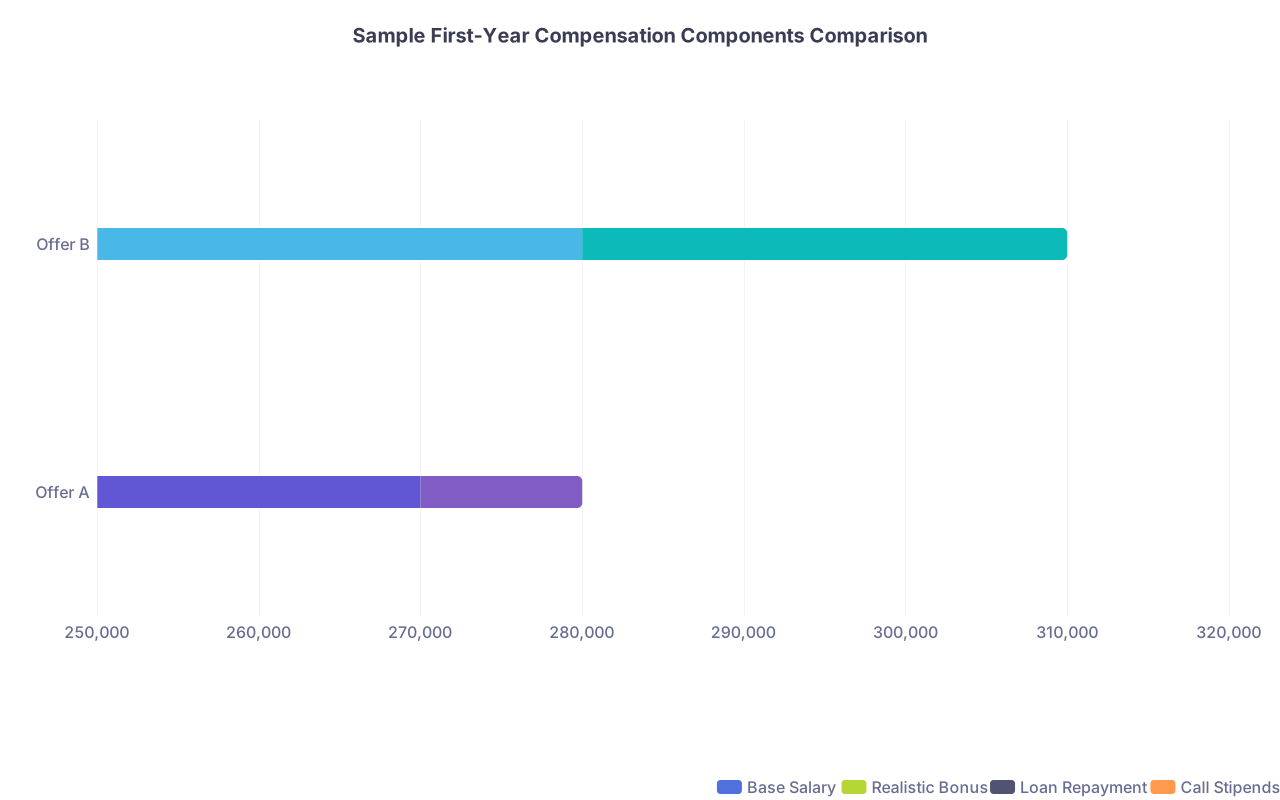
Here’s a clean way to compare two offers quickly:
| Category | Base Salary | Realistic Bonus | Loan Repayment | Call Stipends |
|---|---|---|---|---|
| Offer A | 250000 | 20000 | 0 | 10000 |
| Offer B | 280000 | 0 | 30000 | 0 |
Offer A might look lower on base, but when you total everything, it could be ahead—or at least competitive.
Step 6: Geography and Cost of Living – Stop Assuming Coasts Pay More
Common mistake: “It’s California/New York, they must pay more.”
Often false. Many coasts pay the same or slightly more than Midwest/South in absolute dollars but with far worse cost of living.
Rough reality:
- High demand / rural / Midwest / South:
- Often higher salaries, more sign-on, more loan repayment
- Coastal big cities / “desirable” locations:
- Lower salaries, more competition, academic-heavy systems
- You’re paying in income for lifestyle and geography
Compare offers on post-tax, post–cost-of-living basis, not just raw base.
Step 7: A Simple Framework to Judge Your Offer
Here’s the quick sanity-check flow:

| Step | Description |
|---|---|
| Step 1 | Get Offer |
| Step 2 | Identify Field and Job Type |
| Step 3 | Pull Current Benchmarks |
| Step 4 | Compare Base to Range |
| Step 5 | Evaluate Total Package |
| Step 6 | Plan Counteroffer |
| Step 7 | Scrutinize Workload and Call |
| Step 8 | Decide if Nonfinancials Justify |
| Step 9 | Within 10-15 percent of fair range? |
- Identify: Specialty + academic vs community vs private.
- Pull data: MGMA (if you can), Doximity, Medscape, recruiters, senior residents.
- Ask: “Is this offer within roughly 10–15% of market for my situation?”
- If it’s well below: it’s not “your only option.” It’s your first option. Negotiate or keep looking.
- If it’s surprisingly high: assume the workload, call, or expectations match.
Step 8: Red Flags That Scream “Bad Offer”
I’m blunt here because I’ve watched too many new attendings get burned.
Be suspicious if:
- They won’t give you wRVU numbers for current physicians in the group.
- Your base is clearly below market and the answer is “you’ll make it up with bonuses.”
- There’s a non-compete covering a huge radius or multiple counties.
- You’re asked to sign before seeing full productivity formula and benefits in writing.
- “Partnership” is vague: no written timeline, no details on buy-in and distributions.
A “good” first salary is not just about the dollar amount. It’s about not inheriting a trap disguised as an opportunity.
FAQs
1. How can I find real benchmark data for my specialty?
Use multiple sources. MGMA is the gold standard, but you usually need institutional access. Pair that with Doximity’s compensation reports, Medscape’s annual survey, recruiter quotes, and candid conversations with recent grads in your field. If three independent sources say new outpatient IM in your area runs $240k–$260k, and you’re at $210k, that’s real data.
2. Is it normal for academic salaries to be much lower?
Yes. Academic jobs often pay 20–40% less than private/community roles in the same specialty. You’re trading money for teaching, research, prestige, and (sometimes) more predictable hours. The question isn’t “Is this equal to private?” It’s “Is the discount worth the career incentives I care about?”
3. How much should I negotiate on a first attending offer?
For most W2 employed roles, you can usually move base by 5–15% if you have reasonable leverage (multiple interviews, in-demand specialty, less desirable location to fill). Bigger jumps are possible in high-need areas or if your CV is unusually strong. Don’t only push on base—also negotiate sign-on bonus, loan repayment, call stipends, and tail coverage.
4. My base is low, but the RVU bonus “has no cap.” Is that good?
“Unlimited bonus” means nothing if the RVU target is insane or the clinic can’t feed you patients. Ask:
- What did new hires actually earn in years 1–3?
- What’s the median RVUs for your partners?
If nobody is hitting the target, you won’t either. A reasonable, capped target beats an imaginary uncapped upside.
5. Should I ever take a lower salary on purpose?
Sometimes, yes. If you’re trading cash for:
- Shorter hours
- Highly desirable location
- Strong academic path or niche training
- Genuine mentorship and a clear next step (e.g., fast-track to partnership or leadership)
The key is being intentional. “Lower salary but I love being here and I know the tradeoff I’m making” is fine. “Lower salary because I was scared to negotiate and had no idea of my market value” is not.
6. What’s one number that tells me if my first attending salary is “good”?
Compare your guaranteed first-year comp (base + guaranteed bonus + loan repayment + call stipends) to a realistic market benchmark for your field and region. If you’re within 10–15% of the median and the workload and call are reasonable, you’re in “good” territory. If you’re 20–30% below without a very clear upside, it’s a bad deal, and you should treat it as such.
Key Takeaways:
- “Good” is relative to specialty, region, and job type—anchor to real market data, not vibes.
- Don’t judge an offer by base alone; look at RVUs, call, loan repayment, and benefits together.
- If your offer is clearly below market and they wave it off with “you’ll make it up in bonus,” assume it’s a lowball and push back.