
The difference between $300K and $500K as a physician is not 200K. It’s control over your life.
That sounds dramatic, but it’s accurate. Once you clear about $250K as a doctor, the game stops being “how much do I make?” and starts being “how much control, security, and time do I want to buy?”
Let me break it down like I would for a tired PGY-3 asking if they should chase a higher-paying job.
1. The Tax And Take‑Home Reality
Let’s kill the headline myth first: you do not get an extra $200K in your pocket going from $300K to $500K.
Assume:
- Married filing jointly
- No state income tax vs a moderate/high tax state scenario
- Standard deductions, nothing exotic
Basic idea:
- At $300K, you’re already in a high marginal tax bracket.
- At $500K, you’re just spending more time in that same high bracket.
Your marginal rate (the rate on your last dollar) might be 37–45% when you add federal, state, and payroll taxes. So that “extra” $200K is really more like $110–130K after tax, depending on state, deductions, retirement contributions, etc.
So the real question becomes:
Is an extra ~$10K/month in take‑home worth the tradeoffs that usually come with $500K jobs?
To visualize it, here’s a rough comparison:
| Salary | No State Income Tax | High-Tax State |
|---|---|---|
| $300K | ~$205K–215K | ~$185K–195K |
| $500K | ~$305K–325K | ~$270K–290K |
Ballpark only, but you get the point. You’re not doubling your lifestyle.
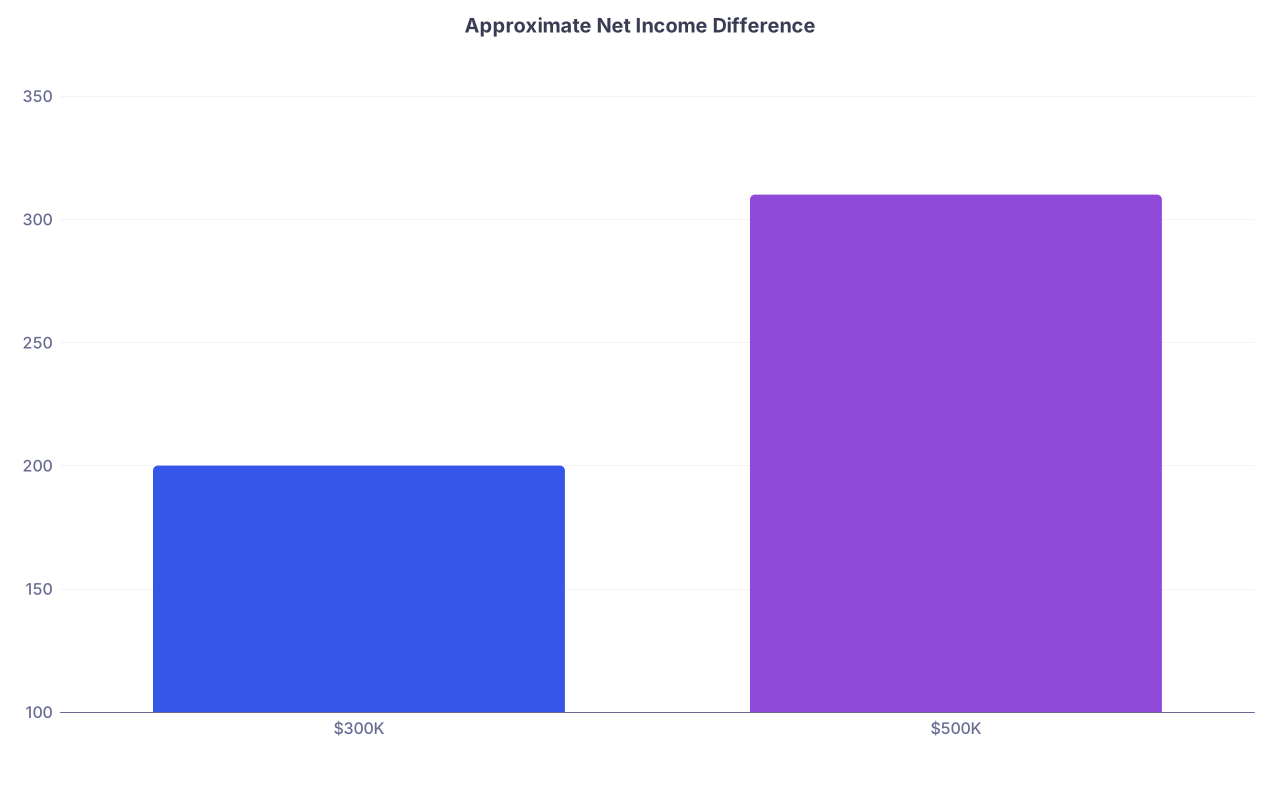
| Category | Value |
|---|---|
| $300K | 200 |
| $500K | 310 |
2. What $300K vs $500K Actually Buys You
At $150K as a resident/fellow, every $10K matters. At $300K and above, money behaves differently. You move from survival to choices.
Let’s compare two reasonably common scenarios.
At ~$300K (Hospital Employed, Moderate COL Area)
Typical setup:
- Hospital-employed IM, FM, non-procedural subspecialty, or lower-RVU surgical job.
- 4–5 days a week, reasonable call, predictable vacation.
What $300K comfortably covers if you’re not reckless:
- Mortgage on a solid but not trophy home in a decent suburb.
- 2 decent cars, one probably paid off.
- Maxing retirement accounts (401k/403b, backdoor Roth, HSA if available).
- Full student loan payoff in 5–10 years if you’re intentional.
- Family vacations that don’t require airline points acrobatics.
You can live a very normal, stress‑reduced upper‑middle‑class life at $300K. You won’t feel rich if you run with the dermatologist/plastic surgeon crowd at a country club, but you’re fine.
At ~$500K (High RVU / Procedural / Private Practice / Hustle Job)
To hit $500K, usually at least one of these is true:
- More call. Nights, weekends, holidays.
- More RVUs. Shorter visits, more procedures, more pressure.
- Less geographic flexibility. High-paying jobs often in less desirable areas.
- More business risk. Partnership buy-ins, private practice overhead, collections volatility.
What the extra $200K (really ~$110–130K net) buys:
- Faster student loan payoff (3–5 years instead of 10–15) if you don’t inflate lifestyle.
- Nicer house, better school district, or both.
- Private school without sweating every tuition bill.
- Higher savings rate (this is actually the real win, if you use it).
- Ability to seriously build wealth (taxable brokerage, real estate, etc.) in your 30s and 40s.
The trap? Most docs convert that extra $10K/month into:
- Bigger house they barely use.
- Luxury car leases.
- Lifestyle creep: clubs, vacations, eating out, random subscription everything.
And then they come to me saying: “I make $500K and still feel broke.”
Because the number doesn’t matter if your burn rate explodes.
3. Time, Burnout, And “The Hidden Cost” Of $500K
This is where I get blunt.
If $500K came with the same hours, stress, and admin burden as $300K, there’d be no debate. Everyone would chase it. It doesn’t.
I’ve seen patterns across a lot of physicians:
- The $300K doc is often home for dinner, goes to kids’ events, has some evenings free, maybe takes 6–8 weeks off a year.
- The $500K doc is often staring at the EMR at 10 pm, rounding on weekends, or taking calls on vacation.
Not always. But enough that you should assume:
More money = more of at least one of these:
- Time at work
- Mental load
- Call and coverage responsibility
- Political / practice management BS
So the real difference:
- $300K can buy you a life with balance if you manage it well.
- $500K can buy you either:
- Financial independence much earlier,
- Or a shinier treadmill that’s much harder to step off.

| Step | Description |
|---|---|
| Step 1 | Choose Job |
| Step 2 | More Time Flexibility |
| Step 3 | More Work or Risk |
| Step 4 | Moderate Savings, Lower Burnout |
| Step 5 | Faster Financial Freedom |
| Step 6 | Golden Handcuffs |
| Step 7 | Target Income |
| Step 8 | Lifestyle Choice |
4. Financial Independence Timelines: 300K vs 500K
Let’s talk FI (financial independence). This is where the real difference can show up.
Assume:
- You want ~$150K/year in retirement income (inflation-adjusted).
- Using a 3.5–4% withdrawal rate, you need ~$3.5–4M invested.
- Investment returns average 5–7% real (long-term stock-heavy portfolio).
Very rough, but good enough for planning.
Now, the lever that matters most: your savings rate, not your salary.
Say two attendings, both age 32:
- Doc A: earns $300K, saves 20% of gross ($60K/year).
- Doc B: earns $500K, saves 35% of gross ($175K/year).
At that savings rate:
- Doc A might hit FI in ~22–25 years (mid-50s), depending on returns.
- Doc B might hit FI in ~12–15 years (early to mid-40s).
If, instead, Doc B also saves only 20% ($100K/year):
- They’re still ahead of Doc A, but not by nearly as much as you’d think. FI maybe in ~18–20 years.
So the extra $200K can buy you a decade of your life back.
But only if you don’t blow it.
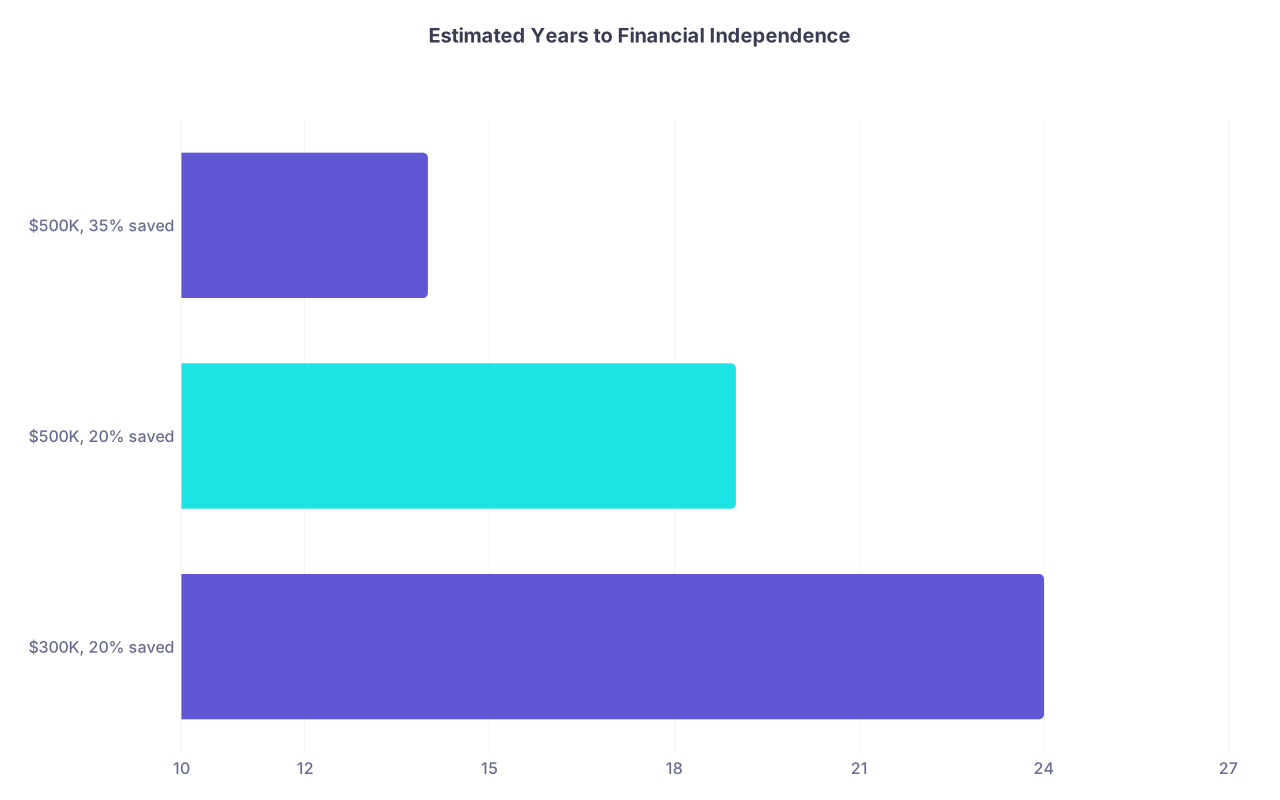
| Category | Value |
|---|---|
| $300K, 20% saved | 24 |
| $500K, 20% saved | 19 |
| $500K, 35% saved | 14 |
That’s the most compelling argument for the $500K job: a brutally focused 10–15 year sprint, then real freedom to downshift, go part-time, or walk away.
5. Lifestyle, Geography, And “Feel” Of $300K vs $500K
This part gets ignored in spreadsheets but dominates in real life.
Geography
You can earn $300K:
- In a medium COL city with good schools and reasonable housing.
- In some high COL coastal cities with less space and more compromise.
You often earn $500K:
- In rural or semi-rural areas.
- In less “desirable” metros where recruiting is hard.
- In specialties or practices that rely on high volume.
I’ve watched physicians move from a $320K job in a solid metro to a $480K job in a rural market. Results:
- Yes, they saved more.
- Yes, they paid off loans faster.
- Also yes: spouse was miserable, kids had fewer opportunities, burnout went up.
That’s a trade. Not right or wrong. Just real.
How It Feels Day to Day
At $300K:
- You feel comfortable if your peer group is normal people (teachers, engineers, business folks).
- You occasionally feel “behind” if you constantly compare to the highest earners in your field.
- Money stress mostly shows up if you overspend on housing or ignore student loans.
At $500K:
- You should feel rich. Many don’t, because they inflate lifestyle to match.
- You feel more pressure to maintain that income level (kids in private school, bigger mortgage, higher fixed expenses).
- Walking away or downshifting feels harder—golden handcuffs.

6. Risk, Contracts, And Legal/Financial Strings
The $500K jobs often come with more “fine print.” You can’t ignore the legal and business side.
Common strings attached:
- Non-compete clauses that actually matter (because leaving means a massive pay cut or relocation).
- Productivity-based comp models where your income can swing 50–100K year-to-year.
- Partnership buy-ins ($150–500K) tied to opaque practice finances.
- Compensation heavily based on hospital subsidies that can vanish when leadership changes.
Where $300K hospital-employed roles often give you:
- More stable salary.
- Better benefits package (health, disability, retirement match).
- Less direct business risk, fewer legal landmines.
You’re essentially choosing between:
- Being a very well-paid “employee” at $300K with less upside but more predictability.
- Being closer to a business owner / top producer at $500K with more upside but definitely more downside risk.
| Feature | ~$300K Jobs | ~$500K Jobs |
|---|---|---|
| Structure | Mostly employed | Employed + private practice mix |
| Income Stability | Higher | Lower (productivity tied) |
| Call Burden | Moderate | Often higher |
| Legal Complexity | Lower | Higher (noncompetes, buy-ins) |
| Burnout Risk | Moderate | Higher if not managed |
7. A Simple Framework: Should You Chase $500K?
Strip away the noise. Here’s how I’d think about it if you’re deciding between a $300K and a $500K path.
You probably lean toward the $300K lane if:
- You value time and predictability more than maximizing your net worth.
- You or your partner are already close to burnout.
- You have young kids and want real presence, not just income.
- You’re in or want a high-COL city where $300K already feels tight but survivable—and you’re willing to be disciplined.
You seriously consider the $500K lane if:
- You can tolerate 10–15 years of higher intensity work for a real shot at early FI.
- You have a low-drama partner who’s on board with the plan and won’t simultaneously blow up the spending.
- You’re willing to live somewhere less flashy or take on higher call temporarily.
- You actually like the work that generates $500K (procedural, high volume, ownership).
Then you pair that with two rules:
Decide on purpose whether the extra income is for:
- Earlier freedom, or
- Higher lifestyle.
Don’t let it drift into “both a little, neither enough.”
Put your decision into numbers:
- How much do you want saved by age 40, 45, 50?
- What percentage of your gross will you save each year?
- What’s your “walk away” number or age?
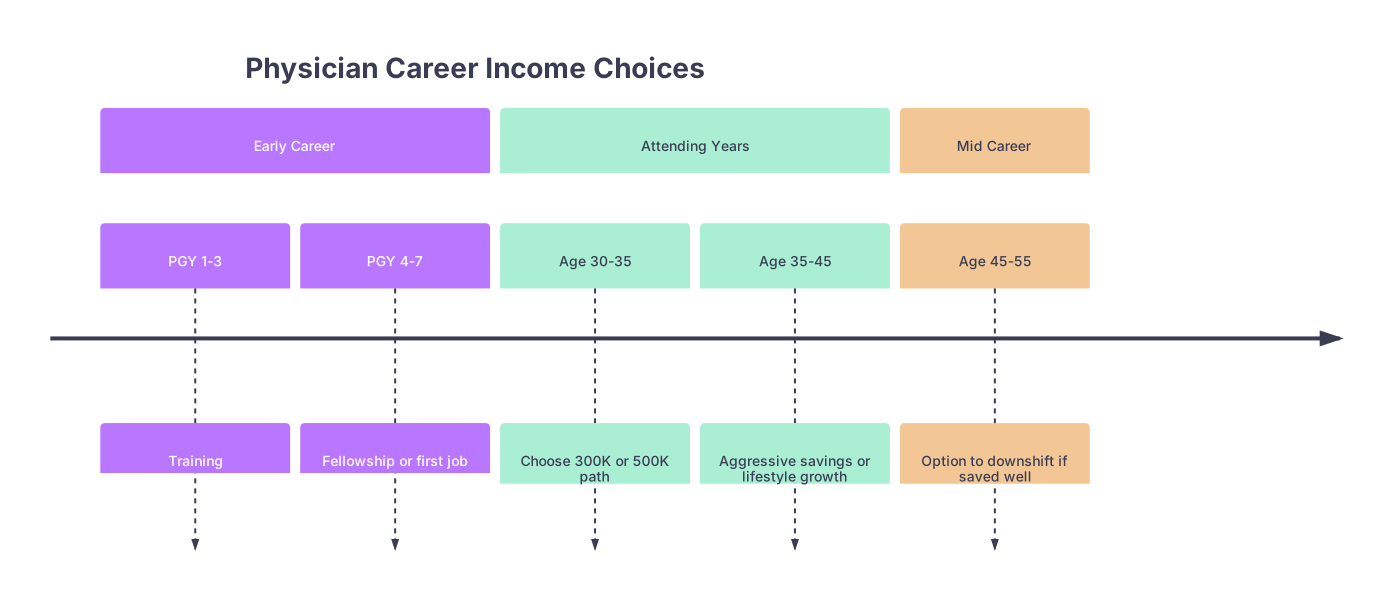
| Period | Event |
|---|---|
| Early Career - PGY 1-3 | Training |
| Early Career - PGY 4-7 | Fellowship or first job |
| Attending Years - Age 30-35 | Choose 300K or 500K path |
| Attending Years - Age 35-45 | Aggressive savings or lifestyle growth |
| Mid Career - Age 45-55 | Option to downshift if saved well |
8. So What’s The “Real” Difference?
Boiled all the way down:
- The jump from $300K to $500K is not a jump from “okay” to “rich.”
- It’s a jump from “comfortable, with balance” to “accelerated wealth-building if you’re disciplined, with more risk and usually more work.”
If you treat $500K like $300K and lock in your lifestyle around the lower number, you can absolutely:
- Hit financial independence early.
- Buy back your time later.
- Say no to toxic jobs and admin nonsense.
If you treat $500K as permission to spend $450K a year?
You’ve just built a very expensive cage.

FAQs
1. Is a $500K physician income “worth it” compared to $300K?
It’s worth it only if you use the extra money intentionally. If you convert the extra $10K/month after tax into higher savings and debt payoff, yes, it can buy you earlier freedom and more options. If you convert it into cars, square footage, and lifestyle creep, the marginal gain in happiness is small and the added stress usually isn’t worth it.
2. At what point does more income stop improving a physician’s happiness?
For most U.S. physicians, happiness gains flatten hard somewhere around $250–350K in reasonable cost-of-living areas. Below that, money helps remove stress (debt, housing, emergencies). Above that, lifestyle choices and time control matter more than raw dollars. Pushing for $500K makes sense for strategy (FI, flexibility), not for day-to-day happiness.
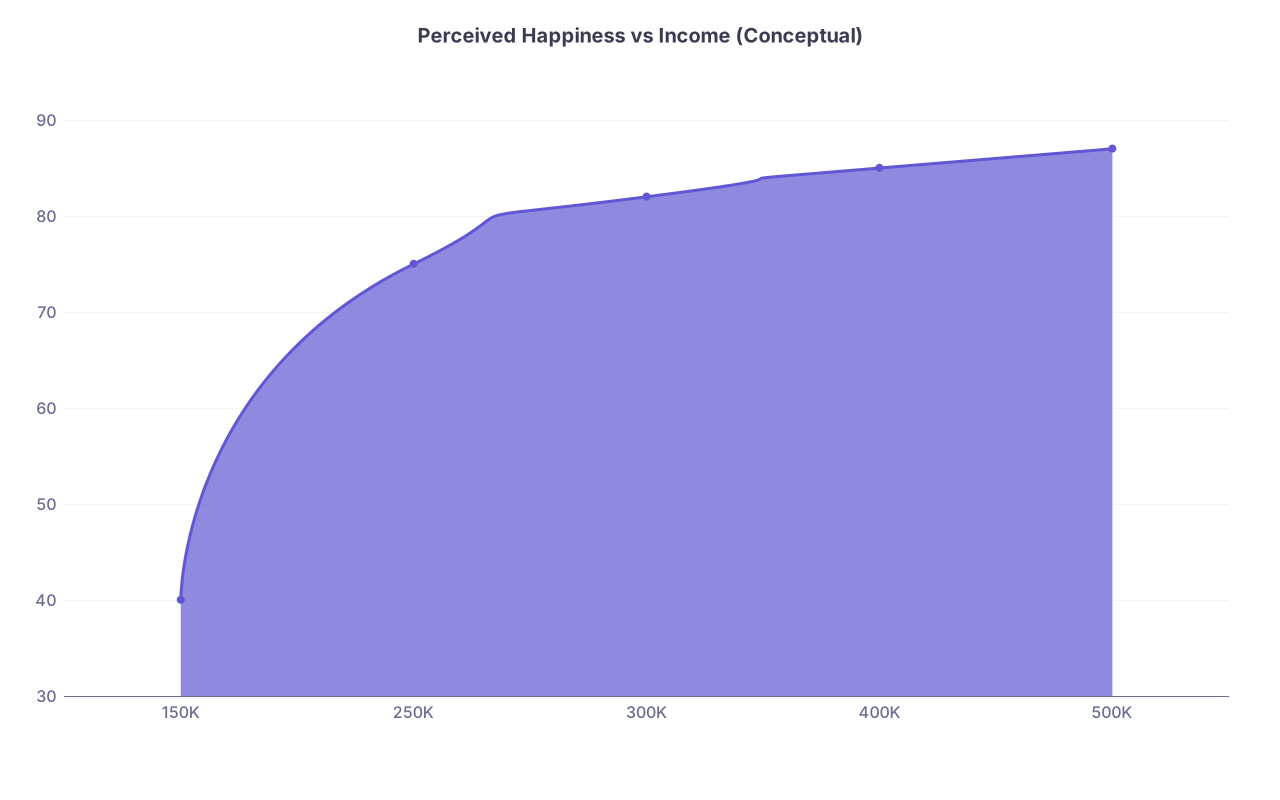
| Category | Value |
|---|---|
| 150K | 40 |
| 250K | 75 |
| 300K | 82 |
| 400K | 85 |
| 500K | 87 |
3. Does specialty choice matter more than income level?
Yes. Specialty largely determines both your ceiling and how hard it is to hit $500K. A procedural specialist might hit $500K with modest hustle; a general pediatrician may never get near it without major side gigs or ownership. Don’t pick a specialty just for money. Pick something you can tolerate doing at high volume for years, because that’s usually what it takes to live in the $500K world.
4. If I’m already at $300K, what’s the smartest first move financially?
Three things, in this order:
- Get clear on your true monthly spending and stop unconscious lifestyle creep.
- Max all tax-advantaged accounts (401k/403b, HSA, backdoor Roth, maybe 457b if safe).
- Pick either fast debt payoff (if loans > ~4–5%) or aggressive investing and automate it. You don’t need exotic strategies; you need a high savings rate and consistency.
5. What’s a good target savings rate for a $300K vs $500K physician?
At $300K, a 20%+ gross savings rate is strong and will usually set you up to retire comfortably in your 50s. At $500K, I push people toward 30–40% gross savings if the goal is early or flexible retirement. If that sounds impossible, your lifestyle is already pushing too close to the edge for your income.
Key points: the $300K vs $500K difference is mostly about how much control, time, and future freedom you buy—not about toys. And unless you pair high income with high savings, the extra $200K is just a nicer leash, not a better life.