
It’s PGY-2. It’s 11:30 pm. You’re between admits, staring at a crusty workroom computer, and your co-resident just said, “Cards people clear $600k. You’d be crazy not to do a fellowship.”
You nod. But in the back of your mind you’re thinking:
“Three more years of training… more call… more exams… Is this actually worth it financially? Does a fellowship really increase lifetime earnings, or is that just what people say to justify suffering longer?”
Here’s the straight answer.
Short Answer: Usually Yes… But Not Always
If you want a one-line takeaway:
For most internal medicine, pediatrics, and anesthesia residents going into higher-paying subspecialties, a fellowship will increase lifetime earnings compared with stopping at general practice.
But there are big caveats:
- It depends heavily on:
- The base specialty (IM vs EM vs FM vs Surgery).
- The subspecialty (GI vs endocrine vs rheum, etc.).
- Fellowship length (1 vs 3 years).
- Your job market (rural vs coastal academic center).
- Some fellowships are financially neutral or bad over a lifetime, especially if they don’t meaningfully boost salary or if you work fewer clinical hours as a subspecialist.
- Lifestyle and burnout risk change the math more than people admit.
So you can’t just say “fellowship = more money.” You need to run the numbers.
Let’s do that.
Step 1: Understand the Core Tradeoff
You’re trading:
- Extra training years at resident pay
vs. - Extra career years at attending pay (maybe higher, maybe not)
So the key questions:
- How many extra years? (Fellowship length)
- What’s the pay gap between:
- Generalist attending vs subspecialist attending?
- Your fellow salary vs attending salary you’re giving up?
- How long will you work after finishing? (Career length)
- What’s your debt and savings rate during each phase?
You don’t need a PhD in economics. Just a simple framework.
Step 2: Typical Numbers – Where Fellowship Clearly Wins
Let’s take a common scenario: Internal Medicine → GI vs Hospitalist.
These are ballpark national numbers (pre-tax, W-2, non-academic, recent MGMA/Medscape style ranges):
| Role | Typical Salary |
|---|---|
| IM Resident/Fellow | $65k–$75k |
| Hospitalist (Gen IM) | $260k–$320k |
| GI Attending | $550k–$800k |
Example: 3-Year GI Fellowship vs Going Straight to Hospitalist
Assumptions (round numbers, to keep this sane):
- Resident PGY-3: $70k
- GI Fellowship: 3 years at $72k, $74k, $76k
- Hospitalist straight out of residency: start $280k, modest increases
- GI attending: start $600k, modest increases
- Working until age 65
- You finish IM residency at 29, start attending at 30 if no fellowship
- If GI: finish fellowship at 33, start attending at 34
You “lose” three years of hospitalist attending income:
- Hospitalist at 30–32: about $280k–$300k per year
- Instead, you’re making fellow money: ~$72k–76k
So the opportunity cost is roughly:
- Year 1: $280k – $72k ≈ $208k
- Year 2: $290k – $74k ≈ $216k
- Year 3: $300k – $76k ≈ $224k
Total “lost” attending income ≈ $650k (pre-tax), plus some missed early retirement contributions and compounding.
In exchange, you get:
- 31 years (age 34–65) of GI-level income vs hospitalist income.
If we just do crude annual difference:
- GI: ~$600k
- Hospitalist: ~$280k
Difference: $320k per year
Even if we bring that down to a more conservative extra $250k/year over a long career:
- Extra income: 31 years × $250k ≈ $7.75 million pre-tax.
- Minus the ~$650k cost of doing fellowship.
Net win isn’t subtle. You come out way ahead financially.
Even if:
- You retire at 60.
- Or your GI job is “only” $500k.
- Or your hospitalist job is $320k.
The math still heavily favors GI in most markets.
Where This Same Logic Applies
Most of the time, this “clear win” pattern holds for:
- IM → GI, Cards, Heme/Onc
- Anesthesia → Pain
- Peds → NICU, PICU (depending on market)
- Pathology → Dermpath (strong markets), some molecular path roles
- Radiology → IR (in many private practice models)
Whenever:
- Fellowship = 1–3 extra years
- Pay jump = $150k–$300k+ per year for most of your career
…lifetime earnings usually increase. By a lot.
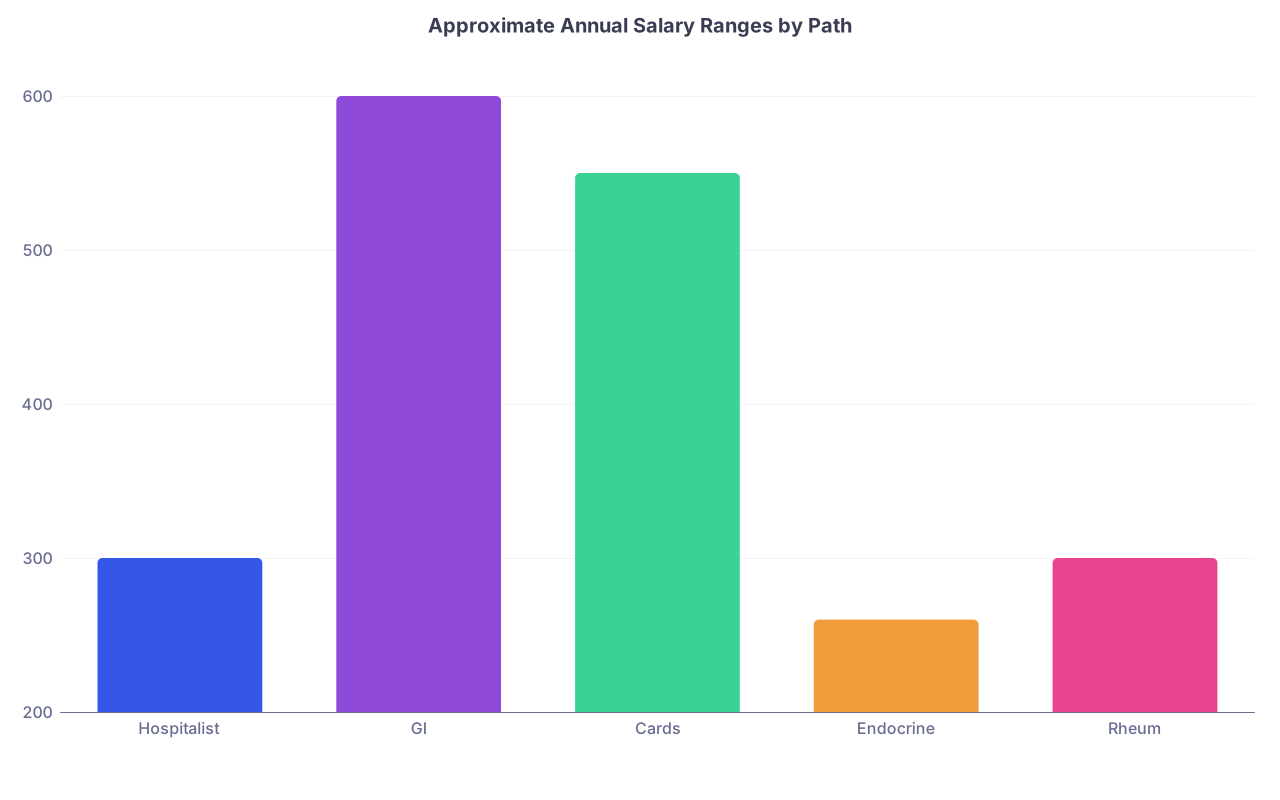
| Category | Value |
|---|---|
| Hospitalist | 300 |
| GI | 600 |
| Cards | 550 |
| Endocrine | 260 |
| Rheum | 300 |
Step 3: Where Fellowship Is Financially Marginal (or Bad)
Now let’s talk about the part people gloss over.
Some fellowships don’t pay enough more than the base specialty to justify:
- Extra years of training
- Extra exams/maintenance
- Delayed loan payoff and investing
Classic “Maybe Not Worth It” Financially
Common examples (purely from a money lens):
- IM → Endocrinology, ID, Geriatrics
- FM → Sports Med, Palliative (varies), Geriatrics
- Peds → Endo, ID, Rheum (in many markets)
- EM → Ultrasound, Admin fellowships (short, minor salary impact)
- Some academic-focused fellowships with weak private practice markets
Take IM → Endocrinology:
Rough ballpark:
- Hospitalist: $260k–$320k
- Outpatient Endocrine: $230k–$280k, some higher, many lower if academic
- Fellowship: 2–3 years
So you’re losing 2–3 years of ~$280k hospitalist income to eventually earn… maybe the same or slightly less.
In that scenario, lifetime earnings usually decrease or at best stay flat, unless:
- You leverage endocrine into high-paying obesity, PCOS, or private thyroid niche practice.
- You move to a high-paying area that really needs endocrine.
- You create side income (consulting, telehealth, etc.).
I’ve seen endocrine attendings making less than hospitalists they used to supervise as residents. That stings.
Step 4: The Role of Career Length and Burnout
Let’s say on paper, you’d earn more as a subspecialist. But will you actually work long enough and hard enough to realize that?
Here’s where reality bites:
- Some high-paying subspecialties are punishing: call, nights, procedures, constant RVU pressure.
- If you burn out and cut to 0.5–0.7 FTE in your 40s, the theoretical “extra $300k/year” becomes “extra $80k for a few years.”
- On the flip side, a specialty with a lower nominal salary but sustainable lifestyle might let you happily work full-time to 65+.
Money doesn’t live on spreadsheets. It lives in:
- Your call schedule
- Your inbox
- Your marriage
- Your cortisol level
If a fellowship path gives you more control, better schedule, or a type of work you don’t loathe, you’re more likely to stick with it and keep earning.
Sometimes that means:
- Doing GI instead of general IM clinic because you truly enjoy procedures and teams.
- Doing rheum over cardio because you hate high-acuity and constant emergencies, even if pay is lower.
That’s still a financial decision. Burnout is expensive.

Step 5: Considering Opportunity Cost and Investing
The strongest argument against long fellowships isn’t “you’ll earn less total,” it’s this:
- You delay high income
- You delay serious debt payoff
- You miss early years of retirement contributions and compounding
Those early attending years matter a lot.
Simple Illustration: Investing Gap
Two paths:
- Path A: No fellowship. Attending at 30, invest $40k/year in retirement accounts starting at 30.
- Path B: 3-year fellowship. Attending at 33, invest $40k/year starting at 33.
Assume:
- 7% annual return
- Both retire at 65
By age 65:
- Path A has 35 years of contributions.
- Path B has 32 years.
The difference in final portfolio size can be well over $500k–$700k just from starting three years earlier with the same annual contributions.
This doesn’t erase the advantage of a very high-paying subspecialty like GI or Cards. But it absolutely eats into the benefit of a low-margin fellowship where salary is only slightly higher.
TL;DR:
For mildly higher-paying fellowships, compounding can flip the answer from “probably more lifetime earnings” to “probably not worth it just for money.”
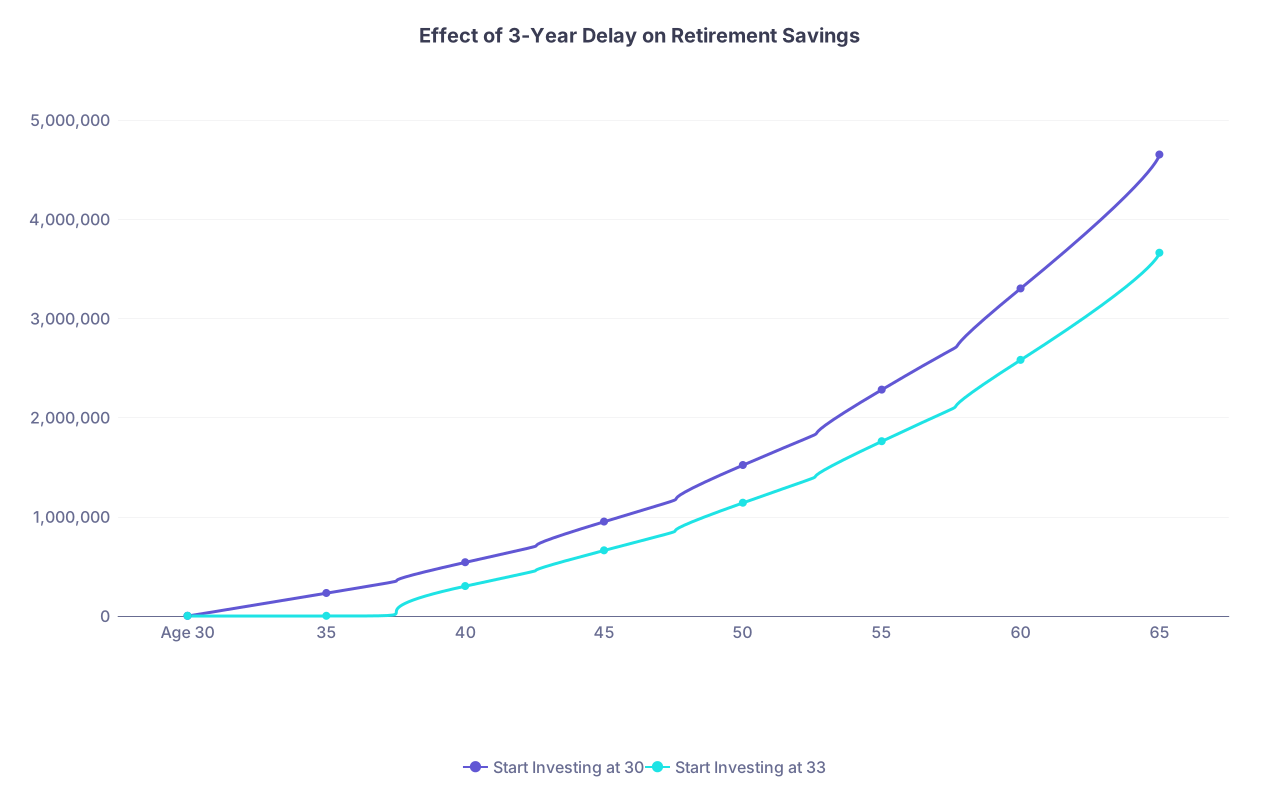
| Category | Start Investing at 30 | Start Investing at 33 |
|---|---|---|
| Age 30 | 0 | 0 |
| 35 | 230000 | 0 |
| 40 | 540000 | 300000 |
| 45 | 950000 | 660000 |
| 50 | 1520000 | 1140000 |
| 55 | 2280000 | 1760000 |
| 60 | 3300000 | 2580000 |
| 65 | 4650000 | 3660000 |
Step 6: Academic vs Private Practice – Huge Swing Factor
Subspecialty pay drops dramatically in pure academic settings for many fields.
Example (rough, real-world style):
- Private practice GI: $550k–$800k+
- Academic GI: $300k–$450k (sometimes lower early on)
- Academic Endocrine: $190k–$260k
- Academic Hospitalist: $220k–$280k
If you’re doing fellowship because you want to be academic and stay academic:
- The pay bump for some fellowships is much smaller.
- In some cases, an academic hospitalist or generalist might match or exceed certain subspecialties.
So if your dream life is half-clinical, half-research at a big-name place, don’t assume “fellowship = big money.” For many academic paths, fellowship is more about doing the work you like and less about maximizing cash.
Step 7: A Simple Framework to Decide if Fellowship Boosts Lifetime Earnings
Here’s the quick-and-dirty framework you can literally sketch on scrap paper on call.
Write down:
- Base specialty salary you’d realistically earn in your desired region (not fantasy top 1%).
- Subspecialty salary in that same region and setting (academic vs private).
Estimate:
- Fellowship length: 1, 2, or 3 years.
- Career length after finishing (what age do you actually see yourself working to? 55? 60? 65?)
Run these three numbers (rough is fine):
a) Training cost
(Base attending pay – fellow salary) × fellowship yearsb) Annual pay difference afterward
Subspecialty salary – base specialty salaryc) Years of “benefit”
Career length after fellowship (e.g., finish at 33, retire at 63 → 30 years)Compare:
- Lifetime benefit ≈ annual pay difference × years of benefit
- Net financial upside ≈ lifetime benefit – training cost
If:
- Net upside is multi-millions and you’re okay with the work →
Fellowship probably increases lifetime earnings.
If:
- Net upside is small or negative, and you’re mostly doing it for “prestige” →
Fellowship probably doesn’t increase lifetime earnings enough to justify it on money grounds alone.

| Step | Description |
|---|---|
| Step 1 | Consider Fellowship |
| Step 2 | Estimate base salary |
| Step 3 | Estimate subspecialty salary |
| Step 4 | Count fellowship years |
| Step 5 | Calculate training cost |
| Step 6 | Annual pay difference |
| Step 7 | Career years after fellowship |
| Step 8 | Lifetime benefit |
| Step 9 | Net financial upside |
| Step 10 | Likely boosts lifetime earnings |
| Step 11 | May not be worth it financially |
Step 8: Non-Financial Factors That Still Affect Your Money
You’re not a robot. So a few realities:
- Malpractice risk and stress: Some high-paying fields carry more risk and psychic load. That can push people into early retirement or downshifting.
- Geographic flexibility: Hospitalists and generalists can often work almost anywhere. Some narrow subspecialties are tied to big centers. That affects COL, housing, and overall net worth.
- Side income: Certain specialties lend themselves to:
- Procedures in-office
- Telemedicine
- Consulting
- Industry roles Which can quietly dwarf your clinical W-2 over 20–30 years.
When you zoom out, the better question isn’t “Does fellowship increase earnings?” but:
“Does this fellowship plus the jobs it unlocks give me a career where I can sustainably earn and invest well for 20–30 years?”
That’s where wealth comes from.

FAQ: Fellowship and Lifetime Earnings (7 Questions)
1. Does doing a fellowship usually increase lifetime earnings?
For high-paying subspecialties that clearly out-earn the base specialty (GI, Cards, some Heme/Onc, Pain, IR, some surgical subs), yes, it usually boosts lifetime earnings by a lot, even accounting for lost early income and compounding.
For low-paying or equal-paying subspecialties (Endocrine, ID, Geri, some Peds subs), no, it often doesn’t meaningfully increase lifetime earnings and can even lower them.
2. Which fellowships are typically the best financial moves?
Consistently strong from a pure money standpoint:
- GI, Cards, Heme/Onc from IM
- Pain from Anesthesia or PM&R
- IR from Diagnostic Radiology
- Some surgical fellowships (orthopedic subs, plastics, certain ENT subs) when tied to strong private practice models
These usually combine relatively short extra training (1–3 years) with big, durable salary jumps.
3. Are there fellowships that are almost never worth it financially?
From a strictly financial lens, fellowships where:
- Pay is equal or lower than base specialty
- Training is 2–3 additional years
- Jobs are heavily academic and lower-paying
Common examples: Endocrinology, ID, many Geriatrics and Palliative Care roles, several pediatric subs in lower-paying markets.
Important caveat: They may still be absolutely “worth it” if you love the field and prefer the day-to-day work. Just don’t fool yourself that it’s a big financial upgrade.
4. How much does academic vs private practice change the calculation?
A lot.
In private practice, many subspecialties crush the base specialty on income. In academia, the spread shrinks or even reverses. An academic hospitalist might earn similar or more than an academic endocrinologist or ID doc.
So if you’re planning an academic career, you need local, specialty-specific salary data before assuming fellowship increases your lifetime earnings.
5. Does a one-year fellowship usually pay off?
Most 1-year fellowships that lead to a salary bump of even $50k–$100k/year probably pay off over a 20–30 year career. The opportunity cost is smaller and you get more years at the higher rate.
Examples: Some EM fellowships (like peds EM in high-demand markets), certain anesthesia or PM&R subs, specific surgical subs. You still need to check your specific field and job market.
6. How should medical school debt affect my decision?
Big debt amplifies the cost of delaying attending income:
- More years of low payment or IDR.
- Higher accrued interest.
- Fewer years of big payments and investing.
If you’re sitting on $400k+ of loans, a low-paying fellowship that delays real money may be a genuine financial anchor. Conversely, a high-paying subspecialty can be an efficient way to kill that debt quickly, if the pay bump is large and durable.
7. Bottom line: Should I choose fellowship mainly for money?
No. Use money as a tiebreaker, not the primary reason.
Do fellowship if:
- You like that work more than your base specialty.
- The job market is solid.
- The lifestyle is acceptable to you.
- And yes, ideally the financials aren’t terrible.
Key idea: A slightly lower-paying specialty you enjoy and can do for 30 years will usually beat a high-paying field you hate and leave in 10.
Key Takeaways
- For high-earning subs (GI, Cards, IR, some surgical fields), fellowship usually does increase lifetime earnings by a big margin.
- For lower-paying subs (Endo, ID, Geri, many Peds subs), fellowship often does not increase lifetime earnings and can reduce them.
- Run your own rough numbers—base vs subspecialty pay, fellowship length, career duration—then layer on reality: burnout risk, lifestyle, and where you actually want to live and work.