
Your clinical gaps are not a secret waiting to explode. They’re a pattern you can learn to explain.
If you’re anything like me, you’re not just “aware” of your weaker rotations or missing experiences—you’re mentally replaying every awkward patient interaction, every mediocre eval, every block where you felt completely lost and just tried not to get in the way. And now residency interviews are coming and you’re thinking:
“They’re going to see it. They’re going to ask. And I’m going to freeze.”
Let’s take that fear seriously and then strip it of its power.
Step 1: Stop Pretending the Gap Doesn’t Exist
The worst strategy is denial. Program directors read your application like a radiology report. They’re trained to look for:
- Missing or weak clinical experiences (no ICU, no acute care, no sub‑I in your chosen field)
- Uneven clerkship grades (Honors → Pass roller coaster, sudden drop)
- Red flags: failed rotation, professionalism comment, remediation, long leave of absence
You already know your soft spots. Say them out loud:
- “I never had a proper inpatient medicine rotation.”
- “I have almost no ICU exposure.”
- “I struggled badly in surgery and it shows on my evals.”
- “I took a leave during core clerkships.”
- “I switched specialties late and my clinicals don’t match my current interest.”
That thing you’re praying they “won’t notice”? They’ve already noticed.
The goal is not to hide it. The goal is to control the narrative before your brain spins out on interview day.
Step 2: Name the Exact Clinical Gap (Not the Vague Cloud of Doom)
You can’t prepare a good answer if your fear is just: “My clinical stuff is weak.”
Make it specific. Clinical gaps usually fall into a few buckets:
| Gap Type | Example |
|---|---|
| Missing Setting | No inpatient or ICU experience |
| Missing Specialty Exposure | No sub-I or elective in desired field |
| Performance Dip | Low grade or fail on a key rotation |
| Timeline Disruption | Leave of absence or delayed rotations |
| Limited Volume | Few hands-on procedures or sick patients |
Pick which one(s) are yours. Be brutally specific:
- “I have no dedicated ICU month.”
- “I didn’t get a sub‑I in internal medicine before applying IM.”
- “My first inpatient rotation evals were bad. I looked unmotivated because I was overwhelmed.”
- “I had a 6‑month leave and came back rusty.”
- “My clinical school was light on acute care—lots of outpatient, few really sick patients.”
Once you name it clearly, you can actually build an answer around it instead of just radiating vague shame.
Step 3: Understand What Program Directors Actually Worry About
This part’s uncomfortable but you need to hear it. PDs don’t care about your ego. They care about risk.
Under all their polite interview questions, they’re asking:
- “Will this person be safe with patients?”
- “Will they crumble on nights or in the ICU?”
- “Will they need constant hand‑holding?”
- “Are they going to bring drama, remediation, or professionalism issues?”
Your job is not to convince them you’re flawless. They already know you’re not. Your job is to show:
- You see your own weaknesses clearly
- You’ve already taken real steps to patch those gaps
- You can learn fast and handle steep learning curves
- You won’t hurt patients while you’re catching up
So when you build answers, you’re not dodging blame, you’re doing damage control around perceived risk.
Step 4: Build a Safe 3-Part Structure for Any “Gap” Question
You do not want to be improvising when they say, “Tell me about your surgery rotation” and your brain flashes back to the time you handed the attending the wrong end of the scalpel.
Use one template for all “weakness/gap” questions:
- Brief, honest description of the gap
- Specific action you took (or are taking) to address it
- Concrete outcome or what you learned that will help you as a resident
That’s it. No soul-baring monologue. No five-minute confession.
Here’s how it sounds in practice.
Example: No ICU experience (for IM or anesthesia)
Acknowledge
“I’m aware I don’t have a dedicated ICU month on my transcript, which is unusual for applicants in this specialty.”Action
“Once I realized that, I did two things: I chose an inpatient-heavy sub‑I with a high acuity census, and I asked to pre-round on the sickest patients so I’d get comfortable with vasopressors, vent settings, and rapid clinical decision-making. I also completed an online critical care course through [X platform] to build my knowledge base.”Outcome
“By the end of the sub‑I, I was presenting complex ICU patients on rounds and writing notes that my senior only had to lightly edit. I know I’ll have a learning curve with ICU, but I’ve already lived that feeling of being new and ramping up quickly in a high-acuity setting.”
That’s a safe answer. You’re not pretending. You’re not overexposing. You’re framing.
Step 5: Script “Minimum Safe Answers” for Your Real Fears
Let’s go through some of the scenarios that make people’s stomach drop and turn them into usable answers.
1. “I bombed a core rotation and they’re going to ask why.”
They might. Especially if it’s a key one for your specialty.
Unsafe answer:
“I just had a bad attending, the rotation was toxic, I didn’t get along with them.”
Safe-ish, professional answer using the 3-part structure:
Acknowledge
“My lowest clerkship evaluation was on surgery. The transition to that environment was honestly rough for me.”What you changed
“I realized I needed to be much more proactive and communicative, so on my next rotation I started pre-reading cases, explicitly asking seniors how they liked things done, and checking in for feedback mid-way instead of waiting until the end.”Result
“Since then my feedback’s been more consistent, and I carried those habits into my sub‑I, where my evals reflected better independent functioning and communication. I’m glad I learned that lesson early, even if it was painful at the time.”
Notice: no trashing of the attending. No long story. You own what you can own.
2. “I have almost no exposure to the specialty I’m applying to.”
This one’s brutal when you’re a late switch or from a small school.
Unsafe answer:
“I just didn’t get the chance. My school sucks for this specialty.”
Safer answer:
Acknowledge
“You’re right that I don’t have as much formal clinical time in [specialty] as many applicants.”Compensating moves
“Once I realized I was genuinely drawn to [specialty] late in third year, I arranged two away rotations, sought out a mentor in the field, and joined call whenever they’d let me. I also made sure my sub‑I was in a related field with high overlap in clinical skills.”Outcome
“Those experiences confirmed that this is the right fit for me, and they helped me see exactly where I’ll need more support starting intern year—particularly with [specific skill], which I’ve started reading and practicing via [resource/sim lab/online modules].”
You’re still not pretending it’s ideal. You’re showing you didn’t just drift into the specialty blindly.
3. “My clinical school just didn’t give me good exposure. I feel undercooked.”
You’re not alone. A lot of people come from schools where they barely touched a truly sick patient.
Unsafe answer:
“My school barely taught us anything clinically.”
Safer:
Acknowledge
“My school’s clinical rotations are very outpatient-heavy, so my exposure to really acute, complex patients has been more limited than I’d like.”What you did
“To push myself, I chose electives at our main teaching hospital, volunteered to see higher-acuity patients when possible, and started doing case-based practice on my own with resources like [X] to simulate acute scenarios.”Why you’ll still be okay
“I know I’ll need a steeper learning ramp at the beginning, but that’s also why I’m looking for a program that offers strong early supervision and teaching. I tend to improve quickly when I’m getting a lot of reps and direct feedback.”
That last line is important. You’re admitting the steeper ramp while signaling you’re coachable.
Step 6: Build a “Risk Reassurance” Sentence for Each Gap
PDs have limited patience. You want one line in your answer that says, clearly: “I am not a danger.”
For each gap, literally write a one‑sentence reassurance:
No ICU: “I’ll absolutely need teaching and repetition at first, but I’m not afraid of sick patients and I’ve already sought out higher-acuity experiences to shorten that learning curve.”
Weak evals early on: “The issues from that rotation—mainly under-communicating and not asking for feedback—are things I’ve intentionally worked on, and you can see that trajectory in my later evaluations.”
Limited procedural experience: “I know I’m coming in with fewer procedures logged, so I’m prepared to be very intentional about early skill acquisition, logging, and asking seniors to observe and correct me frequently.”
Write them down. Say them out loud until they don’t feel like you’re lying.
Step 7: Practice Answering Without Oversharing
Anxious people (hi, us) tend to either:
- Clam up and give a 5-word answer, or
- Word-vomit an entire emotional memoir
Both are risky.
Your target length for these “gap” answers: 30–90 seconds. Long enough to show insight and action. Short enough that you don’t start spiraling into extra details they didn’t ask for.
Practice with someone who will literally say “too much detail” when you drift.
If you don’t have that person, record yourself on your phone answering:
- “Tell me about a weaker part of your clinical training.”
- “I see you didn’t have an ICU/sub‑I in this specialty—can you tell me about that?”
- “Can you explain the lower evaluations on [rotation]?”
Then listen. If you cringe, good. That’s where you tighten.
Step 8: Pre-Plan One Concrete Clinical Story You’re Not Ashamed Of
You need at least one “go-to” clinical story you can use for:
- “Tell me about a challenging patient.”
- “Tell me about a time you made a mistake.”
- “Tell me about a time you felt out of your depth clinically.”
Pick something:
- Clinically real but not catastrophic
- Where you clearly learned something that changed your behavior
- That doesn’t make you sound reckless or chronically unprepared
Example structure:
- Brief case: “Middle-aged patient with sepsis who decompensated rapidly on the floor.”
- Your miss: “I didn’t escalate early enough / I anchored on the wrong diagnosis / I didn’t clarify an order.”
- What happened: “Senior stepped in, patient transferred, did okay.”
- Lesson: very specific change in your behavior since then
- Tie-in to residency: how that makes you safer now
You’re aiming for: “I was green. I learned. I won’t repeat that mistake.”
Step 9: Know the Questions That Feel Dangerous (So You Don’t Panic)
Some questions look innocuous but poke right at clinical insecurity. They might ask:
- “What kind of patients make you uncomfortable?”
- “Where do you think you’ll struggle the most intern year?”
- “What feedback have you gotten repeatedly on rotations?”
- “In what areas do you feel least prepared clinically?”
Don’t say “I don’t know.” That reads as lack of insight.
Use this formula:
- Name a real but manageable area (not “basic patient care,” something more specific)
- Show you’ve already started working on it
- Emphasize that you’re open to coaching
Example:
“I still get anxious with complex ventilator management, because my exposure has been limited. To work on that, I’ve been doing case-based practice and reading with [resource], and during my sub‑I I specifically asked residents if I could be the one to present vent settings and changes on rounds. I fully expect to need close guidance at first, but I’m comfortable asking, ‘Can you walk me through your thinking?’ and learning that way.”
That sounds like someone you can teach. Not someone who’s going to wing it and harm people.
Step 10: Accept That Feeling “Behind” Is Normal—But Don’t Say That in the Interview
Here’s the ugly truth no one tells you: most interns feel behind. Even the ones with fancy sub‑Is and strong evals.
The difference is:
- Some people feel behind and say, “So I’m going to overprepare.”
- Others feel behind and say, “So I’m doomed.”
You are not allowed to bring the “doomed” voice into the interview. You can hear it in your head all you want the night before. But in the room, you play the version of you that says:
“I’m aware of my gaps. I’ve started patching them. And I’m ready to keep doing that with real supervision.”
That’s it. That’s the bar.
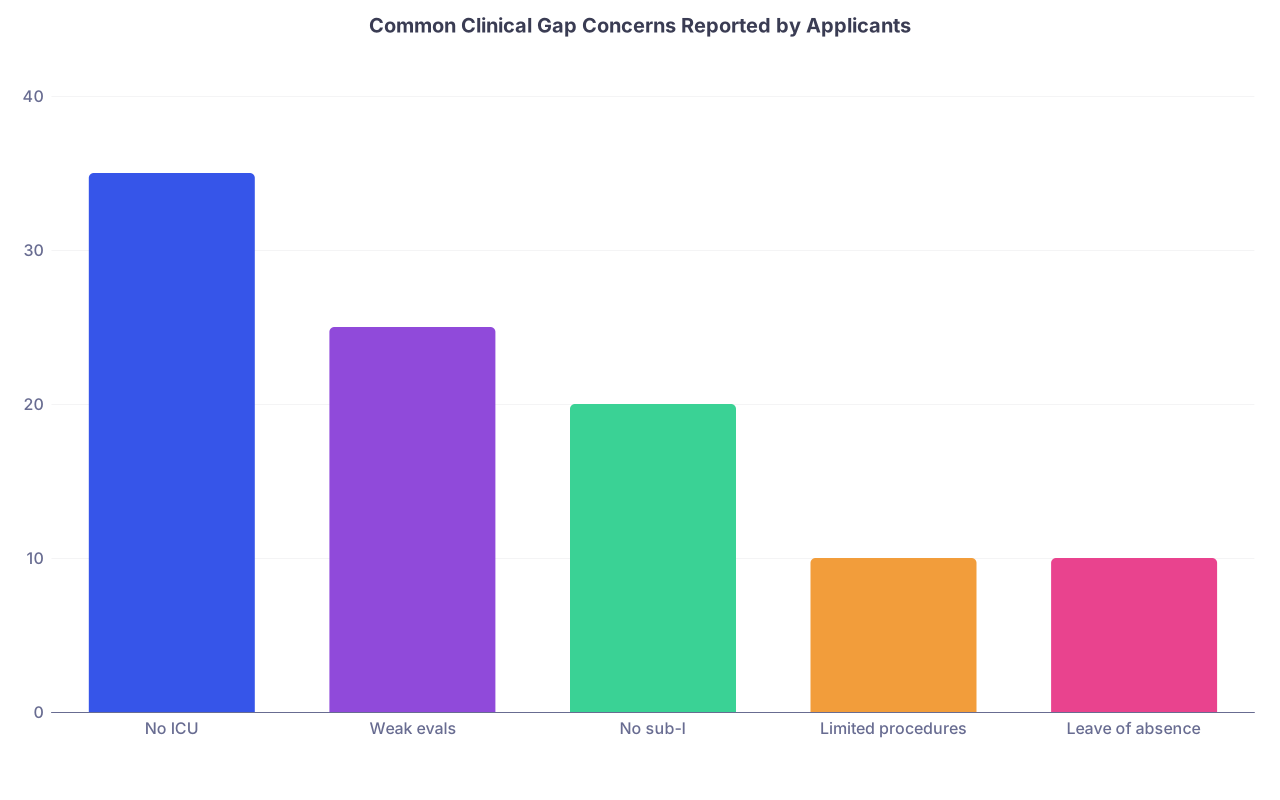
| Category | Value |
|---|---|
| No ICU | 35 |
| Weak evals | 25 |
| No sub-I | 20 |
| Limited procedures | 10 |
| Leave of absence | 10 |

| Step | Description |
|---|---|
| Step 1 | Hear question about gap |
| Step 2 | Pause 1-2 seconds |
| Step 3 | State gap briefly & clearly |
| Step 4 | Describe 1-2 concrete actions you took |
| Step 5 | Share outcome or lesson |
| Step 6 | Add 1 reassurance sentence about residency readiness |


FAQ (Exactly 5 Questions)
1. Should I bring up my clinical gaps myself, or wait for them to ask?
If it’s a major, obvious gap (failed rotation, long leave, no exposure to the specialty you’re applying into), it’s usually better to address it once, briefly, at a natural moment—like “Tell me about your clinical experiences” or “Is there anything else we should know about your training?” Don’t lead with it, don’t keep circling back to it, but don’t act surprised if they mention something that’s clearly visible on your transcript.
2. What if they push back after my initial explanation and I don’t know what else to say?
Have one extra layer ready: a specific example. If they say, “Can you tell me more?” give a short, concrete story from that rotation or experience that shows the problem and what changed. Then stop. If they keep pressing, stay calm and repeat your key point: what you learned and how your later performance improved. You don’t owe them your entire emotional history.
3. How honest should I be about feeling unprepared clinically?
You should be honest about areas you need to grow. You should not say things like “I feel unprepared in general” or “I don’t feel ready for residency.” That’s the nightmare phrase. Translate your feelings into specific, coachable gaps instead: “I need more experience with X,” “I’m still building comfort with Y.” That sounds like insight, not incompetence.
4. My school’s evals are vague and mediocre across the board. How do I talk about that?
You can say, “My school’s evaluations tend to be more narrative and less differentiated, so they may not show the full trajectory of my growth. What I can tell you is that early on, I struggled with [X], and I worked on it by [Y]. My later supervisors commented on [specific improvement].” Then lean on concrete examples and letters of recommendation that highlight your progress.
5. What if my mind goes blank when they ask about a clinical weakness or mistake?
This is exactly why you script and rehearse one go‑to story in advance. If your mind goes blank, use that story. It doesn’t need to be the most dramatic case of your life—just clear, safe, and honest. You can even say, “One example that comes to mind is…” to buy a second. The prep work is what keeps you from panicking into either silence or oversharing.
Key points to walk away with:
- Your clinical gaps are already visible; the power you have is in how you explain them.
- Use a simple structure: name the gap, show what you did about it, and reassure them about your readiness.
- Practice out loud until your answers are calm, specific, and short—so on interview day, your fear doesn’t get to run the show.