
It’s 11:47 PM. Your interview suit is hanging on the closet door. Your ERAS is submitted. You should be sleeping.
Instead, you’re staring at your Step transcript or a shelf exam grade, imagining an interviewer zooming in on that one ugly number and saying:
“So… can you explain this low score?”
And in your head, you freeze. Or ramble. Or start word vomiting defensive explanations. And you’re terrified that this is the moment everything falls apart.
You’re not crazy. This is the question everyone with a blemish dreads.
Let’s walk through this like two people who’ve both sat there staring at that score report thinking, “Well. That’s it. I’m done.”
You’re not done. But you do need to be ready.
Step 1: Be Brutally Clear on What Your “Low Score” Actually Is
Before spiraling, you need to define what you’re even worried about. Programs see a ton of imperfect applications. Not every non-stellar number is a “red flag.”

Common things that trigger the “explain this” anxiety:
- Step 1: borderline pass, fail then pass, or just clearly below that specialty’s usual range
- Step 2 CK: dip compared to Step 1, or score way below program averages
- COMLEX levels: fail or large jump/drop between exams
- Shelf exams or a course/clerkship grade: one or two low outliers
- A semester with multiple low grades or withdrawal/LOA tied to academics
Here’s the part no one tells you: programs don’t care equally about all of these.
A single low shelf exam? Annoying, but usually not a huge deal.
A failed Step score? That will come up and you need a crisp, mature answer.
To keep your brain from catastrophizing everything, separate “I wish this were better” from “This needs a clear explanation.”
| Issue | Likely to Need Explanation? |
|---|---|
| Step 1 just above pass | Sometimes |
| Step 1/2 fail, then pass | Almost always |
| Step 2 lower than Step 1 | Sometimes |
| One shelf exam low | Rarely |
| Multiple course failures | Almost always |
If you’re not sure which bucket you’re in, assume they might ask. Then you’re pleasantly surprised if they don’t.
Step 2: Understand What They’re Actually Asking
They are not asking:
- “Are you dumb?”
- “Convince me this doesn’t suck.”
- “Explain why you ruined your life.”
Even though that’s what it feels like as soon as you see that score on a slide in your nightmares.
What they really want to know:
- Do you take responsibility without collapsing into shame or excuses?
- Can you analyze what happened like an adult, not like a panicked student?
- Did you change your behavior afterward in a sustained way?
- Are you going to fall apart the first time you struggle in residency?
You’re not on trial for the number itself. You’re being evaluated on your insight, maturity, and trajectory afterward.
I’ve seen people with a Step 1 fail match into solid IM and FM programs because they owned it, showed growth, and had strong clinical performance. I’ve also watched people with only slightly low scores torpedo their own interviews by getting defensive, blaming the test, or oversharing personal chaos they hadn’t really processed.
The score is the setup.
Your response is what they remember.
Step 3: Build a Simple 3-Part Structure for Your Answer
Don’t improvise this. If you wing it, you’ll ramble, apologize 40 times, and probably say too much.
Use a strict structure:
- Briefly state what happened.
- Explain what you learned / what changed.
- Show evidence of improvement.
That’s it. Short, controlled, and forward-looking.
1. Briefly State What Happened
This is the part you’re tempted to over-explain. Don’t.
Bad version:
“I had a lot going on, there were some personal issues with my family and then I also didn’t really understand how to study for this exam, and my school didn’t really support us, and then on test day there was noise, and honestly I think the score doesn’t reflect my knowledge because I’d been doing well on practice tests except that week—”
Good version:
“During my initial preparation for Step 1, I didn’t use an effective strategy and I underestimated how much structured repetition I needed. That contributed to my low score/failure.”
If you had a real, concrete disruption (illness, family death, hospitalization), you can mention it. But keep it clean and not melodramatic.
Something like:
“During that exam period, I had a significant family health crisis that affected my focus and routine. I didn’t recognize soon enough that I needed to adjust my schedule and seek support, and my score reflects that.”
Notice: you’re not asking for pity. You’re explaining context and taking responsibility.
2. Explain What You Changed
This is the meat.
Programs are quietly asking: “If we train this person, will they crash and burn on future in-training exams or boards?”
So you answer that directly by walking them through specific changes.
Not “I worked harder.”
More like:
- Switched to a structured schedule with spaced repetition (Anki, question blocks, dedicated time).
- Got tutoring or faculty support.
- Started tracking performance and adjusting earlier.
- Fixed underlying issues: time management, test anxiety, over-studying the wrong things, etc.
Example:
“After that score, I sat down with our academic support office, reviewed where my approach broke down, and completely overhauled my study system. I moved to daily question blocks, consistent spaced repetition, and weekly check-ins with a mentor. That structure made a huge difference for me.”
Short. Concrete. Adult.
3. Show Evidence of Improvement
You need receipts.
- Higher Step 2 score
- Strong shelf exams afterward
- Honors in relevant rotations
- Program director / clerkship director comments in your MSPE about improvement
Example answer segment:
“You can see the impact in my later performance. My Step 2 CK score improved by 25 points, and my clinical clerkship evaluations consistently comment on my preparation and reliability.”
If your Step 2 wasn’t dramatically better but your clinical work was, lean harder on that. If both were rough, focus on trajectory and what’s currently in place (like ongoing systems, coaching, stable circumstances).
Step 4: Actually Script and Practice the Answer (Out Loud)
Here’s where people blow it: they “have an idea” of what they’ll say, but never actually say it out loud until they’re in front of a PD.
Don’t do that to yourself.
Write it out. Then cut it down until it’s:
- 60–90 seconds
- Calm in tone
- Not dripping in shame or defensiveness
Something like:
“You’re right to notice that my Step 1 score is lower than the rest of my record. At that time, I underestimated how much structured review I needed and relied too heavily on passive studying. I also didn’t ask for help early when I realized I was falling behind.
After that, I met with our academic support team, built a very structured schedule based on daily question blocks and spaced repetition, and started tracking my progress with weekly goals. I also learned to be more proactive in seeking feedback when I’m struggling.
You can see that change in my Step 2 CK score, which improved by 22 points, and in my clinical clerkship evaluations, where attendings consistently noted my preparation and knowledge base. The experience was humbling, but it forced me to build the habits I’ll rely on during residency.”
Practice that until it feels almost boring. Boring is good. Boring = controlled, not spiraling.
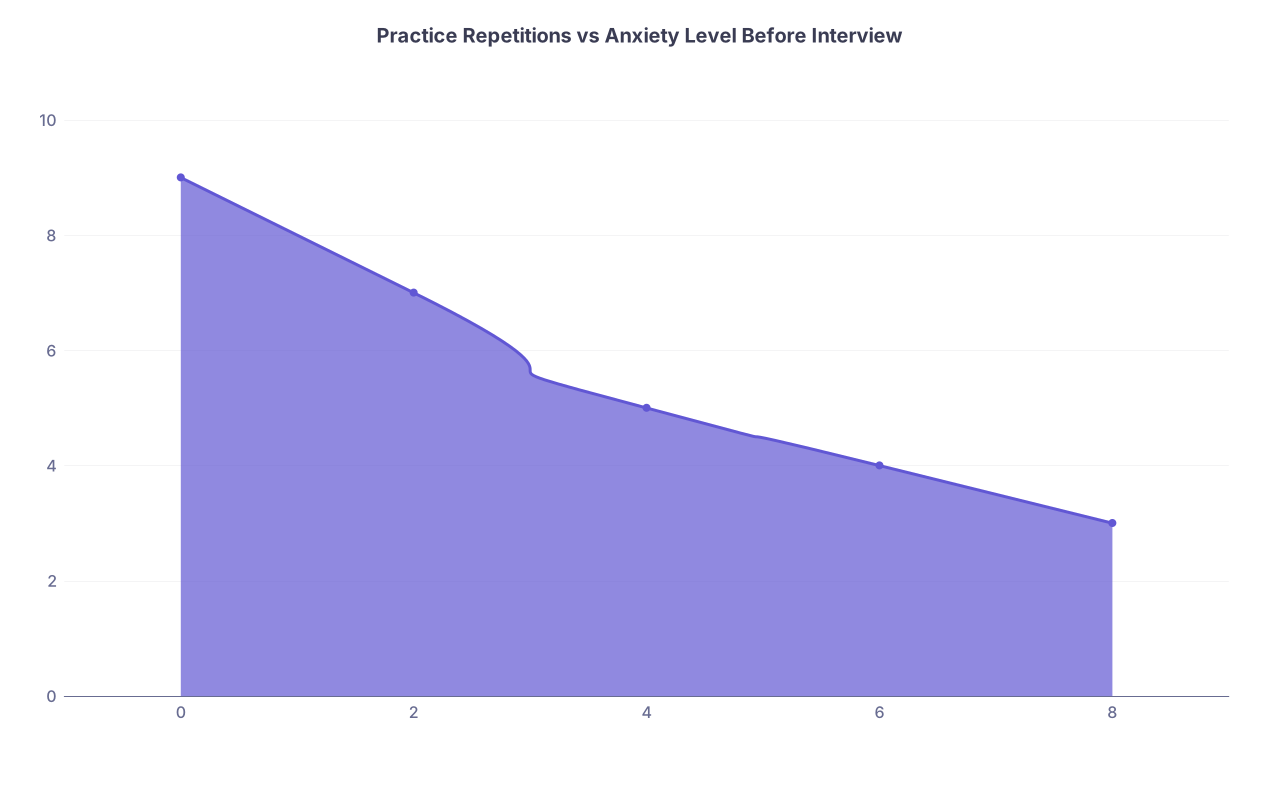
| Category | Value |
|---|---|
| 0 | 9 |
| 2 | 7 |
| 4 | 5 |
| 6 | 4 |
| 8 | 3 |
Step 5: Avoid the 4 Common Self-Sabotage Moves
This is where anxious people (hi, us) tend to overcorrect and make it worse.
1. Over-disclosing personal trauma
You don’t owe strangers your entire medical and family history on Zoom.
If mental health, illness, or family crises were part of it, you can say:
“I was going through a significant personal/health challenge at the time, which affected my performance. Since then I’ve been in stable treatment/support and have systems in place that are working well.”
If they want more detail, they’ll ask. Most won’t.
2. Blaming the exam or the school
Even if your school did screw you over with late NBME access and garbage lectures, throwing them under the bus looks bad.
“I didn’t get enough support from my school” → red flag.
“I didn’t realize early enough that I needed extra structure, but I’ve since built that myself” → much better.
3. Turning the whole interview into a confessional
Answer the question, then move on. Don’t keep circling back to your score like it’s the defining feature of your application.
You want the interviewer thinking, “Okay, they handled that,” and then remembering your research, your letters, your personality. Not just your mistake.
4. Trying to spin it into something unrealistically positive
You don’t need to say, “Failing Step 1 was the best thing that ever happened to me.” It wasn’t. It sucked.
You can be honest:
“It was extremely difficult and humbling, but it pushed me to change how I work, and those changes have been very positive.”
That’s enough.
Step 6: Prepare Variations for Different Flavors of the Question
They may not say, “Explain this low score.” They might say:
- “Walk me through your board performance.”
- “Is there anything in your academic record you’re concerned about?”
- “Can you talk about your Step 1 experience?”
- “If you had to list an academic weakness, what would it be?”
You don’t need four totally different speeches. You just need to be able to:
- Give the full structured answer when they point at a specific exam
- Give a shorter version if it’s part of a broader question
- Tie it into a “weakness” answer without sounding like a rehearsed cliché
For example, for “What’s your greatest weakness?” you might say:
“Earlier in medical school, I struggled with building effective study systems, which you can see reflected in my Step 1 score. I learned from that and now I’m very intentional about using structured review, question banks, and early feedback. That shift is reflected in my Step 2 and clerkship performance. So it’s still something I’m conscious of, but I’ve turned it into an area of active strength.”
Same content. Different packaging.
Step 7: Deal With the Anxiety That This One Question Will Ruin Everything
You’re probably doing the mental math:
“One bad answer = no rank = no match = career over.”
Reality is messier. I’ve watched interviewers:
- Ask about a low score, nod once, and never mention it again
- Rank people highly despite fails because they loved them clinically
- Get far more hung up on weird personality vibes than on imperfect transcripts
Your goal isn’t to “convince them the score is good.” You can’t. The number is the number.
Your goal is to:
- Look like someone who can take a hit and adjust
- Show you already figured out how to prevent it from happening again
- Shift their mental picture from “risky” to “resilient and self-aware”

| Step | Description |
|---|---|
| Step 1 | See low score on application |
| Step 2 | Focus on rest of file |
| Step 3 | Hear explanation |
| Step 4 | Perceived as risky |
| Step 5 | Perceived as resilient |
| Step 6 | Lower rank |
| Step 7 | Rank based on full picture |
| Step 8 | Ask about it? |
| Step 9 | Response quality |
You can’t control who they rank above you. You can control which branch of that diagram you land in.
Quick Reality Check: How Often Do They Actually Ask?
Programs are variable. Some literally have a checklist: “Address Step failure? Y/N.” Others don’t care unless it’s extreme.
Rough rule from what I’ve seen and heard:
- Single borderline-low but passing score, strong Step 2: maybe half will ask, many won’t.
- Clear fail on a major exam: expect it to come up at least once at every program.
- Pattern of underperformance followed by clear upward trend: often asked, but it can actually turn into a positive story if you handle it well.
And yes, some interviews will completely ignore it. You will walk out thinking, “Did they even notice?” They did. They just decided your file already answered it, or they didn’t care enough to ask.
Still prepare like it will come up. That’s how you sleep the night before.
FAQs
1. Should I bring up my low score if they don’t ask?
No. Don’t volunteer it randomly. They already saw it. If an open door appears—like “anything in your academic record you want to explain?”—you can give the short version. But don’t introduce it out of nowhere in answers where it doesn’t belong.
2. What if I don’t have a “good reason” for the low score?
Then you’re in the majority. Most low scores are from boring things: bad strategy, underestimating, poor time management. That’s fine. Be honest:
“I misjudged how prepared I was and didn’t use an effective strategy. I changed X, Y, Z afterward, and you can see that in my later performance.”
Owning a mundane mistake looks better than forcing a dramatic story.
3. My Step 2 is also not great. What can I possibly say?
You focus harder on systems, support, and current stability. Talk about what you’ve learned, what you’re doing now (e.g., regular question blocks, faculty mentorship, coaching), and how your clinical feedback doesn’t mirror your test performance. You can’t pretend the numbers are strong, so you lean on trajectory, insight, and the fact that you’re actively working on this, not ignoring it.
4. Can one low score actually keep me from matching?
Yes—if it’s combined with other issues (poor letters, no improvement, bad interviews, attitude problems). On its own, especially with growth afterward, it’s usually a speed bump, not a wall. Your job is to make sure that when they think about that score, they immediately also think, “Right, and then they turned it around.”
If you remember nothing else:
- The point isn’t to redeem the score; it’s to show growth, stability, and maturity.
- Use a simple structure: what happened → what changed → how you improved.
- Practice out loud until your answer feels boring. Boring is calm. Calm is convincing.