
The thing everyone is secretly afraid of in residency interviews isn’t answering a hard question. It’s losing control. Getting choked up. Actually crying.
Let me say this bluntly: crying in an interview is not an automatic rejection.
You’re not a robot. Programs know that. The people interviewing you have watched patients die, have cried in stairwells themselves, have had to tell families their loved one isn’t coming back. Emotional people become doctors all the time.
But I get it. You’re not worried about “being human.” You’re worried about:
- Your voice shaking.
- Your eyes tearing up and you trying to blink it away.
- Full-on crying and not being able to stop.
- The interviewer thinking you’re unstable, unprofessional, or “too sensitive for this specialty.”
So let’s deal with it like adults who catastrophize at 2 a.m.
We’re going to walk through:
- Why you’re scared of this (and what’s actually realistic)
- What interviewers really think if you get emotional
- How to reduce the chance you’ll cry
- What to do in the moment if it starts happening
- How to recover after and not spiral for days
And yes, we’ll deal with actual worst-case scenarios.
Why This Fear Feels So Huge
You’re not just afraid of tears. You’re afraid of what they mean.
You’re probably thinking some version of:
- “If I cry, they’ll think I can’t handle stress.”
- “If I get emotional, they’ll assume I’m not cut out for this specialty.”
- “Everyone else will be composed and I’ll be the weird one.”
- “I’ll lose my train of thought and ruin my whole interview.”
- “This is my one chance and I’ll blow it because my body betrays me.”
And there’s usually a backstory:
You’ve got a patient death that still lives too close to the surface.
Or a family illness.
Or burnout from rotations.
Or you’ve had a faculty member in the past say some garbage like, “You can’t cry in front of patients,” and it stuck.
Here’s the uncomfortable truth: the higher the stakes feel, the more your body will do its own thing. Residency interviews are peak “my body hates me” environments.
So let’s stop pretending you can just “decide not to cry.”
You might cry. You might not. We’re planning for both.
What Interviewers Actually Think When You Get Emotional
I’ve seen both sides of this. I’ve seen applicants cry. I’ve seen faculty react. And almost nobody reacts the way your 3 a.m. anxiety says they will.
Let’s break it into realistic outcomes.
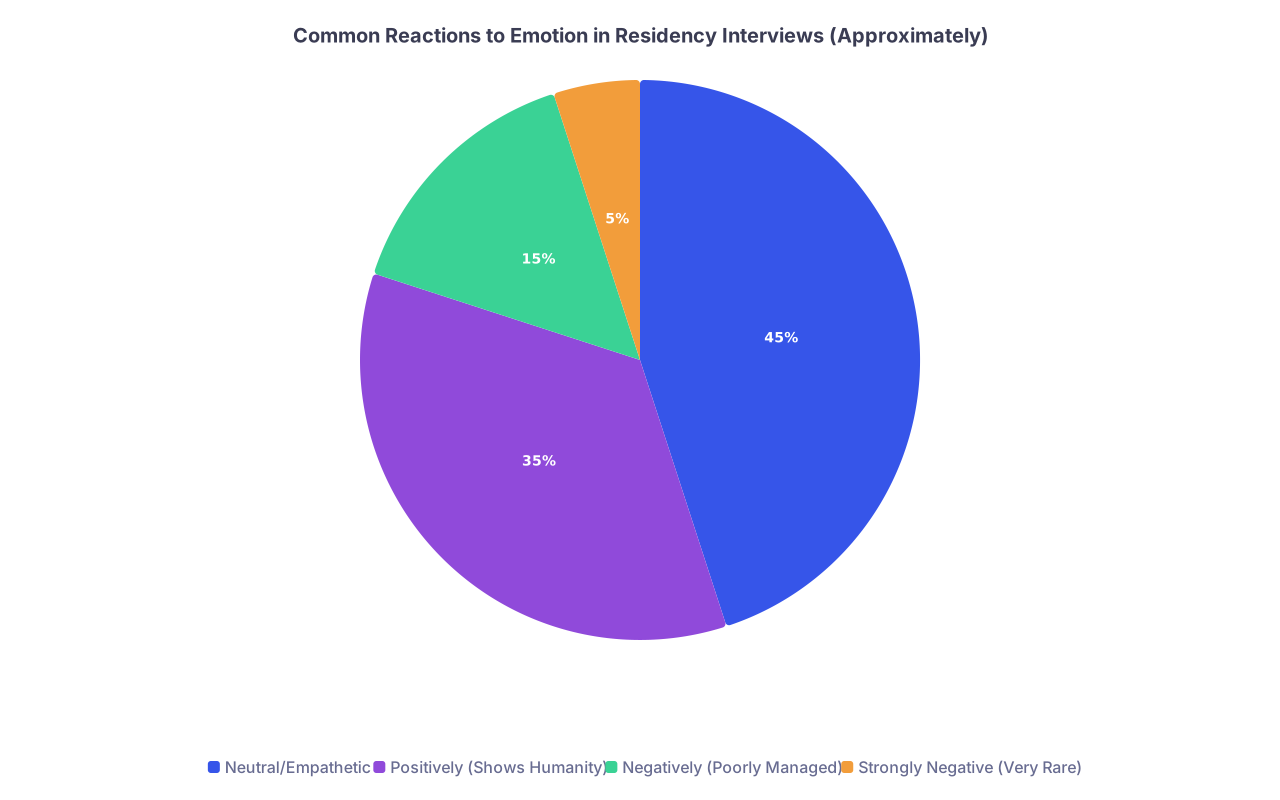
| Category | Value |
|---|---|
| Neutral/Empathetic | 45 |
| Positively (Shows Humanity) | 35 |
| Negatively (Poorly Managed) | 15 |
| Strongly Negative (Very Rare) | 5 |
1. The most common reaction: neutral but kind
You get choked up talking about a patient or a hardship. Your voice shakes, you pause, maybe your eyes water.
Typical interviewer response:
- They pause.
- They soften their face.
- They say something like, “Take your time.”
- Then you both move on.
This doesn’t go in their notes as: “Applicant = unstable.”
It goes in their brain as: “That story really mattered to them.”
2. The positive reaction: “This person actually cares”
Especially if the emotion comes up when:
- You talk about a meaningful patient
- You describe a hardship you’ve worked through
- You mention family, grief, or serious illness
- You share why this specialty matters so much to you
A controlled, understandable emotional reaction can make you feel more real and memorable. As long as you recover and keep talking.
3. The potentially negative reaction: if it looks unmanaged
Where this can tilt against you:
- You completely shut down and can’t continue
- You never answer the actual question
- You cry in response to routine feedback or mild stress, not an emotional story
- You appear blindsided by a topic you should’ve anticipated
That doesn’t automatically kill your chances, but yes, it can raise a quiet flag in their heads: “How will they do during codes, bad outcomes, long nights?”
4. The rare but real worst-case: judgey interviewer
There are some blunt, old-school, not-emotionally-brilliant people who do see any tears as weakness. This sucks. But it’s reality in a few programs.
Here’s the thing:
Those are usually not the programs you’d actually want to train at.
Is this comforting in the abstract? Maybe. Does it help at 2 a.m. when you’re spiraling? Not really. So let’s talk control.
Step 1: Reduce the Chance You’ll Cry Before You Even Log Onto Zoom
You can’t uninstall your tear ducts, but you can stop setting them up to fire.
Know your emotional landmines
Sit down and brutally ask yourself:
- Which stories in my ERAS/personal statement still hit hard?
- Which patient do I avoid thinking about because I tear up?
- What family/personal things are super raw for me right now?
Now do something most applicants never do: decide your boundaries ahead of time.
You can:
- Gently steer away from raw stories if asked for “a meaningful patient”
- Choose a different story you can handle without falling apart
- Prepare a brief, practiced explanation for personal hardships that doesn’t drag you into the emotional center of it
You don’t owe full emotional access to strangers to get a residency spot.
Script your “hard questions” before they ask them
If there’s a topic that wrecks you emotionally, that’s exactly the thing an unprepared brain will mumble about and cry through.
Common triggers:
- “Tell me about a time you made a mistake.”
- “Can you talk about this gap in your CV?”
- “I see you took time off – what happened?”
- “How did you cope with this family illness / loss you mentioned?”
Write out a 3–4 sentence answer to each of these. Out loud. Practice until the words stop feeling like a punch in the chest.
You’re not erasing the emotion. You’re giving it structure.
Step 2: What To Do If You Feel Yourself About To Cry
Here’s the part nobody explains clearly. Let’s say you’re mid-interview and you feel it:
(See also: Terrified of Zoom Glitches During Residency Interviews? Backup Plans for backup plans.)
The throat tightening.
The heat behind your eyes.
That horrible “oh no, not now” feeling.
You still have options.
Use a simple pause script
Memorize one of these and use it exactly as is:
- “Sorry, this is a really meaningful experience for me. Do you mind if I take a second?”
- “I’m okay, this just hits close to home. One moment?”
- “Give me just a second, this was a really formative time for me.”
Then: stop talking. Breathe out slowly.
In through your nose, out through your mouth, at least twice.
Most interviewers will nod and wait. Some will even say, “Of course.”
Ground yourself physically
Tiny things that help when emotion spikes:
- Press your feet firmly into the floor
- Gently press your tongue to the roof of your mouth
- Very lightly press your fingertips together under the table
- Look slightly down or away for a second instead of right into their eyes
You’re basically telling your body: “I’m here, not in that memory.”
Then finish the damn answer
This is the key.
Emotion itself isn’t the issue.
Whether you finish your thought is.
After your pause, pick up with something like:
- “So what I took away from that experience was…”
- “That situation really shaped how I approach patients because…”
- “Since then, I’ve tried to…”
You’re signaling: Yes, I feel this, and yes, I can still function.
Step 3: Handling Different “Levels” of Emotion
Let’s be specific. Different scenarios, different moves.

1. Slightly teary, voice a little shaky
Honestly? This is fine.
You don’t even necessarily have to comment on it. You can just:
- Pause very briefly
- Take a breath
- Keep going
If it feels weird not to address it:
“Sorry, that experience really stayed with me. Anyway, what I learned from it was…”
This usually lands as: human and reflective.
2. Actual tears forming, you need to wipe your eyes
This is where it feels like a disaster to you. From the outside, it usually doesn’t.
You can say:
“Sorry, this still gets to me. I’m okay, just give me one second.”
Wipe your eyes, small smile if you can manage it, breathe, then continue. Do not apologize 20 times. Once is enough.
3. You start crying more than you wanted and can’t talk
This is the nightmare scenario, right?
Here’s your move:
- Stop talking mid-sentence.
- Say, “I’m so sorry, could I just have a minute?”
- Look slightly down or away, breathe, don’t try to talk through it.
- If it doesn’t stop within ~20–30 seconds, say:
“I think I might be a little more emotional about this than I expected. Would it be okay if we moved to a different question and I can circle back to this later if needed?”
You are allowed to ask that. And many interviewers will say yes.
Does this hurt you a bit? Possibly. But it’s very different from completely falling apart and never recovering.
Step 4: What Actually Looks Bad (And How To Avoid It)
Let’s be harsh for a second, because I know that’s what your worst-case brain is already saying.
Things that can hurt you:
- Making the interview primarily about your own unresolved trauma with no reflection
- Responding with tears to basic stress questions like “Why this specialty?”
- Becoming so emotional that you’re unable to answer multiple questions
- Appearing surprised by obvious questions about things you chose to reveal in your application
The workaround isn’t “don’t feel.” It’s:
- Only share what you can talk about without fully unraveling
- Practice high-risk answers out loud until they feel manageable
- Keep coming back to: What did I learn? How did I grow? How does this affect how I’ll be as a resident?
You want them to think: “They’ve been through stuff, and they’re thoughtful and functional,” not “They’re still in the middle of it and can’t cope.”
Step 5: If It Already Happened and You’re Spiraling
(Related: Introvert Facing Residency Interviews: How to Survive Long Interview Days)
Maybe you’re reading this after an interview where you cried and your brain is screaming:
“That’s it, I’m not matching. They all think I’m a disaster.”
Let’s be clinical for a second.
| Scenario | Likely Impact |
|---|---|
| Mildly teary once, finished answer | Basically zero to mildly positive |
| Teared up in 2–3 emotional answers | Neutral to slightly positive if coherent |
| Brief crying, recovered and continued | Some risk, but far from fatal |
| Prolonged crying, couldn’t continue | Possible negative impact at that program |
If you:
- Answered the question
- Eventually gathered yourself
- Didn’t turn the whole interview into an apology tour
Then it was probably a bigger deal to you than to them.
Should you email them about it? Usually no.
Do not send a long “I’m so sorry I cried” note. If you want to send a thank you email anyway, you can include one line:
“Thank you again for your understanding when I became a bit emotional discussing that experience—it’s one that’s been very meaningful in shaping me as a future [specialty] physician.”
That’s it. You frame it as meaning, not as a meltdown.
Then you move on.
Quick Reality Check: Residents Cry. Attendings Cry.
Let’s be brutally honest.
- PGY-1s cry in call rooms.
- PGY-3s cry in their cars between shifts.
- Attendings cry after brutal family meetings.
The question isn’t: “Will you ever cry as a doctor?”
It’s: “Can you still function, communicate, and take care of patients?”
Showing that you can feel deeply and still put coherent words together? That’s not a bad audition for this life.
Programs that want robots are lying to themselves about what medicine actually looks like. Programs that understand human beings cry are where you’ll actually survive training.
A Simple Practice Plan for This Week
If this fear is chewing at you, here’s what I’d tell you to do today and this week:
Today:
- Open your ERAS personal statement and experiences.
- Circle any story that makes your chest tighten when you read it.
- For each one, decide: keep it for interviews, or quietly retire it?
This week:
- Script 3–4 sentence answers for:
- “Tell me about a meaningful patient.”
- “What’s been the hardest part of medical school?”
- Any gap / LOA / personal hardship in your application.
- Practice these with:
- A friend
- A mirror
- Or worst case: your voice memo app
If you cry during practice? Good. Better now than during the actual interview. Keep repeating until your body realizes, “We’ve done this. We survived.”