
It’s 6:10 a.m. Your alarm just went off for interview day. You barely slept. Your suit is hanging on the door, your stomach is already doing somersaults, and you’re staring at the schedule email that says: “Sign-in 7:30 a.m. – Wrap-up 4:30 p.m.”
Nine hours. Of talking. Of smiling. Of small talk with strangers who are literally deciding your future.
And you’re thinking: “There’s no way I’m built for this. I’m going to run out of words by 10 a.m. and spend the rest of the day sounding like a malfunctioning robot.”
If that’s you, you’re not dramatic. These days are brutal for introverts. I’ve watched perfectly good, thoughtful applicants leave a great impression in the 8 a.m. faculty interview… and then look absolutely fried and flat by the afternoon resident social. Same person. Same brain. Just out of social battery.
Let’s talk about how you get through this without melting down halfway through the day.
First: No, You’re Not Doomed Because You’re Introverted
Let me get this out of the way, because this is the background loop in your head: “Programs want bubbly, charismatic, constantly-on people. I’m quiet. I like thinking before I talk. I need breaks. I’m screwed.”
I don’t buy that. And most faculty I’ve seen don’t either.
The people who do well in interviews are not the loudest. It’s the people who seem:
- Genuine
- Engaged
- Not miserable to talk to for 20 minutes
You don’t have to be the resident who cracks jokes nonstop and befriends the whole group chat by lunch.
You do have to show:
- You can hold a conversation
- You can explain your story clearly
- You’re not going to be a black hole of negativity on the team
Introverts can do all of that. Often better, because you actually listen and you don’t bulldoze people.
The real problem is stamina. Not personality. It’s that these days are designed like they were planned by extroverts on Red Bull. Your job is to hack the day so your limited social battery lasts long enough.
Understand the Beast: What a “Long Interview Day” Actually Looks Like
Let’s make this concrete so you can plan. A typical in‑person day for, say, Internal Medicine or Psych might look like:
| Time | Activity |
|---|---|
| 7:30–8:00 | Check-in / Breakfast |
| 8:00–9:00 | Program overview session |
| 9:00–11:00 | 2–3 one-on-one interviews |
| 11:00–12:00 | Resident Q&A |
| 12:00–1:00 | Lunch with residents |
| 1:00–3:00 | More interviews / tour |
| 3:00–4:00 | Wrap-up / closing session |
Now notice something important. Only some of that time is “high-stakes talking.” The rest is:
- Being part of an audience
- Walking around
- Listening to residents complain (which, honestly, is their love language)
But because you’re anxious, your brain treats all of it as “I MUST PERFORM.” That’s what burns you out.
You need to mentally label the day into three modes:
- Performance mode – 1:1 or small group, you’re being evaluated, you’re “on”
- Low-power mode – you’re present, but you don’t have to talk much
- Recharge mode – micro-breaks you steal for yourself
If you can stop treating 7:30–4:30 as one giant, continuous exam and instead see it as chunks where your brain can go up and down, it becomes survivable.
Pre‑Game: How to Prepare Like an Introvert, Not Like an Extrovert
Your instinct will be to over-prepare by rehearsing full monologues in your head until 2 a.m. That’s a great way to sound wooden and destroy any sleep you could’ve gotten.
Do targeted prep instead. Focus on the stuff that drains you the most: thinking on the spot and endless small talk.
Script the “Core Five” Answers
You don’t need to script everything. But you absolutely should have rehearsed, out loud, versions of:
- “Tell me about yourself.”
- “Why this specialty?”
- “Why our program?”
- “Tell me about a challenge / conflict.”
- “What do you like to do outside of medicine?”
Not memorized word-for-word. Just practiced enough that you’re not generating from zero when your anxiety is already at an 8.
Record yourself once. It feels cringe. Do it anyway. You’ll hear where you ramble or sound flat and fix it.
Batch Your Questions So You Don’t Have to Think on the Fly
Programs expect you to ask questions. Introvert nightmare: your brain goes blank and you stare at them like you’ve never heard of residency before.
Make a short bank of questions you can mix and match:
- For PDs: “What kind of resident thrives here and what kind doesn’t?”
- For faculty: “How has the program changed in the last few years?”
- For residents: “What made you stay here vs other places you rotated or interviewed?”
- For everyone: “If you could change one thing about the program, what would it be?”
Print them. Or have them on a small card in your folder. This is not cheating. It’s survival.
Energy Management: The Only Game That Actually Matters
Let me be blunt: the goal is not to be “on” all day. That’s impossible. The goal is to spend your limited energy strategically so you’re still a functioning human at your last interaction.
Think of your energy like this:
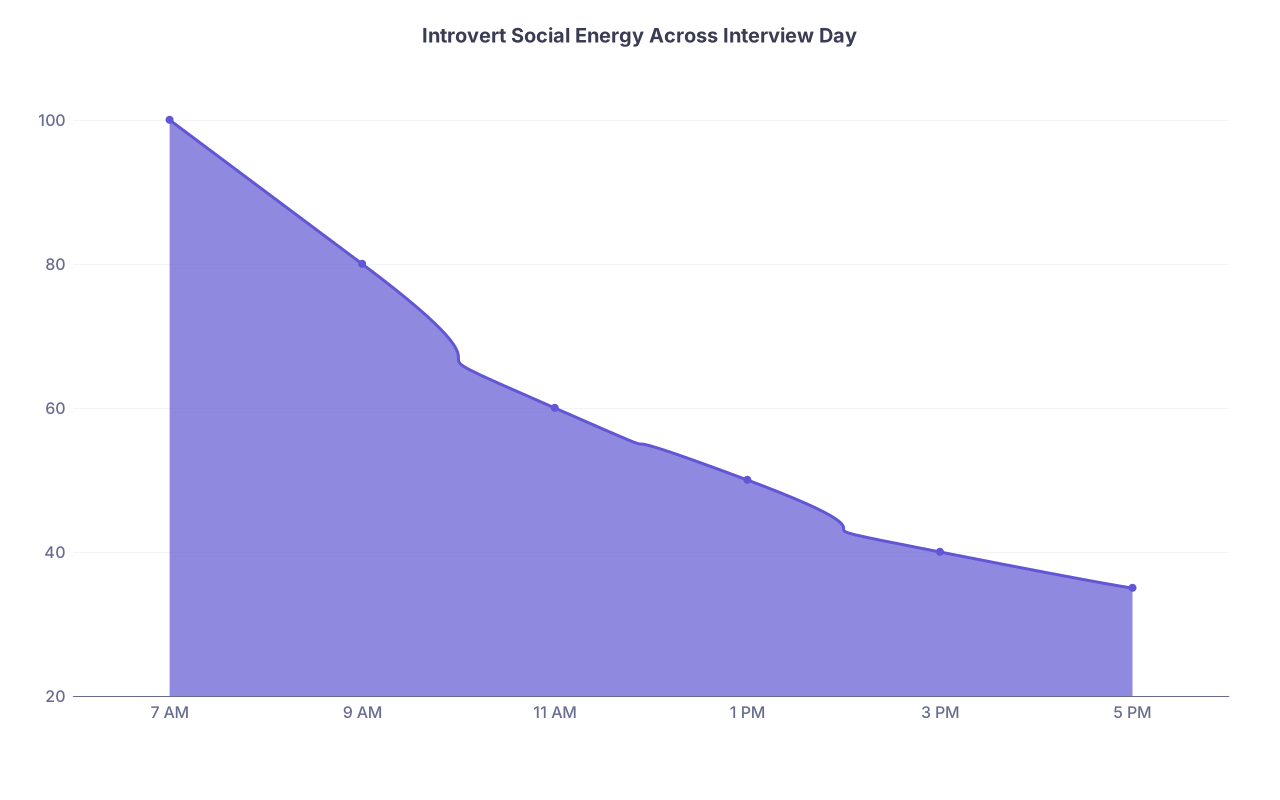
| Category | Value |
|---|---|
| 7 AM | 100 |
| 9 AM | 80 |
| 11 AM | 60 |
| 1 PM | 50 |
| 3 PM | 40 |
| 5 PM | 35 |
If you try to be chatty and “on” at every breakfast table, every hallway walk, every elevator ride, you bottom out by noon. I’ve watched it happen. Bright students turning monosyllabic by afternoon.
Use “Low-Power Mode” Aggressively
Group info session? You don’t need to be the one asking the first question. You can nod, take a couple notes, smile occasionally, and let the gunners carry that part.
On the tour? Stay near the middle of the pack. You don’t have to side-converse with someone the entire time. It’s okay to mostly listen, then drop in one or two comments or questions.
Resident lunch? You do not need to fill every silence. Ask one or two good questions, respond thoughtfully when people ask you things, and otherwise let the conversation flow around you. You’ll feel like you’re “too quiet.” You’re not. You just feel loud inside your own head.
Build Micro-Recharges Into the Day
You’re not going to get a 30-minute nap, obviously. But you can steal small resets that make a big difference.
Examples I’ve seen work:
- Bathroom “fake break” – Even if you don’t need it. Step away, lock the stall, take 5–8 deep breaths, look at your notes quietly. Two minutes alone can reset your brain.
- Water refill = pause – Volunteer to refill your water bottle. Walk slowly. Breathe. Look out a window. You’re not slacking. You’re preserving performance.
- Silent elevator rule – If no one talks to you, you do not have to start conversation. Look at the floor numbers. It’s fine.
You’re not weak for needing this. Extroverts secretly do their own versions; they just don’t call it that.
Talking Without Draining Yourself Completely
The most exhausting part for introverts isn’t talking per se. It’s the performance layer: “Am I saying the right thing? Do I sound weird? Did they like that? Should I have smiled more?”
That mental commentary burns more energy than the words.
Use Structures So You’re Not Inventing As You Go
For common questions, have simple internal frameworks. For example, “Why this specialty?” can be:
- Brief origin (1–2 sentences)
- 2–3 concrete reasons (patients, pace, procedures, etc.)
- Tie to future goals
So when they ask, your brain isn’t flailing to decide how to organize your answer. You’re just filling in the slots.
Same for “Tell me about a challenge”:
- Situation
- What made it hard
- What you did
- How you changed
You don’t say the structure out loud. You just think it. It keeps your brain from spinning.
Have Go-To “Small Talk” Lines to Reuse All Day
You will have the same surface-level conversations over and over:
- “Where are you flying in from?”
- “How’s interview season going?”
- “What did you think of the morning talk?”
Instead of trying to be original every time, pick simple, honest lines you can reuse:
- “I’m at [school], so not too far. Grateful for a short flight for once.”
- “Busy, but this is one of the places I was actually really excited about, so I’m glad to be here.”
- “I liked hearing about [X thing they emphasized]. That’s something I’ve been looking for.”
Cut the pressure to be clever. You’re allowed to sound like yourself, on “interview mode,” not “stand-up comedian mode.”
The Afternoon Crash: Your Personal Worst-Case Scenario
Let’s talk about the part you’re secretly terrified of: 3 p.m., you have one more faculty interview and then a resident social, and your brain has left the building.
What if you blank? What if you sound flat? What if the last interviewer is the PD and that’s the one you tank?
I’ve seen introverted applicants tank an early interview and still match at that program. I’ve also seen people be quiet at the social and still be ranked highly. The day is not decided by one conversation. Everyone knows these days are long and people get tired.
That said, there are ways to avoid a complete energy faceplant.
Pre-Commit to a Midday Reset
If there’s any break (even 10 minutes) between morning and afternoon stuff, treat it like a non-negotiable reset.
- Eat something with protein, not just carbs and caffeine. Carbs + adrenaline = crash.
- Step outside if you can. Cold air helps. Even 3 minutes.
- Do not scroll your phone. That just adds more stimulation. Stare at a tree or a building. Let your brain be empty for a second.
Think of it as protecting your last two interviews, which often matter a lot.
Use Honest, Low-Energy Warmth
When you’re tired, pushing fake, bubbly energy is draining and obvious. Instead, aim for calm, steady, and genuinely interested.
It’s perfectly okay for your energy at 3 p.m. to be:
- Softer voice
- Slower pace
- More listening than talking
One line that helps when you’re feeling fried:
“I’m really grateful to be here; it’s been a long but really helpful day.”
That signals: I’m tired because I care and I’ve been engaged, not because I’m bored or checked out.
Resident Socials: Introvert Final Boss
Honestly, these are the part most introverts dread. No strict structure, residents in loose groups, lots of side chatter. It feels like high school lunch but with your career attached.
Here’s the trick: you are not being scored minute-by-minute here. Mostly, they’re making sure you’re not rude, wildly awkward, or obnoxious.
Your goal is simple: show you’re a normal human they could stand being on call with.
Pick Your Spots, Don’t Work the Room
You do not need to talk to every resident. Find 1–2 small groups and stick with them.
Good starter moves:
- Ask a question to the group: “What’s something about this program you didn’t appreciate until you started?”
- Ask a specific resident: “What rotation has been your favorite so far?”
Then let them talk. Residents love talking about themselves and their program. You ride that wave.
If the social is virtual, same rule. You don’t have to unmute for every topic. Ask a couple good questions in chat or voice, then relax and listen.
Have an Exit Strategy That Isn’t “Irish Goodbye”
You’re allowed to leave on time. You’re not required to be the last one in the Zoom call or bar.
When you’re reaching the end of your battery, find a natural stopping point and say something like:
- “I should head out so I can get ready for tomorrow, but thanks so much for talking with me.”
- “This was really helpful, I appreciate you all staying late to chat with us.”
That leaves a good final impression without you forcing yourself to push through another 45 minutes of social torture.
Quick Reality Check: What Programs Actually Remember
You’re imagining they’re going to write in some secret file: “Applicant was quiet at lunch. 2/10. Reject.”
That’s not how this works. What actually gets remembered and written down:
- Red flags: rude, dismissive, arrogant, made weird/commentary jokes, seemed uninterested
- Strong positives: genuinely kind, thoughtful answers, clear fit with program, connected well with residents
- Overall vibe: “Could I work with this person at 2 a.m.?”
Being a little quieter? Not an automatic negative. You just don’t want to cross into “seems miserable or unapproachable.”
And honestly, calm, observant, measured people are desperately needed in residency. Every program already has enough loud chaos generators. They know that.

Night-Before and Morning-Of: Damage Control for Anxiety
Since your brain loves worst-case scenarios, let’s be practical.
The night before:
- Stop active prep at a set time. 9 p.m. Hard stop. At that point, more cramming just raises anxiety.
- Layout everything: outfit, folder, directions, parking plan. Reduces morning decision fatigue.
- Do one thing that makes you feel like a person, not a machine. 20 minutes of a show, reading, a quick walk.
Morning-of:
- Light breakfast with some protein. Not just coffee on an empty, churning stomach.
- Simple grounding exercise: 5 slow breaths, notice 5 things you see, 4 you can touch, 3 you hear, 2 you smell, 1 you taste. It sounds cheesy. It works.
Tell yourself this, even if you don’t believe it yet: “I don’t have to be perfect. I just have to be real and not a jerk.”
That bar is much lower than the one in your head.
FAQ (Exactly 4 Questions)
1. What if I completely blank in an interview and there’s an awkward silence?
It happens. I’ve seen really strong applicants do this and still match at that program. The move is to own it calmly. Something like, “I’m sorry, I lost my train of thought for a second—would you mind repeating the last part of the question?” Or, “That’s a great question, I’m thinking for a moment.” Then answer simply. One awkward pause doesn’t sink you. Getting flustered and spiraling into panic does more damage than the silence itself.
2. Is it bad if I don’t ask many questions at the resident social?
Not automatically. Programs don’t have a hidden quota. If you ask a couple thoughtful questions and engage when spoken to, you’re fine. Where it starts to look bad is if you’re totally silent, on your phone, or look visibly disengaged. As an introvert, your best bet is to ask a few solid questions early, participate in the conversation in small ways, and then it’s okay to mostly listen. Being a good listener is actually a positive.
3. Will programs prefer extroverted, high-energy applicants over someone quiet like me?
Some individual people might gravitate toward louder personalities, but as a whole, programs need a mix. They know not every resident can be “always on.” Quiet, thoughtful, steady people are often the ones who keep teams grounded. As long as you show you can collaborate, communicate clearly, and aren’t hostile or closed-off, being introverted is not a problem. If anything, your listening skills and self-awareness can stand out in a good way.
4. How many long interview days can I realistically handle in a row as an introvert?
For most introverts I’ve seen, three in a row is the upper limit before quality drops off. Two is usually manageable if you schedule a lighter or travel-only day afterward. If you stack four or five consecutive big interview days, don’t be surprised if the last one or two feel flat. When you’re scheduling, build in buffer days whenever possible—especially before a program you really care about. It’s not weakness; it’s strategy.
Key takeaways:
You’re not doomed because you’re introverted; your issue is energy management, not personality. Script only the essentials, build micro-breaks into the day, and stop trying to be “on” every minute. Aim to be calm, genuine, and not a jerk—not the funniest, loudest person in the room. That’s enough.