
It’s 8:02 AM. You’re in a slightly too-cold conference room at a university hospital. You’ve survived the small talk. They’ve glanced at your ERAS printout. Then the program director leans back, smiles, and says the one thing you’ve been dreading:
“So… tell me about yourself.”
Your brain: static.
Your heart: tachy to 140.
Your mouth: nothing.
You can literally hear the clock ticking on the wall and all you can think is: I have done 20+ years of school and I cannot even describe myself for 60 seconds.
Let me walk through this like a fellow panicked human, not some chill robot who “enjoys interviews.” I’m going to assume your baseline is: overthinking, catastrophizing, and re-playing every awkward social interaction you’ve ever had. Because same.
Why “Tell Me About Yourself” Feels So Terrifying
They could’ve asked about heart failure guidelines. Or your research. Or some ethics scenario. But this? Somehow worse.
Here’s why this question fries your brain:
- It’s too open. There’s no structure. No rubric. Just vibes.
- It feels like they’re judging you, not your scores or CV.
- You know it sets the tone. Nail it and the interview flows. Bomb it and you’re convinced it’s over.
- You’ve seen that one person who rambled for 5 minutes on interview day and you’re terrified that person will be you.
On top of that, your inner monologue is brutal:
- “What do they even want? Childhood? Why medicine? Fun facts?”
- “If I talk about personal stuff, I’ll sound unprofessional. If I only talk about medicine, I’ll sound robotic.”
- “What if I start and then lose my train of thought and just… stop?”
Here’s the first uncomfortable truth:
If you walk in with no pre-thought answer, your odds of going blank are high. Not because you’re dumb. Because your working memory is being hijacked by anxiety.
So no, “I’ll just wing it, I know myself” is not a plan. That’s a trap.
What They Actually Want When They Ask This
Let’s remove the mystery. When an attending asks “tell me about yourself,” they’re not fishing for your life story. They’re usually trying to quickly figure out three things:
- Who are you in 60–90 seconds?
- Can you talk like a normal human and not a Step 1 question bank explanation?
- What’s the “through-line” of your application? (The story that connects your choices.)
They’re not expecting:
- A TED Talk
- Trauma disclosure
- A stand-up routine
- Chronological biography starting with “I was born in…”
They want: a short, coherent frame for who you are as a person and future resident.
And here’s the thing nobody says out loud: most applicants’ answers are… fine. Forgettable. Generic. If yours is structured and calm, you’re already ahead.
The Anti-Blank Strategy: Use a Scripted Skeleton
If you’re scared of going blank, you need a skeleton. Not a word-for-word memorized monologue (that’s how you end up sounding like a hostage video), but a structure with key beats you can hit even when your brain is half-frozen.
Think of it as 4 anchor points:
- Where you are now (who you are professionally, very briefly)
- Key theme or focus (what you’re drawn to in medicine)
- Evidence / examples (1–2 specific things that back that up)
- Tie-in to this specialty / residency (why you’re here)
In practice, it sounds like this:
“Sure. I’m a fourth-year at [School], originally from [place]. Over the last few years I’ve found myself really drawn to [specific aspect of your specialty], especially through [rotation / experience].
I’ve spent a lot of time working on [1–2 concrete things: research, leadership, QI, teaching, community work] because I really enjoy [what that says about you].
That’s also what pulled me toward [specialty] and programs like this one—places that value [1–2 things you know they care about: education, underserved patients, research, tight-knit teams].”
That’s it. That’s the framework.
You don’t have to say it exactly like that, but those 4 points give you a map. Even if you lose a sentence midway, you still know what the next stop is.
To make this more concrete, compare a weak answer and a solid one:
| Aspect | Weak Answer | Strong Answer |
|---|---|---|
| Length | 20 seconds or 4+ minutes | ~60–90 seconds |
| Focus | Random facts | Clear theme |
| Structure | Rambling, jumps around | Logical flow |
| Specialty Link | Vague or absent | Explicitly connected |
| Memorization Risk | Sounds canned or chaotic | Sounds prepared but natural |
“But What If My Mind Still Goes Completely Blank?”
Okay, nightmare scenario time, because I know that’s where your brain goes.
You’re in the chair. They say it. Your rehearsed lines evaporate. Your heart is pounding in your ears. You know you’re staring too long.
Here’s what you do in the actual moment:
1. Buy Yourself 2–3 Seconds on Purpose
You’re allowed to pause. They won’t ding you for taking a breath. Say something like:
- “Yeah, absolutely.”
- “Sure, I can start with where I am now and what drew me to [specialty].”
- “That’s a big question—I’ll give you the short version.”
These tiny phrases let your mouth move while your brain loads the script.
2. Grab Just the First Anchor
When you’re blank, don’t try to recall the whole answer. Just remember: start where I am now.
“Sure. I’m a fourth-year at [School] currently doing my [rotation].”
Once you say that, the rest tends to unstick. It’s like starting an IV—hard until you just put the needle in the skin.
If your mind is still foggy, move to the specialty anchor:
“And over the last few years I’ve realized I’m really drawn to [specialty], especially after [rotation / experience].”
Now you’re talking. Now your brain remembers you actually have a life and experiences.
3. If You Truly Freeze – Name It and Reset
Worst-case: you start, then lose it mid-sentence. This happens. I’ve literally seen it on interview days and the world didn’t end.
You can say:
“Sorry, let me restart that—I’m a little nervous.”
Then go to: “I’m a fourth-year at…” and run through your skeleton.
They know you’re human. A tiny self-correct like that is not a deal-breaker. What matters is that you recover, not that you never glitched.
What tanked people I’ve seen wasn’t the blank. It was the panic spiral that followed. Long silence. Apologizing three times. Saying, “I’m really bad at talking about myself.” Don’t do that to yourself.
Build a Version That Actually Sounds Like You
Another reason people blank: they memorize some random answer off Reddit that doesn’t sound like them at all. Then when adrenaline spikes, the “script” doesn’t match their natural speaking style and it just falls apart.
So: build your own version, using that skeleton, in your own words.
Try writing it first, then read it out loud. Ask:
- Would I actually talk like this to a resident?
- Did I use words I never use in real life?
- Does any line make me cringe?
Cut anything that feels fake. Replace it with your actual voice. It’s better to sound a little less polished and more like a real human than to sound like a LinkedIn post.
You also don’t need to squeeze your entire application in there. You don’t have to name every award, every leadership role, your entire personal statement. You’re giving them the trailer, not the whole movie.
Practice Without Over-Rehearsing (So You Don’t Sound Robotic)
There’s a weird balance here. You do need reps. But if you treat this like memorizing First Aid, you’ll sound flat and scripted.
Here’s what actually works:
- Brainstorm your 4 anchor points.
- Write a rough 60–90 second version.
- Record yourself saying it 3–5 times on your phone, without looking.
- Each time, allow the wording to shift, as long as the structure stays the same.
Look for 3 things when you rewatch:
- Are you going way too long? (Over 2 minutes is usually too much.)
- Do you sound like a human who breathes, or a robot reading a teleprompter?
- Is there at least one concrete detail that makes you memorable? (Not “I care about patient-centered care” – everyone says that.)
You want to be so familiar with the structure that when everything else leaves your brain, the backbone is still there.
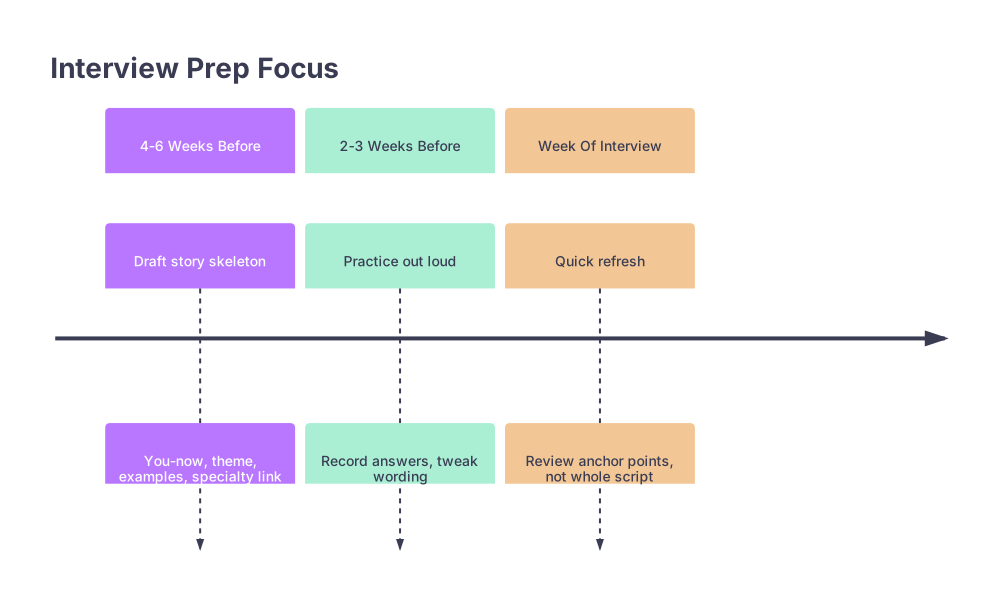
To visualize how this prep fits into your overall interview prep timeline:
| Period | Event |
|---|---|
| 4-6 Weeks Before - Draft story skeleton | You-now, theme, examples, specialty link |
| 2-3 Weeks Before - Practice out loud | Record answers, tweak wording |
| Week Of Interview - Quick refresh | Review anchor points, not whole script |
The Ugly Truth: They Don’t Remember Your Exact Words
This might help your anxiety a bit.
I’ve sat with attendings and residents after a full interview day. By the time they’re discussing candidates, what they remember is not:
- “She said she was from Colorado and worked with underserved patients in clinic.”
They remember:
- “She seemed grounded and thoughtful.”
- “He was a little stiff at the beginning but relaxed by the end.”
- “They clearly really cared about [X] and fit our culture.”
Your “tell me about yourself” answer is less about the content and more about:
- Tone
- Coherence
- Confidence level (or at least the appearance of basic self-possession)
So if you’re spiraling about whether you should mention your undergrad major or that one research project—stop. That’s not what’s going to matter.
What If I’m Non-Traditional / Awkward / Don’t Have a “Neat” Story?
You might be thinking:
- “I did a career before med school; my story is weird.”
- “I don’t have some inspirational narrative; I just like this field.”
- “I’m introverted and I sound awkward when I talk about myself.”
All survivable.
If you’re non-traditional, your structure is the same, you just add one beat:
“I started my career in [field], and over time I realized I wanted more direct patient interaction, which led me to medicine and eventually to [specialty].”
If you don’t have a “hero origin story,” don’t invent one. You can be direct:
“I didn’t have a single dramatic moment that led me to [specialty]. It was more that every time I rotated on [specialty], I found myself enjoying the mix of [X, Y, Z] and consistently looking forward to those days.”
If you’re awkward—own, don’t hide:
“I tend to be a bit more on the introverted side, but I’ve really grown into being comfortable with patients and teams, especially through…”
You don’t need to magically become extroverted for the interview. You just need to be coherent and not actively self-sabotaging.
A Quick Reality Check: How Bad Is a So-So Answer Really?
Let’s get brutally honest.
Interview performance is a whole package:
- How you come across overall
- How you answer clinical/behavioral questions
- How well you fit their vibe
- Your application strength going in
A “meh” answer to “tell me about yourself” is not an automatic rejection. A blank moment with a recovery is not an automatic rejection. People match every year with imperfect interviews.
Where it becomes a problem is when:
- You ramble incoherently for 5 minutes
- You stay visibly rattled for the rest of the interview
- Or you give answers so generic they could be anyone on ERAS
Your goal isn’t perfection. It’s “solid, clear, and not painful to listen to.” That’s a low bar. You can absolutely clear it, even if your heart is slamming in your chest.
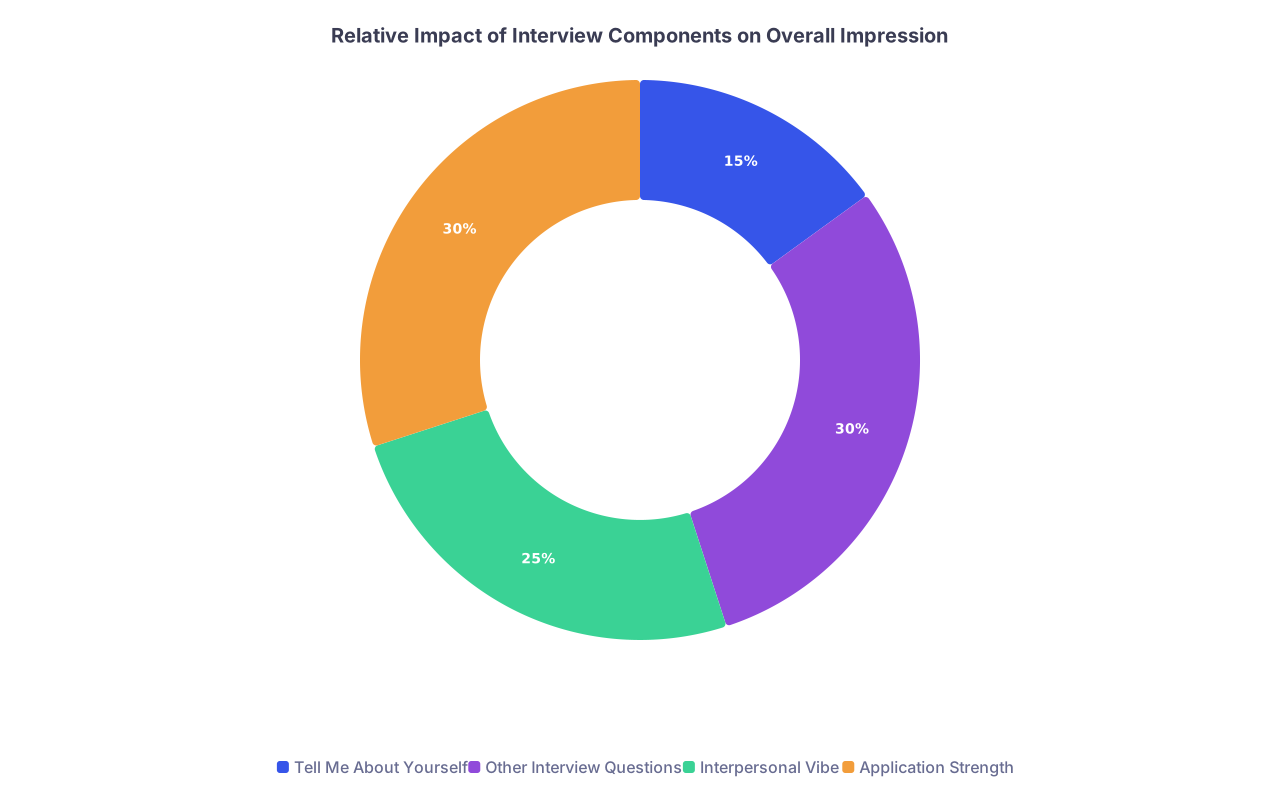
To keep perspective, look at how much weight this one answer really carries in the context of the whole application and interview:
| Category | Value |
|---|---|
| Tell Me About Yourself | 15 |
| Other Interview Questions | 30 |
| Interpersonal Vibe | 25 |
| Application Strength | 30 |
“Tell me about yourself” matters. But it’s not 80% of your fate, no matter what your anxiety says.
FAQ (Exactly 6 Questions)
1. How long should my “tell me about yourself” answer be?
Aim for about 60–90 seconds. Under 30 seconds usually feels abrupt and underdeveloped. Over 2 minutes and you risk rambling and losing them. If you’re talking long enough to feel slightly uncomfortable but not like you’re giving a seminar, you’re probably in the right zone.
2. Should I start with where I was born or my childhood?
Usually no. This isn’t your autobiography. Unless your upbringing is directly relevant to your path (like you grew up in the community you want to serve and it genuinely shaped your career choice), skip the early childhood stuff. Start with where you are now: “I’m a fourth-year at…” and briefly build from there.
3. Is it okay to mention personal things, like hobbies or family?
Yes, but not as the entire answer. Think of it as seasoning, not the main dish. A line like “Outside the hospital, I really enjoy [hobby]—it’s been a good way for me to decompress and stay grounded during med school” is fine. Just don’t spend 45 seconds detailing your marathon training schedule or your Dungeons & Dragons campaign.
4. What if I go totally blank and can’t remember my structure at all?
First, take a short breath. Say something like, “Sorry, I’m a little nervous—let me start with where I am now.” That line alone will usually bring the rest back. If not, keep it ultra-simple: “I’m a fourth-year at [School]. I’ve really enjoyed [specialty]-related rotations, especially [X], and that led me to apply in [specialty]. I’ve been involved in [1–2 things], and I’m really excited about programs that value [Y].” Imperfect but coherent beats panicked silence every time.
5. Should I tailor my answer differently for each program?
You don’t need a totally different speech for every hospital. That’s unsustainable. Have one core answer, and tweak the last 1–2 sentences to nod at the program’s strengths: “That’s also why I’m particularly interested in programs like this one, with strong [community focus/research/education/emphasis on resident autonomy].” That’s enough tailoring to show you’re not just reading a generic script.
6. Can I mention weaknesses, like taking an extra year or low scores, in this answer?
Not in this question. “Tell me about yourself” is not the place to lead with your worst foot forward. You’ll almost certainly get another chance to address red flags later (“Tell me about a challenge,” “I noticed you took an extra year—can you tell me about that?”). Use this answer to frame who you are at your best. You don’t need to pretend problems don’t exist; you just don’t need to volunteer them in the first 60 seconds.
Key points to keep in your head:
- Have a simple 4-part structure so your brain has a map when anxiety hits.
- Practice enough that the structure is automatic, but don’t cling to exact wording.
- If you blank, buy time, reset with “I’m a fourth-year at…,” and just keep going. Recovery matters more than perfection.