
It’s 9:47 AM. You’re in the Zoom waiting room for your third residency interview of the season. Your heart’s pounding. Your mouth is dry. And all you can think is: “What if I say something stupid and completely tank this?”
Or worse: you replay that one interview from last week where you already said something you’re pretty sure was dumb. You’ve been running it on a loop in your brain: the awkward joke, the weird answer, the too-honest comment about burnout, that time you blanked on a basic question about the program’s mission.
So now you’re stuck in this spiral:
- What if I freeze?
- What if I overshare?
- What if I say something that makes them decide instantly, “Nope, not this one”?
- What if I already did?
Let me just say the quiet part out loud: you will say something you wish you hadn’t in at least one residency interview. Everyone does. I have literally never met a resident who didn’t have at least one “oh god why did I say that” story.
The real question isn’t “How do I avoid ever saying something stupid?”
It’s: “How do I recover when I do?”
Let’s go there.
First: What Actually Counts as “Stupid”?
Most of what you’re labeling as “stupid” isn’t actually stupid. It’s just… human and mildly awkward.
There are levels here, and they’re not equal.
| Type of 'Mistake' | Reality Level | Fixable? |
|---|---|---|
| Awkward phrasing / rambling | Harmless | Yes |
| Minor program detail wrong | Mild | Yes |
| Blank moment / lose train | Mild | Yes |
| Slight overshare / too honest | Context | Usually |
| Negative comment about others | Moderate | Maybe |
| Discriminatory / offensive | Serious | Rarely |
The stuff that keeps applicants up at night? Almost always in the first three rows.
I’ve watched faculty roll their eyes (in a fond way) after a student nervously word-vomited for three minutes. They wrote, “Clearly nervous, but thoughtful and hardworking” on the eval. Not “clearly an idiot, reject immediately.”
Program faculty expect you to be:
- Nervous
- Imperfect
- A little rambly sometimes
They do not expect:
- Polished TED-talk-level answers
- Zero verbal flubs
- Perfect recall of every detail of their website
So before we even talk recovery tactics, you need a mental reset: most of your “I blew it” moments are nowhere near as fatal as they feel in your body.
In-the-Moment Recovery: When the Words Are Already Out
You’re mid-answer, something comes out wrong, and you feel that internal scream: “WAIT NO COME BACK.” Here’s what you do in real time.
1. Call it, correct it, move on
The worst thing you can do is pretend you didn’t notice and then spiral while still talking. That’s how you end up rambling into even weirder territory.
Instead, you do a quick, clean correction:
- “Sorry, let me rephrase that more clearly.”
- “Actually, that’s not exactly what I meant—can I say that a bit better?”
- “Let me back up for a second, I want to answer that more directly.”
Then you give the better version. Short. Calm. Like a normal person fixing a sentence.
This reads as:
- Self-awareness
- Composure
- Communication skills
Not stupidity.
2. Own a knowledge gap without sounding incompetent
Say you blank on a guideline, a statistic, or some trivial program detail. Your brain screams, “How can you not know this? You’re done.”
Here’s the grown-up way to handle it:
- “I’m honestly blanking on the exact number right now, but my general understanding is…”
- “I don’t remember the specific year that changed, but clinically it affects how we…”
- “I read your website, but I may mix up details—can you clarify whether your clinic is mainly underserved urban or more mixed community?”
This actually makes you sound more credible, not less. Nobody wants the applicant who pretends to know things and then fakes it badly.
3. If you accidentally sound negative or arrogant
This is the one people obsess over. You say something like:
- “I hated my surgery rotation.”
- “I’m definitely not interested in research.”
- “I just want a chill residency with good hours.”
And then you realize… oh no. That probably sounded bad.
You have about 5–10 seconds to patch it.
For example:
“I hated my surgery rotation—
Actually, let me clarify that. I really struggled with the culture on that particular team, but it taught me a lot about the kind of environment I do best in, which is more collaborative and supportive.”“I’m definitely not interested in research—
I should be more precise: I’m not aiming for a heavy research career, but I do value being able to contribute to QI or smaller projects that actually impact patient care.”“I just want a chill residency with good hours—
That sounded flippant, sorry. I care a lot about balance because I’ve seen burnout up close, but I fully expect residency to be intense. I just want to train somewhere that values residents as humans, not just work output.”
You don’t pretend you didn’t say it. You contextualize it. You soften the edges.
That’s the difference between “red flag” and “okay, they’re just human.”
After-the-Fact: You Already Said the Thing. Now What?
Here’s the part that really eats people alive: the drive home, the walk back to your bedroom after a Zoom day, the 2 AM replay reel.
“Should I email them?”
“Should I explain myself?”
“Did I just lose that program forever?”
Let’s be blunt: 90% of the time, you should do nothing.
Step 1: Ask yourself three questions
- Was it factually wrong or misleading in a meaningful way?
- Was it potentially offensive / hurtful to a group or person?
- Did it fundamentally misrepresent your actual intentions or values?
If the answer is “no” to all three, this was probably:
- Awkward phrasing
- A weird joke that didn’t land
- A rambling answer
- Saying “uhh” a thousand times
- Forgetting a minor program detail
You do not send a follow-up email for that. You just move on and do better on the next one.
If the answer is “yes” to #1 or #3, maybe you send a short clarification. If it’s “yes” to #2, you almost definitely should.
Step 2: What a clarification email actually looks like
This is not a three-paragraph self-flagellation essay. You are not writing a confessional.
Something like:
“Dear Dr. Smith,
Thank you again for the opportunity to interview with [Program Name] on [date].
I’ve been thinking about one of my responses, specifically when I said [briefly describe]. I realized afterward that my wording didn’t accurately reflect what I meant. What I intended to convey was [short, clear corrected version].
I appreciate your time and consideration.
Best,
[Name], AAMC ID [####]”
That’s it. No over-explaining. No dramatic apology paragraph. You correct and get out.
Most faculty will skim that, think, “Okay, good insight, moving on,” and not obsess about it the way you did.
How Programs Actually See “Stupid” Moments
Here’s the part applicants don’t believe until they’re on the other side. So let me spell it out.
Program faculty and residents:
- Are doing 8–10 interviews a day
- Hear almost the same answers over and over
- Notice patterns, not single sentences
They do not have the mental bandwidth to microscopically analyze your one weird answer the way you do at 1:32 AM.
What they do notice:
- Are you rude? Dismissive? Condescending?
- Do you talk badly about nurses / staff / other specialties?
- Do you seem dishonest or fake?
- Are you clearly not interested in their program at all?
- Are there repeated red-flag comments across multiple answers?
What they mostly ignore:
- Normal stumbles
- Nervous laughing
- A few “umm’s”
- Forgetting a minor detail about their program
- One slightly off, slightly awkward answer
To make it concrete, here’s how your internal panic compares to their actual reaction:
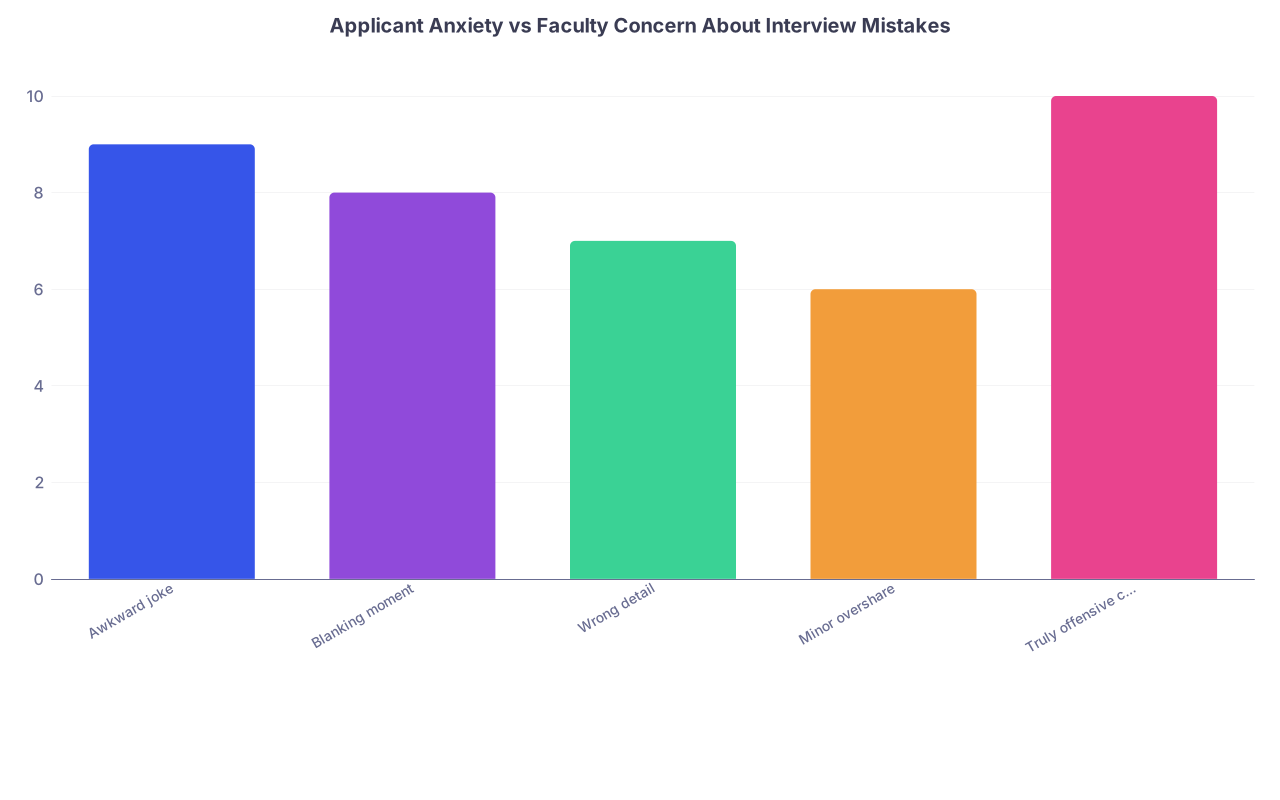
| Category | Value |
|---|---|
| Awkward joke | 9 |
| Blanking moment | 8 |
| Wrong detail | 7 |
| Minor overshare | 6 |
| Truly offensive comment | 10 |
If faculty scored how much they care about each on a 1–10 scale, the first four would be like… 2–3. The last one is the only 10. You’re walking around acting like all of them are 10s.
They’re not.
How to Reduce the Odds of Saying Something You Regret
You can’t make the risk zero. But you can lower it a lot.
Not with fake-sounding scripts. With something better: tested defaults.
1. Build your “default answers” for common traps
Certain questions consistently pull out oversharing or weird answers when you’re nervous:
- “Why our program?”
- “Tell me about a weakness.”
- “Any questions for me?”
- “How do you handle conflict or feedback?”
You don’t need word-for-word scripts. You need bullet anchors so you don’t panic and blurt nonsense.
Example for “weakness”:
- Real, non-fatal issue: perfectionism / overcommitting / discomfort delegating
- Concrete example
- How you’ve worked on it
- One specific system you use now
If you’ve pressure-tested that structure a few times out loud, you’re much less likely to say, “My biggest weakness is that I care too much,” or “I procrastinate a lot and sometimes miss deadlines,” which… yeah, not ideal.
2. Practice “pause and reset” out loud
Nervous people fill silence with increasingly strange words. The skill you actually need is the ability to stop talking for 2–3 seconds without melting.
Practice this literally:
Alone in your room:
- Ask yourself a question out loud
- Answer until you feel yourself losing the point
- Stop.
- Say: “Let me rephrase that more clearly.”
- Restart, more concise
It feels ridiculous. It works.

| Step | Description |
|---|---|
| Step 1 | Interviewer asks question |
| Step 2 | Start answering |
| Step 3 | Finish answer |
| Step 4 | Pause 2 seconds |
| Step 5 | Say Let me rephrase that more clearly |
| Step 6 | Give shorter, clearer answer |
| Step 7 | Lose clarity? |
By interview day, that “reset” line should be muscle memory. So instead of spiraling into word salad, you have a baked-in exit lane.
3. Decide your no-go zones in advance
Figure out what you’re not going to talk about in detail:
- Deep unresolved conflict with attendings
- Raw trauma that still makes you tear up in 2 seconds
- Strong political opinions that don’t belong in this context
You can acknowledge briefly, then pivot:
- “That was a really difficult time for me personally, and I’m still processing parts of it, but the main thing it taught me about being a physician was…”
That way you don’t get sucked into a 5-minute emotional overshare you’ll regret later.
When You Actually Do Say Something Pretty Bad
Let’s go to the worst-case scenario your brain keeps playing.
You said something actually not okay. Maybe you:
- Made a joke that could be interpreted as insensitive
- Spoke negatively about a group of people
- Made a comment you realize later could be sexist / racist / classist / ableist
Does it automatically mean you’re done? Honestly, maybe at that program. Possibly not. Depends on their tolerance and how you respond.
Here’s the best recovery sequence:
In the moment, if you realize it:
- “I’m sorry, that came out wrong and I don’t like how that sounded. Let me say that differently.”
Then fix it. Directly.
- “I’m sorry, that came out wrong and I don’t like how that sounded. Let me say that differently.”
Afterwards, if it’s really bothering you:
Email. Short. No excuses.“During my interview, I made a comment about [topic] that I’ve been thinking about. I’m concerned it didn’t align with the respect and values I aim to bring to patient care and colleagues. I’m sorry for that. I’m continuing to reflect on it and do better.”
You’re not guaranteed redemption. But you give yourself a fighting chance, and more importantly, you act like the kind of physician who takes responsibility when they mess up.
How to Stop the Post-Interview Spiral From Consuming You
Here’s the truth: interview season is not just an evaluation of you. It’s a slow psychological torture if you let every word replay in your head.
You finish a day and suddenly:
- “Why did I mention my Step score again?”
- “Why did I say I prefer urban programs to that rural PD?”
- “Did I sound fake when I said I liked research?”
So you mentally rewrite every answer. For hours. That does literally nothing to help you.
Instead, do this simple, unglamorous thing after each interview day:
- Open a document.
- Write:
- 2–3 answers you gave that felt strong
- 1–2 answers that felt weak
- One concrete tweak for next time (“Stop listing 6 strengths. Pick 2.”)
That’s it. Then you are done analyzing that interview.
You’re not banned from remembering it. You’re banned from ruminating on it.
If your brain tries at 1 AM, you tell yourself: “Already reviewed. Nothing new to see.”
You will not hack interview season by thinking harder at 2 AM. You’ll just drain your ability to show up sane to the next one.
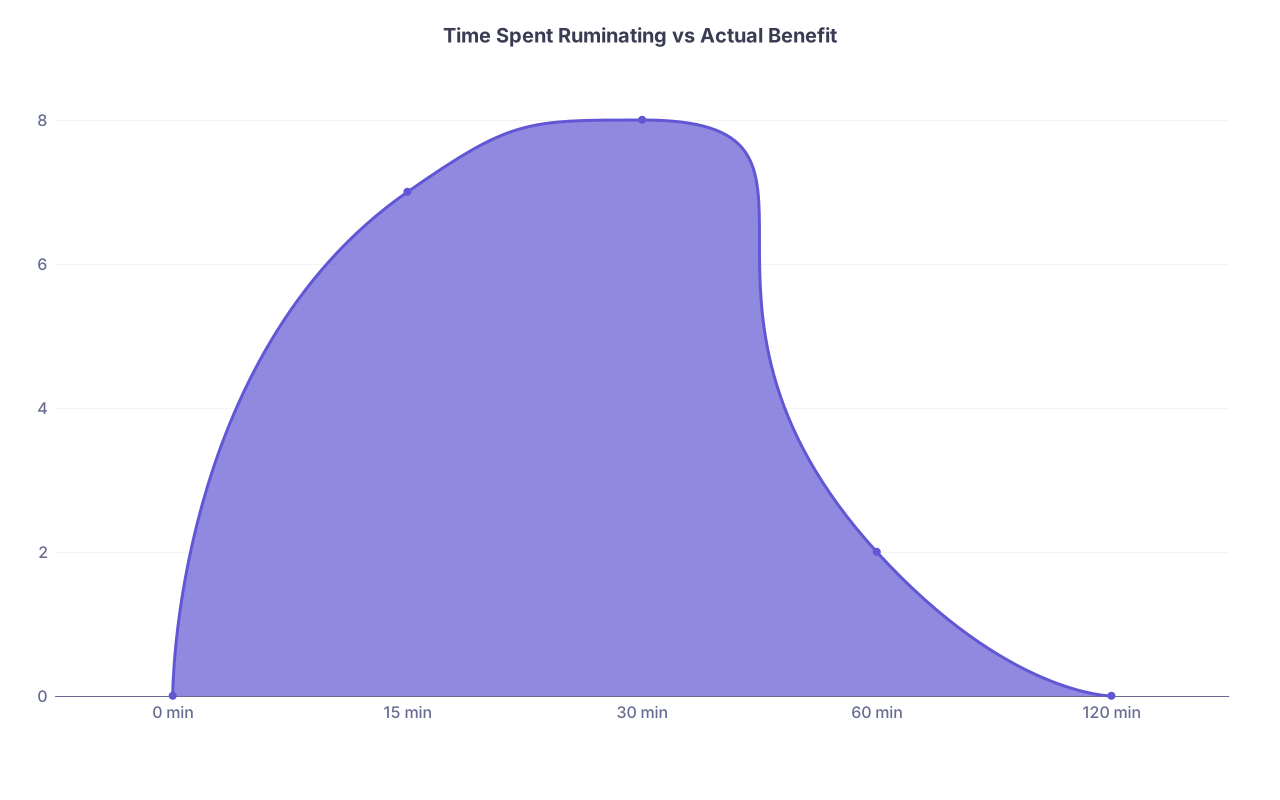
| Category | Value |
|---|---|
| 0 min | 0 |
| 15 min | 7 |
| 30 min | 8 |
| 60 min | 2 |
| 120 min | 0 |
Benefit of reflection peaks quickly. After ~30 minutes, your “analysis” becomes self-punishment.
Quick Reality Check: You Are Not the Only One
Every resident you’ll meet has some version of:
- “I told the PD I wanted to do cardiology. It was a psych program.”
- “I blanked on ‘Why our program?’ and said, ‘Honestly, I applied everywhere.’”
- “I tried to be funny and told a story that just… died. In silence.”
And guess what? They’re residents. Somewhere. Right now. Rounding. Writing notes. Complaining about the EMR.
Your brain is acting like residency interviews are a tightrope where one slip equals death. It’s not a tightrope. It’s a hallway. You can bump into the wall a few times and still get to the end.

FAQ (Exactly 4 Questions)
1. If I said something I regret in one interview, should I change my answers for the next ones?
Yes, slightly. Don’t reinvent your entire personality. But if a certain answer consistently feels off—like your “weakness” answer or how you describe a conflict—tighten it up. Shorten it. Add context. The goal is evolution, not panic-driven reinvention.
2. Will a single bad answer ruin my chances at a program?
Almost never. A pattern of concerning answers can hurt you. One weird or weak answer, surrounded by otherwise solid behavior and a good vibe? They’ll forget way faster than you will. The exception is something truly offensive or clearly unprofessional. That can absolutely tank you.
3. Is it okay to say, “I’m nervous” during an interview?
Yes. And honestly, it usually helps. Something like, “I’m a little nervous, but I’m really excited to be here,” humanizes you and can reset your energy. Just don’t spend the entire interview apologizing for being nervous. Acknowledge it once, then move on.
4. Should I tell my interviewers if this is my top choice program?
If it’s truly your top choice, and you’re not saying that to multiple programs, yes—that can help, especially said directly to the PD or APD. Keep it simple: “I just want to be honest: this program is my top choice.” What’s not okay is telling five different programs they’re your #1. That’s how you end up feeling gross and anxious and second-guessing yourself even more.
You’re not going to make it through interview season with zero “stupid” moments. That’s not the standard. The real test is how you handle them.
Here’s your next step today:
Open a blank doc and write out your answers—bullet points only—to these three landmine questions: “Why our program?”, “Tell me about a weakness,” and “Any questions for me?” Say them out loud once. Notice where you ramble or sound weird. Fix just one thing in each. That’s it.