
The way most applicants answer “biggest weakness” almost guarantees they get forgettable scores on the interview rubric.
Let me be blunt: interviewers are not asking this to catch you in a lie or to watch you squirm. They are testing three things that matter in residency more than your Step score ever will:
- Can you self-assess accurately?
- Can you improve without being defensive or fragile?
- Are you safe to give feedback to at 2:00 a.m. when a patient is crashing?
If your answer fails those, you fail the question. Even if you think you “got away with it.”
Let me break this down specifically.
What Programs Are Actually Scoring When They Ask About Weaknesses
You need to stop treating this as a personality quiz. It is a risk assessment.
When an attending, PD, or senior resident hears your weakness answer, they are unconsciously scanning for:
- Will this person fall apart under stress?
- Will they deny problems or own them?
- Will they be coachable or a constant project?
- Will I regret putting them on nights in November?
Program directors know you are not perfect. They do not trust people who pretend to be.
Here is what they are really rating:
| Dimension | What Interviewers Want To See |
|---|---|
| Insight | Do you see yourself clearly and specifically? |
| Maturity | Can you talk about flaws without oversharing? |
| Growth trajectory | Is there concrete evidence you improve over time? |
| Safety | Any red flags about reliability or professionalism? |
| Fit for training | Will this person work well under supervision? |
If you walk in thinking “I just need a clever weakness that isn’t really a weakness,” you are already losing. That game is obvious and overplayed.
The Common Answers That Quietly Sink Your Interview
Let me go through what I consistently see in actual interviews and mock interviews. These patterns are almost universal across specialties.
1. The Fake-Strength Disguised as Weakness
You know this one:
- “I am a perfectionist.”
- “I work too hard.”
- “I care too much about my patients.”
- “I have trouble saying no because I am so dedicated.”
Interviewers have heard this hundreds of times. It does not make you sound strong. It makes you sound unoriginal and slightly evasive.
The problem is not the content but the framing. “I am a perfectionist” with no context or downside tells me:
- You either lack insight or
- You think I am naive enough to buy this as a real weakness.
If you want to talk about perfectionism, it must sound like a genuine problem with a real cost:
“Earlier in medical school I would spend too much time perfecting notes and presentations. It looked like dedication, but it meant I sometimes ran behind on clinical tasks…”
Now we are in honest territory.
2. The Catastrophic Red Flag
On the other side of the spectrum:
- “I am really bad at time management.”
- “Sometimes I just shut down when I’m overwhelmed.”
- “I have trouble following through on tasks.”
- “I have difficulty taking feedback.”
These are not “weaknesses.” These are reasons not to rank you.
If a PD hears that you “struggle to get things done when busy,” they imagine you on cross-cover with 20 patients and three new admits. They are not thinking, “What nice vulnerability.” They are thinking, “Am I about to sign up for a year of writing this resident’s notes at midnight?”
You must avoid weaknesses that directly question your safety and reliability:
- Chronic disorganization
- Poor follow-through
- Unprofessional behavior
- Interpersonal conflict that sounds like a pattern
- Anything about anger, “speaking my mind too freely,” or “not tolerating incompetence”
Those are interview cyanide.
3. The Vague, Noncommittal Blob
- “I guess I can be hard on myself.”
- “I think I sometimes struggle with balance.”
- “I am always trying to improve in every area.”
That says nothing. I cannot anchor it to a real behavior. I cannot see any skills you used to improve.
Vague answers get average scores. And average scores do not help in a competitive match cycle.
4. The Therapy Session
Overshare is just as bad as under-share:
- Long stories about imposter syndrome with no resolution.
- Deep dives into anxiety or depression without demonstrating stability, treatment, and functioning.
- Emotional tangents that never come back to professional growth.
Honesty is important. But the interview is not your psychotherapy hour. Your answer must end in stability, competence, and growth. Not in unresolved struggle.
The Anatomy of a Mature, Non–Self-Sabotaging Weakness
You need a structure. Otherwise you ramble, apologize, or perform.
Here is the backbone I use when I train residents and applicants:
- Name a specific, behavior-level weakness.
- Give a brief, concrete example (past, not current crisis).
- Show what you did intentionally to improve.
- Describe your current status: better but still watchful.
- Tie it to residency-relevant skills.
Let me show you what this looks like in detail.
Step 1: Pick the Right Kind of Weakness
Good weaknesses live in the zone between “obviously fake” and “definite red flag.”
You are aiming for:
- Real
- Manageable
- Already improving
- Professionally relevant but not disqualifying
Examples that often work well (if they are true and handled correctly):
- Delegating tasks / over-helping others at the cost of your own bandwidth
- Being overly detailed in notes or presentations, slowing you down
- Hesitancy to ask for help early (now improved)
- Struggling initially with big-picture prioritization, now using systems
- Being uncomfortable leading a team early, working on speaking up
- Tendency to over-prepare and under-trust your clinical judgment
Avoid weaknesses that suggest:
- Dishonesty
- Laziness
- Unreliability
- Ethical issues
- Chronic inability to function
You do not need a “creative” weakness. You need a believable one.
Step 2: Anchor It with a Short Example
Two or three sentences. Not a monologue.
Bad: “In third year I was on medicine and I had this attending and this patient and…”
Better: “On my early third-year rotations, I would sometimes spend too long making notes extremely detailed and perfectly formatted. It looked thorough, but it meant I could fall behind on following up labs or seeing the next patient.”
Now your weakness has:
- Time frame (early third year)
- Concrete behavior (overly detailed notes)
- Real consequence (fell behind on other tasks)
This is the level of specificity that sounds like you actually reflected.
Step 3: Show Deliberate Change, Not Magical Transformation
You must describe specific strategies you used. This is where most answers collapse into fluff.
Compare:
Fluff: “I am working on it and trying to be better.”
Strong: “My senior pointed this out directly. I started timing how long I spent on each note and setting myself limits. I also began using templates more effectively and asking seniors what level of detail they actually needed.”
That sounds like a resident I can teach.
Use verbs that scream action:
- I tracked
- I asked for
- I structured
- I created a checklist
- I built a template
- I scheduled protected time
- I rehearsed
- I sought feedback from [specific person]
If you cannot describe a concrete behavior you changed, you are not showing growth.
Step 4: End in “Improved but Still Aware”
Do not claim you fixed it completely. Nobody believes that.
You want:
- “I am significantly better at this now, and I monitor myself for it.”
- “It is still a tendency I watch for, especially when I am tired or stressed.”
For example:
“I am not perfect with it. When I am tired or on a busy call day, I can feel myself wanting to over-document. But now I notice it earlier and consciously adjust. My notes are shorter, and my seniors have commented that I am more efficient on the wards.”
Mature. Resolute. Not defensive.
Step 5: Tie It Back to Residency-Relevant Value
Close the loop to what they care about: your function on their team.
Something like:
“This process taught me to respond to feedback quickly and to constantly think about prioritization: ‘What matters for patient care right now, and what can wait?’ I think that mindset will be essential as an intern balancing notes, pages, and cross-cover responsibilities.”
Now the story is about your future performance, not a confession.
Concrete Examples: Weak vs Strong Answers
Let me give you full scripts so you can hear the difference.
Example 1: Detail-Oriented to a Fault
Weak version:
“I guess I am a perfectionist. I like everything to be done really well, so sometimes I take too long on things. But I am working on balance.”
Strong version:
“One weakness I have worked on is spending too much time making my notes and presentations extremely detailed. Early in third year, I would sometimes fall behind on following up tasks because I was focused on getting every word of the note just right. A senior resident pointed it out to me directly.
Since then, I started timing how long I spend on each note and setting target time limits. I also adopted templates that focus on the key elements my attendings actually care about, and I ask for feedback on whether the level of detail is appropriate. I am much more efficient now, although I still consciously check myself on busy days to make sure I am not over-documenting at the expense of seeing the next patient. This process has really sharpened my sense of clinical prioritization, which I think will be crucial as an intern.”
Notice:
- Specific
- Shows feedback was accepted
- Concrete strategies
- Clear outcome
- No self-sabotage
Example 2: Hesitant to Speak Up
Weak version:
“I can be shy. Sometimes I do not speak up enough, but I am trying to improve.”
Strong version:
“A weakness I have worked on is hesitating to speak up early when I am unsure. During my first ICU rotation, if I was not confident in an idea, I would stay quiet and then mention it later to my resident, instead of bringing it up in the moment during rounds.
My fellow pointed this out to me and emphasized that even tentative thoughts can be helpful if framed appropriately. Since then, I have pushed myself to contribute earlier, using language like, ‘I am wondering if…’ or ‘Could we consider…’ I also started preparing one or two management questions ahead of time for each patient.
I am still naturally more reserved than some of my peers, but I participate much more actively now. Multiple attendings have commented that my questions are thoughtful and timely. I intend to keep pushing that edge in residency, because clear communication is essential to safe patient care.”
Again: no drama, no denial. Just growth.
Example 3: Time Management Reframed Safely
Time management is dangerous as a raw weakness. But you can frame a past inefficiency that has been addressed.
Bad:
“My biggest weakness is time management. I procrastinate and get behind when things are busy.”
Better:
“In the first half of medical school, I underestimated how long it would take me to complete patient write-ups and study for shelf exams. I tended to rely on last-minute sprints, which was stressful and not sustainable.
Before third year, I sat down with a mentor who helped me build a more structured weekly schedule and taught me to break tasks into smaller daily goals. I began using a task manager to prioritize what had to be done that day versus what could wait. On rotations, that translated to planning out my day early on—when I would see patients, when I would write notes, and when I would study.
I am not immune to busy days, but I am far more intentional now and have consistently finished my clinical work on time. I know residency will raise the stakes, so I plan to keep using those systems and refine them with my seniors’ input.”
The difference is that you are not saying, “I am bad at time management.” You are saying, “I had a time management problem; here is how I fixed it; here is how I will maintain it in residency.”
How to Choose Your Weakness Strategically (Without Lying)
You probably have more than one potential weakness. The trick is picking one that:
- Is honest.
- Has a clear improvement arc.
- Does not collide with the core competencies of your chosen specialty.
Think about your specialty’s non-negotiables.
For surgery:
- You probably should not emphasize poor stress tolerance, slow decision-making, or being “easily overwhelmed.”
- You can safely discuss early discomfort with leading a team or delegating tasks, as long as you show progress.
For psychiatry:
- Avoid anything that suggests you struggle with boundaries, emotional regulation, or respecting different viewpoints.
- Discussing early difficulty with sitting in silence, or with tolerating diagnostic uncertainty, can work if you show how you grew.
For EM:
- Do not touch chronic disorganization or freezing under pressure.
- Early challenge with multitasking, now improved through explicit strategies, can be fine.
Here is a quick sanity check:
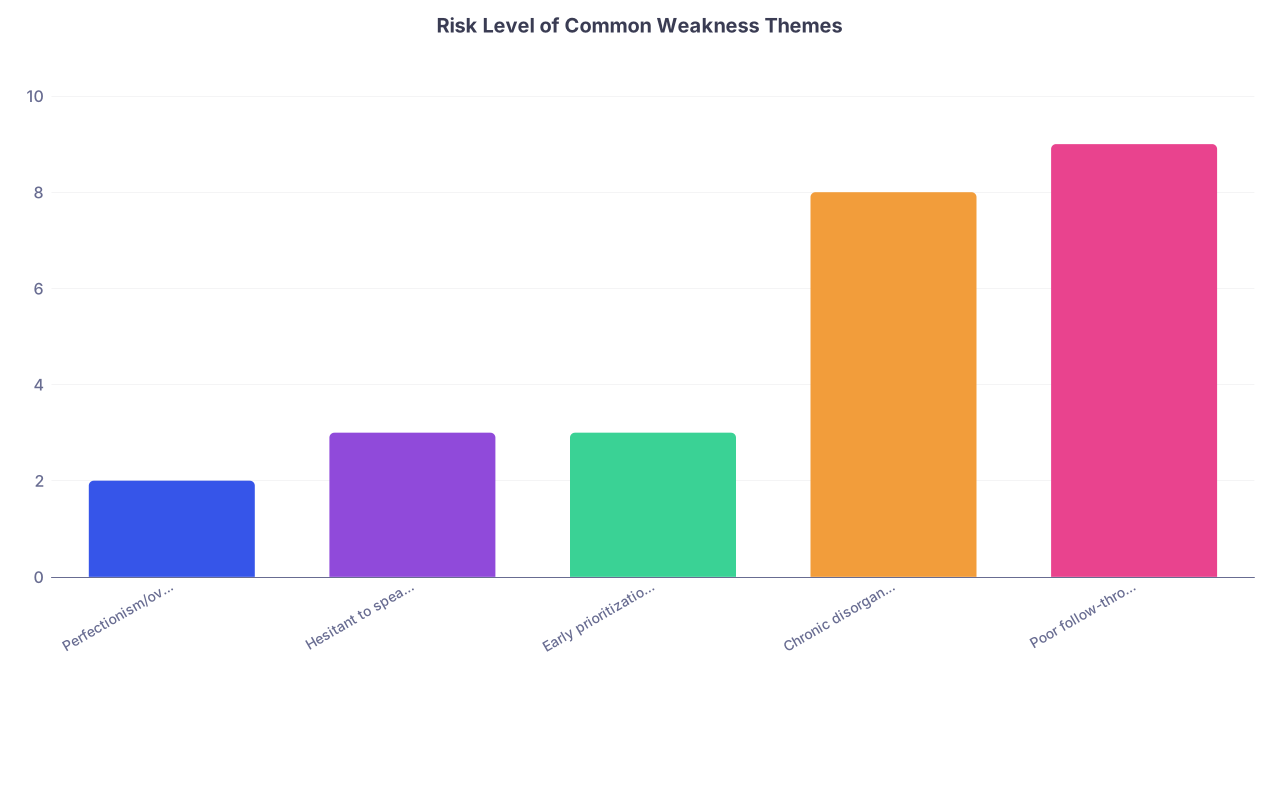
| Category | Value |
|---|---|
| Perfectionism/over-detailing | 2 |
| Hesitant to speak up | 3 |
| Early prioritization issues | 3 |
| Chronic disorganization | 8 |
| Poor follow-through | 9 |
(Scale 1–10: 1 = low risk, 10 = high risk as biggest-weakness theme.)
If your true weakness is one of the high-risk ones (chronic disorganization, poor follow-through), you do two things:
- Get real help for it now. That is not just an interview problem; it is a patient safety problem.
- Do not spotlight it as your headline weakness unless you can truthfully show it is now well controlled and no longer affecting performance. Even then, choose carefully.
Practice It Like a Procedure, Not Like a Script
You cannot wing this question. You will sound either rehearsed or disorganized.
You need rehearsed components, not memorized lines.
Use a simple template:
- One sentence: Name the weakness.
- Two to three sentences: Past concrete example and impact.
- Three to four sentences: Actions you took to improve.
- One to two sentences: Current status and relevance to residency.
Write it out once. Then say it aloud multiple times. Adjust so it sounds like you, not like a brochure.
Record yourself and listen for:
- Excessive apologizing (“I am so bad at…”).
- Over-defensiveness (“But I still did really well…”).
- Over-detailing every twist of the story.
- Overly polished, robotic tone.
You want calm, matter-of-fact, steady.
A mental checklist to run right before you answer in the room:
- Am I being honest but not self-destructive?
- Am I describing behavior, not identity?
- Am I ending on growth, not on struggle?
- Am I connecting it back to being a better resident?
If the answer to those is yes, you are in good territory.
How This Plays Within the Whole Interview
“Biggest weakness” does not exist in isolation. Interviewers mentally cross-check your answer against:
- Your letters
- Your MSPE
- Your personal statement
- How you acted during the day
If your faculty letter says, “Student responded exceptionally well to constructive feedback and improved their efficiency over the rotation,” and your weakness story matches that arc, you look cohesive. Self-aware. Trustworthy.
If your story completely contradicts your application (for example, you claim your weakness is speaking up but every letter calls you “the dominant voice on rounds”), you look either lazy in your preparation or disingenuous.
This is why you should pick a weakness that genuinely matches your narrative.
A quick way to check alignment:
Print your MSPE and at least one strong letter (or their quoted comments if you saw them during mock review). Highlight:
- Any mention of feedback you received.
- Any mention of growth or improvement.
- Any criticism that is framed constructively (“Started rotation somewhat quiet but became more confident…”).
Often your best weakness answer is already hiding in that language.
Rapid Fire: What To Do and What To Avoid
You are smart; you do not need paragraphs for every point here.
Do:
- Choose a real, moderate, behavior-level weakness.
- Anchor it with a short, specific example.
- Show explicit, concrete actions you took to improve.
- Emphasize your responsiveness to feedback.
- End with clear, calm confidence in your current functioning.
Avoid:
- “I am a perfectionist” with no cost or story.
- Weaknesses that question your professionalism, reliability, or ethics.
- Vague, therapy-style monologues with no clear resolution.
- Overly dramatic, self-flagellating language.
- Claiming you “fixed” the weakness completely.
Here is the process visually so you can cement it:

| Step | Description |
|---|---|
| Step 1 | Identify real behavior-level weakness |
| Step 2 | Check risk level for specialty |
| Step 3 | Find past concrete example |
| Step 4 | List specific actions taken to improve |
| Step 5 | Define current status: improved but monitored |
| Step 6 | Connect to residency readiness |
Integrating This into Overall Interview Prep
Do not isolate this question. Prepare it as part of a cluster:
- Biggest weakness
- A time you received critical feedback
- A time you failed or made a mistake
- Strengths and areas for growth
You can reuse the same core story with different framing if you are subtle.
Example cluster around “efficiency / over-detailing”:
- Biggest weakness → The arc we discussed: over-detailed notes → feedback → time tracking.
- Time you received critical feedback → The senior telling you your notes were slowing you down.
- A failure → A day when you left late and missed studying because you spent too long writing.
The trick: adjust the angle and details so it does not sound like you have only one story. But consistency reinforces credibility.
And yes, interviewers notice when your answers line up.
To see how this fits in the wider interview focus, look at what evaluation rubrics actually rate:
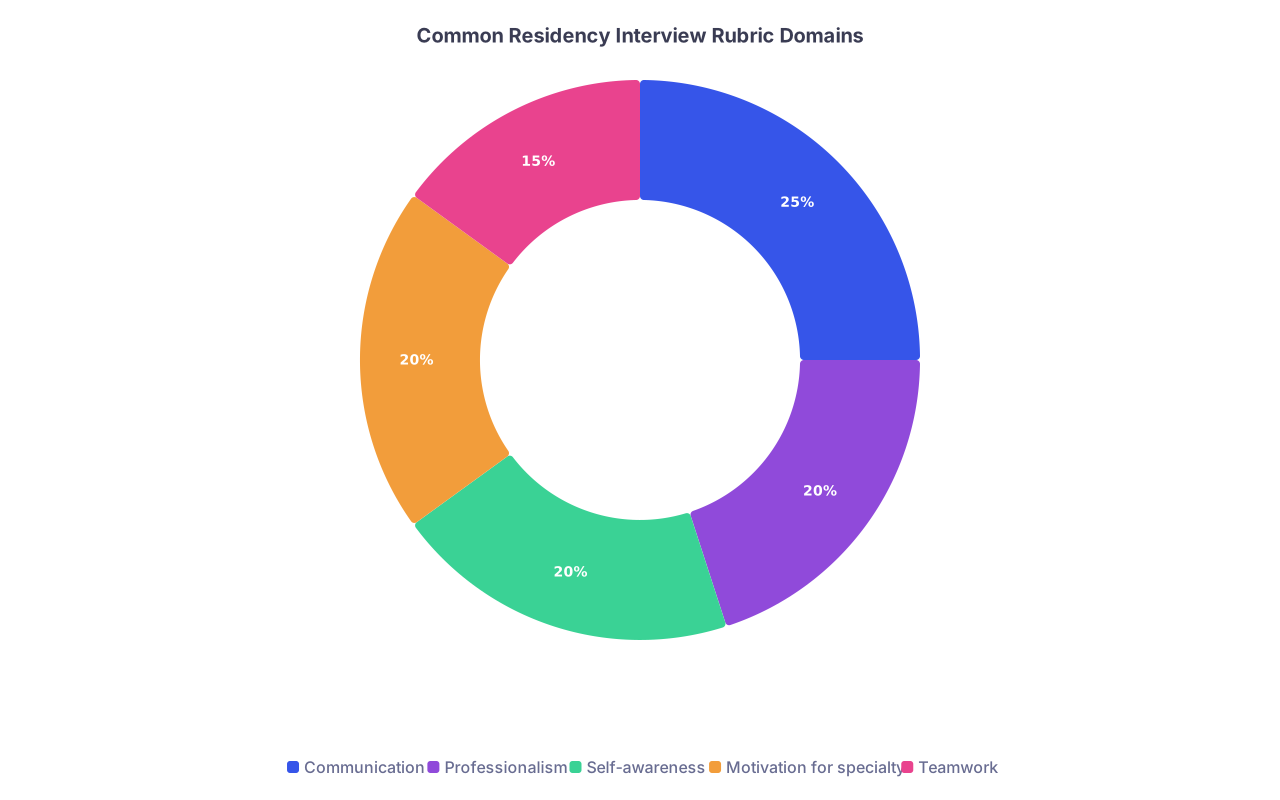
| Category | Value |
|---|---|
| Communication | 25 |
| Professionalism | 20 |
| Self-awareness | 20 |
| Motivation for specialty | 20 |
| Teamwork | 15 |
Your weakness answer hits communication, professionalism, and self-awareness in one shot. Do it well, and you buy a lot of goodwill.
If You Have a Genuine Major Weakness or Red Flag
Some of you are reading this thinking, “My weakness is not a cosmetic one. I actually failed a course / had a leave / struggled with professionalism early on.”
That is a separate but related issue. For genuine red flags, you need:
- A direct, unflinching acknowledgment.
- Clear evidence of remediation.
- Third-party validation (letters, improved grades, stable performance).
- A time gap between the event and now.
You generally do not want to use your most serious red flag as your “biggest weakness” story unless:
- You know they already know about it (it is in your MSPE).
- You have a strong, well-documented recovery arc.
- You can speak about it calmly, without defensiveness.
In those cases, your “weakness” answer sounds more like:
- “Earlier in my training I struggled with X, here is what happened, how I addressed it, and where I am now.”
It is higher risk but sometimes necessary. If you are unsure whether to use a major red flag as your weakness example, run it by your dean’s office or a trusted faculty advisor who knows your file.
Final Thoughts
You do not need a “perfect” weakness answer. You need an honest, disciplined, and strategically framed one.
Three points to take with you:
- Treat “biggest weakness” as a test of self-awareness and coachability, not as a trap to outsmart.
- Pick a real, moderate weakness, tie it to a concrete example, and show specific actions that led to measurable improvement.
- End every answer with clear, calm confidence in your current functioning and a direct link to how this growth will make you a better, safer resident.