
It’s four weeks before your first residency interview. Your ERAS is in. Your emails are full of Zoom links and “We’re pleased to invite you…” messages. And you’re realizing something: you can list your research and talk about your Step scores, but when someone says, “Tell me about a time you failed,” your brain just…whites out.
This one-month schedule is for that exact moment.
I’m going to walk you week by week, then day by day in critical stretches, so by the time you hit “Join meeting” you’re not scrambling for stories. You’ll have a small, sharp arsenal of behavioral examples ready to go—and they’ll actually sound like you, not a robot.
Big Picture: What You’re Doing Over 4 Weeks
At this point, you should not be trying to prepare for every possible question. That’s how people burn 20 hours and still sound scattered.
You’re going to:
- Build a story bank of 12–16 strong experiences.
- Map each story to common behavioral themes (conflict, leadership, failure, ethics, etc.).
- Practice a simple structure (I recommend modified STAR) until it’s automatic.
- Do two serious mock interviews and a few lighter reps.
- Polish delivery: concise, reflective, not braggy, not rambling.
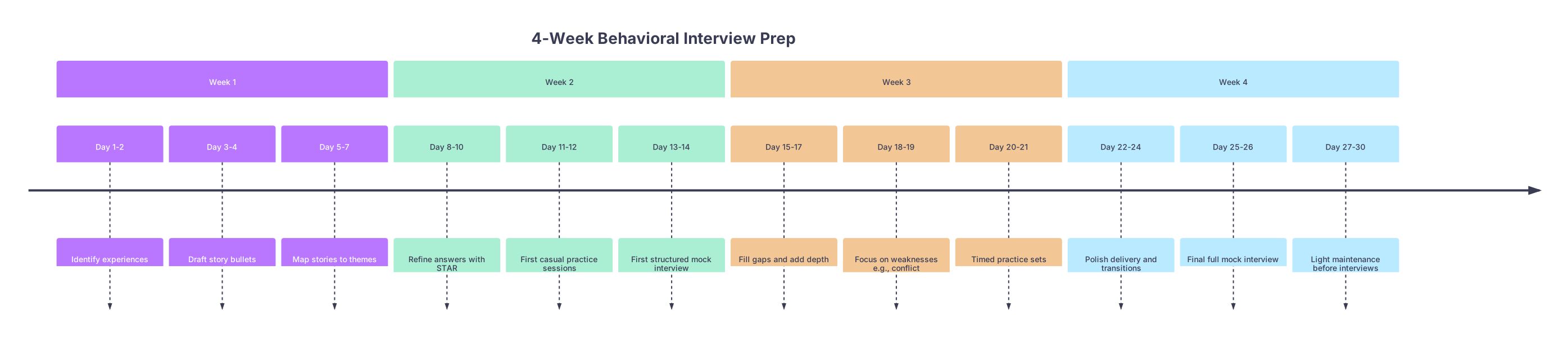
Here’s the month in one shot:
| Period | Event |
|---|---|
| Week 1 - Day 1-2 | Identify experiences |
| Week 1 - Day 3-4 | Draft story bullets |
| Week 1 - Day 5-7 | Map stories to themes |
| Week 2 - Day 8-10 | Refine answers with STAR |
| Week 2 - Day 11-12 | First casual practice sessions |
| Week 2 - Day 13-14 | First structured mock interview |
| Week 3 - Day 15-17 | Fill gaps and add depth |
| Week 3 - Day 18-19 | Focus on weaknesses e.g., conflict |
| Week 3 - Day 20-21 | Timed practice sets |
| Week 4 - Day 22-24 | Polish delivery and transitions |
| Week 4 - Day 25-26 | Final full mock interview |
| Week 4 - Day 27-30 | Light maintenance before interviews |
Week 1: Build the Story Bank (Days 1–7)
At this point you should forget about “perfect answers” and focus on raw material. You can’t polish what doesn’t exist.
Days 1–2: Brain Dump Every Usable Experience
Goal: Generate 20–30 possible stories. You’ll cut later.
Sit down with a blank document and timeline your last 4–6 years:
- Preclinical years
- Clinical rotations (core and electives)
- Research projects
- Leadership roles (interest groups, committees)
- Jobs, sports, non-medical stuff (yes, these count)
For each, jot short bullets, not essays. Example:
- “M3 IM – angry family, wanted attending, I mediated.”
- “Surgery – scrub tech conflict over timeout, spoke up.”
- “Clinic – complex diabetic patient, no-show, I built follow-up plan.”
- “Free clinic leader – scheduling chaos, redesigned coverage.”
- “Step 1 fail – remediation, changed study strategy.”
You’re not wording answers. You’re just capturing moments where:
- Something went wrong.
- You had to choose or prioritize.
- People disagreed.
- You took initiative.
- You made a mistake or changed your mind.
Days 3–4: Turn Raw Events into Rough Stories
Now you’ll pull out the 12–16 stories with the best “teaching points.”
For each chosen story, create a bullet STAR skeleton:
- Situation – 1 bullet, context only.
- Task – what you were responsible for.
- Action – 2–4 bullets, what you actually did.
- Result/Reflection – what happened + what you learned/changed.
Example:
Story: Angry family on medicine inpatient
- S: M3 on IM, 65yo with new cancer dx, family upset about “no communication.”
- T: I was the only one available on the team rounding; needed to address concerns, maintain trust.
- A:
- Asked team for 10 minutes to pause rounds.
- Took family to conference room, let them vent uninterrupted.
- Summarized their concerns, clarified what had been communicated.
- Called resident to join for treatment plan explanation.
- R:
- Family calmed, thanked us for taking time.
- Resident later said this prevented formal complaint.
- Learned to proactively schedule family meetings for complex cases.
Do this for each story. Do not write full paragraphs yet; bullets force clarity.
Days 5–7: Map Stories to Behavioral Themes
Now you make the stories work for you.
Common behavioral themes you must cover:
- Conflict with team member
- Dealing with a difficult patient or family
- Leadership / initiative
- Working with a difficult supervisor or attending
- Mistake or failure
- Handling stress / burnout / time management
- Ethical dilemma or professionalism issue
- Diversity / working with different backgrounds
- Working in a team / communication
- Learning from feedback
- Going above and beyond / advocacy
- Biggest challenge / resilience
Build a simple map:
| Theme | Primary Story ID | Backup Story ID |
|---|---|---|
| Conflict | IM-1 | Surg-2 |
| Difficult patient | FM-3 | Psych-1 |
| Leadership | FreeClinic-1 | SIG-Lead-1 |
| Failure/Mistake | Step1-Remed | OR-Error-1 |
| Ethical/Professional | Charting-Delay | Confidential-1 |
If a theme has no story, that’s your red flag. You’ll patch those gaps in Week 3, but for now, just notice them.
Week 2: Structure and First Real Practice (Days 8–14)
Now you have stories. At this point you should start sounding coherent and intentional, not improvisational.
Days 8–10: Tighten Structures and Trim Fat
Convert your bullet STARs into spoken answers. Key word: spoken.
For each story:
- Write out a loose script in your own voice.
- Then immediately edit it down so you can tell it in 60–90 seconds.
Target:
- Situation + Task: 2–3 sentences max.
- Action: 3–5 sentences.
- Result/Reflection: 2–4 sentences.
Example of trimming:
- Bloated: “So this was on my medicine sub-I at a large academic hospital where the patient population was mostly underserved, and I was on a team with an attending, senior resident, intern, and me as the only student…”
- Tight: “On my medicine sub-I, I was the only student on a team caring for an older patient with new cancer.”
Cut fluff like “I learned a lot from this experience” and replace with specifics: “Since then, I always…”
Day 11–12: Light Rehearsal, Low Stakes
You’re not ready for a full mock yet. Instead:
Pick 4–5 common prompts:
- “Tell me about a time you had a conflict on the team.”
- “Tell me about a time you made a mistake.”
- “Tell me about a time you showed leadership.”
- “Tell me about a time you received critical feedback.”
- “Tell me about a challenging patient encounter.”
Answer them out loud into your phone’s voice recorder.
Listen back once. Ask yourself:
- Did I answer the question or just tell a generic story?
- Did I actually say what I learned or changed?
- Did I sound like a human or like I was reading a script?
Tweak 1–2 sentences per story. Don’t rewrite everything.
Day 13–14: First Real Mock Interview
At this point you should schedule one structured mock. Not with your nicest friend who says “You’re great.” With someone who’ll call you out. Good options:
- Career services / academic advising office
- A resident from your home program
- That blunt classmate who always gives real feedback
Ask them to focus on behavioral questions only. 25–30 minutes is enough.
Give them a list like:
- Conflict with resident/attending/peer
- Difficult patient/family
- Handling a mistake
- Times you went above and beyond
- Stress/time management
- Learning from feedback
- Where did you ramble?
- Where did you sound rehearsed and fake?
- Which stories felt weak or confusing?
Write down 3 specific fixes. Not “get better at conflict questions.” More like:
- My conflict stories blame others too much—need more self-reflection.
- I’m vague about results (e.g., “it went well”)—add concrete outcomes.
- I say “like” and “um” constantly—need to slow down.
Week 3: Fill Gaps and Stress-Test Your Answers (Days 15–21)
Now you’ve got the basics. At this point you should start stress-testing. If someone slightly twists the question, you shouldn’t panic.
Days 15–17: Patch Holes and Add Depth
Look back at your theme map and mock feedback.
- Any themes without good stories? Build 1–2 now.
- Any stories that feel forced? Replace them.
Example: Your conflict story is always “I get along with everyone, but one time a nurse misunderstood me…” That’s weak. Find something where there was real tension and you had to do something uncomfortable.
Add one meta-layer to each story: what this says about you as a future resident.
End with lines like:
- “This reinforced that I need to speak up even when I’m junior.”
- “Since then, I’ve asked for expectations upfront when starting new rotations.”
- “It made me more proactive about checking in with nurses early in my shifts.”
Days 18–19: Focus on Your Weak Category
Everyone has one. The usual culprits:
- Conflict (you avoid it)
- Failure (you sugarcoat it)
- Ethical issues (you freeze, afraid of saying the “wrong” thing)
- Diversity / bias (you’re scared of sounding performative)
Pick the one that made you most uncomfortable in the mock and do a mini-bootcamp:
- List 3–4 potential questions in that category.
- For each, decide which story you’ll use.
- Practice them back-to-back out loud, 2–3 rounds.
You’re building flexibility: same story, different angles.
Example: One clinic leadership story might answer:
- “Tell me about a time you led a team.”
- “Tell me about a time you solved a systems problem.”
- “Tell me about a time you worked with someone who wasn’t pulling their weight.”
Same core event, different emphasis.
Days 20–21: Timed Practice Sets
Now simulate a short interview on your own.
Set a timer for 25 minutes. Use a random question generator (or list from a PDF) and answer:
- 8–10 behavioral questions in a row.
- Max 2 minutes per answer.
Record video this time. Painful, but necessary.
When you watch:
- Are you actually answering the question?
- Are you accidentally repeating the same story too often?
- Are you talking for 3+ minutes? (You probably are.)
Fix one thing at a time. Day 20, trim length. Day 21, sharpen reflections.
Week 4: Polish, Final Mock, and Maintenance (Days 22–30)
By now you should have:
- 12–16 stories.
- A clear theme map.
- At least one mock interview done.
This week is about smoothing edges and not burning out.
| Category | Value |
|---|---|
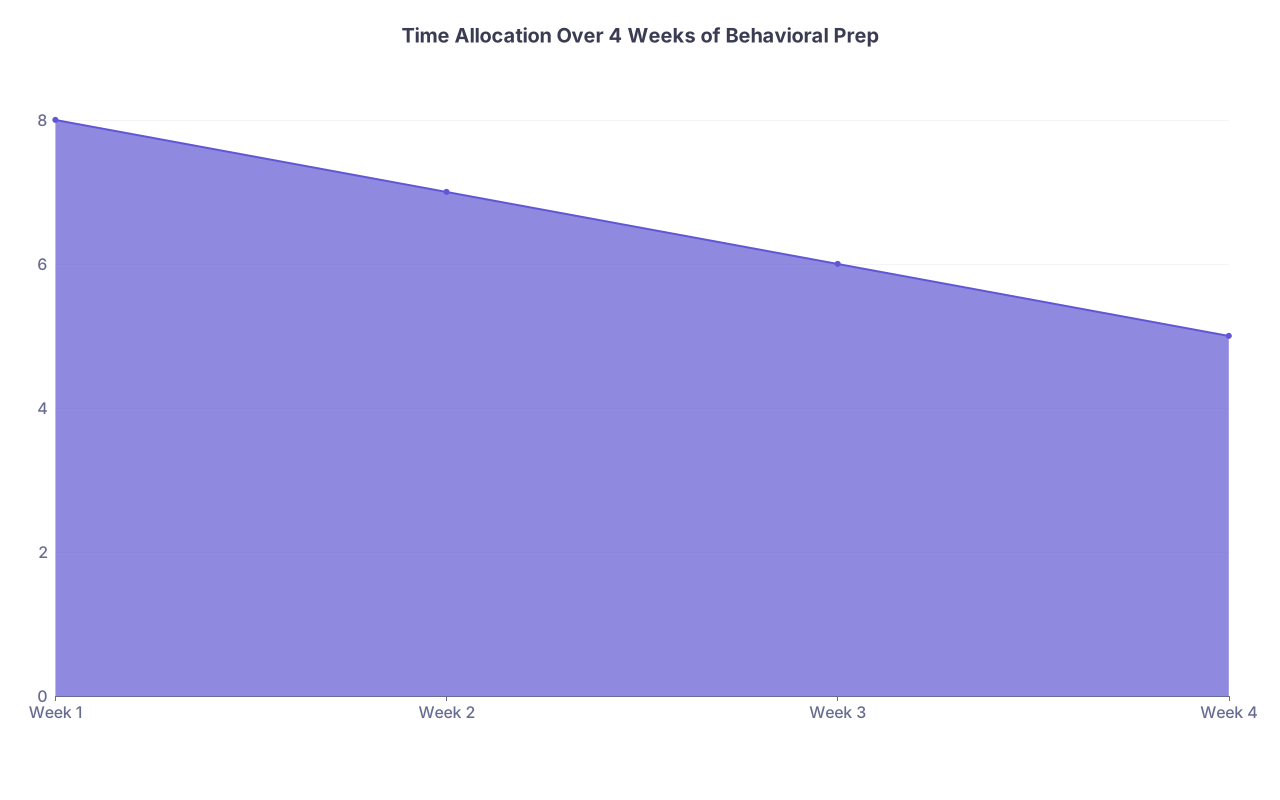
| Week 1 | 8 |
| Week 2 | 7 |
| Week 3 | 6 |
| Week 4 | 5 |
Days 22–24: Delivery and Transitions
Behavioral answers go off the rails in two places: the start and the end.
Work on Openings
You need 1–2 clean sentences to start almost any story:
- “On my internal medicine rotation, I had a situation where…”
- “During my role as a free clinic coordinator, there was a time when…”
- “As a third-year on surgery, I encountered a conflict when…”
Practice those so you don’t fumble at the beginning.
Work on Closings
Never just stop at the result. End with a reflection or takeaway:
- “That experience taught me to…”
- “Since then, I’ve made it a habit to…”
- “As a resident, I’d bring that same approach by…”
Spend one evening just tagging on endings to 6–8 of your core stories.
Days 25–26: Final Full Mock Interview
You want one more serious run-through in this window—ideally 3–7 days before your first real interview.
Structure it like this:
- 10 minutes: traditional “Why this specialty/our program?”
- 25–30 minutes: heavy behavioral questions.
- 5 minutes: brief feedback.
Ask your mock interviewer to surprise you with at least 2 unusual behavioral questions, like:
- “Tell me about a time you changed your mind about a patient.”
- “Describe a time when you had too many tasks and not enough time.”
- “Tell me about a time you disagreed with a policy.”
Afterward, you do a quick post-mortem:
- Which stories felt overused? Mark them as “secondary” going forward.
- Did any new story spontaneously come out that was better? Capture and bullet it.

Days 27–30: Light Maintenance Before Interviews
At this point you should stop heavy rewriting. You’re in maintenance mode.
Daily 15–20 minute routine (especially the night before an interview):
- Pick 3–4 themes you’re likely to get.
- Glance at your bullet skeletons, do not re-read full scripts.
- Answer them out loud once—short, confident.
- Close laptop. Walk away.
The night before your first interview:
- Review your theme map, not the full stories.
- Trust that your repetition will carry you. Over-prepping the night before makes people sound robotic and panicked.
One-Week Accelerated Version (If Your First Interview Is Sooner)
If you’re reading this with 7–10 days left, you can still salvage a lot. Compress like this:
| Day | Focus |
|---|---|
| 1 | Brain dump + select 10 stories |
| 2 | Bullet STAR skeletons |
| 3 | Map to themes + fill big gaps |
| 4 | Convert to spoken answers |
| 5 | Light practice + self-recording |
| 6 | One full mock interview |
| 7 | Polish openings/closings + light review |
You won’t be perfect. You don’t need to be. You just need to sound like a thoughtful, safe future resident who has actually reflected on their experiences. That’s the bar.
Daily/Weekly Checklist
To make this practical, here’s what “done” looks like each phase.
| Category | Value |
|---|---|
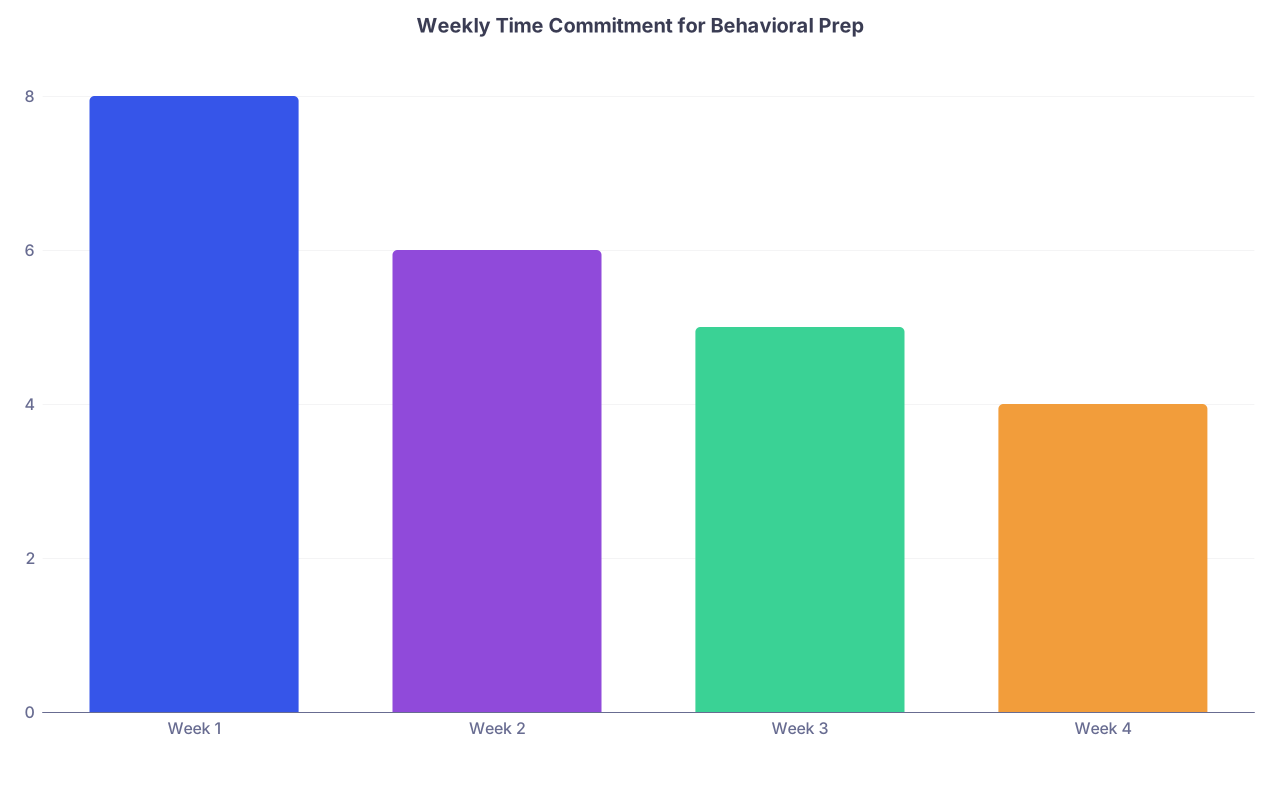
| Week 1 | 8 |
| Week 2 | 6 |
| Week 3 | 5 |
| Week 4 | 4 |
Weekly Milestones
End of Week 1:
- 20–30 raw experiences listed.
- 12–16 chosen stories with STAR bullets.
- Stories mapped to at least 8 major themes.
End of Week 2:
- Most stories can be told in 60–90 seconds.
- At least 1 self-recorded practice session done.
- 1 structured mock interview completed with written feedback.
End of Week 3:
- Gaps in themes filled (conflict, failure, leadership, ethics covered).
- One “weak area” question type specifically targeted.
- 1–2 sets of timed Q&A done with video recording.
End of Week 4:
- Clean openings and reflections for core stories.
- Second full mock interview done.
- Night-before maintenance routine feels quick and manageable.

How to Re-Use Stories Intelligently
One last tactical point I’ve seen trip people up: “Can I reuse the same story for different questions?” Yes. You should.
The key is:
- Change the framing (why you chose that story).
- Shift which actions and reflection you emphasize.
Example: Same free-clinic coordinator story:
- For leadership: focus on organizing schedules, delegating, improving workflow.
- For conflict: focus on the disagreement with a co-volunteer and how you resolved it.
- For ethics: focus on advocating for patients who were being inappropriately turned away.
That’s efficient prep. You don’t need 50 stories. You need 10–15 flexible ones.

Core Takeaways
- Spend Week 1 on story inventory, not memorized answers. Weak prep starts with too few stories.
- Use a simple structure (STAR with real reflection) and practice out loud until 60–90 seconds feels natural.
- Do at least two serious mock interviews and a few self-recorded sessions so your first behavioral questions don’t hit you for the first time on interview day.