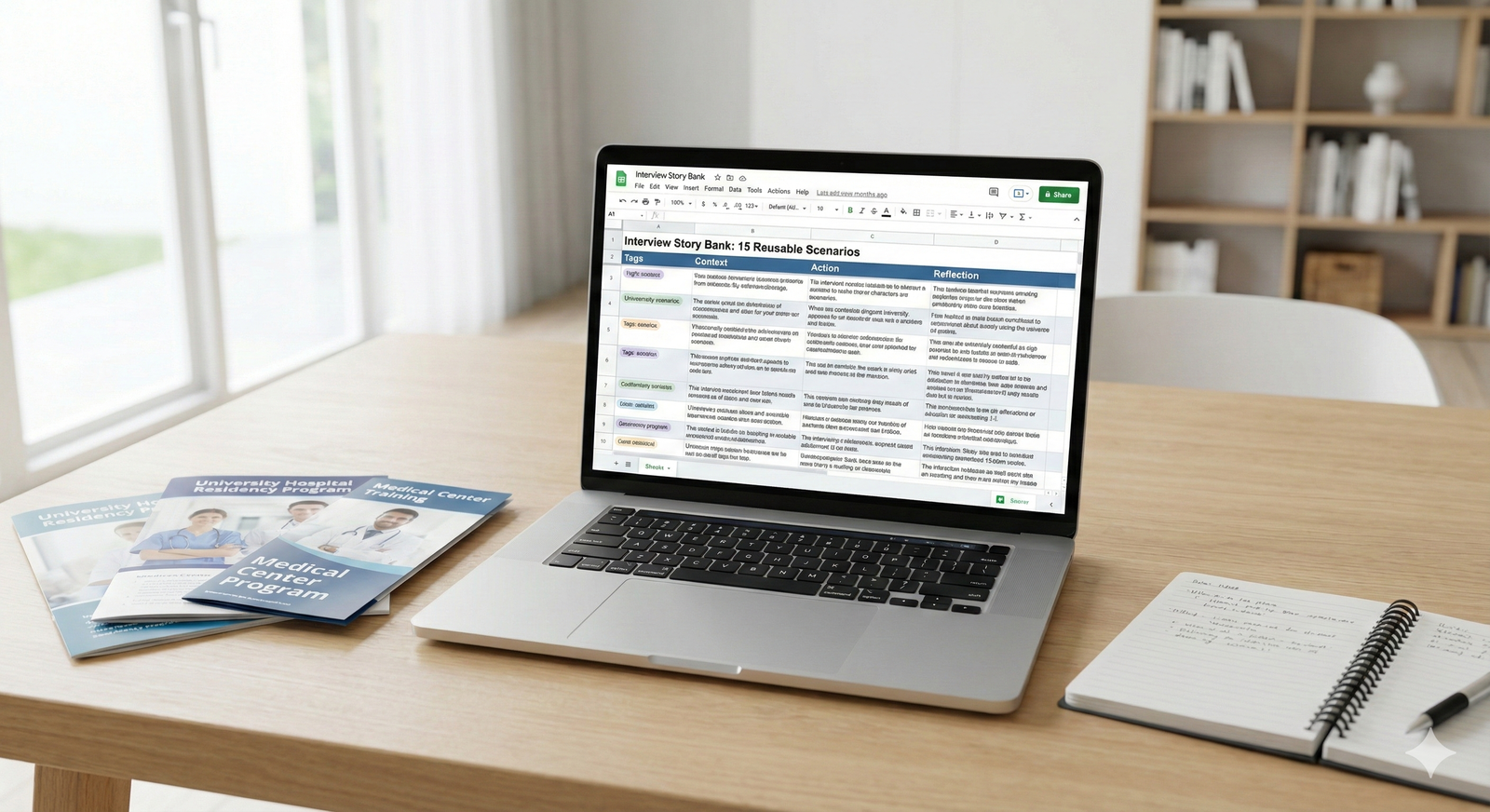
It’s four weeks before your first residency interview. Your ERAS is in. Emails with subject lines like “Interview Invitation” are trickling in. Your white coat’s on the back of a chair, your suit is somewhere in the closet, and your “Tell me about yourself” answer is… a chaotic mess in your head.
This is where you are.
You’ve got 4 weeks. That’s enough time to go from scattered and anxious to sharp, smooth, and ready. But only if you treat this like a bootcamp. Not vibes. Not “I’ll wing it, I’m good with people.” A structured, week‑by‑week build.
I’ll walk you through a 4‑week plan: what to do each week, what to have done by certain days, and what not to waste time on.
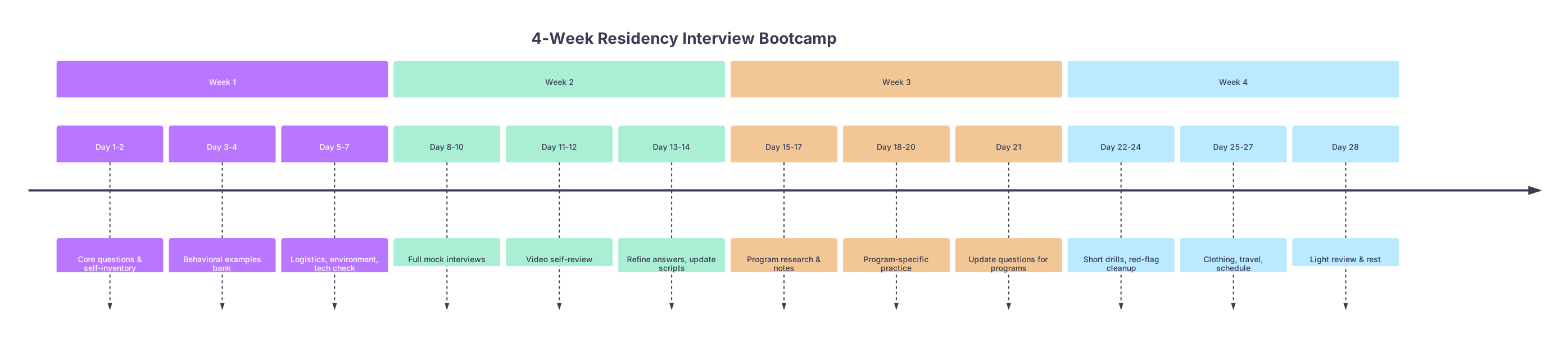
Overview: Your 4-Week Interview Bootcamp Roadmap
At this point you should understand the arc:
Week 1 – Foundation & Story Crafting
Build your core answers, personal narrative, logistics, and system.Week 2 – Reps & Feedback
Heavy mock interviews, behavioral questions, video practice.Week 3 – Program-Specific Deep Dives
Targeted prep for actual interviews on your calendar.Week 4 – Final Polish & Game-Day Routines
Fine-tune answers, timing, and mental prep; finalize details.
| Period | Event |
|---|---|
| Week 1 - Day 1-2 | Core questions & self-inventory |
| Week 1 - Day 3-4 | Behavioral examples bank |
| Week 1 - Day 5-7 | Logistics, environment, tech check |
| Week 2 - Day 8-10 | Full mock interviews |
| Week 2 - Day 11-12 | Video self-review |
| Week 2 - Day 13-14 | Refine answers, update scripts |
| Week 3 - Day 15-17 | Program research & notes |
| Week 3 - Day 18-20 | Program-specific practice |
| Week 3 - Day 21 | Update questions for programs |
| Week 4 - Day 22-24 | Short drills, red-flag cleanup |
| Week 4 - Day 25-27 | Clothing, travel, schedule |
| Week 4 - Day 28 | Light review & rest |
Week 1: Build the Foundation (Days 1–7)
By the end of Week 1, you should have:
- A clear personal narrative
- Solid first drafts for all core questions
- A STAR story bank
- Basic logistics and tech ready
Days 1–2: Core Narrative & “Big 5” Answers
Sit down. No phone. Open a doc. At this point you should get brutal about clarity.
Task 1: Write your one-line identity
You need a simple way to describe yourself that anchors your answers.
Examples:
- “I’m a fourth-year at UMass with a strong interest in academic internal medicine and quality improvement.”
- “I’m a DO student with a non-traditional background in engineering, drawn to EM for its team-based, high-acuity environment.”
Task 2: Draft your “Big 5”
You should have at least rough answers (bullet form is fine) to:
- Tell me about yourself.
- Why this specialty?
- Why our program? (generic template this week; you’ll customize in Week 3)
- What are your strengths and weaknesses?
- Tell me about a time you had a conflict / failed / made a mistake.
Keep them:
- 60–90 seconds each
- Concrete, not slogans (“I’m passionate about…” isn’t a story)
- Anchored in specific clinical or life experiences
Aim: By end of Day 2, you’ve got ugly first drafts on paper. Do not memorize yet. You’re building clay to shape later.
Days 3–4: Build Your STAR Story Bank
You do not “wing” behavioral questions. You prep.
At this point you should create a mini-database of situations using STAR (Situation, Task, Action, Result).
Make a table like this:
| Scenario Type | Story Topic |
|---|---|
| Conflict | Disagreement with resident on plan |
| Leadership | Led QI project on discharge summaries |
| Failure | Failed OSCE communication station |
| Difficult patient | Non-adherent diabetic, frequent admissions |
| Ethical dilemma | Family requesting non-disclosure |
Your goal: 8–12 stories that can flex across many questions.
Categories you must cover:
- Conflict with teammate or supervisor
- Difficult patient / family interaction
- Failure or mistake
- Leadership
- Working with limited resources / time pressure
- Interprofessional collaboration
- Teaching or mentoring someone
- Handling feedback
For each, write 4–6 bullet points:
- 1 for Situation
- 1 for Task
- 2–3 for Actions
- 1 for Result / reflection (“What I learned…”)
You’re not scripting speeches. You’re building memory hooks.
Days 5–7: Logistics, Environment, and Tech
You do not want to be the person whose audio is cutting out or whose camera is pointing at the ceiling fan.
If your interviews are virtual:
By the end of this week you should have:
Environment locked in
- Quiet location reserved (bedroom, office, library room)
- Neutral background or tidy space
- Chair and desk comfortable for 4–6 hours
Tech checked
- Laptop updated, notifications off
- Good external mic or at least tested laptop mic
- Stable internet (run a speed test; 10+ Mbps upload is fine)
- Headphones that do not die after 1 hour
-
- Eye level (stack books if needed)
- Light in front of your face, not behind
- Dress rehearsal call with a friend to verify it all looks normal, not creepy
If your interviews are in-person:
- Try on your suit. Today.
- Does it actually fit? Can you lift your arms?
- Shoes: broken in, polished, no visible damage
- Check travel:
- Rough estimate of flight costs
- Confirm passport/ID is current
- Start a simple spreadsheet for each program: date, city, travel, hotel, contact info
Week 2: Reps and Feedback (Days 8–14)
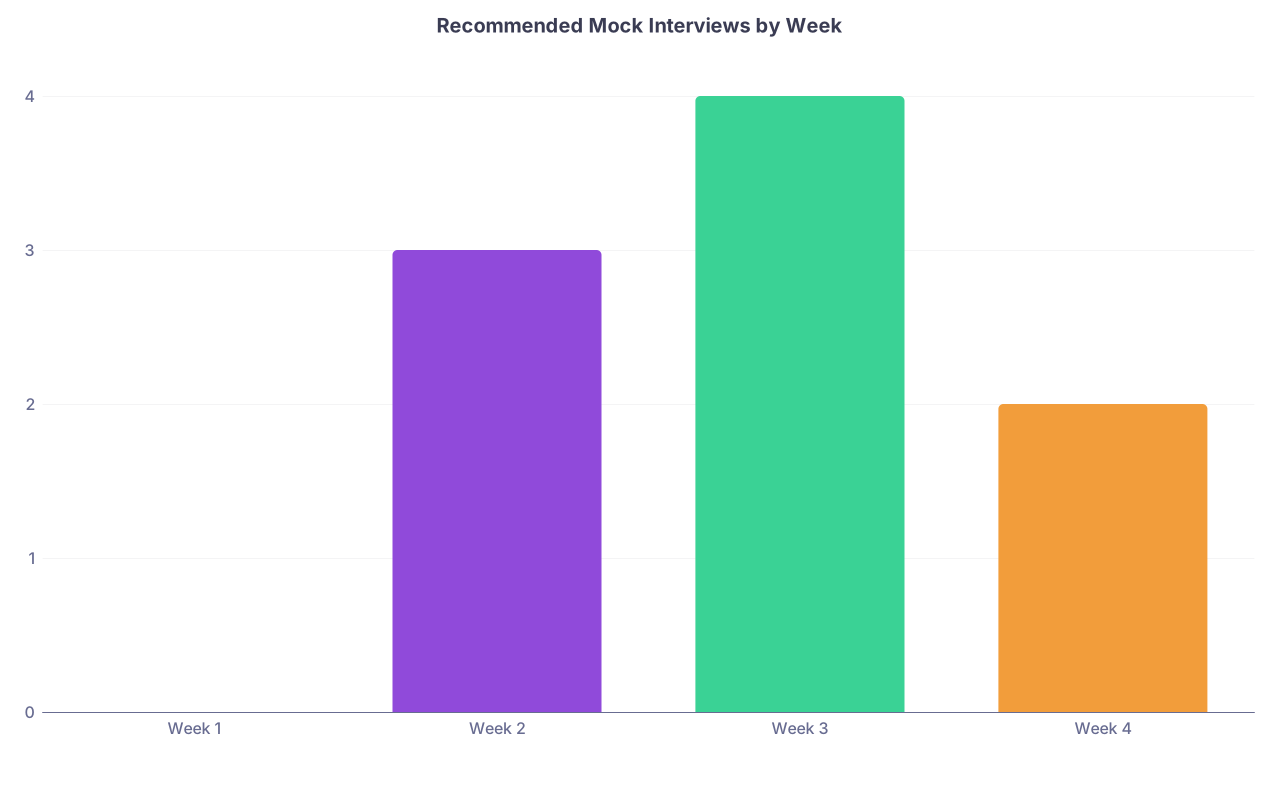
By the end of Week 2, you should have:
- Done at least 3 full mock interviews
- Video of yourself answering common questions
- Updated your answers based on feedback
| Category | Value |
|---|---|
| Week 1 | 0 |
| Week 2 | 3 |
| Week 3 | 4 |
| Week 4 | 2 |
Days 8–10: Full Mock Interviews
At this point you should stop “thinking about” interviews and actually simulate them.
Mock #1 (Day 8–9)
Who: Classmate, partner, or friend who can be blunt.
Format:
- 20–30 minutes
- Focus on the Big 5 + 3–4 behavioral questions
- Record it (Zoom/Teams/phone propped up)
Ask them to critique:
- Rambling vs. concise
- Clarity of your “why this specialty”
- Weird filler words (“like,” “um,” “you know”)
- Any red flags or confusing stories
Mock #2 (Day 9–10)
Who: Someone who actually interviews people, if possible:
- Resident you know
- Faculty advisor
- Career office
This one should be stricter:
- 30–40 minutes
- Minimal feedback until the end
- Try 1–2 “curveball” questions:
- “Tell me something not on your application.”
- “If you couldn’t do this specialty, what would you do?”
You’re stress-testing your narrative now.
Days 11–12: Video Self-Review and Tightening
You’re going to hate this. Do it anyway.
At this point you should watch yourself like an attending watches an intern’s first H&P.
When reviewing your recording, look for:
- Posture: Slouching, rocking in the chair
- Eye contact: Looking at your own image vs. the camera
- Speed: Are you racing through answers?
- Clarity: Can you summarize each answer in one sentence? If not, it’s bloated.
Revise your Big 5 answers:
- Cut fluff
- Add 1–2 specific details to each (service name, approximate patient, a number)
- Ensure each answer has a “so what?” moment—what you learned, how you changed
Days 13–14: Specialty-Specific Prep
Now you layer in specialty flavor instead of giving the same generic answers to every program.
At this point you should:
List 5–7 things you genuinely like about your specialty:
- IM: longitudinal care, diagnostic reasoning, ACP guidelines, QI
- EM: undifferentiated patients, procedures, shift work, resuscitation
- Gen Surg: OR time, immediate impact, technical mastery, team structure
Prepare for common specialty-specific questions:
- “What are the biggest challenges facing [specialty]?”
- “Where do you see yourself in 10 years within this field?”
- “What types of patients do you enjoy working with most?”
Create 1–2 specialty-flavored STAR stories:
- The time you handled a crashing patient on night float
- Your role in a complicated surgical/OB case
- A diagnostic puzzle on wards that stuck with you
End of Week 2 checkpoint:
You should be able to do a 30-minute mock interview without melting down or losing your train of thought.
Week 3: Program-Specific Deep Dives (Days 15–21)
Now we shift from “generic interview-ready” to “this-program-ready.”
By the end of Week 3, you should have:
- Program notes for every place that’s invited you
- 3–4 tailored reasons for each program
- Specific questions to ask each program
Days 15–17: Research and Program Sheets
At this point you should stop saying “I’m excited by your strong clinical training” like a robot to 15 different places.
For each program, create a one-page sheet (digital or printed):
Minimum sections:
Basics: City, size, number of residents per year
Unique features: Community vs academic, major affiliations
What appeals to you: 3–4 bullets that are actually specific:
- “X hospital’s strong county exposure and safety-net population.”
- “Dedicated global health track with elective time PGY-2.”
- “Heavy autonomy at VA site.”
Faculty or areas of interest:
- 1–2 faculty whose interests line up with yours (no stalking; just public info)
- Any fellowships the program is known for in your area of interest
Questions to ask:
- About resident wellness, schedule, mentorship, grad placements, etc.

Days 18–20: Program-Specific Practice
Now you practice why this program until it does not sound like a copied template.
For each program on your calendar this week:
- Rehearse a 45–60 second answer to:
- “Why are you interested in our program?”
- Make sure it includes:
- 1 line connecting your background to the program type
- 2–3 specific features tied to your goals
- A brief forward-looking statement (“I can see myself… here’s how I’d grow”)
Example skeleton:
“Coming from [school type], I’ve really valued [type of patient population/setting]. Your program’s [specific track/rotation/affiliation] lines up with my interest in [X]. I’m also drawn to [resident autonomy / particular site / mentorship structure]. Long term, I see myself [career goal], and I think your emphasis on [training feature] fits that well.”
Also practice:
- How you’ll answer if they ask about a gap, LOA, bad grade, or low score.
- 30 seconds. Own it. No long excuses. End with growth and current performance.
Day 21: Refine Your Questions for Interviewers
By now, you should have stopped asking dead questions like “What is a typical day like?” (They’ve answered that 300 times. They’re bored.)
You need:
- 3–4 questions for residents
- 3–4 questions for faculty/PDs
Examples that don’t suck:
Residents:
- “What aspects of the program have changed for the better in the last 1–2 years?”
- “When residents leave here, what do they feel especially well prepared for compared to colleagues elsewhere?”
- “How responsive is leadership when residents bring up concerns?”
Faculty/PD:
- “What type of resident tends to thrive here, and what traits do they share?”
- “What are you most proud of in how this program has evolved in the last few years?”
- “If you had additional funding, what’s the first thing you’d change or add for residents?”
Week 4: Final Polish and Game-Day Routine (Days 22–28)
By the end of Week 4, you should have:
- Answers that feel natural, not memorized
- All clothes, travel, and tech squared away
- A pre-interview and post-interview routine you can repeat
Days 22–24: Short Drills and Red-Flag Cleanup
At this point you should stop doing 1-hour marathons and start doing sprints.
Daily 20–30 minute drill:
- Pick 3–5 random questions (have a friend choose, or use a question bank)
- Answer out loud, timed
- Record once a day
- Listen once a day
Focus on:
- Keeping answers under 2 minutes unless it’s a complex scenario
- Avoiding repetition of the same story more than twice in any 30 min stretch
- Eliminating verbal tics
Also:
- Rehearse your explanation for any application “issue” 3–5 times out loud until it is boring to you. That usually means it’s clean enough for interview.
Days 25–27: Logistics Lock-In
You should not be figuring out Zoom links or parking the morning of.
If virtual:
- Create a calendar entry for each interview:
- Time (with time zone)
- Platform & link
- Contact phone/email in case of tech problems
- Print or keep open:
- Program one-pager
- List of your questions
- Your schedule for the day
Test run:
- Do a 10-minute “fake interview” at the exact time of your first real one:
- Same room
- Same lighting
- Same clothes if you want full realism
If in-person:
- Confirm:
- Flights booked, seats chosen
- Hotel close enough that a transit hiccup won’t destroy you
- Directions from airport to hotel, hotel to hospital
- Pack your “interview kit”:
- Suit, backup shirt/blouse, extra socks/hosiery
- Folder with copies of your CV, a pen that works
- Portable phone charger, small snack, meds
Day 28: Light Review and Mental Prep
Last day of the bootcamp.
At this point you should not be cramming new answers. You should be calming your nervous system and trusting your reps.
Do:
- One short 15–20 minute warm-up:
- “Tell me about yourself”
- “Why this specialty”
- One STAR story
- Review:
- Tomorrow’s program one-pager
- Your questions list
Then stop.
The rest of the day:
- Move your body. Walk, light workout, something.
- Set out your outfit or check your Zoom setup.
- Go to bed at a realistic hour. This is not the night for a new Netflix series.

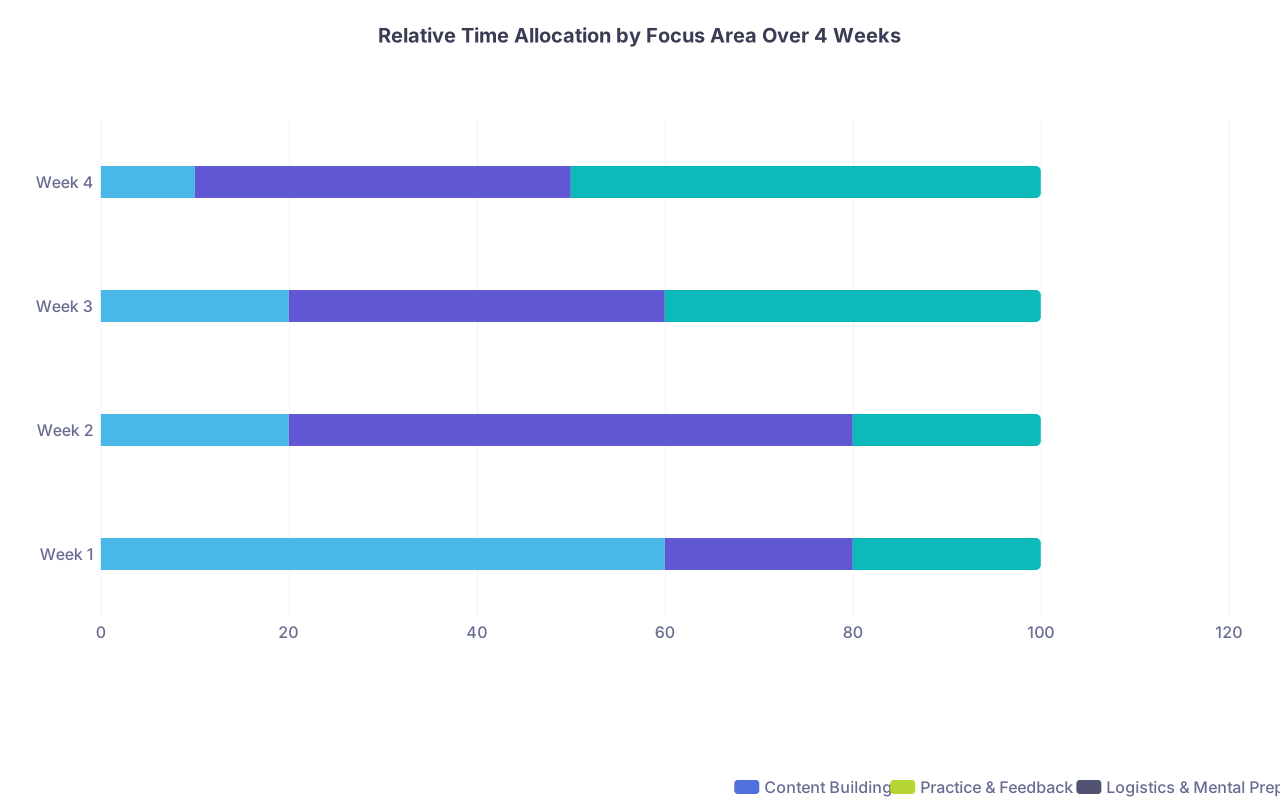
Putting It All Together: Your Weekly Checklist Snapshot
You’re busy. Here’s the compressed version.
| Week | Main Focus | Non-Negotiables Completed By End of Week |
|---|---|---|
| Week 1 | Narrative & Basics | Big 5 answers drafted, 8–12 STAR stories, tech/logistics setup |
| Week 2 | Practice & Feedback | 3 mock interviews, video review, specialty-specific answers |
| Week 3 | Program Targeting | One-pagers for each program, tailored 'why this program', question lists |
| Week 4 | Polish & Execution | Short drills, all logistics confirmed, game-day routine set |
| Category | Content Building | Practice & Feedback | Logistics & Mental Prep |
|---|---|---|---|
| Week 1 | 60 | 20 | 20 |
| Week 2 | 20 | 60 | 20 |
| Week 3 | 20 | 40 | 40 |
| Week 4 | 10 | 40 | 50 |
What You Should Do Today
You’re at the starting line of this 4-week bootcamp.
Do this today, before you close this tab:
- Open a blank document.
- Type “Tell me about yourself” at the top.
- Write a 6–8 sentence answer, no editing, just get it out.
- Underneath, list 5 situations you could turn into STAR stories from your clinical years.
That’s your first 30 minutes. Once that’s done, you’re officially in Week 1—and the rest of the plan has something solid to build on.