How to Integrate Research Experiences Seamlessly into Interview Answers
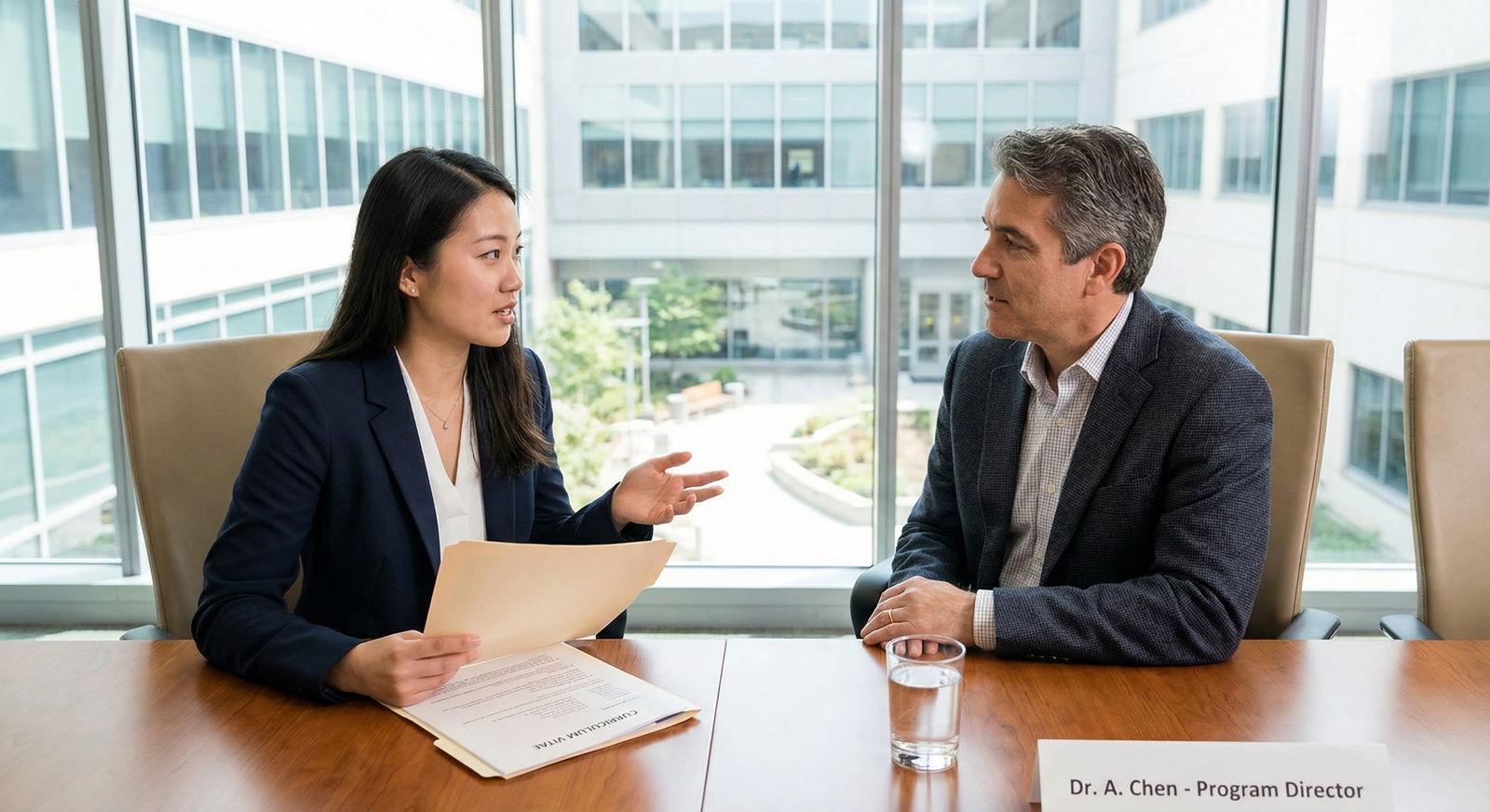
You are sitting in a tiny conference room on your third interview of the week. The associate program director skims your ERAS printout, looks up, and says the line you knew was coming:
“So, tell me about your research.”
You have two choices.
Option A: you recite the abstract of your poster in stiff conference-speak, watch their eyes glaze over, and pray the timer runs out.
Option B: you use that question to demonstrate how you think, how you work on a team, how you handle failure, and why you belong in their program.
This article is about option B. How to make your research work for you in any residency interview question—without sounding rehearsed, pretentious, or like you’re still at journal club.
Let me break this down specifically.
Step 1: Decide What Your Research Actually “Says” About You
You do not need to talk about every project. In fact, you should not.
Your first job is deciding what story each project supports. Think in themes, not titles.
Typical themes you can showcase with research:
- Curiosity and problem identification
- Perseverance through setbacks
- Data-driven thinking and comfort with uncertainty
- Collaboration and communication
- Ownership and follow-through
- Teaching and mentoring
Take each substantial project and assign it 1–2 primary themes. Example:
- Retrospective CHF outcomes project → perseverance, systems thinking
- QI project reducing ED boarding times → teamwork, implementation, leadership
- Basic science bench work in a cardiology lab → attention to detail, tolerance for delayed gratification
- Medical education project on OSCE redesign → communication, curricular thinking, feedback culture
Write this out once. Literally make a small table for yourself.
| Project Type | Example Theme 1 | Example Theme 2 |
|---|---|---|
| Retrospective clinical | Perseverance | Systems thinking |
| QI/Patient safety | Teamwork | Implementation |
| Basic science | Attention to detail | Resilience |
| Med ed research | Communication | Feedback culture |
| Global health project | Resourcefulness | Cultural humility |
Now you have a menu. When they say, “Tell me about a time you overcame a challenge,” you do not fish through your life in real time. You already know which research story is built for that answer.
Step 2: Translate Your Research into Plain, Interview-Usable Language
Most applicants lose interviewers in the first sentence because they start like this:
“I worked on a multicenter retrospective cohort evaluating the prognostic value of…”
Stop. That belongs in a paper, not in a conversation.
You need two parallel versions of each project:
- A 1–2 sentence, layperson-level description (for non-research-heavy interviewers).
- A slightly more technical but still clear version (for academic, research-focused faculty).
Practice both.
Example – bad vs better:
Bad:
“I was involved in a retrospective chart review of 600 patients evaluated for suspected PE, where we aimed to validate a novel risk stratification tool in comparison with the Wells score and PERC criteria.”
Better (general audience):
“I worked on a study looking at how we decide which patients need CT scans for possible blood clots in the lungs. We looked at past patients and tried to see if a newer tool could safely reduce unnecessary imaging.”
Better (research-heavy audience):
“I was part of a retrospective cohort study of ED patients evaluated for suspected pulmonary embolism. We compared a newer risk stratification tool to Wells and PERC to see whether we could maintain safety while ordering fewer CTs.”
Same content. Less jargon. Easier to follow.
Rule I use: your opening description should make sense to a smart, non-physician relative in one try. If it doesn’t, it is too dense.
Step 3: Use a Tight Story Framework (That Is Not Just Methods/Results)
Most applicants narrate research like a Methods section. That is the fastest way to sound dull and interchangeable.
You need a structure that focuses on you and how you think, using the project as the context.
Use a very tight framework—adapted from STAR—but geared for research:
Context → Problem → Your Role & Actions → Outcome → Reflection
- Context – 1 sentence. Where were you and what was the general area?
- Problem – 1–2 sentences. What question or obstacle? Why did it matter?
- Your Role & Actions – 3–5 sentences. What did you actually do? Be concrete.
- Outcome – 1–2 sentences. Results + dissemination + impact (if any).
- Reflection – 1–2 sentences. What you learned, how it shaped you/your goals.
Example, fully built:
“During my third year, I joined a cardiology outcomes group studying readmissions for heart failure.
We were seeing a lot of patients bounce back within 30 days, and there was no clear process for identifying who was highest risk at discharge.
My role was to help build the dataset and refine the variables. I worked with our data analyst to pull several years of admissions, then spent a lot of time cleaning the data and defining comorbidities consistently. When we realized we were missing important discharge medication data, I proposed and led a manual chart review on a subset of patients to capture that.
We found a few key factors that strongly predicted readmission, including low health literacy markers and suboptimal discharge medication reconciliation. We presented the work at [conference], and our hospital is now piloting a discharge checklist that grew out of those findings.
The experience taught me how messy real-world data can be and how important it is to combine statistics with clinical judgment. It also reinforced my interest in cardiology outcomes research as a resident.”
Notice the ratio: about 70% is about what you did and learned. Not a monologue about hazard ratios.
Step 4: Build a “Research Answer Bank” for Common Interview Questions
Here is where you separate yourself. You do not want “research questions” and “behavioral questions” in different mental boxes. Research can answer both, if you pre-plan.
Take the top 8–10 common question types and map research stories to them.
Examples:
- “Tell me about yourself.”
- “Walk me through your CV.”
- “Tell me about a research project you did.”
- “Describe a challenge or failure.”
- “Tell me about a time you worked on a team.”
- “Tell me about a time you showed initiative or leadership.”
- “What are your future career goals?”
- “What are your strengths and weaknesses?”
- “Tell me about a time you dealt with uncertainty or incomplete information.”
- “Anything else on your application you want to highlight?”
You do not need a unique story for all ten. You need 2–3 flexible research stories that can be framed differently.
Example bank:
Project A: Basic science lab; early failure; long experiment cycles
Good for: failure, perseverance, dealing with uncertainty, weakness turned growth.Project B: QI project improving discharge instructions
Good for: teamwork, systems thinking, leadership, communication.Project C: Med ed or global health research
Good for: initiative, aligning with teaching, patient communication, future goals.
During prep, literally write:
“Failure question → Project A, focus on early experiments that failed and what I changed.”
“Team question → Project B, focus on interdisciplinary coordination and conflict.”
“Future goal question → Project C, tie to interest in academic medicine / QI / med ed.”
You are not scripting full answers; you are pre-attaching stories so you avoid blank stares.
Step 5: Seamlessly Weave Research into Non-Research Questions
This is where people get awkward. You do not want to force research into a question that clearly calls for a clinical scenario (“Tell me about a difficult patient” → please do not talk about your Western blot).
Use research when:
- The question is open-ended enough (“Tell me about a challenge,” “Walk me through your CV”)
- The interviewer has already flagged research (“I saw you did a lot of research…”)
- The question is clearly about your long-term goals or academic interests
- The clinical example you have is weak but you have a strong research parallel
And use a clean transition phrase, not a clumsy pivot.
Examples of smooth pivots:
- “One place I really had to work through that was in my heart failure outcomes project…”
- “A concrete example of that from my research experience was…”
- “Outside of clinical work, the most challenging situation was actually in a QI project where…”
- “That came up sharply during a med ed project I helped lead…”
Contrast with clunky:
- “Well, I guess maybe I could talk about research here…”
- “I do not really have a clinical example but I could tell you about research?”
You sound like you are asking permission. Do not. Choose the better story and own it.
Step 6: Calibrate Depth Based on Who Is In Front of You
Not every interviewer wants to hear about your sample size calculations.
Fast heuristic I have used and seen work:
Community program, busy clinician, or PGY-2 interviewer
Focus on: teamwork, communication, time management, what you learned.
Keep methods high-level. One sentence is usually enough.Academic program director or core faculty
Focus on: your role, question significance, any outcomes, how you think about future work.
Give a bit more on design and limitations, but still in English, not in STATA code.Research director, R25 track, or known physician-scientist
This is where you can go a bit deeper: design, confounders you worried about, how you handled missing data, how you chose your primary outcome.
Still: don’t ramble, and don’t pretend to be an epidemiologist if you are not.
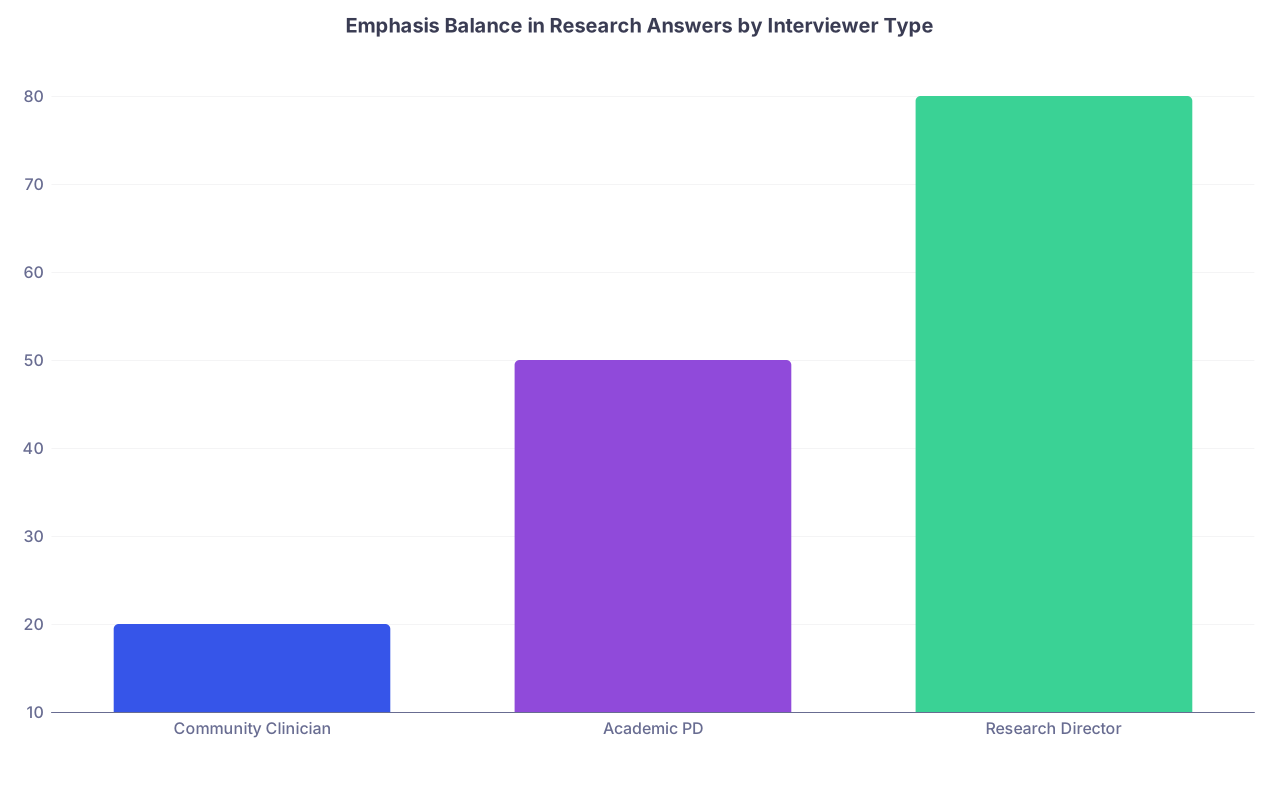
| Category | Value |
|---|---|
| Community Clinician | 20 |
| Academic PD | 50 |
| Research Director | 80 |
Interpret the chart this way: the higher the value, the more technical depth is reasonable. That does not mean you must fill all that space; it just tells you the ceiling.
If you are unsure, start general. Let them pull you deeper:
“If you are interested, I can tell you more about how we designed it.”
If they are, they will ask. If not, you just saved both of you 90 seconds.
Step 7: Handle Common Research-Related Traps Cleanly
There are a few patterns I see every year that sabotage good applicants.
Trap 1: Over-claiming your role
They say: “So you led this R01-funded trial?”
You say: “Yes, I was the PI’s right hand.”
Then they ask detailed trial design questions and you are cooked.
Better structure:
“On that project I was one of the sub-investigators / student members. My main responsibilities were X and Y. The PI and fellows handled the higher-level design, but I can talk about how we implemented [specific part you actually did].”
You do not lose points for being a student. You lose points for pretending not to be.
Trap 2: Apologizing for “not enough” research
“I only did one project.”
“I just helped with data entry.”
This comes out of insecurity and it sounds worse than the reality.
Reframe:
“My main research experience was a single, longitudinal project in [area], where I focused on [your piece]. Working on one project over time gave me the chance to see it through from early design to presentation.”
“On that project my role was primarily [data collection, chart review, recruitment]. It gave me a good sense of how much work goes into the ‘front end’ before any analysis can happen, and it made me more comfortable with meticulous, repetitive tasks.”
Own what you did. If it was “small,” emphasize what you extracted from it.
Trap 3: Getting defensive about gaps or lack of publications
If asked “Any publications from this?” and the answer is no:
Bad:
“We submitted but the reviewers were kind of unreasonable and my PI never got back to me…”
Better:
“We presented this as a poster at [venue]. We drafted a manuscript, but it has not been submitted yet because [brief, non-blaming reason—e.g., ongoing data collection / competing priorities]. Regardless, the main lessons for me were [X and Y].”
If there truly was poor mentorship or an abandoned project:
“I learned that not every project reaches publication, especially when teams are pulled in different directions. It helped me realize the importance of clear expectations and timelines. As a resident, I plan to seek out mentors who have a track record of getting projects across the finish line.”
Direct, mature, not bitter.
Trap 4: Getting too technical when you are out of your depth
If they push deeper than you can go, do not double down with jargon you do not fully understand.
Example:
“That is a great question. The fellow and PI made most of those design decisions, so I cannot speak in detail about the specific modeling choices. From my vantage point, the key limitation I saw was [something you genuinely noticed—selection bias, missing data, generalizability], and that is something I would be more involved in if I take on projects as a resident.”
You are allowed to be a learner. You just have to know where your knowledge stops.
Step 8: Tie Research Back to Why You Fit Their Program
The most underused move: using your research answers to show actual program fit, not just “I like research.”
You should know, in advance, which aspects of your research align with:
- The program’s strengths (strong QI culture, big transplant center, busy county hospital)
- The program’s stated priorities (health equity, med ed scholarship, patient safety)
- Faculty you would realistically work with
Then, when they ask about your research, you can naturally bridge:
“In that QI project, I really enjoyed working on discharge transitions and seeing how small process changes affected readmissions. One of the reasons I am excited about your program is the strong QI infrastructure here, especially the transitions-of-care work led by Dr. X. I can see myself plugging into that kind of initiative as a resident.”
Or:
“Doing med ed research around OSCEs made me realize I like thinking about assessment. I know you have a clinician-educator track, and I would be very interested in pairing future projects with that pathway.”
This is how you turn a generic “tell me about research” answer into a subtle “this is why I should be here” pitch.
Step 9: Practice Out Loud Until It Sounds Like You, Not a Grant Application
You will not pull this off by thinking about it in your head. You have to hear yourself.
Concrete practice plan:
Write skeleton notes, not essays
- One line for context
- 2–3 bullet prompts for your actions (not full sentences)
- One line for outcome
- One line for reflection / tie-in to future
Record 2–3 answers on your phone
- “Tell me about your main research project.”
- “Tell me about a time you faced a challenge.” (use research)
- “What are your long-term goals?” (include research angle if relevant)
Listen for three things
- Jargon density (too high? translate)
- Excessive detail on methods vs your role (shift balance)
- Monotone or run-on sentences (add pauses, vary structure)
Mock with a friend or resident
Give them your CV. Tell them: “Ask me about any project on this list and one behavioral question. I’ll try to bring research in where it fits.”Refine, do not script
If you can recite your answer verbatim, it is over-rehearsed. You want stable structure, variable words.
Step 10: Special Situations – Know How to Handle Edge Cases
You will get some odd variations. Prepare for them.
Situation A: You did zero research
Do not lie. Do not inflate that one “helped a resident with a survey for a week” experience into a full project.
Be straightforward and pivot to what you do bring:
“I have not had extensive formal research experience, largely because I [brief reason – e.g., worked to support family, pursued other longitudinal commitments]. That said, I am very comfortable with reading and applying evidence, and I am interested in getting involved in [QI/med ed/clinical projects] during residency. For example, one area that has caught my attention is [tie to their program strength].”
Some programs care; others genuinely do not. Your honesty will help you find the right match.
Situation B: You have heavy research and minimal clinical anecdotes
Common in MD/PhD or research-track applicants.
Your job is to prove you’re not just a lab person who happens to wear a white coat occasionally.
When answering general questions, blend research and clinical:
- Start with a clinical rotation or patient interaction.
- Then show how your research mindset enriched that, or how it pushed you to ask a question.
- End with a statement about wanting a career that integrates both.
Example:
“On my oncology rotation, I took care of a patient with [brief story]. That experience really connected to my lab work in [cancer biology field], where we were studying [simple description]. Seeing both sides made it clear that I want a career where I can bring questions from the bedside back to the lab and eventually translate them forward again.”
You are selling integration, not two separate lives.
Situation C: You switched fields (e.g., basic science in nephrology, applying in EM)
You will be asked: “How does this relate to [specialty]?”
Do not scramble. Pre-decide your bridge.
- Skill bridge: data analysis, critical appraisal, handling long projects, presenting complex info to teams.
- Content bridge (if any): shared physiology, methods, generalizable patient population.
Example:
“Most of my research was in nephrology, looking at AKI in ICU patients. While I am applying in EM, the skills transfer very directly: working with large, messy datasets, thinking about critical illness trajectories, and understanding how small decisions early in a hospitalization can change outcomes. It also made me comfortable collaborating across services, which I see as central in EM.”
You are not pretending it is the exact same field. You are showing maturity in extracting transferable value.

| Step | Description |
|---|---|
| Step 1 | Review your research |
| Step 2 | Assign themes to each project |
| Step 3 | Map projects to common question types |
| Step 4 | Practice concise narratives |
| Step 5 | Adjust depth for interviewer type |
| Step 6 | Connect to program fit |
Quick Reality Check: What Interviewers Actually Remember
After a day of 12 applicants, here is what sticks for a faculty interviewer:
- 1–2 specific stories per person (“She talked about redesigning discharge instructions and measuring readmissions.”)
- Overall vibe: thoughtful vs canned, humble vs self-promotional, clear vs confusing
- Whether your interests seem to match what the program offers
- Any red flags (“Could not explain her own project,” “Threw PI under the bus,” “Massively overstated role”)
They do not remember your exact sample size. They do remember if you looked lost when they probed one layer deeper.
If you can clearly explain:
- What the question was
- What you did
- What came out of it
- What you took away
—you are already above average.
Key Takeaways
- Treat each research project as a flexible story tool: define its themes, your role, and a plain-language explanation you can deliver in 60–90 seconds.
- Use research to answer not just “tell me about your research” but also challenges, teamwork, leadership, and future goals—when it genuinely fits.
- Aim for honest, specific, and program-connected answers: no over-claiming, no jargon dumps, and always bring it back to what kind of resident and colleague you will be.