
Most applicants botch “Why this program?” because they answer a different question: “Why this specialty?” or “Why any residency at all?”
Programs are not fooled. They hear hundreds of versions every season. The ones who match answer this question with surgical precision: specific, believable, and clearly tied to their own trajectory.
Let me break this down specifically.
The Real Question Behind “Why This Program?”
On paper, the question sounds polite and generic. It is not. Program directors and interviewers are actually asking:
- Have you done your homework on us, or are we just one of 60 copy-paste applications?
- Do your goals and our strengths actually align, or are you forcing the fit?
- If we rank you highly and invest three years in you, are you likely to thrive here and stay all the way through?
If your answer sounds like it could be said at any of the 15 programs you are interviewing at, it has already failed.
They are listening for three things:
- Specific evidence that you understand this program (not just the website header).
- A coherent story of why you fit them in particular.
- Insight into how you think about your own development.
If you walk in with that frame, the structure almost writes itself.
Step 1: Do Targeted, Not Lazy, Program Research
You cannot build a strong “Why this program?” answer out of thin air. You need raw material. Most applicants stop at, “Strong clinical training, diverse patient population, supportive environment.” That is fluff.
You are going for specific, verifiable details. Think sniper, not shotgun.
Where to Look (and What Actually Matters)
Here is where I tell you to be ruthless with your time. You do not need to memorize the entire website. You need targeted data.
| Research Target | Yield for Your Answer |
|---|---|
| Program website faculty/interests | High |
| Rotation structure & unique tracks | High |
| Resident “life after residency” page | High |
| Social media resident takeovers | High |
| Doximity / random online reviews | Low |
| Generic mission statement alone | Low |
Focus on:
Clinical structure
- How are rotations structured? Night float vs traditional call? Longitudinal clinics?
- Unique rotations (e.g., VA, county, tertiary care, community hospitals mix).
- Volume and pathology: trauma level, referral base, underserved populations.
Educational features
- Tracks: clinician-educator, global health, research, QI/leadership, rural, ultrasound, HIV, etc.
- Conference structure: protected time? simulation curriculum? board review?
- Any genuinely distinct features: four+1 schedule, integrated palliative care, early subspecialty exposure.
People and outcomes
- Faculty with specific interests that overlap with yours.
- Recent resident projects, publications, QI initiatives.
- Where graduates go: fellowships (and which ones), hospitalist jobs, academics, community practice.
Culture and “feel” (this is where most applicants are hand-wavy; you are going to be concrete)
- How residents talk about autonomy vs supervision.
- How they describe wellness that is not just yoga and pizza.
- How they talk about feedback, mentorship, and responsiveness of leadership.
Now, two key sources almost everyone underuses:
- Pre-interview resident zooms/socials: This is where you steal the language they use about their own program.
- Conversations with alumni / upperclassmen / your home attendings who know the program.
You are listening for phrases like:
- “We get a lot of early responsibility in the ICU.”
- “The PD is incredibly responsive; when we asked for X, it changed within months.”
- “Most of us end up doing fellowships in [areas].” Those are usable in your answer.
Step 2: Build Your Personal “Anchor Points”
Before you try to match yourself to a program, you need to know what you are actually looking for. Otherwise, your answer sounds like you adapted it on the fly.
I like to force applicants to pick 3–4 “anchor points” that define what they genuinely care about in a residency. Not 12. Not “everything.”
Examples of high-yield anchor points:
- Strong preparation for a specific fellowship (cards, GI, heme/onc, critical care, sports, peds, etc.).
- High-volume, high-acuity training with early autonomy.
- Dedicated clinician-educator or medical education track.
- Longitudinal care and continuity clinic emphasis.
- Robust QI and systems-based practice opportunities.
- Global health, underserved care, rural medicine.
- Mentorship and close relationships with faculty.
- Collegial, non-toxic resident culture where people actually help each other.
- Strong research infrastructure with protected time.
Pick yours. Be honest. If you say research is central to your trajectory and you have one case report and nothing else, that disconnect will show.
Now map:
- Anchor point → concrete evidence in your application.
- Anchor point → corresponding feature in the program.
If an anchor point cannot anchor to your past and their present, drop it.
Step 3: Use a Clear, Repeatable Answer Structure
You need a skeleton. Without structure, you ramble and run out of time.
Here is a simple, lethal structure that works for “Why this program?” in 60–120 seconds:
- One-sentence thesis:
- What you want in a residency and the kind of physician you are becoming.
- 2–3 program-specific connections:
- Each tied directly to one of your anchor points.
- A forward-looking wrap-up:
- How training there specifically advances your goals and how you see yourself contributing.
Let us make that less abstract.
Template You Can Adapt
Do not recite this verbatim. But this is the skeleton:
- “I am looking for a program that will [core training goal] and help me grow into a [type of physician you see yourself as]. [Program Name] stands out to me because of three things.”
- “First, [specific program feature] aligns with my interest in [your anchor point + brief evidence from your past].”
- “Second, I was struck by [another specific program detail: track, rotation, culture piece] which fits with [another anchor point + your experience].”
- “Finally, talking with your residents/faculty, I heard repeatedly that [culture/mentorship/autonomy description], which matches the environment where I know I do my best work.”
- “So I see [Program Name] as a place where I can both [what you will get] and [what you will give back—teaching, QI, leadership, service].”
That is the spine. Now we put muscle on it.
Step 4: Converting Research + Anchors Into a Strong Answer
Let us work through a few specialties so you see how specific I mean.
Example: Internal Medicine, Fellowship-Oriented Applicant
Anchor points:
- Wants cardiology fellowship.
- Values strong research and mentorship.
- Thrives in high-acuity, tertiary care environments.
Program features:
- Large academic IM program with a formal cardiology pathway.
- Dedicated research track with protected time.
- Major referral center with high-volume CCU and cath lab.
Sample answer:
“I am looking for a residency that will give me rigorous general medicine training while setting me up for a career in academic cardiology. [Program] stands out to me for how intentionally it supports that path.
First, the cardiology pathway you offer, with early exposure to the CCU and structured mentorship, fits exactly with my interest in advanced heart failure. During medical school I completed a sub-I on the CCU and worked on an outcomes project in heart failure readmissions, and I want to be in a place where I can build on that from day one.
Second, the research infrastructure here is frankly on another level. When I saw that residents in your program had first-author publications with Dr. [Name]’s group in outcomes and imaging, and that there is dedicated elective time for research, I could realistically see myself developing a focused project and presenting at ACC or AHA during residency.
Finally, when I spoke with your residents, what came through consistently was that they feel pushed academically but well-supported—especially in the ICU and cardiac rotations. I know I grow the most in that kind of high-acuity environment with strong backup.
So I see [Program] as somewhere I could become a solid general internist, develop as a future cardiologist, and contribute to ongoing clinical research and teaching.”
This is specific. It mentions:
- A named pathway.
- A subspecialty interest.
- Concrete prior experience.
- Real resident feedback.
Nothing in that answer could be pasted into a random community IM program without sounding absurd.
Example: Emergency Medicine, Community + Academic Hybrid
Anchor points:
- Loves procedure-heavy, high-volume EDs.
- Wants mix of community and academic practice.
- Enjoys teaching, wants to work with med students.
Program features:
- Two main sites: busy community ED plus academic trauma center.
- Strong ultrasound and procedure curriculum.
- Significant role for residents in teaching rotating students.
Sample answer:
“I am drawn to emergency medicine programs that combine high-volume, hands-on training with real teaching responsibility. [Program] hits that balance better than most places I looked at.
The dual-site structure, with time split between the community hospital and the main academic trauma center, really appeals to me. On my EM rotation at a community site I found that I liked the efficiency and breadth of pathology, but I also want exposure to complex trauma and resuscitation, which your Level I center clearly provides.
I am also very interested in point-of-care ultrasound, and the dedicated ultrasound rotation plus the longitudinal scanning requirements you build into all three years stand out. I have already completed an introductory ultrasound course and used it regularly on my sub-I, and I want to be somewhere that will push that further so I can be the person running the probe on critically ill patients.
Finally, I enjoyed hearing from your residents about the expectation that seniors teach med students at the bedside and run some of the conference sessions. I have consistently sought out teaching roles, from peer tutoring in preclinical years to leading small-group case discussions, and I am looking for a program that sees residents as teachers, not just learners.
For me, [Program] offers the kind of diverse clinical training and teaching culture that would let me grow into the kind of emergency physician I want to be.”
Again: specific sites, specific curriculum details, not fluff.
Example: Family Medicine, Underserved + Full-Scope Focus
Anchor points:
- Committed to underserved care.
- Wants full-spectrum FM with OB.
- Values community engagement and continuity.
Program features:
- FQHC-based continuity clinic with underserved population.
- Strong OB training; residents do deliveries.
- Community outreach, mobile clinics, and longitudinal community projects.
Sample answer:
“I am looking for a family medicine program that will let me practice full-spectrum care in an underserved community and build long-term relationships with patients. [Program] aligns with that better than anywhere else I have seen.
The fact that continuity clinic is based at the FQHC, serving a largely immigrant and underinsured population, is exactly the kind of setting where I see myself practicing. During medical school I worked in a student-run free clinic and on a migrant farmworker outreach project, and I want to continue that work in a more longitudinal way.
I am also very interested in keeping OB as part of my practice, and your volume of deliveries, plus the opportunity for residents to be primary providers for prenatal care through postpartum follow-up, really stands out. Many programs I looked at mentioned OB, but your graduates actually continue to do OB in practice, which tells me the training is real.
Lastly, when I spoke with your residents, they talked a lot about being involved in community health projects beyond the clinic—like the mobile hypertension screening program and school-based health education. That is the kind of integration with the community that motivates me.
I see [Program] as a place where I can train to be a full-spectrum family physician while staying deeply engaged with the underserved communities I care about.”
Notice how values → prior behavior → program features → future goals line up.
Step 5: What To Avoid (These Kill Your Credibility Immediately)
Some mistakes are so common they are almost cliché. Interviewers roll their eyes internally and move on.
1. Generic, Copy-Paste Phrases
If your answer includes any of the following with no specifics, you are in trouble:
- “Strong clinical training.”
- “Diverse patient population.”
- “Supportive environment.”
- “Excellent research opportunities.”
- “Great reputation.”
Those can be fine only if you immediately prove them with a program-specific example. Otherwise, they are just filler.
2. Flattery Without Evidence
“Your program is amazing,” “This is my dream program,” “This is the best program in the country.”
They know that is nonsense, and they assume you are saying the same thing everywhere. Respect the program, absolutely. But praise tied to facts sounds far better than pure flattery.
3. Overemphasizing Location in a Shallow Way
“It’s close to the beach.” “I love [city] and have always wanted to live here.”
Geography matters. But if that is your lead point, you sound unserious. You can mention family ties or regional roots as one component, especially for community programs, but not as the backbone of your answer.
4. Misaligning Your Story With Their Identity
Applying to a heavy academic, research-driven program while saying you want a purely clinical community career with no interest in scholarship? Or vice versa?
That does not mean you must be a clone of their typical grad, but your goals should not clash with what they actually are.
Step 6: Adapting for Different Contexts (Interview, LoRs, Emails, PS)
You will answer “Why this program?” repeatedly in different forms:
- Pre-interview emails or supplemental questions.
- On interview day, with faculty vs residents vs PD.
- Post-interview communication (if allowed).
- Sometimes even in second looks.
The core data stays the same. The packaging shifts.
On Interview Day
With faculty:
- Emphasize academic/clinical alignment.
- Bring in your specific projects, future niche, how you will plug into their work.
- Emphasize culture, workload, call structure, support, how you function on teams.
With the PD:
- Combine both. They care about fit, professionalism, and whether you will finish the program and make them look good later.
Pre-Interview Written Responses
Short text box, e.g., “Briefly tell us why you are interested in our program” (often 250–500 characters, yes, characters):
You compress to:
- 1 anchor + 1–2 program specifics + 1 outcome.
Example:
“Interested in academic cardiology; drawn to your cardiology pathway, strong CCU exposure, and resident involvement in outcomes research with Dr. [Name]. See a clear fit with my prior HF research and fellowship goals.”
Still specific. Just compressed.
Step 7: Practicing Until It Sounds Natural (Not Scripted)
I have seen outstanding content ruined by robotic delivery. You can hear the mental PowerPoint slides turning.
Here is how you practice without sounding like a machine:
- Write it out fully once. Get the structure and specifics right.
- Highlight only key phrases you must hit: program features, your anchors, 1–2 names/paths.
- Convert that into a loose outline, not a script.
- Practice aloud, recording yourself, until you can say a clean version in under 90 seconds without reading.
- Then practice slight variations. Change order. Change phrasing. Keep the skeleton, flex the words.
Your goal: if someone asked you at a bar, “So why that program?” you would give an answer that sounds like a human, not a brochure.
Visualizing How Your Reasons Should Stack Up
To sanity-check your answer, think in categories. A balanced “Why this program?” typically pulls from several domains.
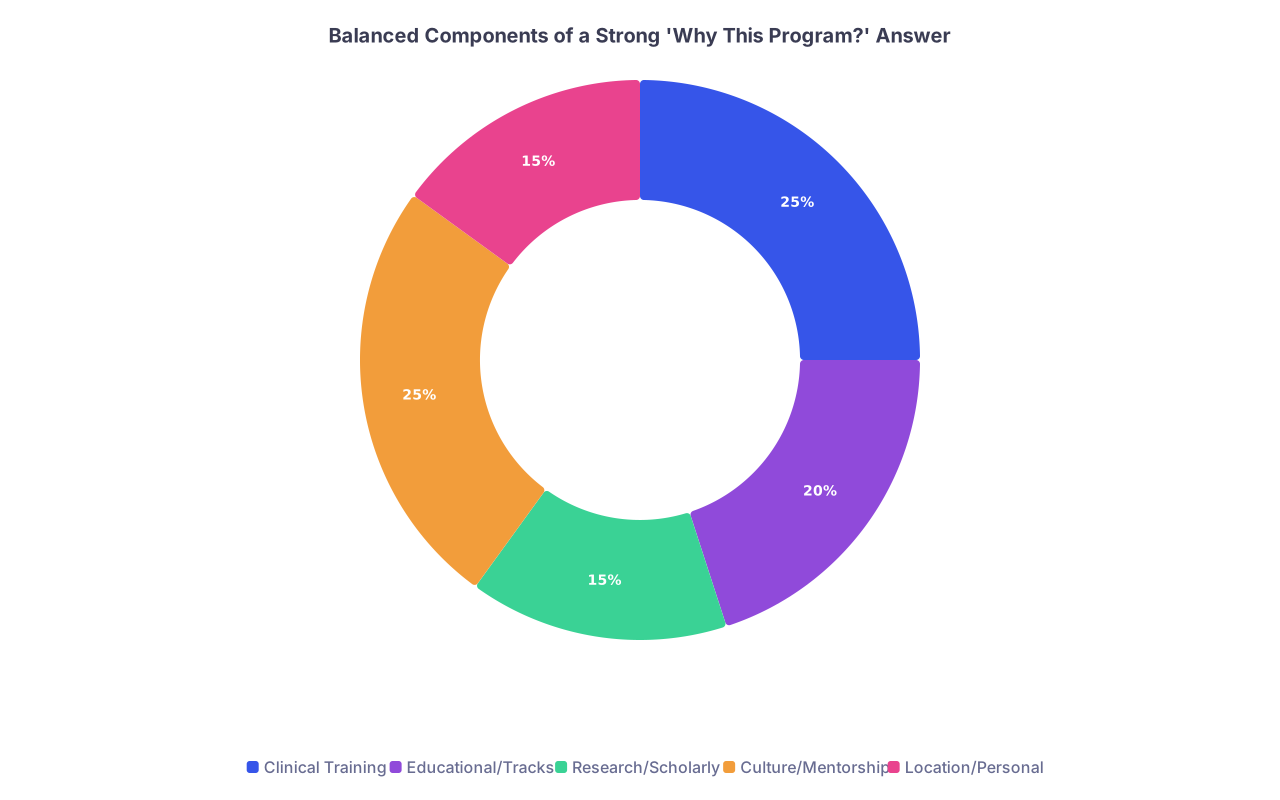
| Category | Value |
|---|---|
| Clinical Training | 25 |
| Educational/Tracks | 20 |
| Research/Scholarly | 15 |
| Culture/Mentorship | 25 |
| Location/Personal | 15 |
You do not need all five. But if your entire answer is “location and vibes,” that is a problem. If it is purely “research” for a community-heavy program, also a problem.
A Simple Workflow to Build Each Program Answer
Here is a practical, no-nonsense workflow. Do this once per interview.

| Step | Description |
|---|---|
| Step 1 | Identify 3-4 personal anchors |
| Step 2 | Research program website & materials |
| Step 3 | Talk to residents/alumni |
| Step 4 | Map anchors to 3 program specifics |
| Step 5 | Draft 60-90 sec answer |
| Step 6 | Record & refine delivery |
| Step 7 | Create 1-line written version |
If you follow that, you will not walk into an interview with hand-wavy answers.
How This Plays Out On the Interview Trail
You are going to repeat versions of this 10, 15, 20 times. It is exhausting. The temptation will be to recycle answers.
Do not recycle blindly. Re-use your anchors, not your sentences.
For each program:
- Same 2–3 internal anchors (e.g., “I want strong clinical training for [fellowship] + research + good culture”).
- Different program-specific proof for each anchor.
The interviewer is listening for that triangulation:
- You know who you are.
- You know who they are.
- You did the work to see that the overlap is real.
That is how you stand out in a stack of otherwise similar applicants with the same scores and same “hard-working team player” line.

Quick Reality Check: What Programs Actually Remember
Interviewers do not remember monologues. They remember:
- 1–2 concrete, specific things you said.
- Whether you seemed genuinely interested vs going through the motions.
- Whether your goals made sense for what they offer.
So do not chase perfection. Chase clarity.
If they walk away thinking, “This is the applicant who wants ID fellowship and already worked on antibiotic stewardship, and we actually have a strong ID division,” that is enough. You are in the “fits here” bucket.
Final Tight Example: 45–60 Second Version
You will sometimes be mid-conversation and get a quick, informal version of this question. Here is a compact, high-yield template:
“For residency I am looking for [1-line summary of what you want]. Your program really stands out because of [specific feature 1] and [specific feature 2]. Given my background in [briefly link your experience/goal], I see this as a place where I could [how you would grow] and also contribute through [what you bring—teaching, QI, research, service].”
Swap the brackets with real content. Done.

Key Takeaways
- “Why this program?” is a test of whether you did serious homework and whether your goals realistically match what they offer. Generic answers fail instantly.
- Build your response from 3–4 personal anchor points and 2–3 program-specific features, tied directly to your past experiences and future goals.
- Practice a flexible, 60–90 second structure you can adapt per program, so you sound prepared but not scripted.
FAQ (Exactly 4 Questions)
1. How long should my “Why this program?” answer be in an interview?
Aim for 60–90 seconds. Under 45 seconds usually means you are being superficial. Over 2 minutes and you risk rambling or sounding rehearsed. You want enough time for 2–3 specific program features tied to your anchors, plus a brief wrap-up.
2. Is it okay to mention location or family as a key reason?
Yes, but not as the only reason. Saying you have strong ties to the region or a partner’s job nearby is perfectly valid and often reassuring for programs, especially community ones. Just make sure it is one piece of a broader answer that still emphasizes training, fit, and your professional goals.
3. Should I name specific faculty or divisions in my answer?
If you can do it accurately, yes. Referencing a faculty member whose work you have actually read, or a division whose focus aligns with your interests, signals genuine preparation. Do not rattle off a list of names you pulled five minutes before. One or two well-chosen, authentic references are enough.
4. Can I reuse the same core answer across different programs?
You can reuse your anchors (what you want in a residency) but you must change the program-specific details. If a sentence could plausibly be said at any of your interviews without editing, it is too generic. For each program, plug in 2–3 details that are uniquely and obviously theirs—tracks, curriculum, sites, culture, outcomes.