
You are sitting in a small conference room at a large academic medical center. The program director has your ERAS printout in front of them, pen underlining a section. They look up and say:
“So you were the president of your school’s Internal Medicine Interest Group, and also chief scribe at the ED. Tell me about your leadership experience. What did you actually do?”
This is the moment that exposes people.
Some applicants launch into a vague monologue about being “passionate about leadership” and “really enjoying teamwork.” Others recite their CV line by line. The strong candidates do something very different: they frame their leadership roles in a way that sounds relevant, concrete, and directly translatable to residency.
Let me break down how to be in that second group.
1. What Academic Programs Actually Mean by “Leadership”
In academic residency interviews, “leadership” is code for three things:
- Can you move people and systems, not just yourself?
- Will you make this program better while you are here?
- Are you already acting like a junior faculty member in training, not just a student?
Most applicants miss that third one.
Academic programs care less about your title and more about function. A no-title student who built a new QI initiative that dropped central line infections is more interesting than the fifteenth “Campus Wellness Co-Chair” who held two yoga sessions and vanished.
When a faculty interviewer scans your ERAS and sees leadership lines, they are subconsciously sorting them into buckets:
| Bucket | Example Thought | Impact on You |
|---|---|---|
| High-yield, real leadership | "They changed something measurable." | Strong follow-up questions, higher ranking |
| Positional, low-detail | "Title is there, but what did they do?" | Skeptical probing, neutral impact |
| Fluff | "Vague, resume-padding." | Hurts credibility if oversold |
Your job in the interview is to move as many of your roles as possible into the first bucket. That is a framing problem, not a CV problem.
2. Translate Leadership into “Residency-Relevant Currency”
Academic faculty think in particular currencies:
- Patient care outcomes
- Efficiency and workflow
- Education and curriculum
- Scholarship and QI
- Culture, professionalism, and team functioning
If your leadership anecdote does not cash out in one of those currencies, it sounds like background noise.
So instead of describing “what the club was,” you translate every leadership role into one of these:
- “This is really a story about leading change in workflow.”
- “This is an example of peer education and curriculum building.”
- “This one is a small-scale QI project wrapped in a student group.”
Example:
Weak framing:
“I was treasurer of SNMA and I managed the budget and helped organize events.”
Residency-relevant framing:
“I served as treasurer of SNMA, which in practice meant building a sustainable financial model for our mentoring and recruitment programs. Over two years, we increased our operating budget by 40% and added a recurring M1 mentorship series that still runs without me. The piece that maps most directly to residency was learning how to get buy-in from skeptical stakeholders and hand off a project so it survives turnover.”
Same role. Different currency.
3. A Simple Structure That Actually Works in Interviews
You do not need a 17-part storytelling framework. For academic residency interviews, this 4-part backbone is enough for almost every leadership question:
- Context in one line
- Your specific responsibility
- The problem or tension
- What you did + measurable or visible outcome
That is it.
Notice what is missing: introspective fluff about how “this taught me the importance of leadership.” They already assume you learned something. Show it in how you talk.
Example with that structure:
“Sure. Our medicine interest group had been dormant for a few years, so I stepped in as president during my second year. (Context) My main responsibility was to rebuild participation and make it something residents and faculty actually wanted to be part of. (Responsibility) The problem was that turnout was low and residents saw it as a time sink. (Tension) I shifted us from generic talks to resident-led ‘how I think through this case’ sessions, moved everything to the noon hour, and created a shared email calendar with the program coordinator. Over the year, average attendance tripled and we had faculty competing to present—so much so that the department kept the format after I left.”
Quick, focused, residency-relevant.
4. Choosing Which Leadership Roles to Highlight (And Which to Bury)
You probably have more leadership lines than you can reasonably explain in 15 minutes of interview time. You need a hierarchy.
Academic interviewers care most about roles that show:
- Longitudinal commitment (≥ 1 year is better than a one-off “leadership retreat”)
- Responsibility for other humans’ work or learning
- Direct interaction with systems: schedules, policies, QI, curriculum, workflows
- Outcomes that are countable or at least observable (“we changed X”)
Look at your CV and sort roles into three tiers:
- Tier 1: Things that changed a system or produced measurable outcomes
- Tier 2: Things that involved coordinating people over time
- Tier 3: Titles that were mostly ornamental or minimal work
In the interview:
- Lead with Tier 1 every time.
- Use Tier 2 when they ask for another example or different context.
- Keep Tier 3 in your back pocket as quick side notes, never center stage.
Example:
Tier 1: Created a resident-led ultrasound curriculum that became mandatory orientation content.
Tier 2: Organized a recurring student-run free clinic schedule involving 40 volunteers.
Tier 3: “Student rep” on a committee that met twice and accomplished nothing.
You do not lie about Tier 3. You just do not build your narrative around it.
5. Matching Leadership Stories to Different Academic Programs
Not every “academic program” is the same. You tailor.
Think of three rough archetypes:
- Research-heavy, big-name (Hopkins, Penn, Brigham, UCSF)
- Clinically intense, academically solid (most large university affiliates)
- Education-focused, “resident as teacher” culture (many mid-sized academics)
Your leadership framing should bend slightly depending on where you are.
For research-heavy:
- Emphasize leading projects, managing data or teams, pushing things to publication or presentations.
- Highlight your ability to persist through slow, bureaucratic processes, IRB, multi-stakeholder coordination.
- Use QI and curricular projects that had rigorous evaluation.
For clinically intense:
- Emphasize workflow improvement, patient flow, efficiency, cross-disciplinary coordination.
- Leadership in ED scribe teams, EMS, free clinics, or any role where you moved actual patient care along.
- Talk about handling pressure and multi-tasking while still running a team.
For education-focused:
- Emphasize peer teaching, curriculum development, feedback systems, tutoring, OSCE coaching.
- Any role where you taught juniors or standardized processes for learners is gold.
- Show that you enjoy teaching and you are already thinking about assessment and feedback.
You do not reinvent the story. You change which angles get 80% of the airtime.
6. Specific High-Yield Leadership Contexts (And How to Frame Each)
Let me go through the most common leadership roles I see on ERAS and show you how to frame them in an academic interview so they do not sound generic.
A. Student Interest Group / Organization President
Default (weak):
“I organized meetings, invited speakers, and managed our email list.”
Academic framing:
“This was essentially a small educational and professional development program. I rebuilt the structure from ad-hoc talks to a four-part series aligned with our pre-clinical curriculum: clinical reasoning nights, specialty spotlights, resident Q&A, and skills workshops. The key leadership piece was getting resident and faculty buy-in and adjusting based on feedback—after low M1 participation, we moved content online and attendance doubled. That process of iterating and responding to data is exactly how I approach QI and education in clinical settings.”
Key moves:
- Call out structure and intentional design.
- Show how you used feedback or data.
- Emphasize continuity beyond your tenure.
B. Chief Scribe / Lead MA / Clinical Team Coordinator
These are underrated. Academic programs like them because they show you understand hospital reality before you have MD after your name.
Weak:
“I trained new scribes and made schedules.”
Academic framing:
“As chief scribe in our ED, I supervised 25 scribes, handled hiring and onboarding, and built the monthly schedule. The real leadership challenge was reducing documentation errors and no-shows without burning people out. I introduced a brief standardized training on common note templates, paired new scribes with experienced ones, and set clear expectations with transparent consequences for missed shifts. Over six months, our no-show rate dropped by half and we were getting unsolicited positive feedback from attendings about note quality. It felt very similar to what chief residents do in terms of balancing service coverage, morale, and accountability.”
You can almost see the program director thinking, “This person will not be a scheduling nightmare.”
C. Free Clinic / Community Outreach Leadership
Weak:
“I volunteered at the student-run free clinic and helped coordinate volunteers.”
Academic framing:
“I served as operations lead for our student-run free clinic, which meant I was responsible for having a functioning, staffed clinic every Tuesday night. Initially, we were turning away patients because of bottlenecks at triage. I mapped the workflow with our faculty advisor, shifted one volunteer from back-office to triage during peak check-in time, and piloted a simple pre-visit questionnaire. Within two months, we were seeing 20–25% more patients per session with the same number of volunteers. That taught me how small workflow changes and clear role definitions can meaningfully impact access to care.”
Again: systems, outcomes, translatable skills.
D. Research Team Lead / Sub-PI / Senior Student on Project
Weak:
“I led a research project and coordinated meetings.”
Academic framing:
“I was the student lead on a multicenter QI study looking at reducing unnecessary telemetry on the wards. My role was to coordinate data collection at our site and keep our team moving. The hard part was aligning residents, nurses, and IT around changing default order sets. I set up brief, focused stakeholder meetings, collected baseline data on telemetry overuse to build a case, and worked with IT to create an ‘indication required’ field. Implementation dropped telemetry use by 18% on pilot units without increase in RRTs, and we presented the data at SGIM. That experience maps directly to academic medicine: aligning different groups, driving change, and closing the loop with data.”
Academic ears perk up at that.
E. Curriculum / Teaching Leadership
Weak:
“I tutored first-years and helped with OSCE prep.”
Academic framing:
“I co-led our peer-teaching program for M1s in clinical skills. Beyond just tutoring, I helped redesign our OSCE prep sessions after low pass rates on the first exam. We moved from content-heavy reviews to case-based, station-style practice with structured feedback forms. We also trained tutors to give behaviorally specific feedback. The following semester, first-time OSCE pass rates increased by 15%. That was my first real exposure to thinking like faculty—backward designing sessions from assessment goals and measuring impact beyond ‘people liked it.’”
Education-focused programs in particular love hearing this kind of language.
7. Handling the “So What Did You Learn?” Question Without Sounding Like a Robot
At some point someone will ask:
“What did you learn about yourself as a leader from that experience?”
or
“How has that leadership role prepared you for residency?”
The trap is to answer with generic abstractions:
“I learned the importance of communication and teamwork.”
Every applicant says that. It makes you sound like you skimmed a leadership book.
Instead, you want to land on 1–2 specific, slightly nuanced insights that:
- Show self-awareness
- Connect directly to being an intern or senior resident
- Sound like you have already lived through some mess, not just theory
Examples:
“Initially I thought being a leader meant having the best plan. What I learned running that free clinic is that if you do not bring the quiet resistor into the conversation early, they will block you later in ways you do not see. As an intern, that translates to deliberately checking in with the bedside nurse before I assume my discharge plan is realistic.”
Or:
“That role forced me to get very comfortable with partial progress. I like to ‘fix’ things completely, but pushing the telemetry project showed me that in a big system you are often negotiating for a 10–15% win, then protecting it. I think that mindset will keep me from burning out on QI work as a resident while still pushing things forward.”
You do not need poetry. You need one concrete, slightly uncomfortable-sounding lesson.
8. Avoiding the Three Most Common Leadership Interview Mistakes
I have watched plenty of good applicants sink themselves with how they talk about leadership. The same three mistakes repeat.
Mistake 1: Over-titling, under-describing
They list a big impressive title, then cannot describe a single hard decision they made or system they changed.
Fix: If you cannot describe a tension you dealt with and a concrete outcome, do not center that role. Mention it briefly and shift to something you can substantiate.
Mistake 2: Hero narratives
They make it sound like they single-handedly rescued a failing system. Faculty who have run actual divisions roll their eyes.
Fix: Emphasize team and structure more than your brilliance. You can still be central without claiming you were the entire solution.
Example change:
“I fixed our curriculum”
→
“I proposed a restructuring, but the real key was working with our clerkship director and two residents who had institutional memory and could see the landmines I was about to step on.”
Mistake 3: Zero metrics, all vibes
They describe working “really hard” and “being passionate,” but never give numbers, comparative baselines, or visible changes.
Fix: For each major role, pre-identify 1–2 simple quantifiable changes or qualitative but clearly observable differences.
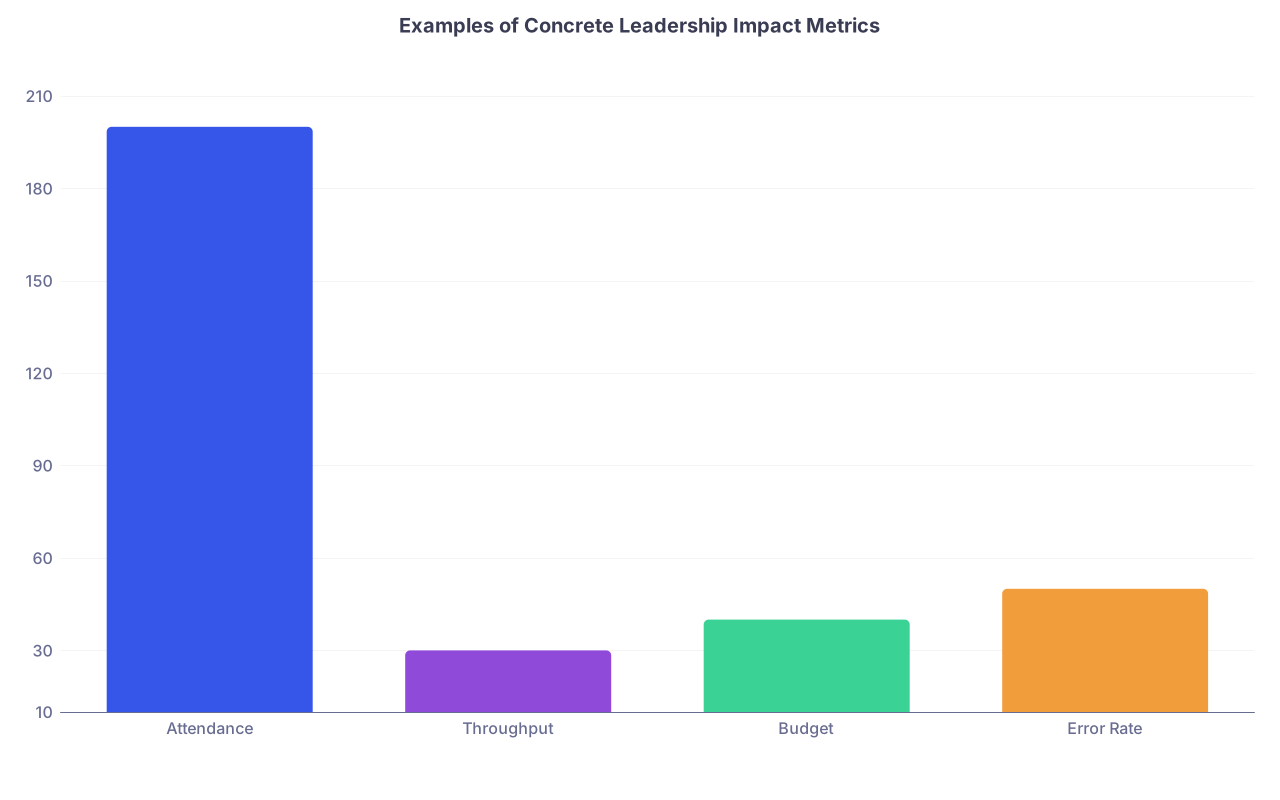
| Category | Value |
|---|---|
| Attendance | 200 |
| Throughput | 30 |
| Budget | 40 |
| Error Rate | 50 |
Interpretation (for you, not the interviewer):
- 200% increase in attendance
- 30% more patients seen per session
- 40% increase in sustainable budget
- 50% reduction in documentation errors
You do not need perfect p-values. Ballpark is fine. “Roughly doubled,” “about a 30% drop,” “went from 8 to 15 sessions per year.”
9. Prepping Your Leadership “Portfolio” Before Interview Season
You cannot wing this on the fly in January. The time to frame leadership is before you step into your first Zoom room.
Here is a practical way to prep.
Step 1: Pick 4–6 leadership roles that you are willing to talk about in depth. Include at least:
- 1 education/mentoring example
- 1 system/operations or QI example
- 1 community/patient-facing example
- 1 research or scholarly leadership example (if you have it)
Step 2: For each, write out:
- One-line context
- Your responsibility
- The main problem/tension
- 1–2 visible outcomes (with rough numbers)
- 1 specific “what I learned about leading in a medical system” insight
Step 3: Say them out loud, timing yourself. Each story should be 60–120 seconds. If it is 4 minutes long, you will lose your listener.
Step 4: Map them to common academic questions:
- “Tell me about a leadership role you are most proud of.”
- “Describe a time you had to get buy-in for an idea.”
- “Tell me about a time you improved a process or system.”
- “How have you prepared for leadership responsibilities as a resident?”
- “Describe a time your leadership did not work the way you hoped.”
You will notice the same handful of stories can be angled to fit all of these.
10. Handling Leadership Failures and Conflicts (The Questions They Really Care About)
Academic residency interviews almost always probe the limits of your leadership:
“Tell me about a time you failed as a leader.”
“Describe a conflict you had in a leadership role and how you handled it.”
Here is where many strong candidates collapse, because they suddenly become either defensive or self-flagellating.
What faculty want to see:
- You actually picked a real example. Not “I care too much.”
- You can articulate where your thinking or behavior was off.
- You fixed something in yourself, not just blamed context.
Structure that works:
- Brief, real situation (10–15 seconds)
- What you did that was suboptimal (own it)
- Consequence or feedback you received
- What you changed in your approach afterward
- One sentence linking that to residency
Example:
“In my first year running the free clinic, I pushed through a new triage process without fully involving the nurses who had been there for years. I was excited about the efficiency gains and basically presented it as a done deal. One nurse pulled me aside and told me very directly that I had ignored safety concerns they had already dealt with. She was right. I had to back up, reopen the discussion, and incorporate their suggestions, which actually made the protocol better. Since then, whenever I am in a leadership role, I consciously start by asking, ‘Who has seen this movie before?’ As an intern, that translates into checking my plans with the rest of the team, especially people with more contextual experience than me.”
That sounds like someone who can survive and grow in an academic system.
11. Live Dynamics: How You Sound Matters as Much as What You Say
Even perfectly framed leadership stories can fall flat if your delivery screams “memorized” or “performative.”
A few specific things academic interviewers pick up on:
- Do you acknowledge others by name or role (“our clerkship director,” “our charge nurse”), or is it all “I”?
- Do you sound surprised that leadership was hard, or do you talk like someone who has already accepted complexity as normal?
- Do you maintain eye contact and a calm pace when describing conflict, or do you speed up and get vague?
You can practice this. Record yourself answering:
“Tell me about your most significant leadership role in medical school.”
Then listen with three questions in mind:
- Did I talk about outcomes or just activities?
- Did I mention at least one person I had to influence or collaborate with?
- Did I reveal any genuine self-critique, even a small one?
If the answer to all three is “no,” your content is not ready.
12. Quick Rehearsal Blueprint (Use This the Week Before Interviews)
Here is a compressed, practical way to tune up your leadership framing in the final prep window.

| Step | Description |
|---|---|
| Step 1 | List 4-6 roles |
| Step 2 | Write 60-120 sec stories |
| Step 3 | Add concrete metrics |
| Step 4 | Identify 1-2 lessons each |
| Step 5 | Practice out loud 2-3x |
| Step 6 | Get feedback from resident/friend |
| Step 7 | Refine for different program types |
You should be able to do this in a weekend if you focus.
13. A Final Point Most Applicants Miss: Leadership as a Signal, Not a Trophy
Academic programs do not care about your leadership roles for their own sake. They care because leadership predicts a few very concrete things:
- Will you be the intern residents trust to run with a complicated discharge?
- Will you be someone they can tap to build a new QI pathway or curriculum?
- Will you be a future chief, fellow, or junior faculty member who reflects well on the program?
Every time you talk about leadership, you are signaling whether you belong in that future picture.
If you frame your roles as “I had a title and did some tasks,” you sound like a good student. If you frame them as “I worked on systems, people, and change, and I can show you how,” you sound like a future colleague.
That is the difference.
You are still early in this process. Right now, you are trying to survive interviews and secure a spot. But a year from now you will be sitting at a resident retreat, watching your chiefs juggle schedules and QI projects, and someone will say, “We need a resident to lead this.” The way you talk about and approach leadership now will decide whether your name comes up in that conversation.
Get your framing right now, in your academic residency interviews, and you are not just boosting your rank list chances. You are laying down the first clear signals of the physician-leader you intend to become.
What comes next is using those same skills—structuring, measuring, iterating—on your actual interview performance and then, before you know it, on real services with real patients and real teams. But that is the next phase of the journey. For now, make sure that when they point to the “Leadership” section of your ERAS and say, “Tell me about this,” you are ready to give them the version that belongs in academic medicine.