
The biggest mistake applicants make is treating residency interview prep as a last‑minute sprint instead of a 2–3 month project.
You are not “getting ready for a day.” You are rebuilding your professional story, your communication skills, and your logistics system so that by the time invites hit, you are executing, not scrambling.
Here is exactly what to do from 8–12 weeks before interviews, broken down by week and then by specific action items.
12 Weeks Before: Build Your Foundation
At this point you should accept that interview season will consume your life more than you expect. You are front‑loading the work now so you are not tweaking PowerPoints in call rooms in November.
This week, you should:
Clarify your specialty story (why this field, why now)
Sit down with a blank page. No laptop, no ERAS in front of you.Write out in bullet form:
- The 3 strongest reasons you chose this specialty
- 2 clinical experiences that genuinely shaped that decision
- 1 research/leadership/teaching experience that reinforced it
- 1 personal value (e.g., continuity, procedures, advocacy) that aligns with the field
This becomes the skeleton for:
- “Tell me about yourself.”
- “Why [specialty]?”
- “Walk me through your path here.”
If you cannot answer those cleanly now, you will flounder later under pressure.
Extract themes from your ERAS application
Print your ERAS. Yes, print it. Grab a highlighter.- Highlight repeated themes: underserved care, QI, teaching, global health
- Circle big anchors: year off for research, former career, military service, competitive sport, etc.
- Put a star next to anything unusual: multiple LOAs, Step fail, significant grade issues, change of specialty
By the end of this, you should know:
- Your 3–4 core themes (e.g., teaching, systems improvement, advocacy, critical care)
- The 2–3 “red flags” or questions PDs will likely ask about
Draft your master answer bank (Version 1)
Open a document called “Residency Interview Answer Bank.”Add headings like:
- Tell me about yourself
- Why this specialty?
- Why our program?
- Greatest strength
- Greatest weakness
- A time you made a mistake
- A conflict with a team member
- A time you showed leadership
- A time you failed
- A time you advocated for a patient
Under each, free‑write bullet points. Not prose. Just:
- Key story
- What you did
- What you learned
You are not polishing yet. You are inventorying.
Set up your interview logistics system
At this point you should build the infrastructure that will save you when you have 15 invites in 3 time zones.
Create:
- A tracking spreadsheet (or Notion/Airtable board) with:
- Program name
- City
- Interview format (virtual/in‑person)
- Interview date/time + time zone
- Pre‑interview social? (Y/N, time)
- Contact email/phone
- Interview day structure (from invite or website)
- Notes / red flags / must‑ask questions
- A folder system:
- /Residency_Interviews/
- /Program Sheets
- /Thank You Templates
- /Contracts & Policies (drug tests, background checks, etc.)
- /Residency_Interviews/
It looks obsessive now. In 6 weeks, you will be grateful you did this.
- A tracking spreadsheet (or Notion/Airtable board) with:
11 Weeks Before: Research Strategy, Not Rabbit Holes
At this point you should build a repeatable research process so you are not spending 3 hours per program later.
This week, you should:
Define your “must know” info per program
Create a one‑page template you will fill for each place. For example:- Basic overview:
- Location, size, type (academic, community, hybrid)
- Number of residents per class
- Curriculum features:
- ICU months, elective time, continuity clinic structure
- Notable tracks (research, global health, leadership, QI)
- Strengths:
- Well‑known fellowships
- Procedural volume
- Unique patient population / pathology
- Pain points (from forums/word of mouth):
- Call schedule
- Didactics quality
- Your personal fit:
- Why you would thrive here
- What you can contribute
- 3 tailored questions to ask
- Basic overview:
Build a sample of 5–7 “likely” programs
Pull a mix of:- Your home program
- 1–2 “reach” places
- 2–3 realistic mid‑tier programs
- 1 “safety” program you still would attend
Complete the one‑page template for each. Time yourself. It should eventually take 20–30 minutes per program, not 2 hours.
Create your “Why our program?” structure
Most people ramble or recite the website. That is how you blend in.
Your answer should hit:
- Shared values: something about their mission/culture that matches your priorities
- Concrete program features: specific rotations, tracks, or patient population
- Personal fit and contribution: what you bring and how you will use their resources
Example skeleton:
- “What stood out to me about your program is…”
- “Clinically, I am especially drawn to…”
- “Given my background in X, I see myself contributing by…”
Save this as a plug‑and‑play template in your answer bank.
Audit your online presence
Programs and residents Google you. They just do.
- Search your name + medical school
- Clean up:
- Public Facebook/Twitter/X/Instagram/LinkedIn
- Old blogs, public comments that are unprofessional
- Update:
- LinkedIn with accurate training, research, pronouns (if you want), and a professional photo
- Ensure your email signature looks like an adult wrote it:
- Name
- Medical school and expected graduation year
- Phone number
10 Weeks Before: Core Interview Skills (Behavioral + Storytelling)
By this point you should shift from content building to delivery.
This week, you should:
Structure your behavioral answers (STAR but actually usable)
Use a simplified STAR:
- Situation – one sentence
- Task – what needed to happen
- Action – what you did (most of your words)
- Result/Reflection – what changed + what you learned
Pick 6–8 core stories that can flex to multiple prompts:
- Difficult patient interaction
- Mistake you made
- Conflict on the team
- Leadership moment
- Working with limited resources
- Time you advocated for safety or equality
Map each story to at least 2–3 possible questions. Now one good story does triple duty.
Rewrite 2–3 key answers in full sentences
Not because you will memorize them. Because writing forces clarity.
Draft:
- “Tell me about yourself”
- “Why this specialty?”
- “Greatest strength & greatest weakness”
Read them out loud. If you would never speak that way on the wards, it is wrong. Edit until it sounds like you.
Begin low‑stakes practice
At this point you should not book formal mock interviews yet. Start with:
- Recording yourself answering:
- “Tell me about yourself” (2 minutes)
- “Why our program?” (1.5–2 minutes)
- Watch for:
- Filler words (um, like, you know)
- Rambling > 2.5 minutes
- Weird facial tics or staring at the ceiling
- Adjust your pacing. Aim for answers:
- Big openers: 1.5–2 minutes
- Behavioral questions: 1.5–2 minutes
- Simple factual questions: 30–60 seconds
- Recording yourself answering:
Decide on interview wardrobe and grooming
It sounds early. It is not.
Especially if you need tailoring or are changing cities.- Choose:
- Suit in navy, charcoal, or black (or professional equivalent attire)
- 2 shirts/blouses that fit properly
- Ties or accessories if you use them
- Shoes you can stand in all day
- Try everything on, sit at a desk, look in good lighting
- Plan for:
- Haircut timeline (not the day before the first interview)
- Facial hair strategy
- Makeup level you are comfortable maintaining on multiple days
- Choose:
9 Weeks Before: Mock Interviews and Feedback Loops
By this point you should expose your answers to other humans. Your own ear is too forgiving.
This week, you should:
Schedule 2–3 mock interviews over the next month
Ideal mix:
- 1 with faculty or PD/APD (even if not in your specialty)
- 1 with chief resident or senior resident
- 1 peer mock (classmate or friend applying in another field)
Stagger them:
- Week 9: peer mock
- Week 8: resident/fellow
- Week 7: faculty / structured mock
This spacing lets you refine between sessions.
Run your first full mock (60 minutes)
Structure:
- 30–40 minutes interview
- 20–30 minutes debrief
Ask explicitly for feedback on:
- Clarity of “Tell me about yourself”
- Conviction of “Why this specialty?”
- Whether your stories sound rehearsed or genuine
- Any red flags or confusing parts of your application
Take notes immediately after. Add them to your answer bank as “feedback log.”
Start a “question dump” document
Every time someone asks you a question in a mock, write it down verbatim.
After 2–3 sessions, categorize:
- Behavioral / teamwork
- Professionalism / ethics
- Specialty‑specific
- Personal / hobbies
- Program‑fit / future goals
This becomes your practice set for quick reps later.
Refine your weakness / failure answers
Most applicants mess these up. They either confess something horrifying or give a fake weakness.
At this point you should:
- Pick a real, non‑catastrophic weakness (e.g., delegating, saying no, speaking up in large groups)
- Show:
- Concrete example (brief)
- How it negatively impacted you or the team
- What specific steps you took to improve
- Evidence of progress
If your mock interviewer winces, fix it now.
8 Weeks Before: Systems, Tech, and Schedule
You are entering the window when early invites can start trickling in for some specialties. You need to be technically and logistically ready to accept and attend interviews.
This week, you should:
Lock in your interview tech setup
For virtual interviews:
- Environment:
- Quiet space with a door that closes
- Neutral background (plain wall or simple shelves)
- No backlighting from a bright window behind you
- Hardware:
- External webcam or high‑quality laptop camera
- External microphone or reliable headset
- Stable internet (test speed; aim for >10 Mbps upload)
- Lighting:
- Position light source in front of you
- Avoid harsh overhead lighting that creates shadows
Run a full test call with a friend using Zoom, Teams, or whatever platforms your likely programs use.
- Environment:
Create your “interview day” checklist
This is the list you will use repeatedly, so build it early.
Example items:
- Devices charged / plugged in
- Backup device ready
- Links and times verified
- Program sheet printed or open
- Water, light snack
- Notepad and pen
- Email and phone silence / Do Not Disturb
- Wardrobe ready and lint‑rolled
Save this as a one‑pager in your folder. You will run it mechanically on each interview day.
Outline your travel strategy (if in‑person or hybrid)
Look at your likely regions. Decide:
- Are you grouping interviews geographically?
- Will you stay with friends/family in certain cities?
- What is your max nights in a row you can stay on the road before performance drops?
Build a simple travel template:
- Flights/train options
- Hotel vs. staying with a friend
- Time buffer before and after the interview
Do not book yet. Just know how you will think about it.
Time‑block “interview work” in your schedule
You are still on rotations. Your time is not endless.
At this point you should reserve:
- 2 short blocks (30–45 mins) on weekdays for:
- Quick question reps
- Updating program sheets
- 1 longer block (1.5–2 hours) on a lighter day or weekend for:
- Mock interviews
- Deep answer revision
- Program research bursts
Protect these blocks like an OR case. If you do not, interview prep will become “whenever I am free,” which means “never consistently.”
- 2 short blocks (30–45 mins) on weekdays for:
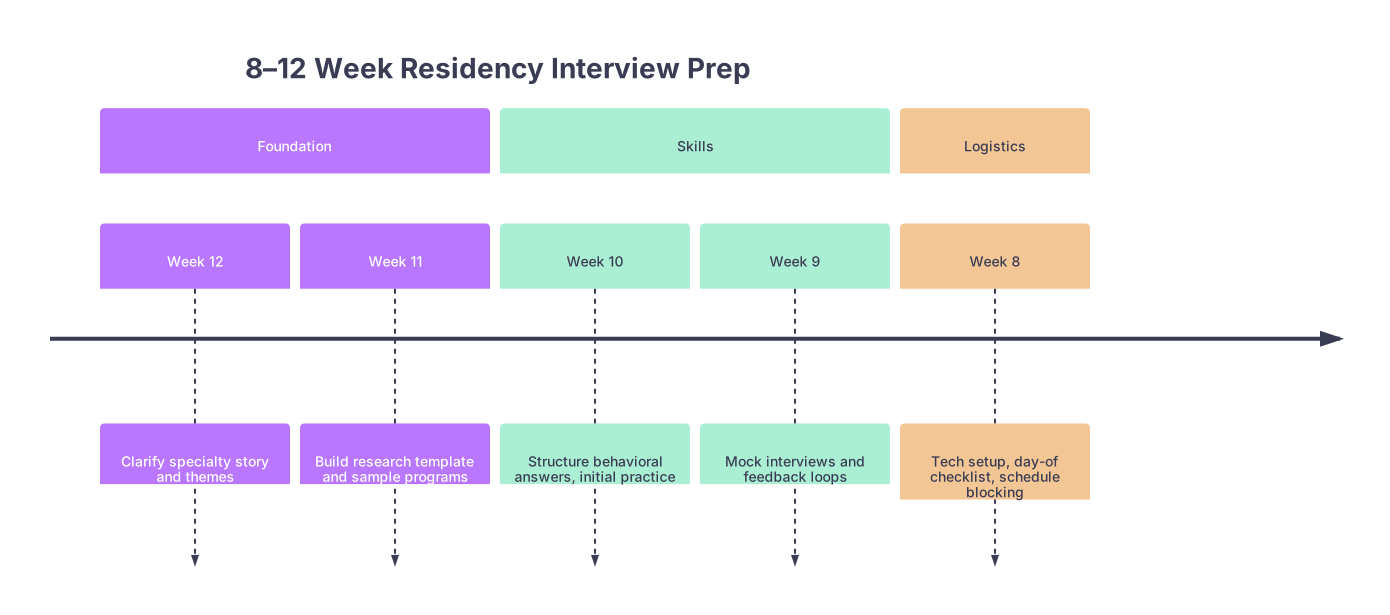
| Period | Event |
|---|---|
| Foundation - Week 12 | Clarify specialty story and themes |
| Foundation - Week 11 | Build research template and sample programs |
| Skills - Week 10 | Structure behavioral answers, initial practice |
| Skills - Week 9 | Mock interviews and feedback loops |
| Logistics - Week 8 | Tech setup, day-of checklist, schedule blocking |
Weekly Breakdown Summary (8–12 Weeks Out)
To make this brutally clear, here is what your calendar should roughly reflect.
| Week (Before Interviews) | Primary Focus |
|---|---|
| 12 Weeks | Story, themes, logistics system |
| 11 Weeks | Program research process |
| 10 Weeks | Core answers and delivery |
| 9 Weeks | Mock interviews and feedback |
| 8 Weeks | Tech, travel, and scheduling |
Sample 1‑Week Micro‑Schedule (Around Week 9–10)
Most people ask, “But what does this look like in a real week on service?” Here is a realistic breakdown assuming a moderately busy rotation:
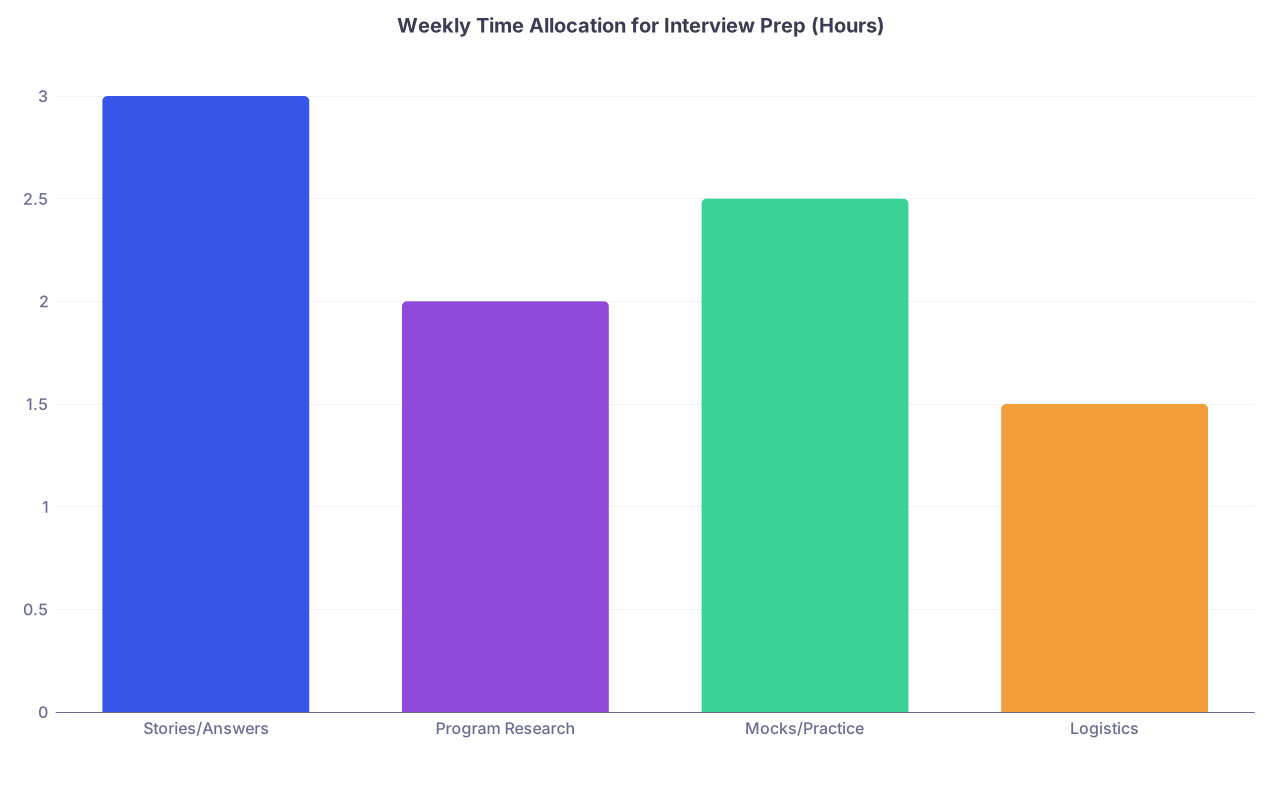
| Category | Value |
|---|---|
| Stories/Answers | 3 |
| Program Research | 2 |
| Mocks/Practice | 2.5 |
| Logistics | 1.5 |
Example week (total ~9 hours of prep):
- Monday (evening, 45 min)
- Refine “Tell me about yourself” and “Why this specialty?”
- Wednesday (evening, 60 min)
- Complete 1 program sheet
- Create 3 tailored questions for that program
- Friday (evening, 90 min)
- Conduct 45‑minute peer mock
- 45‑minute debrief + updating answer bank
- Saturday (2–3 hours)
- Record yourself answering 8–10 common questions
- Review recordings and note 3 things to fix
- Tweak logistic sheet and confirm tech setup
- Sunday (60–90 min)
- Another program sheet
- Quick review of your core stories
This is what consistent, non‑frantic prep looks like.
Daily Micro‑Habits (Starting Now)
From this point forward, you should add a few small, repeatable habits that compound.
1. 10‑Minute Question Reps
Once a day:
- Open your question dump document
- Pick 3–4 questions
- Answer them out loud, no notes
Rotate categories:
- Monday: behavioral
- Tuesday: personal / hobbies
- Wednesday: ethics / professionalism
- Thursday: program fit
- Friday: curveballs (“Tell me something not on your application”)
You are training your brain for retrieval under stress, not memorization.
2. One Story Per Day
Each day, choose one core story and:
- Re‑tell it aloud using the STAR framework
- Trim any part that feels long or self‑indulgent
- Add one concrete, sensory detail (what the unit looked like, the sound of the monitor, the feeling in the room)
This keeps your stories fresh but not scripted.
3. Micro‑reflection on service
After a notable event on rotation:
- Write 3–4 bullet points:
- What happened
- Your role
- What you took away
These become “recent examples” you can use in interviews for questions about:
- Growth this year
- Handling stress
- Teaching moments
Mistakes To Avoid During the 8–12 Week Window
I have watched strong applicants sabotage themselves here.
1. Over‑researching, under‑practicing
Spending 3 hours reading about faculty interests and 10 minutes practicing “Tell me about yourself” is backwards.
At this point you should:
- Cap program research to 30 minutes per program
- Spend at least the same amount of time on delivery practice each week
2. Memorizing scripts
Faculty can hear it in the first 5 seconds. The cadence changes, your eyes go unfocused, you sound like ChatGPT with anxiety.
Use your answer bank as bullet prompts, not speeches.
3. Ignoring your red flags
If you have:
- Step failure
- LOA
- Failed clerkship
- Major specialty switch
You need a clean, non‑defensive, 60–90 second explanation.
Do not wait for a late‑night panic two days before your first interview.

| Step | Description |
|---|---|
| Step 1 | Red Flag Identified |
| Step 2 | Write 3-4 bullet facts |
| Step 3 | Add brief context |
| Step 4 | Describe what you learned |
| Step 5 | Explain how you changed behavior |
| Step 6 | Practice 60-90 sec delivery |
Two Weeks From Now, You Should Be Able To…
If you follow this 8–12 week plan, here is what you should realistically have in place by around 10 weeks out:

You should be able to:
- Give a 90‑second “Tell me about yourself” without freezing or rambling
- Articulate 3 coherent reasons for your specialty tied to actual experiences
- Walk through 3–4 behavioral stories using a clear structure
- Pull up one‑page sheets on at least 5 programs you know reasonably well
- Run a full mock interview without technical or logistical chaos
If you are not there, do not panic. But do not keep doing the same thing. Increase the frequency of short practice blocks and cut down the perfectionism in your written answers.
Key Takeaways
- Interview prep is a 2–3 month project, not a weekend cram. At 8–12 weeks out, you are building systems and content, not polishing every comma.
- By the time invitations arrive, you should already have your story, answer bank, tech setup, and research template in place so you can focus on performance, not scrambling.
- Consistent, small‑dose practice—10–20 minutes a day plus 1–2 longer blocks a week—beats any last‑minute marathon. Stick to the timeline and you will walk into interviews prepared, not just hopeful.