
What do you say when a program director looks you in the eye and asks, “Tell me about a time you struggled,” and the real answer is: depression, anxiety, or burnout that almost broke you?
Here’s the answer you’re actually looking for: you do not owe anyone your full mental health history in a residency interview. You do, however, owe them a clear, credible story that shows you can get knocked down and get back up in a safe, professional way.
Let’s break down how to do that without torpedoing your application or lying about who you are.
The Core Question: Are You Safe, Stable, and Reliable Now?
Residency programs are not asking about “resilience” because they want your trauma biography. They’re screening for three things:
- Can you function under sustained stress?
- Do you recognize when you're in trouble and get help early?
- Are you likely to be a future problem for the program (leaves of absence, professionalism issues, patient safety concerns)?
So when you think about disclosing mental health history, ask yourself:
- Does this story clearly show that I am stable now?
- Can I explain how I’m better prepared for residency because of this?
- Can I tell it confidently and briefly without sounding like I’m still in crisis?
If you cannot answer “yes” to all three, do not use that story as your main “resilience” example.
Should You Disclose? A Simple Decision Framework
Here’s the blunt version.

| Step | Description |
|---|---|
| Step 1 | Considering mental health story |
| Step 2 | Do NOT use this story |
| Step 3 | Use the safer story |
| Step 4 | Use mental health story with boundaries |
| Step 5 | Am I clearly stable now? |
| Step 6 | Is there objective closure? e.g. no current impairment |
| Step 7 | Can I tell this without oversharing or sounding raw? |
| Step 8 | Is there a safer, still-strong story I can use instead? |
My stance after watching dozens of cycles up close:
- If your mental health history is recent, unresolved, or still fragile → do not feature it.
- If it involved serious impairment (prolonged LOA, hospitalization, academic failure) and you must explain a concrete red flag (failed Step, repeated year) → you can disclose a carefully edited version.
- If it’s older, clearly resolved, and you’ve got a clean track record since → it can be used, but only if you frame it correctly and briefly.
- If you have other strong resilience stories (family responsibilities, moving countries, working through hardship, research failures, etc.) → use those first.
You’re not being dishonest by choosing a different story. You’re being strategic.
What You Can Safely Share — And What You Should Keep Private
Programs are legally and ethically not supposed to discriminate based on mental health diagnoses, but let’s not pretend bias doesn't exist. There are safer and less safe ways to talk.
Safer to Share (if framed well)
These can show resilience without labeling yourself:
- “I was going through a very difficult period emotionally and realized I needed support, so I sought counseling.”
- “During M2, I struggled with burnout and had to completely rethink how I manage stress and boundaries.”
- “I went through a difficult adjustment period, had a performance dip, and then used structured support to get back on track.”
You’re describing:
- Stress / struggle
- Insight
- Appropriate help-seeking
- Concrete changes you made
- Improved performance afterward
You are not required to say the words “depression,” “anxiety,” PTSD, bipolar, etc. The diagnosis code does not add value here.
Higher-Risk Details (usually avoid in interviews)
I’ve seen these backfire:
- Specific diagnoses (especially anything that sounds “serious” to a non-psychiatrist audience)
- Inpatient psychiatric hospitalization details
- Self-harm history
- Substance use disorder details
- Ongoing serious symptoms that impact reliability (insomnia, panic attacks, cognitive issues)
If those exist and impacted your training, you can reference them in a very high-level, de-identified way if needed, for example in a program director letter or personal statement for remediation. But in a typical interview answer about resilience, it’s usually a bad move to dive into this level of detail.
How to Craft a “Resilience” Story That Protects Your Privacy
Think in this structure:
- Brief context
- The challenge
- What you did about it
- What changed after
- How it prepares you for residency
Here’s a concrete example using a mental health–adjacent story without overexposure:
Before (too raw, too specific):
“In M2 I became very depressed and had suicidal thoughts. I started an SSRI and took 3 months off. It was really hard; I couldn’t get out of bed. Eventually I went back and passed my classes.”
Problems: specific diagnosis, acute risk behaviors, focus on suffering more than growth.
After (boundaried, professional):
“During my second year I hit a point of significant emotional exhaustion. My performance dipped and I realized I wasn’t coping well. I reached out to student health, started regular counseling, and worked with my advisor to make a concrete plan for study schedules, sleep, and boundaries. Within a semester my grades were back up, I passed Step on the first attempt, and I’ve continued those habits since. That experience taught me to recognize early warning signs and address them before they affect my work — which I think is crucial for residency.”
Notice what you’re doing here:
- You acknowledge real struggle.
- You name specific actions (counseling, advisor, schedule changes).
- You give objective outcomes (grades improved, passed Step).
- You end with future relevance (how it helps in residency).
You do not share your entire mental health chart.
If You Have a Red Flag You Need to Explain (LOA, Failure, Remediation)
This is where you may need to reference mental health more openly. Programs see your MSPE, transcripts, failures, LOAs. Silence is not your friend if something major is sitting there.
Here’s the rule: briefly own it, frame it, and show the “after.”
Example: leave of absence for mental health:
“I took a one-year leave during my second year for personal health reasons. At that time I was struggling significantly and realized I could not maintain safe, consistent performance. I worked closely with my physician and the school, focused on treatment and healthier routines, and returned with a structured plan that I’ve followed since. Since my return I’ve had no further leaves, I passed Step 1 and Step 2 on the first attempt, and I’ve completed all clinical rotations without issue. That period made me much more proactive about seeking support early, and I’m very comfortable using the resources available to maintain my wellness and my reliability as a team member.”
Things you’re doing right here:
- You do not detail the diagnosis or symptoms.
- You clearly state: the problem is addressed, and your performance since then backs that up.
- You explicitly connect it to patient safety and professionalism.
If they press you for a diagnosis (rare, but I’ve heard it happen):
You’re allowed to set a boundary:
“I’m happy to share that this was a mental health issue that has been appropriately treated and has not impaired my functioning since my return. I prefer to keep the specific diagnosis between me and my treating clinician, but I’m very open about the systems I now use to maintain my stability.”
That’s a perfectly professional answer.
Common Interview Questions About Resilience — And How to Answer Them
Let me show you how to answer without oversharing and without sounding evasive.

1. “Tell me about a time you faced a significant challenge.”
If your instinct is to talk about a depressive episode, pause. Ask: do I have a non-psychiatric story that still shows resilience?
Safer examples:
- Juggling a sick family member and clerkships
- Failing a major exam and coming back strong
- Being an IMG navigating a new system and language
- A bad clinical evaluation that you turned around
If you do use a mental-health-related story, keep it general:
“I went through a period during M2 where I was not managing stress well. My performance dropped and I realized I needed to change my approach. I started meeting with a counselor, adjusted my study methods, and created a more sustainable routine. Within a few months my grades improved, and I’ve maintained those systems through my clerkships, which helped me handle long hours without burning out.”
2. “How do you take care of your own mental health and wellness?”
Here you can be more open about habits, less about history.
Good themes:
- Regular exercise
- Sleep boundaries
- Talking to a therapist or mentor
- Debriefing after hard cases
- Using vacation and time off appropriately
Example:
“I’m very intentional about wellness. I schedule regular exercise, protect at least one full day off per week when possible, and debrief difficult cases with peers or mentors. I’ve also found periodic counseling to be helpful, and I’m very comfortable seeking professional support early if I notice signs of burnout.”
Notice: You normalize counseling without dumping your chart on the table.
3. “Have you ever struggled with burnout or stress?”
Almost everyone has. Denying it outright can sound fake.
Better approach:
“Yes. I think most people in medicine do at some point. For me, that showed up in M3 when I started feeling constantly drained and less engaged. I talked with a faculty mentor, scaled back some extracurriculars, and built in consistent time for sleep and exercise. I also learned to ask for help earlier when my plate is full. Since then, I’ve handled demanding rotations much more sustainably.”
You’re showing insight and action. Not drama.
Balancing Honesty, Stigma, and Self-Protection
Let’s be blunt: stigma in medicine is real. You do not need to sacrifice your career to make a point about it during an interview. You can fight that battle later, from a position of stability and power.
Your goals in the interview:
- Be honest about having navigated difficulty.
- Be selective about what you disclose and how much detail you give.
- Be confident in describing yourself as stable, reliable, and self-aware now.
You are not required to confess everything to be ethical. You are required to not lie. Those are different.
If in doubt, here’s a simple test:
Would a reasonable non-psychiatrist program director, after hearing this story, worry that you might:
- Not show up consistently?
- Need frequent leave?
- Jeopardize patient care?
If the answer is “maybe,” your story is either the wrong one or told the wrong way.
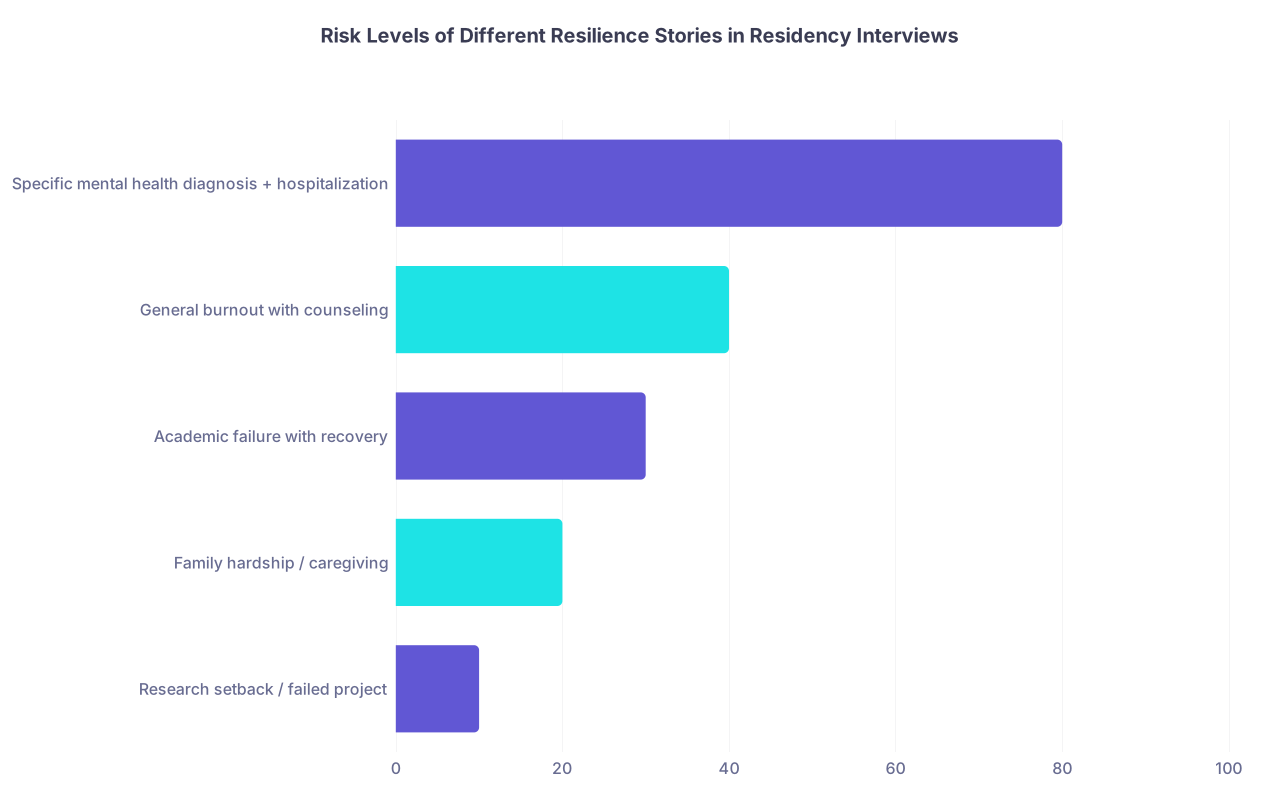
| Category | Value |
|---|---|
| Research setback / failed project | 10 |
| Family hardship / caregiving | 20 |
| Academic failure with recovery | 30 |
| General burnout with counseling | 40 |
| Specific mental health diagnosis + hospitalization | 80 |

A Quick Practice Script You Can Use Today
Take 10 minutes and draft one answer to this question:
“Tell me about a time you faced a setback and how you responded.”
- “During [year/rotation], I faced [brief description of challenge].”
- “Initially, this led to [specific impact: grade drop, stress, feedback].”
- “I realized [insight].”
- “So I did [2–3 concrete actions: sought help, changed strategy, built routines].”
- “As a result, [specific outcome: improved performance, better feedback, no recurrences].”
- “Now, I [lesson you carry into residency].”
Then read it out loud and cut anything that sounds like you’re still in crisis or trying to shock them.
| Scenario | Safer Framing | Riskier Framing |
|---|---|---|
| Step 1 failure | Performance issue + structured plan + success | Detailed breakdown + untreated depression |
| Burnout during M3 | Stress, support, habits, improved evaluations | Emotional collapse, near-quit story |
| Leave of absence | “Personal health reasons,” clear recovery, no recidivism | Full diagnostic history, symptom details |
| Using therapy | Routine counseling as a wellness tool | Long description of past crisis episodes |
FAQ: Mental Health and Residency Interviews (6 Questions)
1. Is it ever a good idea to name my specific diagnosis in an interview?
Usually no. Naming “depression,” “bipolar,” “PTSD,” etc. doesn’t help you and may activate bias. You can accurately say “I was dealing with significant mental health challenges, sought treatment, and have been stable since.” The focus should be on functioning and recovery, not the code.
2. What if they directly ask: ‘Have you ever had a mental health problem?’
Most programs will not ask this outright because it walks right into legal and ethical landmines. If someone does, a safe response is: “I believe mental health is important for everyone in medicine, and I’ve learned to use appropriate support and healthy habits to maintain my own wellness. I’m currently functioning well and fully able to meet the demands of residency.” You’ve answered the real question (are you okay now?) without volunteering a chart review.
3. How do I explain a leave of absence without hurting my chances?
Be straightforward, brief, and outcome-focused:
“I took a leave of absence for personal health reasons. During that time I addressed the issue with my physician, and since returning I’ve completed all coursework and rotations without interruption, passed my boards, and had strong clinical feedback. The experience made me more proactive about maintaining my health so I can consistently show up for patients and my team.” Do not get into symptom-level detail.
4. Can I talk about going to therapy without raising red flags?
Yes, and frankly I think it often helps. Frame it as a professional health behavior: “I’ve found periodic counseling helpful, especially during transitions. It’s part of how I stay self-aware and address stress early so it doesn’t affect my work.” That reads as mature, not unstable.
5. What if my main resilience story really is about serious depression or anxiety?
You can use the skeleton of that story without exposing every detail. Focus on: you were struggling, you recognized it, you sought appropriate help, you made concrete changes, and your performance and stability since then have been solid. Strip out specific diagnosis labels, crisis details, and anything that sounds unresolved.
6. How do I know if I’m oversharing in an answer?
If your answer includes: graphic details, specific diagnoses, descriptions of self-harm, or more time on suffering than on solutions and outcomes, you are oversharing. Another simple test: would you feel comfortable if your future co-resident repeated your exact answer in the workroom? If not, tighten it up.
Open your interview prep document right now and write one resilience story without naming any diagnosis. Then read it out loud and ask yourself: “Does this make me sound stable, proactive, and ready — or still in the middle of the storm?” Adjust until the answer is obviously the first.