Maximizing Your Research Experience: A Key Ingredient for a Strong Residency Application
As an aspiring physician, your residency application is the launchpad for your future in medicine. In today’s competitive environment—especially with more programs using holistic review and pass/fail exams—residency programs look far beyond board scores and transcripts. One of the most powerful ways to distinguish yourself is through meaningful, well-articulated research experience.
Research is much more than a checkbox. Done well, it demonstrates that you can think like a physician-scholar: asking good questions, evaluating evidence, working in teams, and contributing to better patient care. This guide will show you how to maximize your research experience, turn it into a compelling story of physician development, and showcase it effectively throughout your residency application.
Why Research Matters in Residency Applications and Physician Development
Research as a Competitive Advantage
In many specialties—such as dermatology, radiology, orthopedics, ophthalmology, neurosurgery, and academic internal medicine—research experience is now closer to an expectation than a bonus. Even in less research-heavy fields, programs increasingly value applicants who understand evidence-based medicine and can engage with the literature.
Research strengthens your application by:
- Differentiating you among peers with similar grades and scores
- Demonstrating intellectual curiosity and initiative
- Showing you can follow a project from conception to completion
- Providing tangible accomplishments (posters, abstracts, manuscripts)
When programs read your application, they’re asking: “If I invest in this resident’s training, will they help advance our department’s mission and improve patient care?” High-quality research experience helps answer “yes.”
How Research Enhances Clinical Reasoning and Patient Care
Research and clinical practice are deeply interwoven. Strong research experience can:
- Refine your clinical reasoning
- Learning to form hypotheses mirrors forming differential diagnoses
- Interpreting data parallels synthesizing lab results and imaging
- Improve your comfort with uncertainty
- Research teaches you to make decisions despite imperfect information
- You learn to question assumptions and search for better answers
- Sharpen your technical and procedural skills (for some projects)
- Clinical trials may involve procedures, standardized assessments, or advanced imaging protocols
- Strengthen your communication with patients
- Explaining risks, benefits, and evidence in research informs how you obtain informed consent and discuss treatment options
Residency program directors know that trainees who understand research methods are often better equipped to critically appraise new therapies, guidelines, and technologies throughout their healthcare careers.
Building Networks, Mentors, and Future Opportunities
Research environments are fertile ground for mentorship and professional networking:
- Mentors can:
- Guide your specialty choice
- Write strong, detailed letters of recommendation
- Introduce you to collaborators and program directors
- Peers and co-authors may become:
- Future co-residents and colleagues
- Partners on multi-institution projects
- Faculty collaborators can:
- Invite you to present at grand rounds or departmental conferences
- Connect you with research fellowships or advanced degrees (MPH, MS, PhD)
Viewed through the lens of physician development, research is one of the best ways to join the academic and clinical community early and build relationships that last well beyond residency.
Demonstrating Commitment to the Medical Community
By participating in research, you signal:
- A desire to improve care beyond a single patient at a time
- Willingness to deepen the scientific foundation of medical education
- Interest in quality improvement, patient safety, or innovation in healthcare delivery
Residency selection committees value applicants who see medicine not only as a job, but as participation in a constantly evolving scientific community.
Finding and Choosing the Right Research Opportunities

Aligning Research with Your Career Goals and Interests
You’ll get more out of research—and talk about it more convincingly—if it matches your genuine interests and long-term goals. Consider:
- Specialty alignment
- Aspiring cardiologists: outcomes research on heart failure or arrhythmias
- Future surgeons: surgical outcomes, simulation, or device studies
- Psychiatry-bound: neuroimaging, psychopharmacology, or psychotherapy trials
- Type of research
- Clinical research: patient-oriented, outcomes-based, trials
- Translational research: bench-to-bedside, biomarkers, molecular pathways
- Basic science: mechanistic, laboratory-based investigations
- Medical education research: curriculum development, assessment tools
- Quality improvement (QI): process metrics, patient safety, system redesign
You don’t have to know your final specialty, but picking something you could plausibly see yourself pursuing in the future is helpful. Programs like to see a coherent narrative as your healthcare career unfolds.
How to Systematically Find Research Opportunities
Instead of waiting for opportunities to appear, use a structured approach:
Explore your institution’s research landscape
- Browse your medical school or hospital’s department websites
- Look for faculty with recent publications in areas that interest you
- Review grand rounds and seminar announcements for active projects
Reach out to faculty effectively
- Send a concise, professional email:
- 2–3 sentences introducing yourself
- One line on why their work interests you
- Brief mention of any relevant skills or experiences
- Clear ask: “Are there any ongoing or upcoming projects where a motivated student could help?”
- Attach a 1-page CV tailored to research (list any stats, programming, or prior projects)
- Send a concise, professional email:
Use institutional and online resources
- Office of Research or Office of Medical Education for project listings
- Research electives or scholarly track programs
- Online platforms:
- PubMed to identify authors at your institution
- Institutional research databases
- Professional society websites with student sections
Consider remote or multi-institutional projects
- Many collaborative projects (systematic reviews, meta-analyses, education projects) can be done remotely
- This is especially valuable if your school has limited research infrastructure
Evaluating Whether a Project Is a Good Fit
Before committing, ask yourself:
- Is there a clear mentor who will meet with me regularly?
- Are the goals and timeline realistic given my clinical and academic load?
- What will my role actually be (data collection, analysis, writing, design)?
- Is there a plausible pathway to dissemination (poster, abstract, paper)?
- Does this help tell a coherent story in my future residency application?
It’s better to decline a vague role on an overstaffed project than to spend months doing work that doesn’t lead to meaningful learning or outcomes.
Doing Research Well: Prioritizing Quality Over Quantity
Why Depth Matters More Than a Long List
Residency committees can easily tell the difference between:
- A long list of projects where the applicant had a minimal role
- Versus 1–3 substantial projects where the applicant clearly took ownership
Depth allows you to:
- Understand the full lifecycle of a project (from idea to dissemination)
- Speak confidently during interviews
- Demonstrate resilience, problem-solving, and leadership
- Obtain stronger, more personalized letters of recommendation
In your CV and ERAS application, it’s more compelling to showcase a few well-executed projects with mature reflections than a long catalog of superficial involvement.
Ways to Maximize the Quality of Your Contribution
Even as a student, you can add real value:
Own a clearly defined component
- Designing a survey instrument
- Managing REDCap databases or data entry
- Leading IRB submissions or amendments (with guidance)
- Coordinating patient recruitment and follow-up
Learn and use key skills
- Basic statistics (e.g., t-tests, chi-square, regression)
- Statistical software (R, Stata, SPSS) or spreadsheet analysis
- Reference managers (EndNote, Zotero, Mendeley)
- Data visualization tools (GraphPad Prism, R, Python libraries)
Take initiative
- Volunteer to draft sections of the manuscript (Methods or Results are good starting points)
- Offer to create tables, figures, or poster layouts
- Propose secondary analyses or sub-studies if appropriate
These activities not only enhance the project, but also give you concrete talking points for your residency interviews and personal statement.
Active Engagement: How to Be More Than “Just a Name” on a Project
Behaviors That Signal Genuine Engagement
To transform research from an activity on your CV into real professional growth:
Attend and participate in meetings
- Come prepared with updates on your tasks
- Ask clarifying questions about design or analysis
- Offer to take and distribute minutes or action items
Demonstrate curiosity
- Read the key background papers
- Ask why particular methods were chosen
- Inquire about alternative interpretations of results
Communicate proactively
- Set expectations and timelines with your mentor
- Send brief, professional progress updates
- Alert the team early if obstacles arise
Learning to Think Like a Clinical Researcher
Use your projects to practice skills vital for modern clinicians:
- Translating a clinical problem into a research question
- Evaluating whether a study design appropriately answers that question
- Interpreting p-values and confidence intervals in the context of patient care
- Identifying limitations and sources of bias
- Asking, “How would these findings actually change what we do for patients?”
This is exactly the type of thinking you’ll need in journal clubs, M&M conferences, and quality improvement projects during residency.
Publishing, Presenting, and Disseminating Your Work
Pathways to Sharing Your Research
Dissemination is where your work becomes visible and impactful. Common routes include:
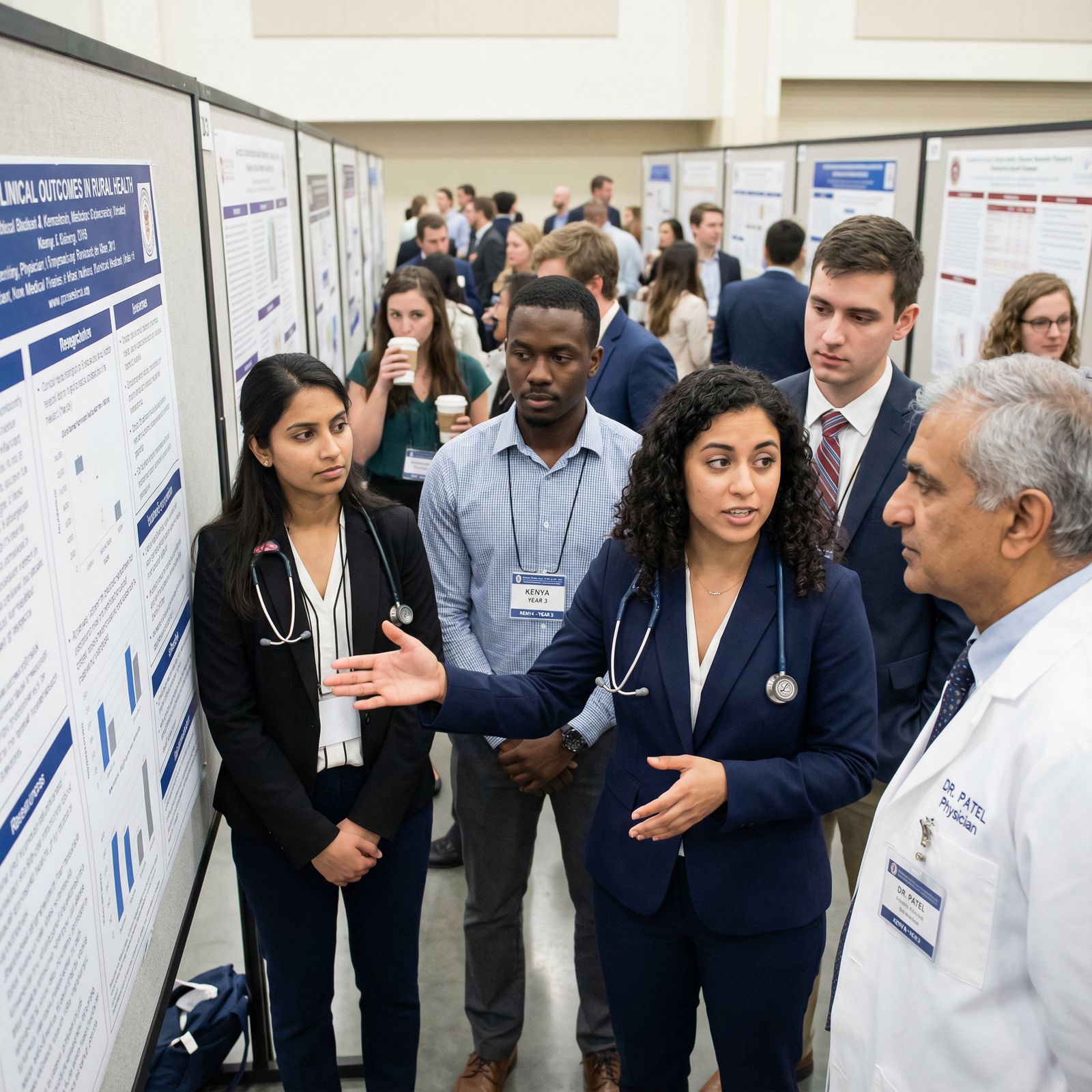
Abstracts and poster presentations
- Specialty society conferences (e.g., ACP, AAFP, AANS)
- Student research days at your institution
- Regional or national academic meetings
Oral presentations
- Selected talks at conferences
- Departmental grand rounds or clinical conferences
- Medical education symposia
Manuscripts
- Original research articles
- Case reports or case series
- Brief reports or research letters
- Review articles or systematic reviews (if appropriately rigorous)
How to Improve Your Chances of Publication
Clarify authorship early
- Discuss expectations and roles at the start (following ICMJE guidelines)
Study target journals in advance
- Skim recent issues to understand scope, structure, and style
- Confirm that your study fits the journal’s audience and mission
Be disciplined about writing
- Start drafting the Methods and Background sections while data collection is ongoing
- Use a shared document with track changes to streamline co-author feedback
- Set internal deadlines for drafts, revisions, and submission
Even if a project doesn’t make it to a high-impact journal, the experience of going through peer review is extremely valuable and looks favorable on a residency application.
Conferences as Practice for Residency Interviews
Presenting your work at conferences offers:
- Low-stakes practice explaining complex ideas to diverse audiences
- Opportunities to refine your “research pitch” into a short, clear narrative
- Networking with faculty and residents who might later review your application
You’ll also become more comfortable handling questions on the spot—an essential skill for both bedside rounds and residency interviews.
Documenting and Showcasing Your Research in the Residency Application

How to Describe Research on Your CV and ERAS Application
When listing research experiences:
Be specific about your role
- Instead of: “Participated in cardiology research project”
- Use: “Designed data collection instrument, enrolled 45 patients, and performed preliminary analysis of echocardiographic outcomes”
Highlight concrete skills
- “Performed multivariable logistic regression using R”
- “Led IRB submission and coordinated data sharing agreement”
- “Created patient recruitment materials and coordinated consent process”
Separate sections for research and publications
- Research Experience (with brief descriptions)
- Publications and Presentations (formatted in standard citation style)
Program directors often skim quickly; clear, action-oriented bullet points make your contributions obvious.
Weaving Research into Your Personal Statement
Your personal statement should not read like a CV in paragraph form. Instead, use research to illustrate:
- A turning point in your understanding of medicine
- How you learned to cope with setbacks or failed experiments
- A specific patient or case that linked the research to clinical care
- Why you value evidence-based practice in your chosen specialty
For example, you might write about:
“While working on a quality improvement project to reduce central line infections in our ICU, I realized that small changes in everyday practice—checklists, standardized draping, and team briefings—could measurably improve patient outcomes. This experience solidified my interest in internal medicine, where long-term, data-informed, system-level thinking is crucial to patient care.”
This ties your research directly to your motivation for a particular field, reinforcing your narrative as a developing physician.
Preparing to Discuss Research in Interviews
Program faculty consistently report that one of the most common weaknesses in interviews is applicants being unable to clearly explain the research listed on their CV.
Prepare by:
Practicing a 1–2 minute overview of each major project
- Question, methods, key findings, and clinical relevance
Anticipating questions such as:
- “What was the most challenging part of this project?”
- “If you were to repeat this study, what would you do differently?”
- “How did this research shape your approach to patient care?”
Being honest about your role
- It’s acceptable to say: “I primarily worked on data collection and analysis, while my mentor led the study design and final manuscript.”
- Don’t overstate your contributions; authenticity is crucial.
Well-articulated research discussions can transform a good interview into a memorable one.
Integrating Research into a Sustainable, Long-Term Career in Medicine
Balancing Research with Clinical and Personal Demands
Realistically, your time is limited. To maintain balance:
- Use dedicated blocks (e.g., research electives, summers, lighter rotations) for intensive work
- Break large tasks into smaller, scheduled blocks (30–60 minutes)
- Communicate with your mentor when exam periods or call schedules limit your availability
Residency programs respect applicants who engage in research thoughtfully, without compromising clinical performance or well-being.
Building a Longitudinal Scholarly Identity
You don’t need a PhD to have a scholarly career. Many clinician-educators and community physicians:
- Lead quality improvement initiatives in their practice
- Contribute to medical education research and curriculum design
- Participate in multi-center clinical trials
- Serve on guideline committees or expert panels
Early research experience shows you how these roles work in practice and helps you imagine how scholarship may fit into your long-term healthcare career.
FAQs: Research Experience and the Residency Application
1. What type of research is most beneficial for residency applications?
The “best” research is research you can explain clearly, reflect on thoughtfully, and connect to your future goals. In general:
- Clinically relevant projects in or adjacent to your intended specialty are especially helpful
- Quality improvement and medical education research are increasingly valued
- Basic or translational science can be powerful, particularly if you’re considering academic or research-intensive careers
What matters most is depth of involvement, your understanding of the project, and your ability to describe how it contributed to your development as a future physician.
2. How can I find research opportunities if my school has limited resources?
If your home institution has fewer options:
- Reach out to faculty who have any publication record and ask about small, focused projects
- Look for multi-institution or remote collaborations, such as:
- Systematic reviews
- Survey-based studies
- Education projects
- Attend virtual conferences, webinars, and professional society meetings; many have:
- Student research opportunities
- Mentorship match programs
- Consider short-term, structured summer or year-long research fellowships at larger academic centers (if feasible)
Even a small, well-mentored project can be more impactful than trying to chase distant, poorly supported opportunities.
3. Do I need a publication to have a strong residency application?
Publications are helpful, but not mandatory for most specialties. Residency programs look for:
- Evidence that you completed meaningful work (posters, abstracts, oral presentations)
- Signs that you understand research principles and can apply them
- Reflections on how the experience shaped your thinking about patient care and medicine
For highly competitive academic specialties, publications and multiple presentations can be advantageous. For many others, solid participation and clear learning outcomes are sufficient.
4. How should I prioritize research among other application components?
Your application should be balanced. Programs still place major emphasis on:
- Clinical performance (clerkship grades, narrative comments)
- Letters of recommendation
- Professionalism and teamwork
- Personal statement and interviews
Research should enhance, not replace, strong clinical and interpersonal development. If forced to choose, it’s usually better to maintain excellent clinical performance and professionalism while pursuing research at a sustainable level.
5. What if my research project “fails” or doesn’t lead to results?
Negative or inconclusive results are part of science. Programs understand this. What they care about is:
- How you dealt with obstacles and setbacks
- Whether you followed ethical and rigorous methods
- What you learned about study design, data quality, or feasibility
- How you might apply those lessons to future projects or quality improvement efforts
In interviews and essays, an honest discussion of a challenging project—what didn’t work and how you grew from it—can be extremely compelling and authentic.
By approaching research strategically—choosing meaningful projects, engaging deeply, disseminating your work, and presenting it clearly—you can transform this part of your medical education into a powerful asset for your residency application and long-term physician development.