Why Case Volume Matters So Much for Caribbean IMGs
When you graduate from a Caribbean medical school and pursue U.S. residency, case volume is one of the most important—and most overlooked—factors in building a strong clinical foundation. Especially as a Caribbean IMG, you may already feel the need to “prove yourself.” The right residency environment can help you do exactly that; the wrong one can leave you underprepared.
Case volume generally refers to:
- How many patients you see
- How many operations or procedures you participate in
- How often you’re involved in key decision-making and follow-up
For surgical and procedure-heavy fields, this often breaks down into:
- Surgical volume – total number of operations per resident or per service
- Procedure numbers – how many of each type of procedure you perform or assist with (e.g., central lines, intubations, laparoscopic cholecystectomies, colonoscopies)
- Residency case volume – your cumulative experience across rotations and years
For Caribbean IMGs, strong case volume can:
Compensate for bias
Programs and employers may scrutinize your background as a Caribbean graduate. A robust operative log and procedure list helps demonstrate that you are clinically ready.Boost fellowship and job competitiveness
Fellowship directors and employers often ask, “What can this graduate actually do?” Your case logs and letters that mention your hands-on surgical volume or high procedure numbers can make you stand out.Build genuine confidence and independence
Performing a procedure once or twice isn’t enough. Repetition is what makes you safe, efficient, and confident. Programs with high residency case volume allow more repetition under supervision.Strengthen your letters and CV
Faculty who see you performing a high number of procedures can write stronger, more specific letters: “She independently managed X number of ventilated patients” or “He performed more central lines than most interns I’ve worked with.”
Your goal isn’t just to “match” from a Caribbean medical school residency perspective; it’s to match into a program where you’ll graduate ready to practice or pursue competitive fellowships.
Understanding Case Volume Across Specialties
Not every specialty defines case volume in the same way. Knowing what matters in your chosen field helps you ask the right questions and interpret numbers correctly.
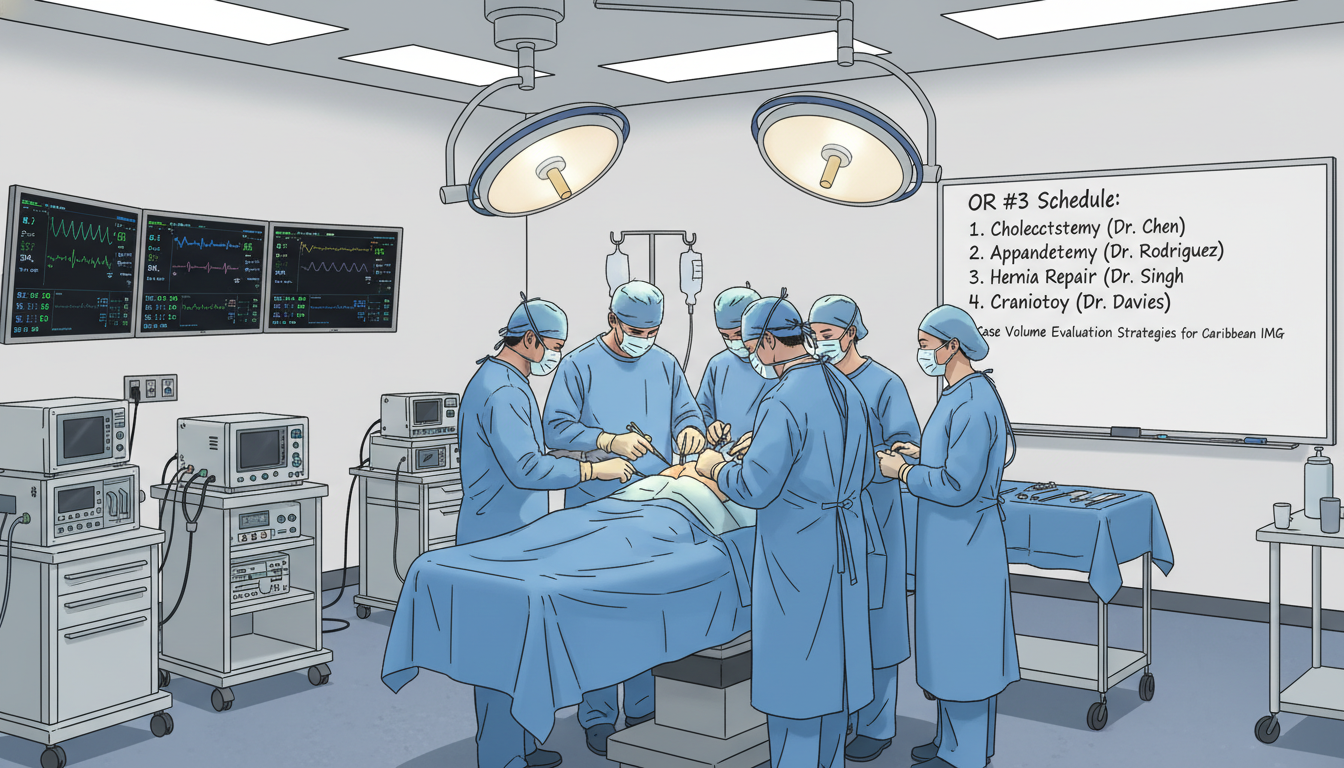
1. Surgical Specialties (General Surgery, Ortho, ENT, Plastics, Neurosurgery)
In these fields, surgical volume is central:
- Total cases per resident over the full program
- Index cases – key procedures considered essential for competence
- Case mix – how complex the cases are (simple hernias vs. complex cancer resections)
- Experience level – how often you are the primary surgeon vs. first assistant vs. observer
Typical metrics you’ll hear:
- “Average chief resident logs 1,000–1,300 cases.”
- “Residents meet or exceed ACGME minimums in all key categories.”
- “Plenty of bread-and-butter general surgery plus advanced minimally invasive cases.”
For a Caribbean IMG looking at a general surgery program, for example, you’d want to know:
- Do seniors graduate with well above the ACGME minimum for general surgery?
- Do junior residents (PGY‑1/PGY‑2) get hands-on, or mostly retract and observe?
2. Procedural Internal Medicine-Focused Fields (Cardiology, GI Pulm/Crit Targeters)
If you’re in Internal Medicine now but eyeing a procedural fellowship (Cardiology, GI, Pulm/CC), look at:
- Inpatient procedure exposure:
- Intubations
- Central lines
- Arterial lines
- Paracentesis
- Thoracentesis
- ICU rotation structure and autonomy
- Dedicated procedure services or tracks
Even though IM isn’t surgery, your procedure numbers and comfort level with acutely ill patients will heavily influence your fellowship competitiveness.
3. Non-Surgical but Procedure-Rich Fields (EM, Anesthesia, OB/GYN, Radiology)
Each has its own procedure core:
Emergency Medicine:
- Intubations
- Chest tubes
- Reductions
- Procedural sedation
- Ultrasound-guided procedures
Anesthesiology:
- Airway management (mask ventilation, direct and video laryngoscopy)
- Neuraxial blocks (spinal, epidural)
- Peripheral nerve blocks
OB/GYN:
- Vaginal deliveries
- C-sections
- Hysterectomies
- D&Cs, LEEPs
Radiology (especially IR-oriented):
- Biopsies
- Vascular access
- Drainage procedures
Here, “case volume” means exposure to a wide breadth of procedures and opportunities to perform them yourself under supervision.
4. Cognitive Specialties (Psychiatry, Neurology, Pathology, etc.)
Case volume still matters, just differently:
- Number of patient encounters (inpatient vs outpatient)
- Diversity of pathology and psychosocial backgrounds
- Complexity: psychosis, treatment-resistant depression, status epilepticus, stroke codes, etc.
- Autonomy in treatment planning and follow-up
Even if you’re in a field without many invasive procedures, a program that sees more patients and a broader case mix will better prepare you for independent practice.
How to Research Case Volume Before You Apply
As a Caribbean IMG, you often have fewer “inside” contacts and less in-person exposure to U.S. programs. You must be more systematic and data-driven when researching residency case volume.

1. Start with Public Data Sources
Use these baseline tools:
Program websites
Look for:- “Graduates & Fellowships” pages
- “Resident Experience” or “Case Volume” tabs
- Example statements like:
- “Our chief residents graduate with an average of 1100–1300 operative cases.”
- “Residents consistently exceed ACGME minimums in all major categories.”
ACGME Case Logs (by specialty)
You won’t see program-by-program details, but you can see national averages and minimums. That gives you a benchmark; if a program only brags about barely meeting minimums, be cautious.Doximity, FREIDA, and program review forums
Look specifically for:- Comments about “strong operative experience” vs “low surgical volume”
- Whether junior residents get hands-on cases
- Complaints that “fellows take all the good cases”
Use online reviews as supplement, not primary evidence. Verify what you read.
2. Use Your Caribbean Network (Especially SGU, AUC, Ross, etc.)
If you’re from a large Caribbean school—such as SGU, AUC, Ross, Saba—your alumni footprint is extensive:
- Search LinkedIn, hospital websites, or your school’s alumni office for graduates in specific programs.
- Contact them with short, targeted questions:
- “How is the overall residency case volume for residents?”
- “What kind of surgical volume or procedures do interns get early on?”
- “Do Caribbean IMGs from your program feel well-prepared for fellowship or practice?”
For SGU students specifically asking about SGU residency match outcomes:
- Identify SGU alumni in your target specialty and program.
- Ask how their case volume compared to co-residents from U.S. schools.
- Ask whether SGU grads in their program had any issues meeting procedure minimums.
People are more willing to respond to brief, respectful messages than long essays. Show you’ve done basic research first.
3. Analyze Hospital and System Data
Beyond residency websites, the hospital’s profile tells you a lot about potential case volume:
Bed count and trauma level
- Level 1 trauma centers and large urban hospitals typically have higher surgical volume.
- Small community hospitals may offer more autonomy but fewer complex cases.
Annual ED visits and surgical procedures
Some hospital websites publish:- Number of surgical procedures performed annually
- Number of deliveries
- Number of ED visits
If a general surgery program has only a few residents per year but the hospital performs thousands of operations annually, that usually signals good surgical volume.
Evaluating Case Volume During Rotations and Interviews
The best information often comes once you’re on-site—during audition rotations, sub-internships, or interviews.
1. Questions to Ask Residents (And How to Phrase Them)
Residents are your most honest source. Ask:
- “Do you feel you’re getting enough surgical volume to feel confident as an attending?”
- “Roughly how many cases do you log each year?”
- “How early do interns start operating or doing procedures?”
- “Are there any rotations where you feel underutilized or mostly observing?”
- “How do fellows impact your surgical volume or procedure numbers?”
Be specific to your field:
Internal Medicine:
- “How many central lines did you do as an intern?”
- “Do residents or fellows get first opportunity for procedures?”
- “How much ultrasound-guided procedure training do you receive?”
OB/GYN:
- “How many vaginal deliveries and C-sections do graduating residents average?”
- “Do junior residents get primary surgeon roles on C-sections early?”
Emergency Medicine:
- “About how many intubations and chest tubes does a typical graduate have in their log?”
- “Do you have a dedicated procedure month or ultrasound month?”
2. What to Observe on an Audition or Elective Rotation
If you rotate at a program as a Caribbean IMG, watch for:
Resident presence in OR or procedure rooms
- Are residents scrubbed in every case, or do attendings often operate alone?
- Are junior residents there, or only seniors and fellows?
Who gets called for procedures?
- Are residents being paged for central lines, paracenteses, etc.?
- Do nurses or hospitalists perform many procedures instead?
Workflow and capacity
- Are ORs running all day with a full board?
- Are there frequent cancellations or underutilized OR time?
Make mental (or discreet written) notes. This real-world impression may later override what you read online.
3. Using Interviews to Clarify Case Volume
Program leadership will often give you polished answers. Your job is to ask well-structured, non-confrontational questions:
To the Program Director:
- “How does your program ensure residents exceed ACGME minimums?”
- “Have there been any concerns about residents’ case volume or board pass rates?”
- “Can you share approximate average procedure numbers (or surgical volume) for graduates?”
To the Chair or faculty:
- “How has surgical volume or patient volume changed in the past 5 years?”
- “Do you anticipate any changes in case volume due to new fellows, services, or hospital expansions?”
You’re not interrogating them; you’re signaling that you think like a future colleague who cares about training quality.
Interpreting Procedure Numbers and Surgical Volume: What’s “Enough”?
Knowing that a resident logs “800 cases” is meaningless without context. Here’s how to interpret residency case volume thoughtfully.
1. Compare to ACGME Minimums and National Averages
Each specialty’s residency review committee (RRC) sets minimums. Examples (these numbers change over time; always verify current ACGME data):
- General Surgery: Minimum total operative cases and specific categories (hernia, GI, vascular, trauma, endoscopy, etc.)
- OB/GYN: Minimum vaginal deliveries, C-sections, major surgeries
- EM: Minimum intubations, critical care encounters, stroke codes, pediatric patients
- Anesthesiology: Minimum neuraxial blocks, peripheral nerve blocks, pediatric cases, cardiac exposure
You generally want a program where average graduates exceed minimums comfortably, not barely:
- Minimum: 850–900 cases → Program average: 1100–1300 = robust
- Minimum: 100 intubations → Program average: 150–200 = robust
If you’re hearing numbers that are just above minimums, ask:
- “Is that typical for most residents or just the highest volume ones?”
- “Any recent changes that may affect future case volume (new fellowship, change in call structure)?”
2. Balance Volume with Supervision and Teaching
High numbers alone are not enough; you also need:
- Structured teaching (not just service work)
- Attending feedback on your technique and decision-making
- A progression from observer → assistant → primary operator
Red flags:
- “We operate all the time—but there’s little teaching or feedback.”
- “Residents run the service alone overnight with minimal backup.”
- “Attendings or fellows take most complex cases, leaving residents with only the easiest ones.”
You want a program that offers high volume plus strong supervision and graduated responsibility.
3. Case Mix and Complexity
Ask about:
- Varied pathology vs a very narrow set of cases
- Availability of advanced or subspecialty procedures:
- Advanced laparoscopy
- Robotic surgery
- Complex OB (e.g., high-risk pregnancies)
- Advanced endoscopy (ERCP, EUS)
- Interventional radiology or cardiology exposure
For fellowship-bound residents, having at least some exposure to advanced or specialized cases can be valuable, even if you don’t log them as primary operator.
Strategic Considerations for Caribbean IMGs
As a Caribbean IMG, case volume is important, but it’s not the only variable. You must think strategically about how surgical or procedure-heavy your training should be—given your goals and likely placement.
1. Match Strategy vs. Training Quality
Some applicants from Caribbean medical schools feel pressure to “take any spot.” But you still need a baseline of case volume and quality. Ask yourself:
- “If this were my only offer, would I feel safe graduating from this program?”
- “Will I be able to meet ACGME minimums and feel truly competent?”
You might accept a slightly lower-volume program if:
- It has a strong track record of graduates passing boards and finding good jobs or fellowships.
- It offers excellent didactics and strong mentorship, even if surgical volume is moderate.
Avoid programs where:
- Residents regularly struggle to meet minimums.
- Alumni quietly warn you about being underprepared.
2. Fellowship Aspirations and Case Volume Needs
If you plan a fellowship (especially competitive ones), you may need above-average case volume and complexity:
Cardiology / GI / Pulm-Crit from IM:
- Choose an IM program with strong ICU exposure, high procedure numbers, and robust inpatient volume.
- Demonstrated autonomy in managing sick patients is often as important as raw procedure counts.
Surgical fellowships (MIS, Surgical Oncology, Vascular, etc.):
- Seek programs where chief residents handle a wide range of complex cases.
- A strong operative log and excellent letters from busy surgeons will help you overcome Caribbean bias.
3. Community vs University Programs
Rough patterns (with many exceptions):
Community programs
- Often higher individual case volume (fewer residents sharing a large case pool)
- More autonomy, more bread-and-butter cases
- May have fewer complex or rare cases, less research
University programs
- More fellows, which can reduce resident surgical volume in some areas
- Larger variety and complexity of cases (transplants, advanced oncology)
- More research, subspecialty exposure
For Caribbean IMGs:
- If your main goal is being a strong, hands-on clinician, a busy community program may serve you very well.
- If you want academic or highly specialized fellowship, a university program with moderate-to-high volume plus strong mentorship and research may be preferable.
4. Protecting Yourself from “Service-Heavy, Learning-Light” Programs
Some programs lean heavily on residents as workforce rather than learners. Warning signs:
- Residents frequently say they’re “too busy to log cases or study.”
- Heavy scut work (transporting patients, excessive paperwork) with little structured teaching.
- Chronic understaffing with little faculty presence overnight or on weekends.
Ask residents directly:
- “Do you feel the workload allows adequate time for learning and case preparation?”
- “How often do attendings scrub and teach vs. operating quickly and leaving?”
As a Caribbean IMG, you’re investing extra effort and cost to train in the U.S. You deserve a program that views you as a learner, not just labor.
Putting It All Together: A Practical Evaluation Checklist
Use this checklist as you explore programs for case volume, especially as a Caribbean IMG:
Before Applying
- Reviewed program and hospital websites for:
- Statements about case volume and procedure numbers
- Number of residents per year and length of training
- Presence of fellows in your specialty
- Compared what you see to ACGME minimums and national averages
- Reached out to at least 1–2 alumni from your Caribbean medical school (SGU, AUC, Ross, etc.) in that specialty to ask about:
- Operative or procedure exposure
- Preparedness for boards and independent practice
During Rotations/Auditions
- Observed who actually performs key procedures (residents vs fellows vs attendings)
- Noted whether junior residents get meaningful hands-on experience
- Asked residents:
- How many cases or procedures they logged last year
- How they feel about preparedness and autonomy
- How case volume has changed over time
During Interviews
- Asked Program Director:
- “How do your graduates’ case logs compare to national averages?”
- “Any recent concerns from ACGME about resident case volume?”
- Asked faculty:
- “How do you ensure residents gain graduated responsibility in procedures and operations?”
- Assessed whether answers were specific (with numbers or examples) vs vague
Final Decision
For each program on your rank list, summarize:
- Approximate case volume (low / moderate / high)
- Procedure numbers or key metrics you learned
- Case mix: bread-and-butter vs complex
- Impact of fellows on resident experience
- Resident perception of being well-prepared
- Fit with your long-term goals (community practice vs fellowship vs academic)
Rank programs not just by prestige, but by how well they will train you, especially given the added pressure of being a Caribbean IMG.
FAQs: Case Volume Evaluation for Caribbean IMGs
1. As a Caribbean IMG, should I prioritize case volume over program reputation?
You need a balance. An unknown program with excellent residency case volume can still produce strong clinicians, but very low-volume training will hurt you regardless of name. Aim for programs where:
- Graduates exceed ACGME minimums comfortably
- Residents feel confident and successful after graduation
If choosing between a slightly less “prestigious” program with strong surgical volume and a well-known one with borderline case volume, the high-volume program is often better—especially if your goal is clinical practice or procedural fellowship.
2. How can I estimate case volume if a program doesn’t publish numbers?
Use an indirect approach:
- Ask residents during interviews: “Roughly how many [key procedures] do you log per year?”
- Look at hospital data: bed count, trauma level, annual surgical procedures, ED visits.
- Ask whether residents “ever struggle to meet ACGME minimums.”
If multiple residents hesitate or answer vaguely, that may signal issues.
3. Do fellows always reduce resident surgical volume?
Not always. Fellows can:
- Take some of the most complex cases, which might reduce chief resident exposure to those
- But they can also bring in more referrals and more advanced cases, increasing overall surgical volume
The key question: “Do residents feel that fellows help or hurt their operative experience?” Ask multiple residents across PGY levels for an honest view.
4. How can I strengthen my case logs and procedure numbers during residency if my program isn’t extremely high-volume?
You can still be proactive:
- Volunteer for procedures (e.g., ask to be called for lines, intubations, codes).
- Rotate through higher-volume sites within your system (ICU, trauma, busy community affiliates).
- Ask chiefs and attendings directly: “Can I scrub with you on more cases to build experience?”
- Meticulously log every procedure (even “small” ones): they add up and demonstrate engagement.
As a Caribbean IMG, a strong, well-documented case log plus good letters can significantly boost your competitiveness for fellowship and jobs—even if your program isn’t the busiest in the country.
By treating case volume as a strategic priority—not an afterthought—you can choose and navigate a residency that truly prepares you for the next phase of your career, despite the extra obstacles that often come with being a Caribbean IMG.